What Is Parasitic SEO, and Is It Worth the Risk for SaaS?
 Sabari Rohith
Last updated on
Sabari Rohith
Last updated on
Parasitic SEO is a marketing strategy where you publish content on a high-authority third-party website, Medium, LinkedIn, Quora, or a major publication, instead of your own domain, to rank quickly in search engine results by borrowing that platform’s established trust.
TL;DR
- Parasitic SEO means publishing on a platform Google already trusts, rather than your own domain, to bypass the months or years it takes to build authority on a new or small site.
- Common platforms include Medium, LinkedIn, Quora, Reddit, and major news publications, each with different content and formatting rules.
- The upside is fast visibility, lower upfront cost, and instant access to a platform’s existing audience.
- The downside is real: no long-term equity accrues to your own domain, and the platform can change its policies, deindex content, or remove it entirely without warning.
- It works best as a supplementary tactic for specific, competitive queries, not as a replacement for building your own site’s authority.
How Parasitic SEO Works
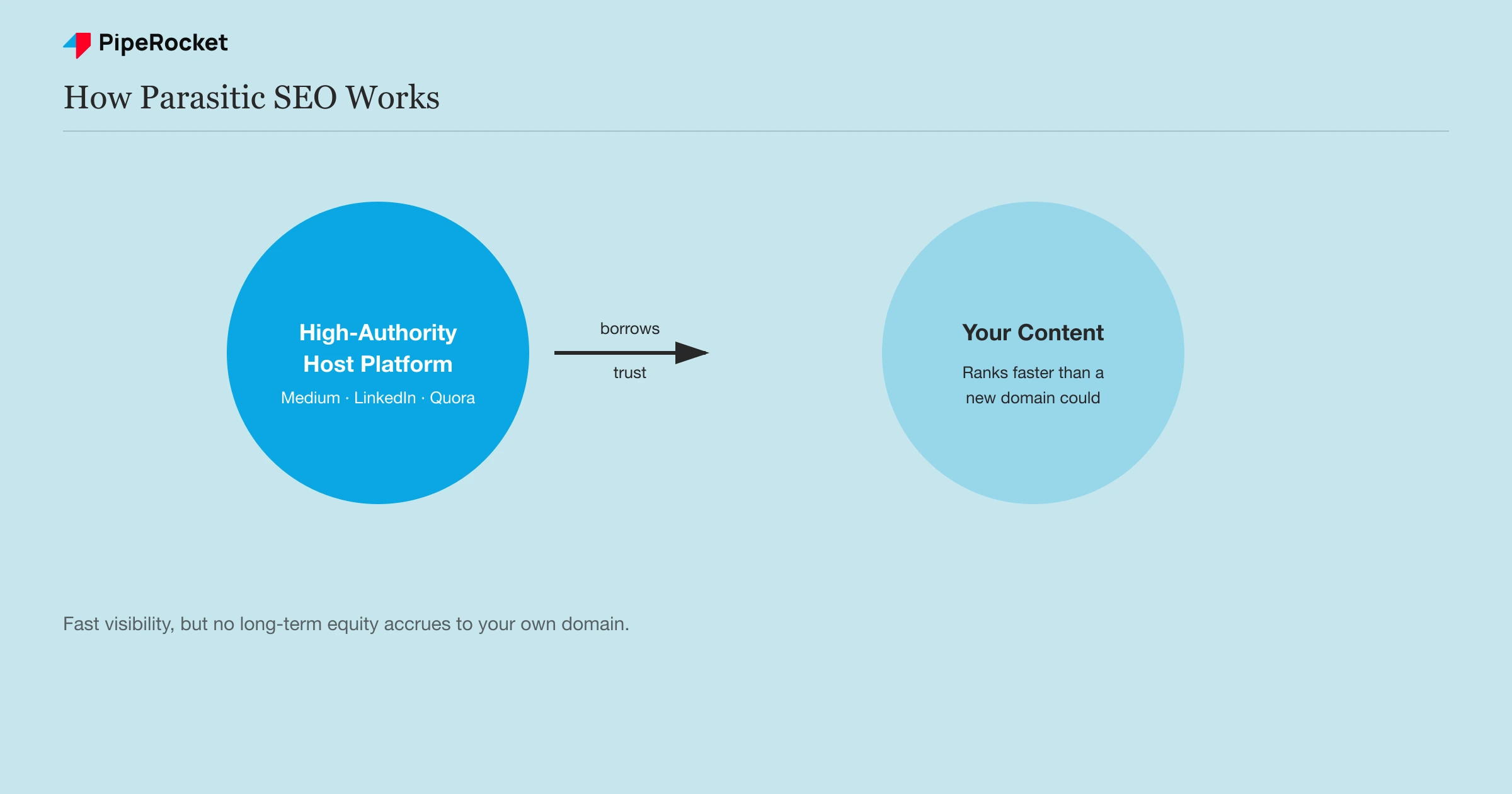
Parasitic SEO works by borrowing a high-authority domain’s established trust with Google, letting content published there rank faster than the same content would on a newer or lower-authority site of your own.
- Borrowed authority is the core mechanic. Google already trusts platforms like Medium, LinkedIn, and major news sites based on years of accumulated backlinks , traffic, and content history, and a new post published there inherits some of that trust immediately.
- Fast rankings follow from that borrowed trust. Your content bypasses the months or years typically required to build domain authority on a new or small website, since the platform’s reputation does that work for you.
- Common platforms each carry their own rules. Marketers commonly use Medium, LinkedIn articles, Quora answers, Reddit posts, and guest contributions to major news publications, and each platform has distinct formatting, promotional, and self-linking restrictions worth understanding before you publish.
Consider a SaaS company trying to rank for a competitive comparison query where their own domain had no existing authority for the topic. Publishing a well-researched comparison piece on Medium got that specific piece ranking within weeks, well before their own domain’s equivalent page could realistically compete for the same query.
Benefits and Risks of Parasitic SEO
| Pros | Cons | |
|---|---|---|
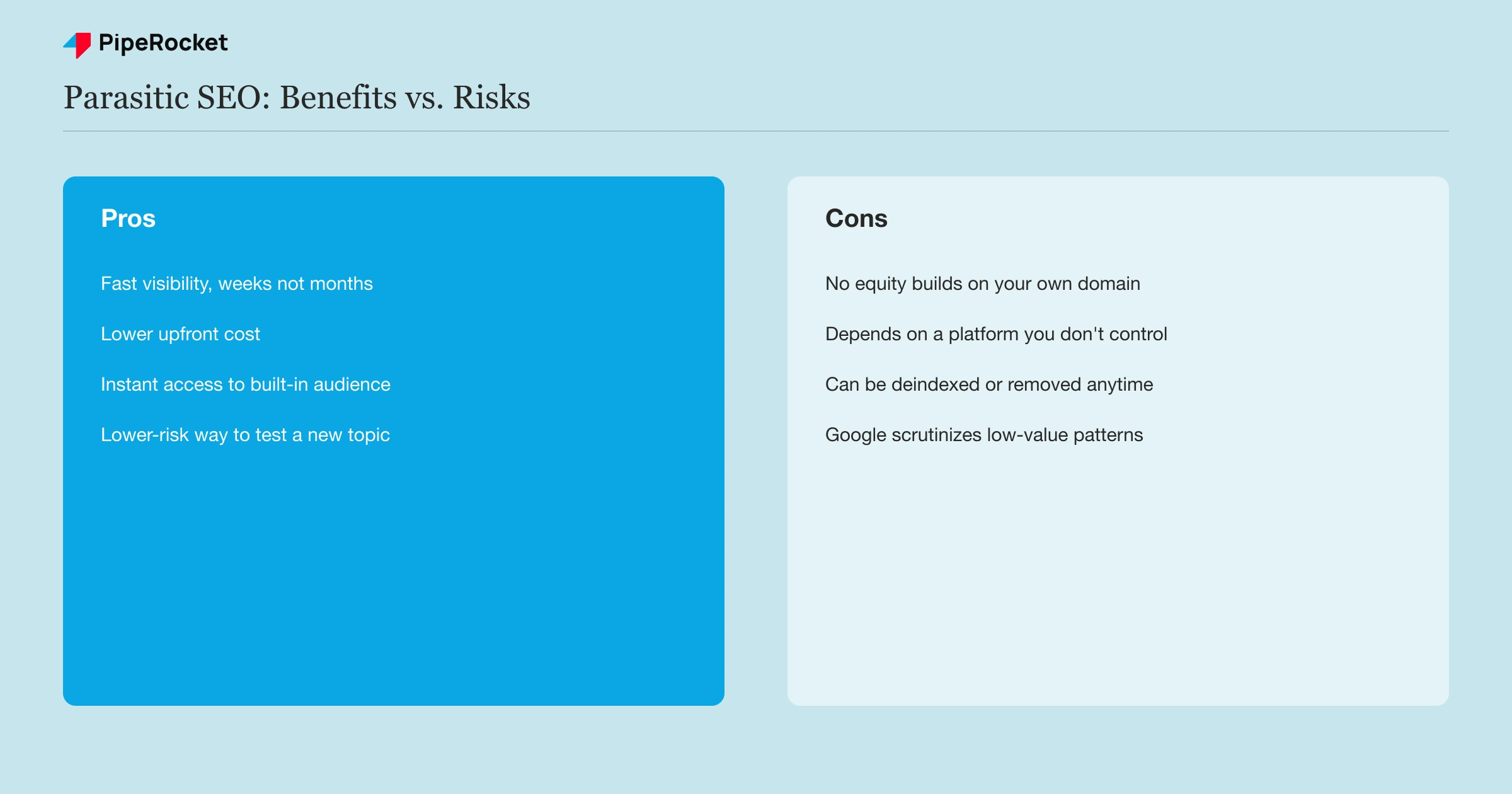
| Speed | Fast visibility, often ranking within weeks | No long-term equity builds on your own domain |
| Cost | Lower upfront cost than months of domain-authority building | Ongoing dependency on a platform you don’t control |
| Audience | Instant access to a platform’s existing built-in audience | Platform can change policies, deindex, or remove content anytime |
| Risk | Useful as a lower-risk test for an unproven topic | Google has publicly signaled scrutiny of low-value parasite content |
The risk side of this table isn’t hypothetical. Google’s site reputation abuse policy specifically targets a host site that lets third parties publish content to exploit the host’s own ranking signals. Google has taken enforcement action against large-scale instances of that pattern.
Marketer-published parasite content on Medium or LinkedIn sits outside that specific policy. It’s still subject to each platform’s own content and promotional rules, plus Google’s broader thin-content and scaled-content-abuse standards.
How to Use Parasitic SEO Without Overexposing Your Brand
How to Approach Parasitic SEO Responsibly, Step by Step
- Treat it as a supplement to your own domain’s authority. Parasitic SEO can extend your reach on specific, competitive queries, but it shouldn’t substitute for building genuine authority on your own domain, since you don’t control the platform hosting your content.
- Publish genuinely valuable content over thin promotional copy. Content that offers little real value to the reader is the pattern most likely to fall under a hosting platform’s own content rules or Google’s broader thin-content standards, even outside the narrower site reputation abuse policy.
- Use it to test unproven topics at lower risk. Publishing a new content angle on a high-authority platform first, before committing the resources to build it out fully on your own domain, lets you validate demand with less upfront investment.
- Include a genuine, non-spammy link back to your own site. A single, contextually relevant link back to a relevant page on your domain, over multiple aggressive self-promotional links, both respects most platforms’ rules and gives you a durable benefit even if the parasite content eventually gets deprioritized.
- Diversify across a few platforms rather than depending on one. Relying entirely on a single third-party platform means a policy change or deindexing event there can wipe out that entire channel of visibility overnight.
- Track performance separately from your own domain metrics. Parasitic content’s traffic and rankings live outside your own analytics setup, so building a habit of checking it directly avoids losing sight of whether it’s still working.
Common Mistakes to Avoid
Publishing Thin, Purely Promotional Content
Content that exists mainly to link back to your product, without real informational value, risks removal by the hosting platform itself or deindexing under Google’s broader thin-content and scaled-content-abuse standards.
Treating Parasitic SEO as a Long-Term Strategy
Since no equity accrues to your own domain, relying on parasitic SEO indefinitely instead of investing in your own site’s authority leaves your visibility permanently dependent on platforms you don’t control.
Ignoring Platform-Specific Rules
Medium, LinkedIn, Quora, and news publications each have distinct content, formatting, and self-promotion rules, and violating them risks account suspension or content removal beyond just an SEO penalty.
Concentrating All Effort on a Single Platform
Publishing exclusively on one third-party site means a single policy change or algorithm update there can eliminate your entire parasitic SEO presence at once, with no fallback.
How PipeRocket Digital Thinks About Parasitic SEO
We use parasitic SEO selectively, as a supplement for testing unproven topics or extending reach on specific competitive queries. It’s never a substitute for building genuine authority on a client’s own domain. This connects to our broader SaaS link building and digital PR work. Get in touch if you’re weighing whether a parasitic SEO tactic fits your broader content strategy.
Frequently Asked Questions
What is parasitic SEO?
Parasitic SEO is a marketing strategy where content gets published on a high-authority third-party website, such as Medium, LinkedIn, Quora, or a major news publication, instead of the marketer’s own domain, borrowing that platform’s established trust with Google to rank faster than a new or lower-authority site could on its own.
Is parasitic SEO against Google’s guidelines?
It depends on execution. Google’s site reputation abuse policy specifically targets a host site that lets third parties exploit its own ranking signals, a narrower case than most marketer-published parasite content on Medium or LinkedIn. That said, thin, low-value content still risks removal under a platform’s own rules or Google’s broader thin-content standards.
Genuinely useful, well-researched content published on a legitimate platform, with a reasonable, non-spammy link back to your own site, carries meaningfully less risk than thin promotional content built purely to game rankings.
What’s a real example of parasitic SEO?
A common example is publishing a well-researched comparison or how-to article on Medium or LinkedIn to rank for a competitive query the marketer’s own domain doesn’t yet have the authority to compete for. It typically includes a contextual link back to a relevant page on their own site.
This differs from spam-style parasitic SEO, which publishes low-effort content purely to exploit a platform’s authority without offering the reader genuine value.