
$3.9K Spend, $200K Pipeline: Enterprise LinkedIn ABM for a Finance Ops SaaS Company
Company Overview
Our client is a Finance Ops SaaS company. Its platform reconciles data across ERP, bank, invoice and spreadsheet systems, runs the month-end close, and handles order-to-cash workflows in one place. It sells to CFOs, controllers and shared-services heads.
That’s a big-ticket, committee-led purchase. The buyers sit inside large companies, and most of them already run software from one of the big incumbent finance-automation vendors. They aren’t out looking for a new vendor, so waiting for them to find you doesn’t work.
PipeRocket took over the paid program in July 2026 with one brief: get in front of the enterprise finance teams the company actually wants to sell to, and turn that attention into pipeline.
The Challenge
The best-fit buyers were a few hundred named companies, and nothing was reaching them:
- No account-based layer: Nothing in the program was aimed at the target companies by name, and there was no LinkedIn presence to warm them up.
- Buyers who don’t search: Enterprise finance leaders rarely go looking for a reconciliation vendor. They have to be reached before they’re in the market.
- An entrenched incumbent: Many of the target companies were already paying for a large finance-automation suite, so generic “automate your finance ops” messaging gave them no reason to look again.
- A small, senior audience: The people who matter in each account are a handful of finance leaders, which makes LinkedIn audiences small and easy to waste on the wrong titles.
Our approach
We ran the whole program on LinkedIn, as two enterprise-focused campaigns with two different jobs: an enterprise 1:1 campaign aimed at a short list of named enterprise accounts, and a Southeast Asia enterprise campaign built to reach finance teams at large companies across the region.
Campaign 1: Enterprise 1:1 ABM for named accounts
The enterprise 1:1 campaign went after large companies already using the large incumbent finance-automation vendors. Those customers were wrestling with order-to-cash problems and worried about what a migration would take, so we built the creative around exactly those two pain points.
We picked the top 7 enterprise incumbent customers and made 7 dedicated creative variations for each one, every ad written around that company and its situation.
We ran two campaigns against that same audience:
- A lead gen campaign with LinkedIn’s in-platform form, so anyone ready to talk could raise their hand without leaving LinkedIn.
- A website visitors campaign aimed at people from those accounts who had already visited the website, so anyone who had shown interest kept hearing from the company.
Running both meant the target accounts got a cold-to-warm path: the lead gen ads introduced the company and asked for a conversation, and the website visitors campaign followed up with the people who had already come to look.
When the 1:1 audiences proved too small to deliver, we widened the regions, job functions and seniorities while excluding every company outside the target list. That kept delivery up without letting a single impression leak to companies we didn’t want.
Campaign 2: Southeast Asia enterprise campaign, localised by market
The Southeast Asia enterprise campaign started from an account list of around 200 enterprise companies that matched the ideal customer profile.
This audience was colder and broader than the 1:1 list, though still made up entirely of enterprise accounts, so we kept the messaging simple: what the platform does and the finance problem it fixes. We didn’t try to be clever with it. What we did do was personalise it for each market in the region, so every country saw a version written for its own finance teams.
The first month told us what to cut. The native-audience and record-to-report ad sets weren’t reaching the right companies, so we paused them and kept the company-list approach.
Enterprise targeting rules across both campaigns
- Job titles in and out. We built separate inclusion lists for decision-makers (CFOs, finance heads, VPs of accounting and shared services) and champions (accounts payable leads, treasury managers, finance team leads). Then we excluded titles that carry “finance” without ever buying finance software, such as loan officers, bank employees and sales executives.
- Competitor exclusions. We excluded rival vendors’ companies so we weren’t paying to show ads to their staff.
- Spend follows response. As the incumbent-customer accounts kept engaging, we moved more budget toward them.
The results
We measured pipeline from the client’s own sales log, against the total LinkedIn spend for the first quarter, July to September 2026.
$200K in enterprise pipeline from $3.9K
The enterprise LinkedIn program opened $200K in enterprise pipeline in its first quarter, from about $3.9K of total LinkedIn spend. That’s roughly 52x, or $52 of pipeline for every $1 spent.
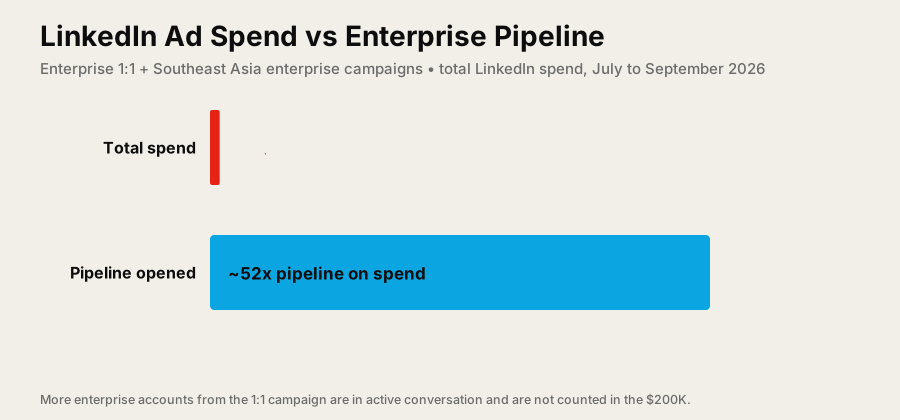
Both enterprise campaigns fed the pipeline. It sits with large enterprise finance teams, the exact buyers the company wanted to reach, including global brands already running the incumbent vendors’ software.
More enterprise accounts in play
More enterprise accounts from the 1:1 campaign are in active conversation and aren’t counted in the $200K yet.
The 1:1 ads reached 43% of the people on the incumbent-customer target list, up from 39% a month earlier. That’s the kind of saturation an enterprise buying committee needs before it takes a meeting. The most personalised ads also held an engagement rate above 1% in both months they ran.
Why it worked
- Two enterprise campaigns with separate jobs. The 1:1 campaign did the precise work on a handful of high-value enterprise accounts. The Southeast Asia campaign covered the wider enterprise market with simple, local messaging.
- Targeting the incumbents’ customers. Companies already paying for a large finance-automation suite know the problem, have the budget, and have felt the pain points.
- Following up on interest. Pairing the lead gen campaign with a website visitors campaign meant anyone from a target account who had already looked at the site kept seeing the company.
- Personalised creative. Writing the 1:1 ads around each company’s own situation, and localising the regional ads by market, made the program feel specific to the people seeing it.
- Cutting what didn’t work. Pausing the ad sets that weren’t reaching the right companies early kept the budget on the account lists that were.
More Success Stories

How DevRev Achieved 127% Organic Traffic Growth: A Case Study with PipeRocket
Read full story

3x Pipeline ROAS: How DevRev Saved a Google Ads Channel That Was About to Be Shut Down
Read full story
+67% Inbound Leads: How QX Scaled Pipeline Across Two Regions at Once
Read full story

Book a call today. Scale your pipeline tomorrow
Please note that we only partner with 1-2 new clients per month
Let's talk!