
Return on Spend Nearly Tripled: How LeadSquared Rebuilt Its Google Ads Pipeline with PipeRocket
The challenge
When we first looked at LeadSquared’s Google Ads account, the leads were there. The pipeline wasn’t.
Volume looked fine on paper. But leads weren’t moving down the funnel, and the sales team was spending time qualifying prospects that were never going to close. Budget was going toward lead count, not lead quality. Cost per SAL kept climbing. SQL numbers stayed low.
The core problem wasn’t demand. It was targeting. The account was built to generate leads, not to generate the right leads.
Our approach
We looked at the full customer journey from click to pipeline, not just the ads in isolation. The diagnosis was clear: structural problems at every stage, from campaign format to keyword match type to landing page messaging to how leads were being handed off to sales.
We rebuilt around three pillars.
Pillar 1: Rebuilt search-first account structure
The account was running Performance Max, Display, and broad mobile traffic alongside search. None of it was influencing pipeline. So we cut it.
- Eliminated Performance Max, Display, and low-quality mobile placements
- Restructured campaigns around two core pipeline-driving categories, and selectively tested two additional ones that showed early positive signals
- Shifted from Broad match to controlled Phrase match across the board, improving intent capture without sacrificing lead quality
- Consolidated campaigns to improve budget control and signal clarity
- Built a category-level campaign framework so every ad matched the specific decision-stage intent of the searcher
Every dollar that stayed in the account was mapped to a keyword that had actually influenced a sale.
Pillar 2: Reduced spend without breaking pipeline
Cutting spend hard sounds aggressive. The key is knowing exactly which spend to cut.
- Identified and paused low-ROI keywords and categories using actual pipeline data, not just CPL
- Dynamically shifted budget toward high-intent search that was already moving leads into pipeline
- Applied strict CPL versus pipeline-quality thresholds before scaling anything
- Cut Search Network Partners and low-quality mobile traffic that were generating clicks, not pipeline
- Protected top-performing campaigns from budget shocks during the reduction
Spend dropped. The leads that stayed were the ones actually converting.
Pillar 3: Aligned ad messaging end-to-end
The biggest gap we found was between the ad and the page. Searchers were clicking on one promise and landing somewhere that didn’t deliver it.
We fixed it across every layer:
- Rewrote headlines, descriptions, and extensions around ICP pain points, not generic feature claims
- Mapped ad copy directly to keyword intent and landing page content, so the pre-click and post-click experience matched
- Revamped the landing page: improved keyword-level relevance and page speed, added G2 badges, SOC and HIPAA compliance markers, and testimonials above the fold
- Highlighted use-case-driven features aligned with what decision-stage buyers were actually searching for
- Streamlined the sales follow-up structure to enable faster lead qualification and quicker pipeline entry
We also ran daily performance hygiene throughout the engagement: search term audits, Microsoft Clarity session monitoring, and continuous bid and budget optimisation.
The results
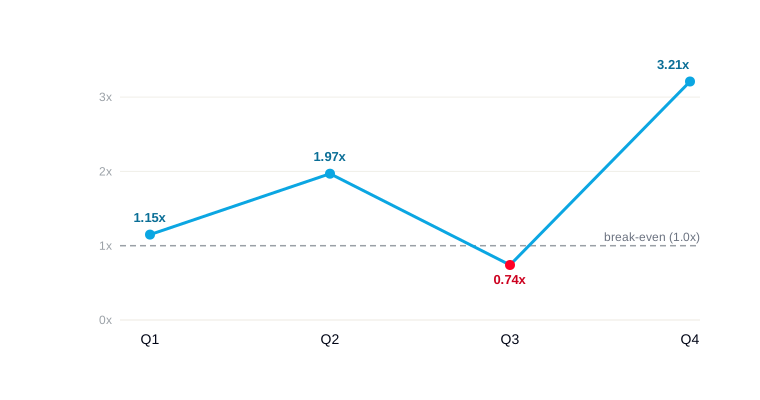
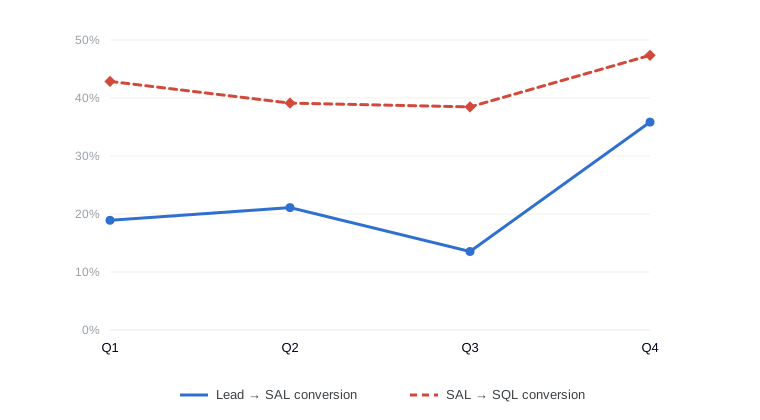
The journey wasn’t linear. Q3 was the trough, pipeline being rebuilt and conversion rates dipping as we tightened targeting. Q4 is where everything landed.
| Quarter | Lead → SAL | SAL → SQL | Return on spend |
|---|---|---|---|
| Q1 | 18.9% | 42.9% | 1.15x |
| Q2 | 21.1% | 39.1% | 1.97x |
| Q3 | 13.5% | 38.5% | 0.74x |
| Q4 | 35.9% | 47.4% | 3.21x |
By Q4, Lead-to-SAL conversion had nearly doubled from Q1 and SAL-to-SQL hit its highest point of the engagement. Return on spend climbed from 1.15x to 3.21x. The account was doing more with less at every stage of the funnel.
Q3 tells the honest part of the story. As we cut low-quality traffic and tightened match types, volume dropped before quality caught up. That’s what a structural rebuild actually looks like mid-flight. By Q4, the signal was clean, conversion quality was at its peak, and every dollar of spend was returning over 3x in pipeline.
Why it worked
Three things drove the outcome:
- We diagnosed the full funnel, not just the ads. CPL looked manageable. The problem was downstream. Fixing click-to-lead without fixing lead-to-pipeline would have just moved the problem somewhere else. We rebuilt end-to-end.
- We cut by pipeline contribution, not by spend percentage. The budget reduction wasn’t a target. It was a byproduct of cutting everything that couldn’t show pipeline influence, and concentrating what remained on what could.
- Messaging alignment compounded. When the keyword, the ad, and the landing page all say the same thing to the same buyer, conversion rates improve at every stage. That’s what happened here. Each fix reinforced the next.
More Success Stories
From Stagnation to Domination: PipeRocket's Impact on Spendflo's 81% Traffic Rise
Read full story
Achieving 3.5X MQL Growth: HyperVerge's Success Story with PipeRocket
Read full story
How DevRev Achieved 127% Organic Traffic Growth: A Case Study with PipeRocket
Read full story

Book a call today. Scale your pipeline tomorrow
Please note that we only partner with 1-2 new clients per month
Let's talk!