12 B2B Growth Marketing Tactics That Actually Move Pipeline
 Ranjeeth Kumar
Last updated on
Ranjeeth Kumar
Last updated on
B2B growth marketing tactics are the specific, testable plays a team runs inside a channel to move pipeline. Think trigger-based outbound sequences, comparison pages built for switchers, or a gated teardown ad, not the channel itself, which is just where the tactic runs.
Quick Answers Before You Test Anything
- The tactics that move pipeline are specific plays inside a channel, not the channel names themselves.
- Trigger-based outbound, comparison pages, and gated teardowns outperform generic content and cold blasts because they target a moment, not a persona.
- Founder-led LinkedIn and customer-advisory referral programs work because they borrow trust a company account can’t buy.
- Most tactic lists fail because they run five plays at once instead of committing budget and time to two.
- Track each tactic against pipeline it touched, not clicks or downloads, or you’ll keep funding the wrong ones.
What Actually Makes Something a B2B Growth Marketing Tactic
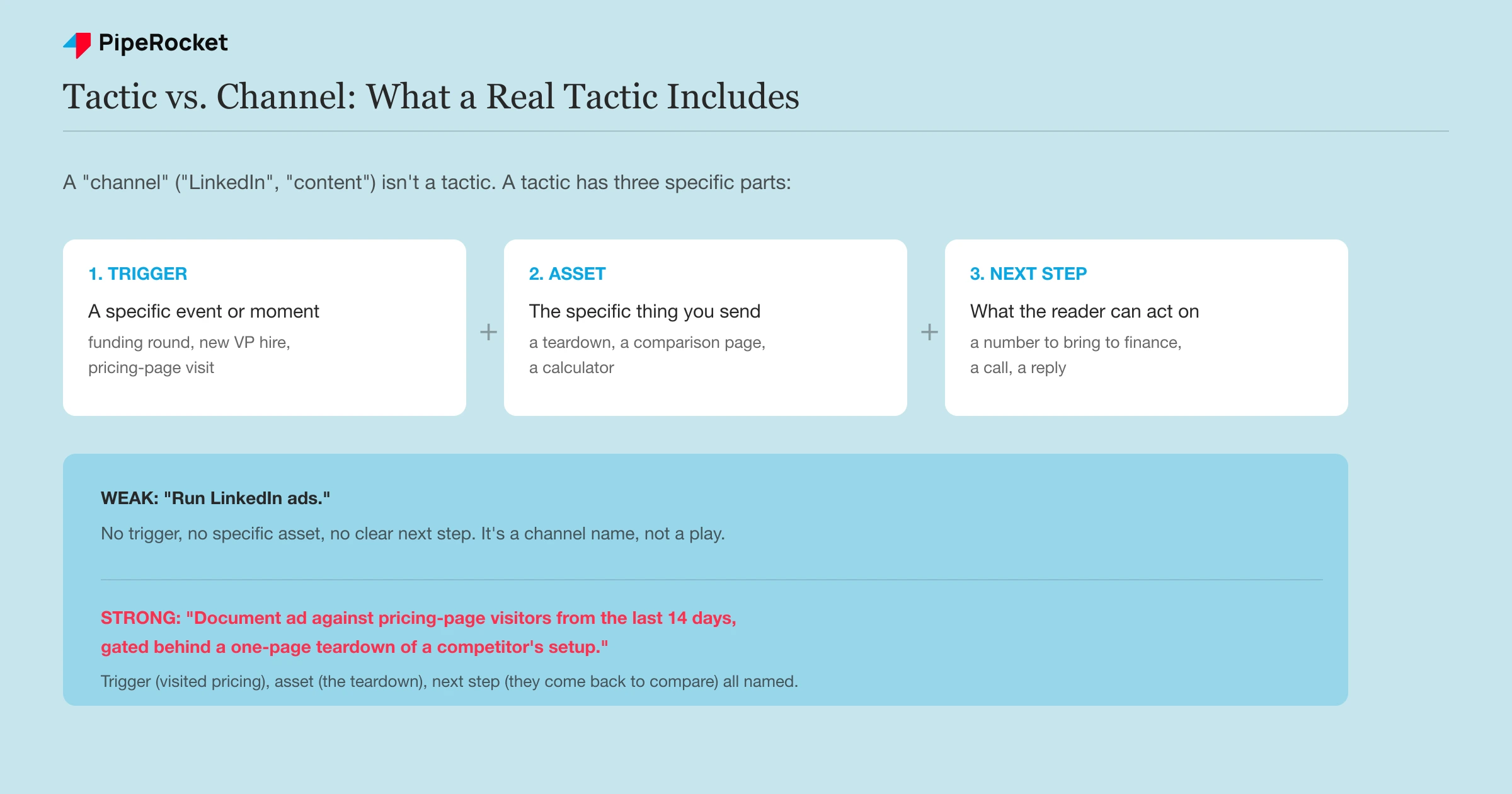
A real tactic has three parts: a specific trigger or audience, a specific asset, and a specific next step. “Run LinkedIn ads” fails that test, it’s a channel, not a tactic. “Run a document ad against people who visited your pricing page in the last 14 days, gated behind a one-page teardown of a competitor’s setup” passes it, because that version tells you exactly what to build.
Most “growth marketing tactics” lists skip this distinction and just name channels: “do LinkedIn ads,” “invest in content.” Those are categories with no instructions inside them, which is why teams read ten of these roundups and still don’t know what to build next Monday. The twelve tactics below skip the channel-naming and go straight to the plays, each specific enough that you could hand it to a teammate and they’d know what to build first.
These aren’t a replacement for strategy
If you haven’t picked a segment and a buying motion yet, run those decisions first. Our B2B growth strategy guide covers how to choose the segment and motion before any tactic gets funded. Tactics executed against the wrong segment just waste the budget faster.
Tactic 1: Trigger-Based Outbound Instead of Persona-Based Lists
Trigger-based outbound targets a specific event, like a funding round, a leadership change, or a new job posting, instead of a static persona list. The trigger tells you the buyer is more likely to be in-market right now, which a persona list alone can’t do.
Build a short list of triggers that correlate with your buyer having a live budget or a live problem:
- A new VP hired into the function you sell to
- A competitor’s product picking up bad reviews
- A compliance deadline hitting their industry
Set up alerts for those triggers through a sales intelligence tool, or a simple RSS and job-board watch if the budget’s tight.
Write the outbound message to reference the trigger directly in the first line, not buried in paragraph three. “Saw you just brought on a VP of Compliance” opens far better than a generic “Hi, wanted to reach out about…” because it proves the message isn’t a template.
Tactic 2: Comparison and Alternative Pages Built for the Switcher, Not the Newcomer
A comparison or alternative page targets someone actively trying to leave a competitor. It converts at a different rate than top-of-funnel content, because the reader already knows they need a solution and is deciding between two named options.
Write these pages around what the switcher is actually annoyed about: pricing changes, a feature the competitor removed, support that got worse after an acquisition. Pull this from G2 and Capterra reviews of the competitor rather than guessing.
Keep the page honest about where the competitor still wins. A page that claims total superiority reads as marketing copy and loses the trust it needs to convert a skeptical switcher.
Don’t gate this page
Switchers are close to a decision and researching fast. A form in front of a comparison page just sends them to a competitor’s ungated version instead.
Tactic 3: Founder-Led LinkedIn Instead of Only the Company Page
Founder-led LinkedIn content earns more reach and trust than a company page post saying the same thing. A person’s voice with real opinions travels further on LinkedIn than a brand account’s polished update.
Pick one leader, a founder or a VP of the relevant function, and commit them to two to three posts a week for a real quarter before judging results. Sporadic posting doesn’t build an audience. The algorithm and the audience both reward consistency.
Write posts that take a real position, not a generic list:
- A mistake the leader made and what it cost
- A number that genuinely surprised them
- A disagreement with common advice in your category
“5 tips for X” posts blend into the feed. A specific claim with a reason behind it stops the scroll.
We’ve watched this work well for early-stage SaaS founders who had no ad budget and no domain authority. A consistent, opinionated LinkedIn voice tends to outpace what a sleepy company page produces, because buyers trust a person’s take over a brand’s.
Tactic 4: A Gated Teardown Instead of a Generic Ebook
A gated teardown, meaning a specific critique or audit of a real (anonymized) account, converts better than a generic ebook. It demonstrates expertise on a real example instead of restating industry advice the reader has read five times already.
Pick a category your buyer cares about (a pricing page teardown, an onboarding flow audit, a landing page critique) and produce a short, visual breakdown with specific fixes, not a 40-page report. The value is in the specificity, and length just adds friction.
Promote this as a LinkedIn document ad or a retargeting asset for site visitors who didn’t convert. It works especially well retargeting people who visited your pricing or comparison pages but left, because they’re already evaluating and a sharp teardown gives them a reason to come back.
Tactic 5: Customer Advisory Board Tied Directly to Referrals
A customer advisory board that meets quarterly builds enough trust with your best customers that a referral ask stops feeling transactional. It starts feeling like the natural next step in a relationship that already exists.
Invite eight to twelve of your most engaged customers, run a real quarterly session where you share roadmap and ask for feedback, and treat it as a relationship, not a marketing channel in disguise. Customers can tell the difference and disengage from the fake version fast.
Once the board is running for a quarter or two, ask directly: would they be open to a joint case study, a quote, or an introduction to a peer facing the same problem. The ask lands better here than a cold “please refer us” email because the relationship already exists.
Tactic 6: Dark Social Distribution Instead of Only Owned Channels
Dark social distribution means seeding your content into newsletters, niche Slack and Discord communities, and forums where your buyers already gather. A large share of B2B research now happens in places you can’t track with a pixel, and this is how you show up there anyway.
Find the three to five communities your ICP actually spends time in. Not the biggest one, the one where they’re actually engaged. A niche 2,000-member Slack community with real daily activity usually beats a 50,000-member Discord that’s mostly dead.
Share genuinely useful things there, not links to your blog with no context. A specific answer to someone’s question, with your content as one option among the help, works. A drive-by link drop gets you banned from the group and rightly so.
Tactic 7: Intent Data Layered on Top of Your Existing ABM List
Layering intent data on top of an account list lets you sequence your ABM effort by which accounts are actively researching related topics right now. That beats treating every account on the list the same, regardless of where they actually are in the buying process.
Feed your ABM account list into an intent data platform and watch for accounts showing a spike in research on your category or a competitor’s. Move those accounts to the front of your outreach queue instead of working the list in the order it was built.
This changes timing more than it changes targeting. The accounts on the list don’t change. The order you approach them, and the message you lead with, does.
Tactic 8: A Self-Serve ROI or Cost Calculator as the Bottom-Funnel Asset
A self-serve ROI or cost calculator gives a buyer close to a decision a concrete, personalized number to bring to their own internal approval process. It converts better than another case study, because it produces something the buyer can actually act on.
Build the calculator around the specific inputs your buyer’s finance or ops team will ask about (current spend, headcount, time lost to the current process) and output a number tied directly to the deal size they’d be signing off on.
Put this on your pricing and comparison pages, not buried three clicks deep. This is a decision-stage asset, and it belongs where decision-stage traffic already lands.
| Tactic type | Fits when | Skip when |
|---|---|---|
| Trigger-based outbound | Deal size supports a rep’s time, triggers are trackable for your category | No clear trigger correlates with buying intent |
| Comparison/alternative pages | A named competitor has a visible weakness (pricing, support, a dropped feature) | Your category has no dominant competitor buyers compare you against |
| Founder-led LinkedIn | A leader is willing to post consistently and has real opinions to share | No one on the team wants to commit to a real posting cadence |
| Gated teardowns | You have real expertise to demonstrate on a specific example | You’d have to fabricate the example, which reads as fake fast |
| Customer advisory board | You have 8+ engaged customers and a real roadmap to share | Your customer base is too small or too early to sustain quarterly sessions |
| Dark social distribution | Your ICP is active in identifiable niche communities | Your buyers research alone and don’t participate in communities |
| Intent data on ABM | You already have an account list and a scored ICP | You haven’t built an account list yet, fix that first |
| ROI/cost calculator | Buyers need to justify spend internally with a number | Deal size is too small to require internal budget approval |
Common Mistakes That Kill Tactic-Level Testing
Most tactic failures trace back to how the test was run, not whether the tactic itself was a bad idea.
Running five tactics at once with no budget behind any of them
Splitting a small budget five ways guarantees none of the five tactics gets enough volume to tell you anything real. Pick two tactics that match your current motion and fund them properly.
Warning: a test that never reaches statistical significance isn’t a failed tactic. It’s a failed test, and you’ll never know which one it actually was.
Judging a tactic by clicks instead of pipeline it touched
A gated teardown or a LinkedIn post can generate plenty of clicks and zero pipeline, and clicks alone won’t tell you which is happening. Tag every tactic in your CRM so you can trace it to an opportunity, not just a form fill.
Copying a tactic without checking if the trigger applies to your buyer
A trigger-based outbound sequence built around funding announcements works great for startup software and falls flat selling to government agencies that never raise funding rounds. Check whether the trigger you’re copying from a case study actually exists in your buyer’s world before building the sequence around it.
Stopping a tactic before it’s had a fair test window
Founder-led LinkedIn and dark social distribution both take longer to show results than a paid campaign does. Killing either after two weeks because the numbers look flat usually just means the test ended before the channel had time to compound.
How to Know Which Tactics Are Actually Working
Track each tactic against the pipeline it touched, not the surface-level engagement metric that’s easiest to pull.
- Pipeline attribution by tactic: which specific tactic is showing up as a touchpoint on opportunities that reach a real sales stage, tracked separately from the channel it ran in.
- Time to first meaningful reply: trigger-based outbound and comparison pages should get faster replies than generic content, because the trigger or the intent is already there.
- Real cost per tactic: a comparison page and a paid retargeting campaign sitting inside the same “content” budget line can have wildly different real costs once you account for the time spent building each.
Two tactics tied for the same pipeline number rarely deserve the same budget going forward. The one that took a quarter of the effort to produce that number is the one worth scaling first.
How PipeRocket Digital Runs These Tactics for B2B Teams
We build and run these plays inside our clients’ B2B SEO and B2B PPC programs. We start with the two tactics that best match the account’s segment and motion, not a scattershot list. If you want help picking which of these to run first, reach out to us here .
Frequently Asked Questions
What are B2B growth marketing tactics?
B2B growth marketing tactics are the specific, testable plays a team runs inside a marketing channel to move pipeline, such as a trigger-based outbound sequence, a comparison page built for a competitor’s dissatisfied customers, or a gated teardown promoted through retargeting.
They differ from a growth strategy, which decides the segment and motion first, and from a channel name like “LinkedIn” or “content,” which describes where a tactic runs but not what the tactic actually does.
What are the best B2B growth marketing tactics for a small team?
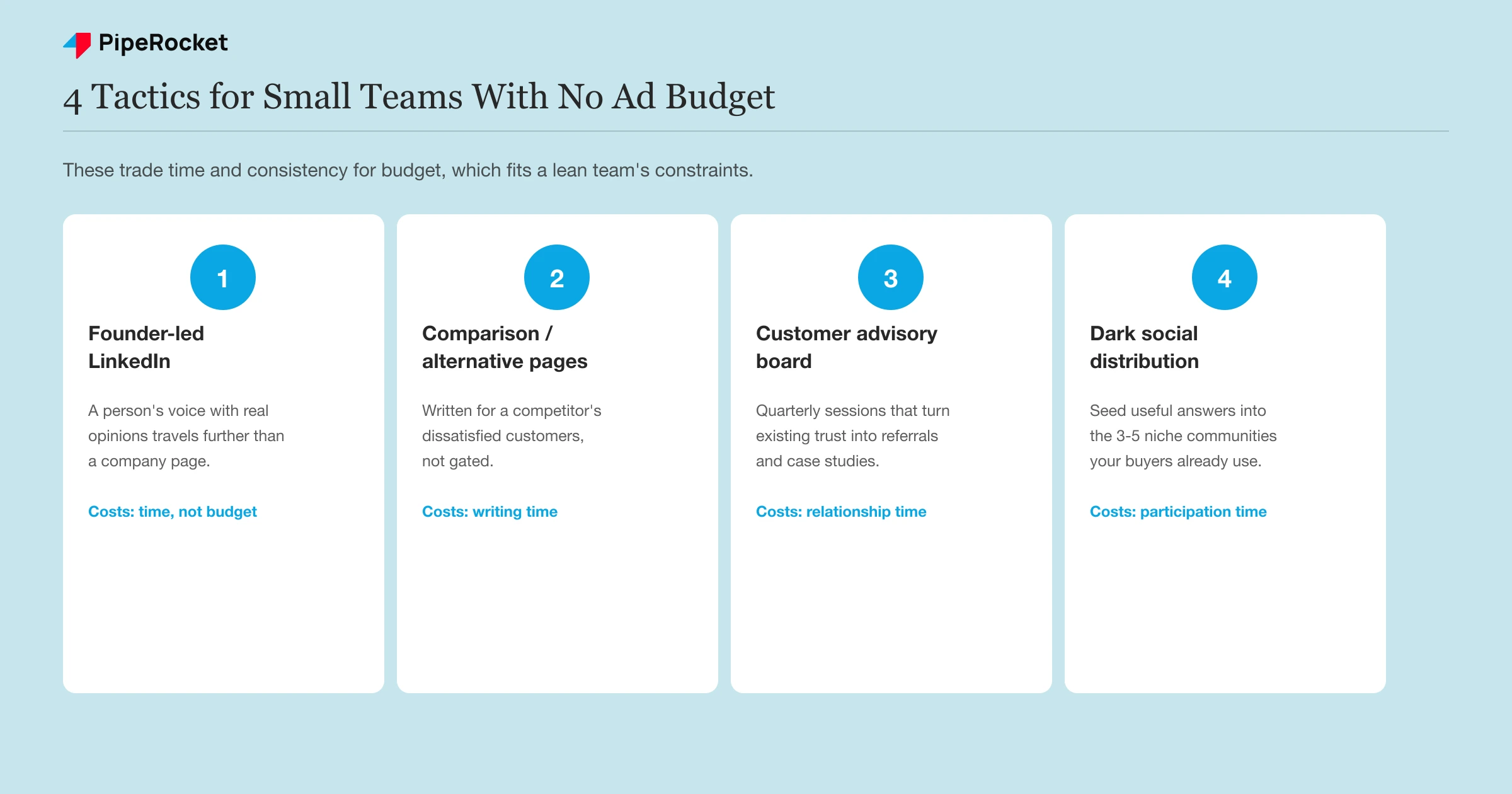
For a small team, the highest-leverage tactics are usually the ones that don’t require a large ad budget: founder-led LinkedIn content, comparison pages targeting a named competitor’s weak spots, and a customer advisory board that turns existing relationships into referrals and case studies.
These work because they trade time and consistency for budget, which fits a small team’s constraints better than a paid-heavy tactic list would.
How is a growth marketing tactic different from a growth marketing strategy?
A growth marketing strategy is the decision layer: which segment to target, which buying motion fits that segment, and which channels make sense given that motion. A tactic is the specific, executable play run inside one of those chosen channels.
Picking tactics before the strategy is settled is how teams end up running a well-built comparison page or outbound sequence against the wrong segment entirely, which wastes the execution effort regardless of how well the tactic itself was built.