B2B Growth Strategy: How to Build One From Scratch
 Vignesh Sampath
Last updated on
Vignesh Sampath
Last updated on
A B2B growth strategy is a company-wide plan for compounding revenue. It matches acquisition channels, sales motion, and retention work to how your specific buyers actually decide, rather than serving as a marketing calendar with a bigger name on the folder.
TL;DR
- Most companies calling something a “growth strategy” actually have a marketing plan, and the two solve different problems.
- A real strategy has to decide the segment, the buying motion, and whether the base can hold what acquisition brings in, before any campaign gets built.
- Channel selection should follow your buying motion (self-serve, sales-assisted, or committee-led) rather than whatever channel worked at your last company.
- Growth stalls in a small number of predictable places: chasing reach over close speed, one channel carrying all the weight, or a leaky retention base under a full funnel.
- A B2B growth marketing strategy is the demand-generation layer inside the bigger growth strategy, executing decisions instead of replacing them.
- You can tell a growth strategy is working from a handful of numbers: pipeline by channel, CAC by segment, and how much revenue comes from expansion versus new logos.
Why Most B2B “Growth Strategies” Are Actually Marketing Plans
A marketing plan lists campaigns, channels, and content for a quarter. A growth strategy decides which parts of the business, not just marketing, need to change for revenue to compound. Confusing the two is the single most common reason B2B companies feel busy and stay flat.
I’ve reviewed a lot of “growth strategy” decks that were really a content calendar with a LinkedIn ads line item bolted on. They looked thorough. Fifteen blog topics, three paid campaigns, a webinar series. None of it said anything about who the ICP actually is, why the sales cycle takes four months, or why half the trials never convert.
That’s the gap. A real growth strategy sits above marketing and answers questions marketing alone can’t:
- Which segment gives you the fastest path to revenue right now, and which one are you chasing out of ambition?
- Does your sales motion match how that segment actually buys, or are you running enterprise outbound against a self-serve buyer?
- Is your product ready to retain and expand the customers your acquisition channels are about to bring in?
Marketing executes inside the answers to those questions. It doesn’t set them. Skip straight to campaigns without deciding the segment, the motion, and the retention plan first, and you end up with a marketing plan pretending to be a growth strategy.
That shows up six months later as flat pipeline despite a busy content calendar.
It’s not exclusive to SaaS
This applies whether you’re a SaaS company, a professional services firm, or an agency selling retainers. A pentest-as-a-service (PTaaS) company and a fintech platform face the same structural question: who’s the fastest-closing segment, and does the sales motion match how they buy? The tactics differ. The diagnostic doesn’t.
What a B2B Growth Strategy Has to Actually Decide
A growth strategy has to make three decisions before a single campaign gets built, and skipping any one of them is where most companies go wrong.
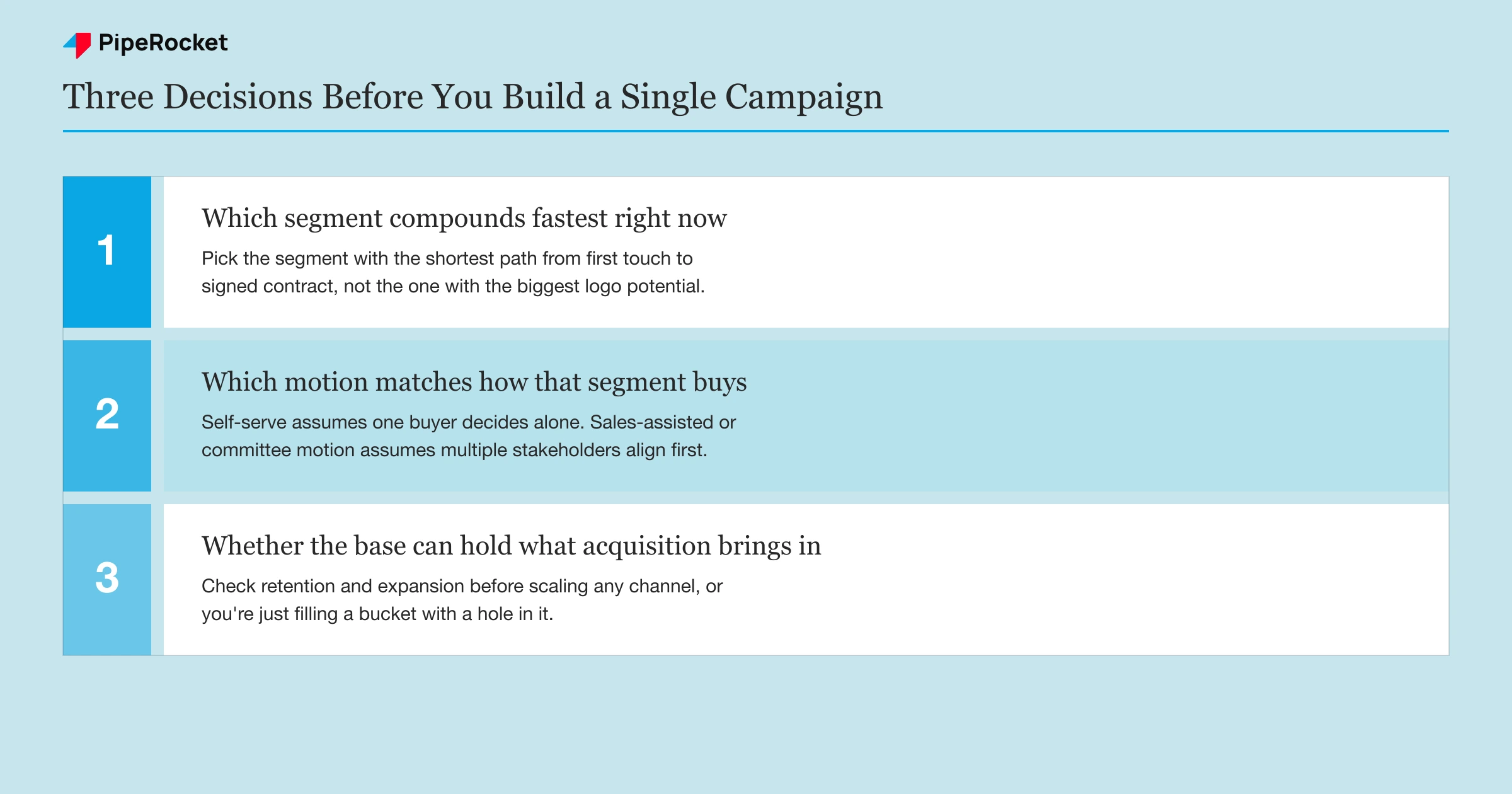
Which segment compounds fastest right now
Not every segment that could theoretically buy from you is worth building a strategy around. Some segments close in three weeks with a $15,000 deal size. Others take nine months and a legal review, even if the logo looks impressive on a case study page.
Pick the segment with the shortest path from first touch to signed contract. Fastest-closing beats biggest-logo, and you can always widen scope once the first segment is compounding. Chasing enterprise logos before you’ve proven the model on a faster-closing segment is how teams burn a year of runway on pipeline that never closes.
Which motion matches how that segment buys
Your growth motion, meaning how prospects move from stranger to customer, has to match the buying behavior of the segment you picked. A self-serve motion assumes one person can evaluate and buy alone. A sales-assisted or committee motion assumes multiple stakeholders need to align first.
Get this wrong and you end up building a slick self-serve trial flow for a product that a compliance team has to approve before anyone can pay for it. The friction shows up as abandoned trials rather than an obvious strategy failure, so it’s easy to miss for months.
Whether the base can hold what acquisition brings in
Acquisition without a retention plan just fills a bucket with a hole in it. Before scaling any channel, check whether new customers are actually sticking, reaching value, and expanding, or whether you’re replacing churned revenue every quarter without anyone noticing the treadmill.
If you want the full operating model for running these motions inside a SaaS company specifically, our SaaS-specific operating model guide walks through acquisition, activation, retention, and expansion as a sequenced system.
This piece stays at the broader diagnostic level: picking a segment, a motion, and a channel mix before you get to that operating detail.
How to Choose the Right Channels for B2B Growth
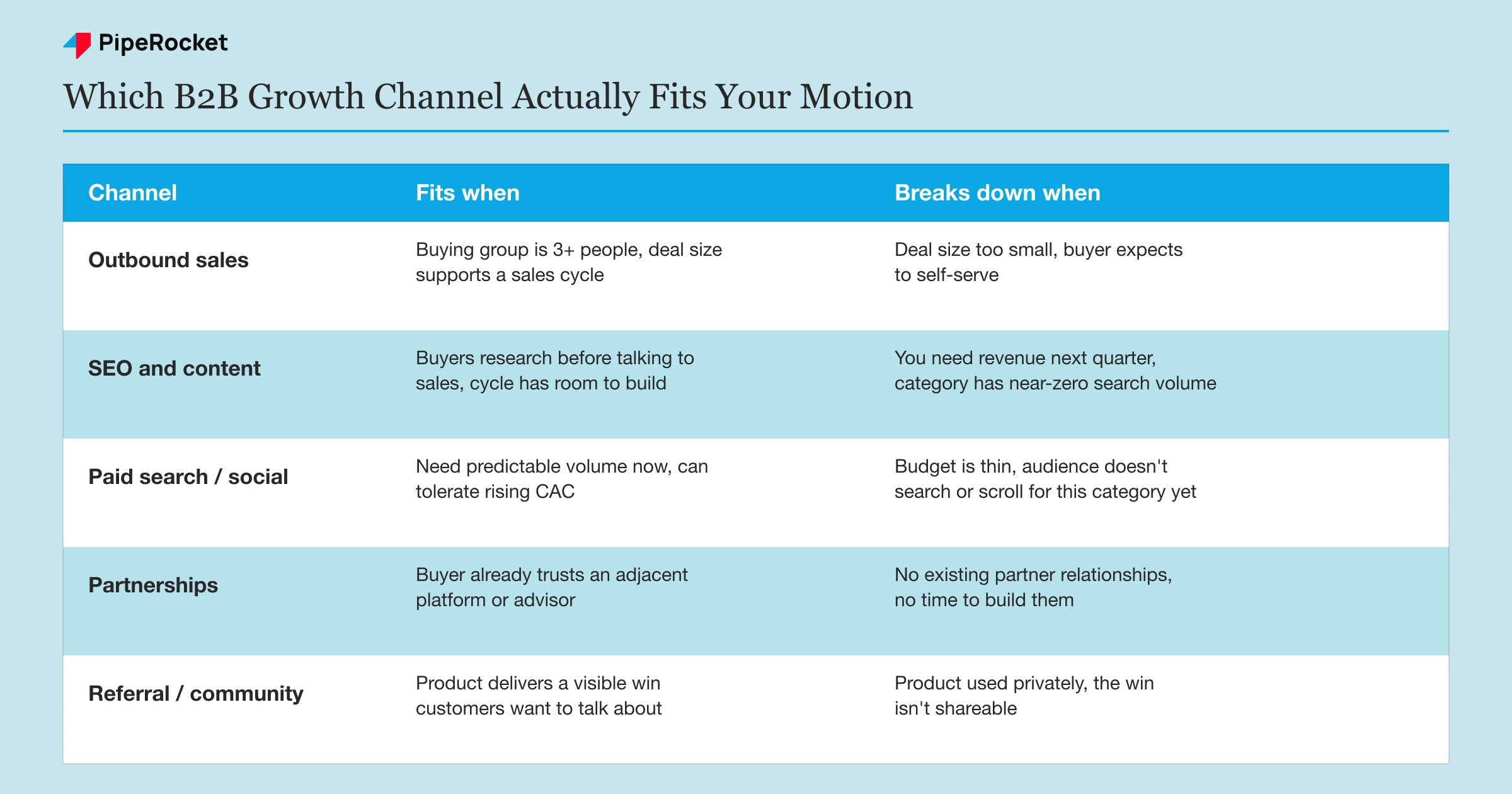
Channel choice should follow the buying motion you identified, not personal preference or what a competitor is doing. Here’s how the major B2B channels line up against buying behavior.
| Channel | Fits when | Breaks down when |
|---|---|---|
| Outbound sales | Buying group is 3+ people, deal size supports a sales cycle, ICP is narrow and identifiable | Deal size is too small to justify a rep’s time, or the buyer expects to self-serve |
| SEO and content | Buyers actively research before talking to sales, sales cycle has room for a multi-month build | You need revenue in the next quarter, or the category has near-zero search volume |
| Paid search and social | You need predictable, scalable volume now and can tolerate rising CAC | Budget is thin, or the audience doesn’t search or scroll for this category yet |
| Partnerships and integrations | Your buyer already trusts an adjacent platform or advisor | You have no existing partner relationships and no time to build them |
| Referral and community | Product delivers a visible win customers want to talk about | The product is used privately or the win isn’t shareable |
Don’t run every channel at once
Running five channels at 20% effort each produces worse results than running two at full strength. Each channel needs enough budget and attention to reach statistical significance before you can judge whether it’s working, and spreading thin guarantees you never get there on any of them.
Pick the one or two channels that best match your segment’s buying motion, fund them properly, and prove they work before adding a third. This is the same discipline that stops teams from confusing a busy dashboard with a working growth engine.
Channel fit changes as you scale
A channel that worked to get your first fifty customers can stop working at customer five hundred. Early outbound often works because you can personalize every message. That personalization breaks down once you need volume, and the same messages that felt bespoke start reading as spam.
Revisit channel fit every time you cross a growth stage, not just when a channel visibly stops performing. By the time performance visibly drops, you’ve usually already burned a quarter’s budget figuring out why.
Where a B2B Growth Marketing Strategy Fits Inside This
A B2B growth marketing strategy is the demand-generation layer that executes the channel decisions above. It’s marketing’s part of the bigger growth strategy, and once you’ve picked a segment and a motion, growth marketing is where you decide the specific campaigns, content, and paid programs that fill the channels you chose.
This is where most of the tactical work actually lives:
- Keyword targeting
- Ad structure
- Landing page design
- Nurture sequences
- Content that supports each stage of the buyer’s research
Get the strategic layer right first and this part gets much easier, because you’re no longer guessing which channel to build campaigns for.
The mistake I see most is teams building an elaborate growth marketing strategy, meaning a full campaign calendar with defined KPIs, before anyone has confirmed the segment or the motion underneath it. The campaigns look professional.
They’re just aimed at the wrong audience, or built for a buying motion that doesn’t match how that segment actually decides. Confirm the strategic layer first, then let growth marketing execute against it.
Common Mistakes That Stall B2B Growth
Growth stalls in a short list of predictable ways, and most of them trace back to skipping one of the strategic decisions above.
Targeting a segment for reachability instead of close speed
Some segments respond well to outreach and content because they’re active online, not because they’re likely to buy. The fix: score segments on close speed and deal size before you score them on how easy they are to reach. A team that skips this chases response rates and engagement instead of closed deals, and wonders six months later why pipeline looks busy but revenue doesn’t move.
Running one channel until it’s exhausted, then panicking
A single channel, usually paid search or outbound, carries the entire growth number for a year. The fix: warm up a second channel before the first one saturates, not after. When the first channel saturates or CAC climbs past what the business can afford, there’s no second channel ready to absorb the gap, and growth falls off a cliff instead of slowing down gracefully.
Scaling acquisition on top of a leaky base
New customer volume goes up while net revenue stays flat, because churn is quietly canceling out every new signed deal. The fix: check retention before adding acquisition budget. Leadership sees growing top-line activity and funds more acquisition, which just accelerates how much revenue leaks out the bottom.
Letting sales and marketing define the ICP separately
Marketing builds campaigns around one definition of the ideal customer while sales is closing a slightly different profile in practice. The fix: get both teams working off one written ICP definition, reviewed together quarterly. Neither team is wrong exactly, they’re just optimizing for two different targets, and the mismatch shows up as marketing-qualified leads that sales calls a waste of time.
Copying a competitor’s channel mix without checking fit
A competitor’s growth looks enviable from the outside, so a team copies their channel mix, their content cadence, their outbound cadence. The fix: copy the diagnostic behind their strategy instead of the surface tactics. What’s invisible from the outside is the competitor’s sales cycle, deal size, and buying motion, and those rarely match yours even when the tactics look identical.
How to Know Your B2B Growth Strategy Is Working
You can tell whether a growth strategy is actually working from a small set of numbers, not from how busy the marketing calendar looks.
- Pipeline by channel: which channels are producing qualified pipeline instead of just clicks or form fills, and is that concentrated in one channel or spread across a healthy two or three?
- CAC by segment: is acquisition cost rising, flat, or falling for your priority segment, and does it still make sense against deal size and lifetime value ?
- Sales cycle length by motion: is the actual buying process matching what you assumed when you picked the motion, or is a “self-serve” flow quietly turning into a three-month sales-assisted cycle?
- Revenue mix, new versus expansion: how much of this quarter’s revenue came from new logos versus existing accounts growing, and is that ratio moving in a direction you’d want?
Read these together rather than one at a time. Two patterns tell very different stories:
- Rising pipeline with rising CAC and flat expansion revenue means the strategy needs a channel or retention fix.
- Rising pipeline with falling CAC and growing expansion means it’s compounding the way it should.
How PipeRocket Digital Helps B2B Companies Build Growth Strategy
We start every growth engagement by confirming the segment, the motion, and the channel fit before touching a single campaign. That’s where most stalled B2B growth actually breaks.
From there, we build organic acquisition through our B2B SEO work and paid demand capture through B2B PPC programs, matched to whichever motion your buyers use. If your growth feels stalled and you’re not sure which layer is broken, reach out to us here .
Frequently Asked Questions
What is a B2B growth strategy?
A B2B growth strategy is a plan for compounding revenue that starts by choosing which customer segment to prioritize, which sales and marketing motion matches how that segment buys, and which channels can deliver that motion at scale. It sits above individual marketing campaigns and decides what marketing should even be building toward.
Without it, teams end up running channels and campaigns that don’t match how their buyers actually decide, which shows up as busy activity and flat revenue.
How is a B2B growth strategy different from a demand generation plan?
A demand generation plan is the execution layer: the specific campaigns, content, and paid programs that fill a chosen channel with pipeline. A B2B growth strategy is the decision layer above it, covering which segment to target, which buying motion fits that segment, and whether the business can retain and expand what acquisition brings in.
Demand gen answers “how do we fill this channel.” Growth strategy answers “which channel, for which segment, and is the rest of the business ready for what it brings in.”
What is a B2B growth marketing strategy?
A B2B growth marketing strategy is the marketing-specific execution of a broader growth strategy, covering the campaigns, keyword targeting, content, and paid programs built to fill the channels the growth strategy identified as the right fit. It’s the part marketing owns once the segment, motion, and channel decisions are already made, not a separate plan running alongside them.
Building a growth marketing strategy before confirming those decisions is the most common way B2B teams end up executing well against the wrong target.