Claude SEO: How to Use Claude for SEO Work That Actually Ships
 Omar Sheriff
Last updated on
Omar Sheriff
Last updated on
Claude SEO refers to using Anthropic’s Claude, usually through Claude Code or a packaged Claude Skill, to run SEO tasks directly: crawling a site, reading Search Console exports, drafting content, and writing the code fixes an audit turns up. It’s a workflow, not a ranking factor.
What You Need to Know About Claude SEO
- Claude SEO means running actual SEO tasks through Claude, not optimizing content so Claude cites you in an answer.
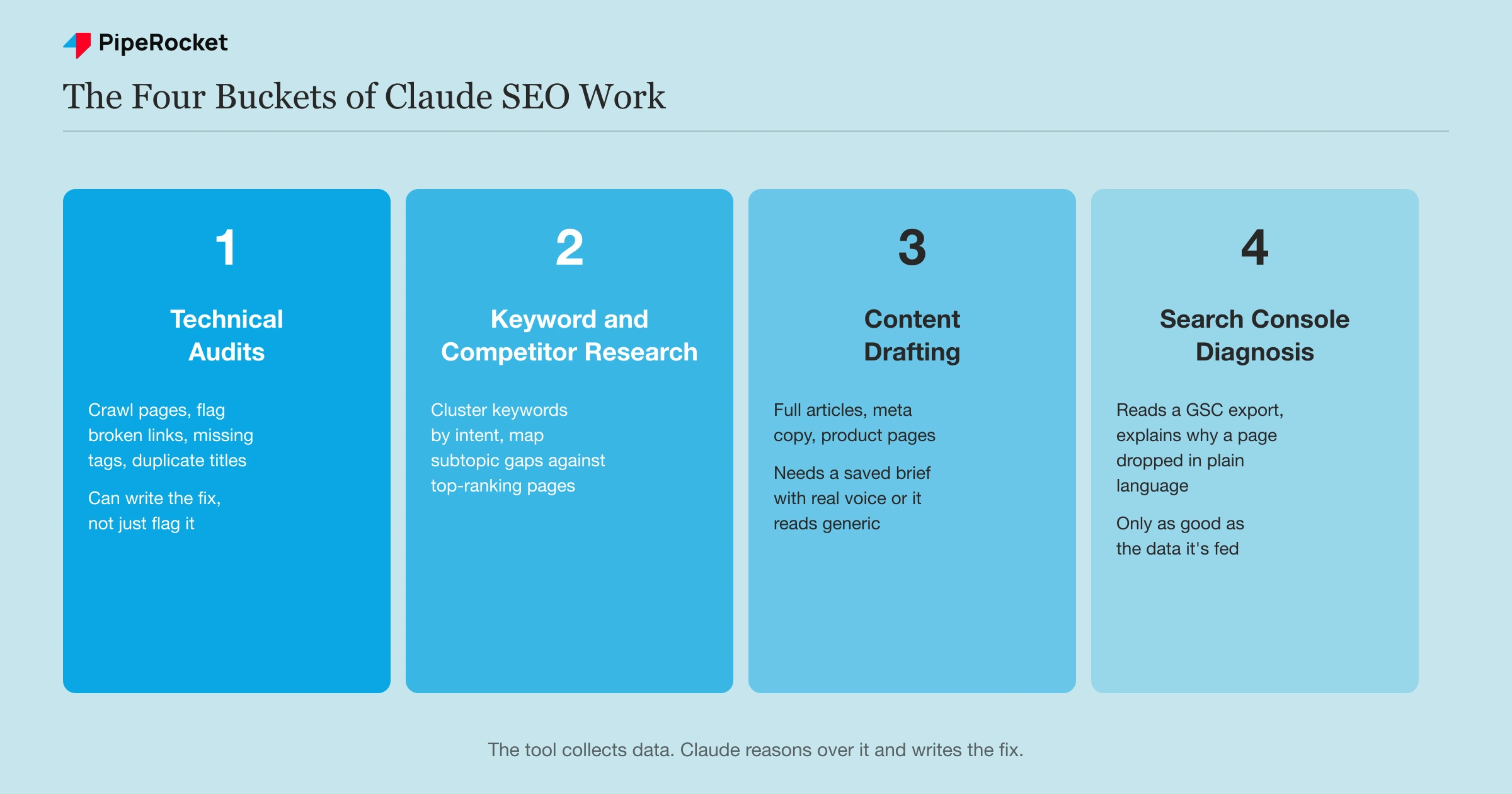
- The real work splits into four buckets: technical crawls, keyword and gap research, content drafting, and Search Console diagnosis.
- Claude Code and Claude Skills package this into repeatable workflows, some with 20+ sub-agents, instead of one-off chat prompts.
- It replaces the manual grunt work of an audit, not the judgment call on what your site should rank for.
- The setups that hold up long-term give Claude your business context once, in a saved project or skill file, instead of re-explaining it every session.
Why Is “Claude SEO” Suddenly a Search Term?
“Claude SEO” is trending because practitioners are running entire SEO workflows through Claude Code and posting the results, not because Claude changed how Google or AI engines rank pages. Search interest here tracks a tool, not a ranking mechanic.
Three things are driving the search volume:
- Open-source skills and plugins. Projects like Claude SEO Skill and the AgriciDaniel/claude-seo plugin package dozens of sub-agents into one command that crawls a site, scores technical health, flags content gaps, and hands back a report.
- Long-form YouTube walkthroughs. Channels are publishing hour-long breakdowns of the exact prompt chains people used to rank new sites in weeks.
- Reddit threads from practitioners. r/ClaudeAI has posts from marketers running their whole SEO operation, from keyword research to code fixes, through a single Claude setup.
None of that is about GEO or getting mentioned inside a Claude-generated answer. It’s builders and in-house marketers treating Claude as a tool that does SEO work, the same way they’d treat Ahrefs or Screaming Frog, except this one can also write the fix.
That distinction matters because the two topics get confused constantly. If you’re trying to get your brand cited when someone asks Claude a question, how AI engines pick which sources to cite is the piece for that. This one is about pointing Claude at your own site and having it do the work.
What Can Claude Actually Do for SEO?
Claude can run four categories of SEO work well: technical audits, keyword and competitor research, content drafting, and Search Console diagnosis, because each one is a data-in, structured-output task that plays to how an LLM processes information.
Claude Can Crawl a Site and Flag Technical Issues
Claude Code can fetch pages and read your sitemap, checking for:
- Broken links
- Missing meta tags
- Duplicate title tags
- Slow-loading templates
It then writes the report in a format you can hand to a developer. Skills built for this run Lighthouse-style checks and grade dozens of on-page signals in a single pass instead of you clicking through pages one at a time.
That detection itself isn’t new. Rank trackers and crawlers have flagged broken canonicals for years. Claude Code adds the ability to write the redirect rule or the schema fix itself, in the same session, if it has repo access, which collapses “here’s your audit” and “here’s your fix” into one step.
Claude Can Speed Up Keyword and Competitor Research
Feed Claude a seed keyword and it will generate semantically related terms, cluster them by intent, and map them against what a competitor’s top-ranking page already covers. That’s the same output a keyword tool gives you, minus the manual clustering.
Where it adds something a tool alone doesn’t: you can ask it to compare your page against three competitor URLs and name the specific subtopics they cover that you don’t. That’s a judgment call a keyword-volume export can’t make on its own, and it’s the reason threads like “10 SEO prompts for Claude” keep circulating.
Claude Can Draft Content, But It Still Needs Your Voice
Claude will draft a full article, a meta description set, or product-page copy from a brief in minutes. The failure mode people run into is generic output that reads like every other AI-drafted post on the same topic, and that’s the part every “don’t let it sound like AI slop” tutorial is really about.
The fix practitioners land on is consistent: build a standing brief inside a Claude Project with your actual customer language, your named competitors, and a few examples of your own voice. Reuse that brief every time instead of starting a blank chat. Skip that step and you get a draft that needs a full rewrite anyway.
Claude Can Read Search Console Data and Tell You Why a Page Dropped
Point Claude at a Search Console export and it can spot a page that’s losing clicks while impressions hold, then flag which queries drove the drop. You get a plain-language explanation instead of a spreadsheet you have to interpret yourself.
That’s the workflow behind the Reddit post claiming Claude functions as someone’s “entire SEO team”: weekly GSC review, gap-finding, and draft fixes, run on a schedule instead of manually.
The output is only as good as what you gave it to read. Claude can’t pull live Search Console data on its own unless it’s connected through an MCP server or an export you feed it, so this only works as a repeatable habit if that connection is already wired up.
Claude vs a Dedicated SEO Tool: When Each One Wins
Claude and a platform like Ahrefs or SE Ranking aren’t competing for the same job. One structures and explains data; the other collects it at scale and tracks it over time.
| Task | Claude’s strength | Dedicated tool’s strength |
|---|---|---|
| Backlink index size and history | Weak, no crawl of its own | Strong, built for this |
| Rank tracking over time | Weak, no persistent tracking | Strong, purpose-built |
| Explaining why a metric moved | Strong, reads context and reasons | Weak, shows the number only |
| Drafting content and code fixes | Strong, generates directly | None, exports data only |
| Clustering keywords by intent | Strong with the right prompt | Moderate, mostly volume-sorted |
The pattern holds across most of the workflows people are posting: the tool does the collecting, Claude does the reasoning and the writing. SE Ranking’s own Claude Skills sit on top of its MCP server, which exposes 180-plus of its own tools, rather than asking Claude to fetch data blind.
That’s the shape most serious setups take: a data source Claude can query, not a chatbot guessing from memory.
How Do You Set Up Claude for SEO Work Without Starting Over Every Session?
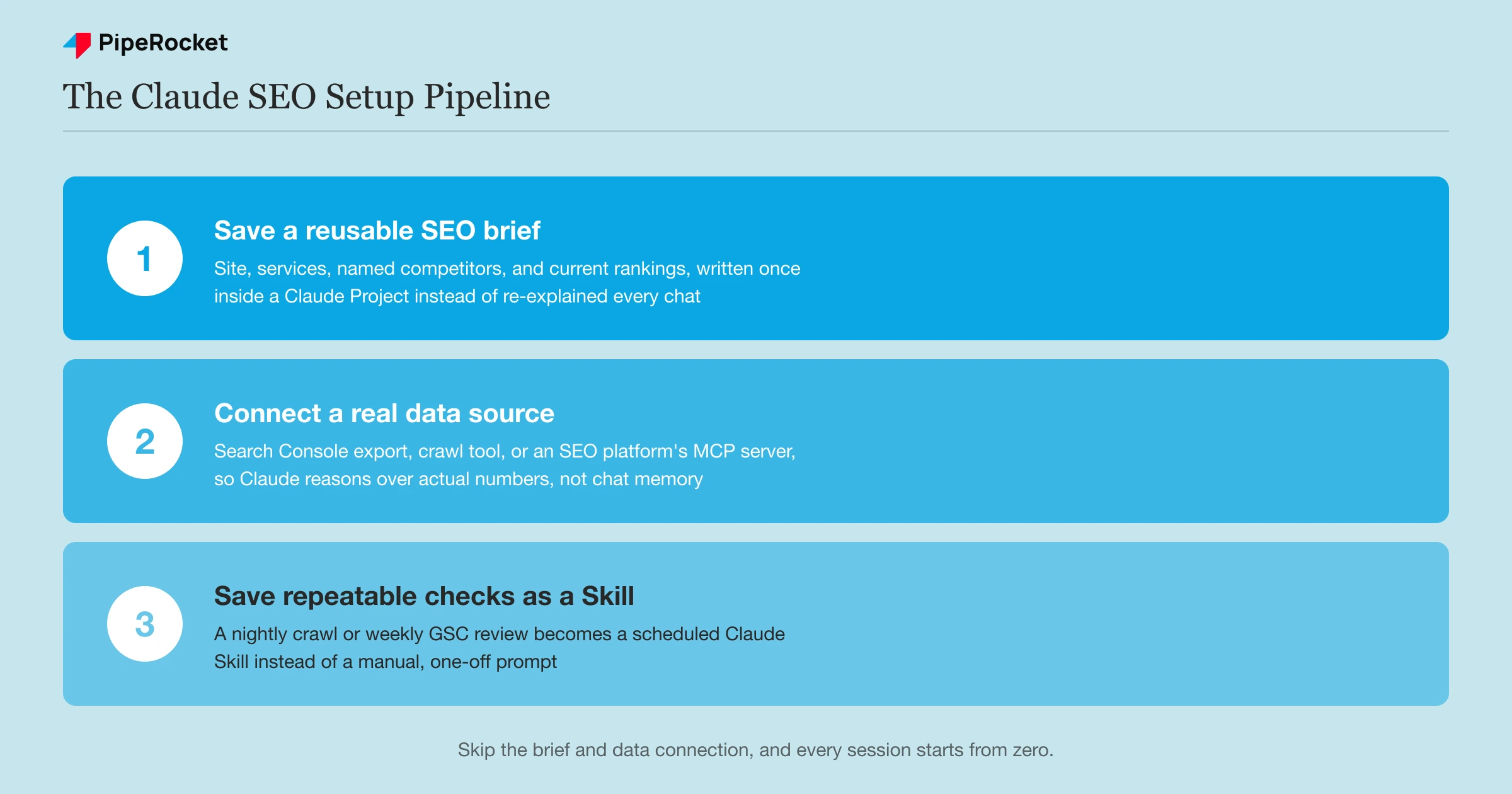
Set up Claude for SEO by saving your business context once in a Claude Project or Skill file, then giving it a real data source to query instead of re-explaining your site from scratch in every new chat.
Give It an SEO Brief It Can Reuse
Create a project that holds your site, your services, your named competitors, and your current rankings, written once as a short brief. Every time you ask for keywords, a content plan, or an audit read, Claude works from that context instead of guessing. You stop losing the first ten minutes of every session to re-explaining your business.
Connect It to Real Data Instead of Chat Memory
Wire Claude to your Search Console export, your crawl tool, or an SEO platform’s MCP server so it’s reasoning over your actual numbers. A Claude session with no data connection can still write a plausible-sounding audit, and plausible-sounding is exactly the failure mode you’re trying to avoid.
Turn the Repeatable Checks Into a Saved Skill
Once a workflow works, like a nightly crawl for broken links or a weekly Search Console review, save it as a Claude Skill or a scheduled prompt instead of re-running it manually. This is the step that turns “I asked Claude to check my site” into a system you don’t have to remember to run.
Common Mistakes to Avoid With Claude SEO
Treating a Generic Chat as a Finished SEO Strategy
Asking Claude “give me an SEO strategy for my SaaS” with no site data, no competitor list, and no customer language gets you a generic framework you could have copied from any blog post. The strategy still needs your actual constraints: budget, team size, current rankings, and which keywords convert.
Publishing the First Draft Without Editing for Voice
Claude’s first pass on an article is a structural draft, not a finished piece. Skip the edit and you get a page that reads like it was written by the same model as ten competitor pages, which hurts you twice: with readers who can tell, and with any downstream check for originality.
Letting It Push Code Fixes Without Review
Claude Code can write the redirect rule or the schema markup for an issue it found, and that’s genuinely useful. Shipping it straight to production without a human review is how a well-intentioned fix takes down a template across the whole site. Route every Claude-written fix through the same PR review a human’s code would get, no exceptions for “it’s just a redirect.”
Assuming It Has Live Access to Your Rankings
Claude doesn’t have a standing connection to your Search Console or rank tracker unless you’ve built one. Ask it about “today’s rankings” with no data attached and it will either say it doesn’t know or, worse, generate a confident-sounding guess. Always check what it’s actually reading before you trust the answer.
How PipeRocket Digital Uses AI Tools Like Claude in Our SEO Work
We use Claude and ChatGPT for AI-content drafting and AI-search testing, part of the standard stack we run for SaaS SEO clients alongside Ahrefs, Semrush, and Search Console for the data side. Claude speeds up the drafting and diagnosis. It doesn’t replace the strategist deciding what to prioritize.
If you want a team that already runs this stack daily, get in touch .
Frequently Asked Questions
What is Claude SEO?
Claude SEO is the practice of using Anthropic’s Claude, most often through Claude Code or a packaged Claude Skill, to carry out SEO tasks such as technical audits, keyword research , content drafting, and Search Console analysis. It describes a workflow built around the tool, not a way to rank higher in Google or get cited by an AI answer engine.
Can Claude generate SEO-optimized website copy?
Yes, Claude can draft meta titles, meta descriptions, and full page copy built around a target keyword and intent. The output tends to read generically unless you give it your own customer language, named competitors, and a couple of voice examples first, since a bare prompt produces the same structure most other users are also getting.
Is Claude Code good for SEO automation?
Claude Code is good at automating the repeatable parts of SEO: crawling for technical issues, drafting fixes, and running scheduled Search Console reviews, especially when it’s connected to real data through an MCP server or export. It’s not a replacement for a rank tracker or a backlink index, since it has no persistent crawl or historical database of its own.