How AI Search Engines Decide Which Sources to Cite
 Omar Sheriff
Published on · Last updated on
Omar Sheriff
Published on · Last updated on
AI search engines decide what to cite by retrieving a batch of candidate pages for a query, then filtering them through layers that check relevance, freshness, structure, and authority before a final answer gets written. Citation happens before generation, not after.
TL;DR
- AI citation runs backward from what most marketers assume. The engine finds and ranks sources first, then writes the answer from what survived, so the writing quality of your page matters less than whether it got retrieved at all.
- Retrieval and reranking are the real gatekeepers. Hybrid search pulls a shortlist, then multiple scoring passes narrow it down, and most candidate pages get cut before a human would ever see them compared side by side.
- Freshness and structure carry more weight than they did in classic SEO. Dated, single-topic, clearly labeled pages survive the pipeline; sprawling pages that bury the answer under narrative don’t.
- Off-site authority still decides who’s trusted enough to cite. Third-party mentions, reviews, and neutral reference sources shape which domains the model treats as safe to quote.
- The four engines don’t behave the same way. ChatGPT leans conservative and editorial, Perplexity is more permissive toward newer domains, and Gemini pulls from a citation pool that barely overlaps with Google’s AI Overviews.
The Order of Operations Nobody Explains
Most people picture AI search as a chatbot that “reads the internet” and writes an answer from memory. That’s not what happens. A live AI search query triggers a retrieval step first: the system fires a query at a web index, pulls back a batch of candidate documents, and only then hands a subset of them to the language model to write from.
This matters because it flips the usual SEO mental model. In classic search, you rank a page and then someone reads it. In AI search, a page has to survive retrieval before the model even knows it exists. Writing a brilliant answer on a page that never gets retrieved earns zero citations, no matter how good the prose is.
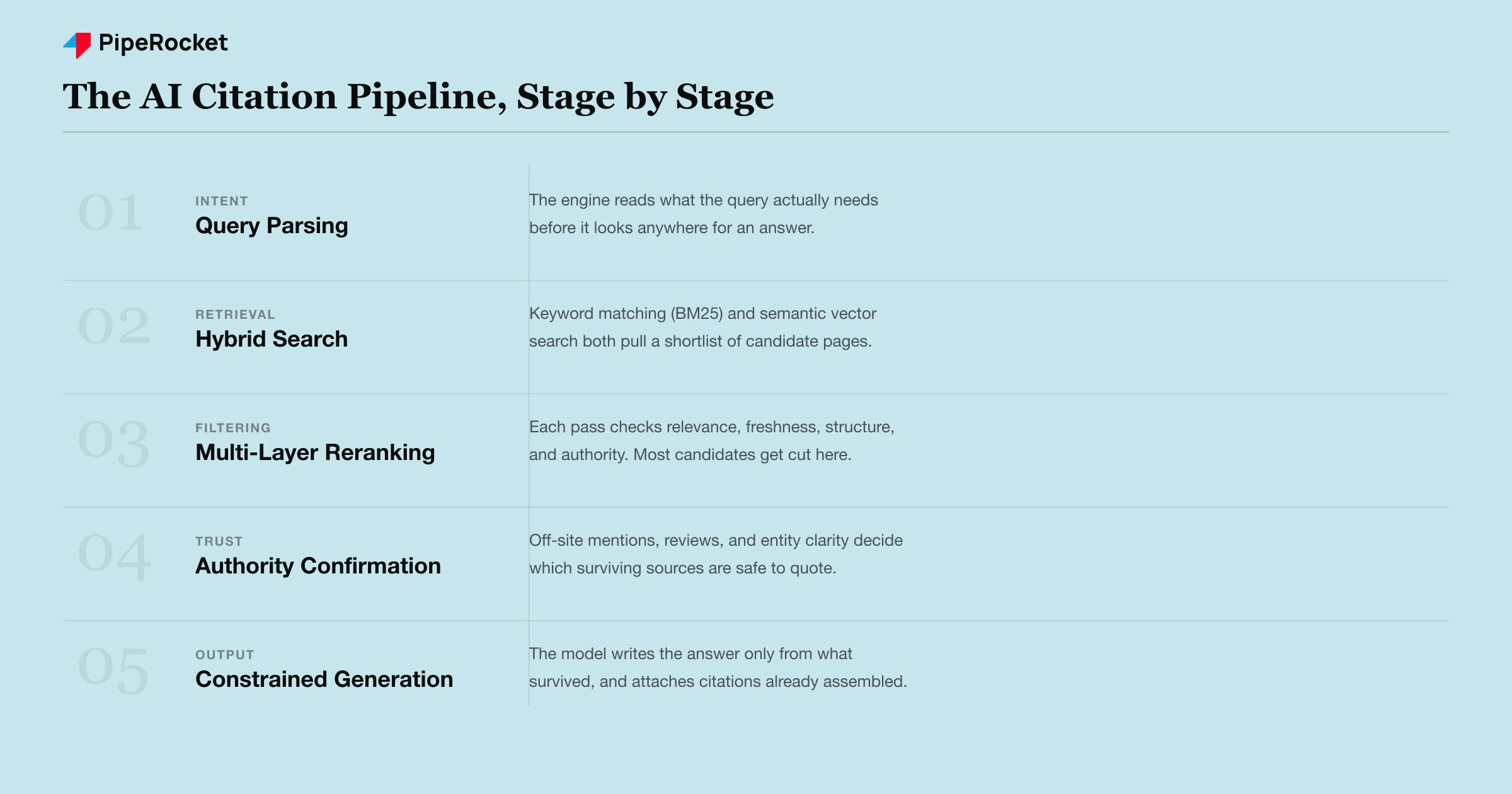
Perplexity’s pipeline is the most publicly documented version of this. It parses the query’s intent, runs a hybrid retrieval pass combining keyword matching (BM25) with dense vector embeddings, then pushes the results through several layers of machine-learned reranking before assembling a final prompt with citations already attached. Of the handful of pages retrieved for a typical query, only three or four survive to become citations.
Google’s AI Overviews work on a related but separate track. It sits inside the SERP rather than a chat interface, and most people assume its citations just mirror organic rankings.
Research on AI Overview citations tells a different story: only a minority of cited sources also rank in Google’s top 10 organic results for the same query. Citation selection and organic ranking are correlated, but they run through different systems, and optimizing one doesn’t automatically win the other.
Retrieval Comes Before Ranking, and Most Pages Never Make the Cut
The first filter is simply whether your page gets pulled into the candidate set at all, not how good it is. If the retrieval step misses your domain, nothing downstream matters.
Hybrid Search Decides Who Gets Considered
Hybrid retrieval blends two different matching methods, and a page needs to work for both. BM25-style keyword matching rewards pages that use the actual terms a searcher typed. Dense embedding search rewards pages that are semantically close to the query’s meaning, even without exact keyword overlap.
A page optimized only for exact-match keywords can miss the semantic pass. A page that’s conceptually relevant but never states its topic plainly can miss the keyword pass. The pages that clear both are direct: they name the entity and the question in plain language near the top, instead of building up to it.
The Reranking Layers Cut Candidates Down Fast
Once a shortlist is retrieved, multiple scoring passes narrow it further, and each layer checks something different:
- Does the passage semantically match the query
- Is the information current
- Is the page structured cleanly enough to extract from safely
- Does the source carry enough authority to trust
- Does the content show real engagement rather than thin filler
A page has to clear all of these gates, not just one. This is the part of AI search that behaves least like traditional SEO. A page can rank well in Google and still get cut at the authority or structure gate in an AI pipeline, because the checks aren’t identical and they run in sequence, not in parallel.
Freshness and Structure Do More Work Than They Used To
Recency is treated as a real signal, not a tiebreaker. Time-sensitive queries especially reward pages with clear, honest publish and update dates, since the system uses that metadata to judge whether an answer is still true.
Structure carries similar weight. Pages that use clean heading hierarchies, one clear topic per page, and explicit schema markup (Article, FAQPage, Organization) give the model less to infer and less room to misread. That reduces the chance the system quietly skips the page rather than risk citing something ambiguous.
Here’s the part that trips people up: a page can be accurate and still get passed over if the accurate part is buried in paragraph six under three paragraphs of scene-setting. The pipeline scans for an answer it can lift cleanly and attribute with confidence, not for narrative quality.
| Signal | What classic SEO rewarded | What AI retrieval rewards |
|---|---|---|
| Keywords | Exact-match density | Plain-language topic naming, works for both keyword and semantic search |
| Freshness | A ranking factor among many | A trust gate, especially for time-sensitive queries |
| Page structure | Helps dwell time and readability | Determines whether the answer can be extracted safely at all |
| Backlinks | The dominant authority signal | Still matters, but shares weight with entity clarity and off-site mentions |
| Length | Comprehensive pages often outrank thin ones | A long page with the answer buried loses to a shorter page that states it directly |
Off-Site Authority Still Decides Who Gets Trusted
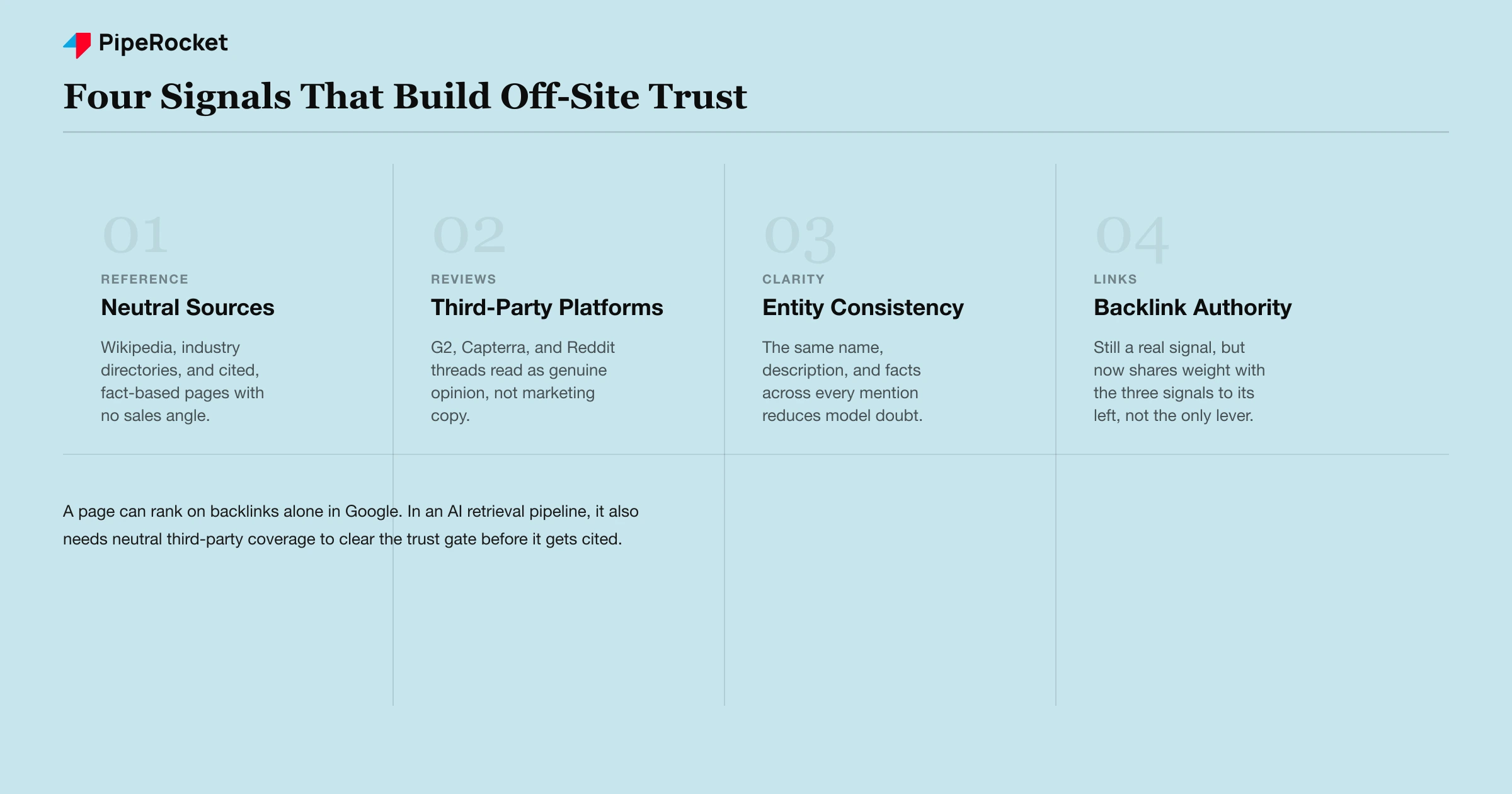
Nothing on your own page can fully substitute for what other sources say about you. AI systems lean on third-party signals to decide which domains are safe to cite, the same way a person double-checks an unfamiliar source before repeating it.
Neutral Reference Sources Carry Outsized Weight
Reference and community sources show up disproportionately often across AI citations. In our own review of AI answers for competitive B2B queries, neutral, well-cited reference pages got pulled into answers far more often than promotional brand pages saying the same thing. That’s consistent with the general finding that AI engines favor sources with no obvious sales angle: neutral tone, cited facts, and no calls to action read as safer to quote.
That’s part of why entity work like getting accurately represented on Wikipedia, G2, or industry directories functions as AI-search infrastructure now, and it doesn’t run like a traditional SEO project. There are no keywords to target and no anchor text to place, just a factual, neutral record the model can point to with confidence.
Review Platforms and Forums Feed the Same Pipeline
Reddit threads, G2 reviews, and comparison pages that read as genuine third-party opinion get pulled into generative answers even when the brand’s own homepage doesn’t. One SaaS agency showed up in a generative answer to “SaaS SEO agency in USA” with the citation sourced straight from a Reddit thread, not the homepage.
Posting about yourself on Reddit isn’t the lesson here. The conversations already happening about your category, on platforms the model trusts, are doing citation work whether you show up in them or not.
The Four Engines Don’t Weigh These Signals the Same Way
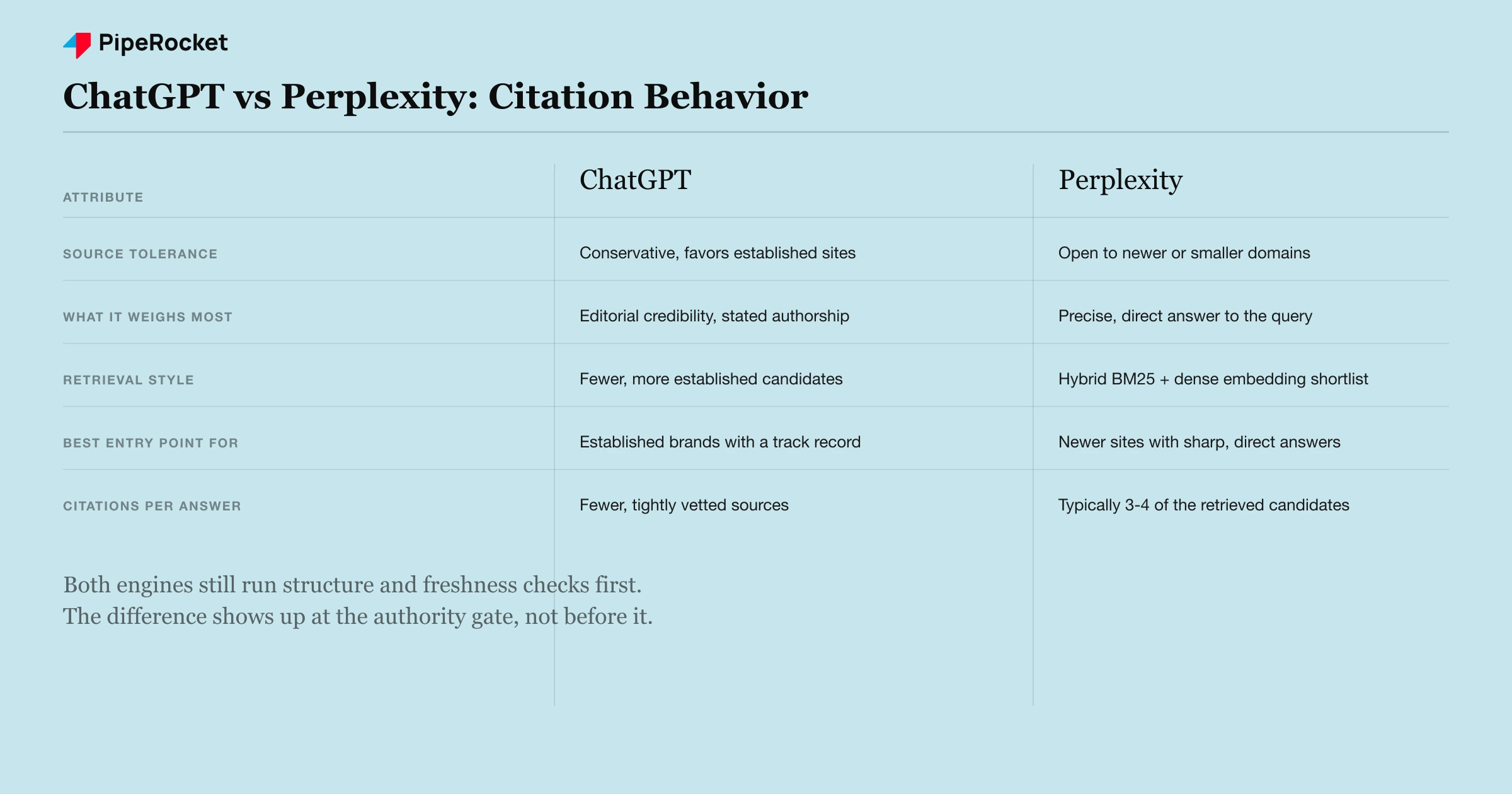
Treating “AI search” as one target is the most common mistake in this space, and it costs teams real visibility. ChatGPT, Perplexity, Gemini, and Claude run different retrieval stacks with different tolerances.
ChatGPT tends to behave conservatively. It favors established, clearly attributed sources with stated authorship, and it’s slower to cite a brand-new or thin domain even if the content directly answers the query.
Perplexity runs looser. It’s more willing to cite a smaller or newer source if that source answers the query precisely, which makes it the more approachable entry point for a site still building authority.
Gemini complicates the picture further. Analysis comparing Gemini’s citation pool against Google’s AI Overviews has found the overlap between the two is far from complete. A page optimized purely for AI Overview citations can still miss a meaningful share of what Gemini cites in its own chat surface.
Claude’s citation behavior is the least publicly documented of the four. It follows the same underlying logic though: retrieval first, then a preference for clearly structured, credibly sourced pages over promotional ones.
| Engine | Source tolerance | What it favors most | Best entry point for |
|---|---|---|---|
| ChatGPT | Conservative | Established, clearly attributed sources | Brands with a track record |
| Perplexity | Permissive | A precise, direct answer to the query | Newer sites with sharp structure |
| Gemini | Moderate, own citation pool | Overlaps only partly with AI Overviews | Pages built for both surfaces separately |
| Claude | Least documented | Clear structure over promotional framing | Well-structured, credibly sourced pages |
What This Means for Where You Focus
Don’t build one page and assume it performs identically across engines. A comparison page with clean tables and dated facts tends to travel well across all four, because structure and freshness are shared gates. A page that leans entirely on brand authority without third-party corroboration will do better in ChatGPT’s conservative pool than in Perplexity’s, where a well-structured competitor with less brand history can still out-cite you.
Common Mistakes That Keep Pages Out of the Citation Pool
Most pages that fail here aren’t bad pages. They were built for a different system and never adjusted for how retrieval actually works.
Writing the Answer as a Slow Reveal
A page that spends three paragraphs building context before stating the actual answer loses at the reranking stage, even if the answer itself is correct. The system is scanning for something it can extract and attribute cleanly, not following a narrative arc. State the direct answer first, then build the supporting case underneath it.
Treating Every AI Engine as One Target
Optimizing only for Google’s AI Overviews and assuming Gemini, ChatGPT, and Perplexity will follow leaves real citation share on the table, since their citation pools only partially overlap. A page needs to clear structure and freshness gates that are shared across engines, not just the one you happened to check.
Skipping Structured Data Because “It’s for Developers”
Article, FAQPage, and Organization schema reduce how much the model has to infer about a page’s topic, author, and publish date. Skipping it doesn’t make a page invisible, but it does mean the model is guessing where it could have been told directly, and guesses are exactly where a page gets filtered out at the confidence gate.
Chasing Backlinks While Ignoring Neutral Third-Party Mentions
Backlinks still matter, but a page with strong link equity and zero neutral third-party coverage (no reviews, no forum mentions, no reference-site presence) is missing the trust signal that gets a domain treated as safe to cite in the first place. Authority in AI search is broader than link equity alone.
How PipeRocket Digital Builds Pages That Survive This Pipeline
We build content to clear retrieval, reranking, and trust gates at the same time, not just to rank in Google. That means answer-first structure, real schema, dated freshness signals, and a deliberate push into the third-party sources these systems already trust.
If you want that audited on your own site, our SaaS SEO agency team can run it, or see how we compare against other options on our list of the best SaaS SEO agencies. Talk to us for the specifics on your category.
Frequently Asked Questions
What is the process AI search engines use to decide which sources to cite?
AI search engines retrieve a batch of candidate pages for a query using hybrid keyword and semantic search, then run those candidates through several reranking passes that check freshness, structure, and authority before a final answer gets generated. Only a fraction of retrieved pages, usually three or four out of five to ten, survive to become actual citations. The generation step, where the model writes the answer, happens last and works only from what made it through the earlier filters.
Do backlinks still matter for getting cited by AI search engines?
Backlinks still contribute to authority, but they’re one signal among several rather than the dominant one they were in classic SEO. Entity clarity, structured data, freshness, and neutral third-party mentions on reference and review sites now share the weight that backlinks used to carry almost alone. A page with a strong backlink profile but no independent third-party coverage can still get filtered out at the trust stage.
Why does the same page get cited by Perplexity but not ChatGPT?
The two engines run different retrieval and filtering logic. Perplexity is more willing to cite smaller or newer domains when their content answers the query precisely, while ChatGPT tends to favor established sources with clear authorship and a longer track record. A page without much brand history can clear Perplexity’s bar while still sitting outside ChatGPT’s more conservative citation pool for the same query.