How to Optimize for Google AI Mode
 Ranjeeth Kumar
Published on · Last updated on
Ranjeeth Kumar
Published on · Last updated on
Google AI Mode breaks one query into a batch of sub-searches, then holds a running conversation across follow-ups. Ranking for the first question isn’t enough. Your content has to survive the second and third question the same session asks.
TL;DR
- AI Mode is a separate, conversational search tab that runs query fan-out and remembers context across follow-up turns, unlike AI Overviews, which summarize once and stop.
- The core mechanic to design for is fan-out. Google splits one query into several sub-searches, so your page needs to answer the sub-questions, not just the headline keyword.
- Multi-turn survival means your first page has to leave room for a second and third question, or AI Mode moves to a competitor’s page for the follow-up.
- Structure wins the citation. Clear H2/H3 sub-answers, comparison tables, and one-idea-per-passage sections get pulled into fan-out results far more than dense prose.
- Off-page presence still matters. AI Mode leans on sources it already trusts from listicles, reviews, and forums when it’s assembling a multi-step answer under time pressure.
Why AI Mode Isn’t Just Another AI Overview
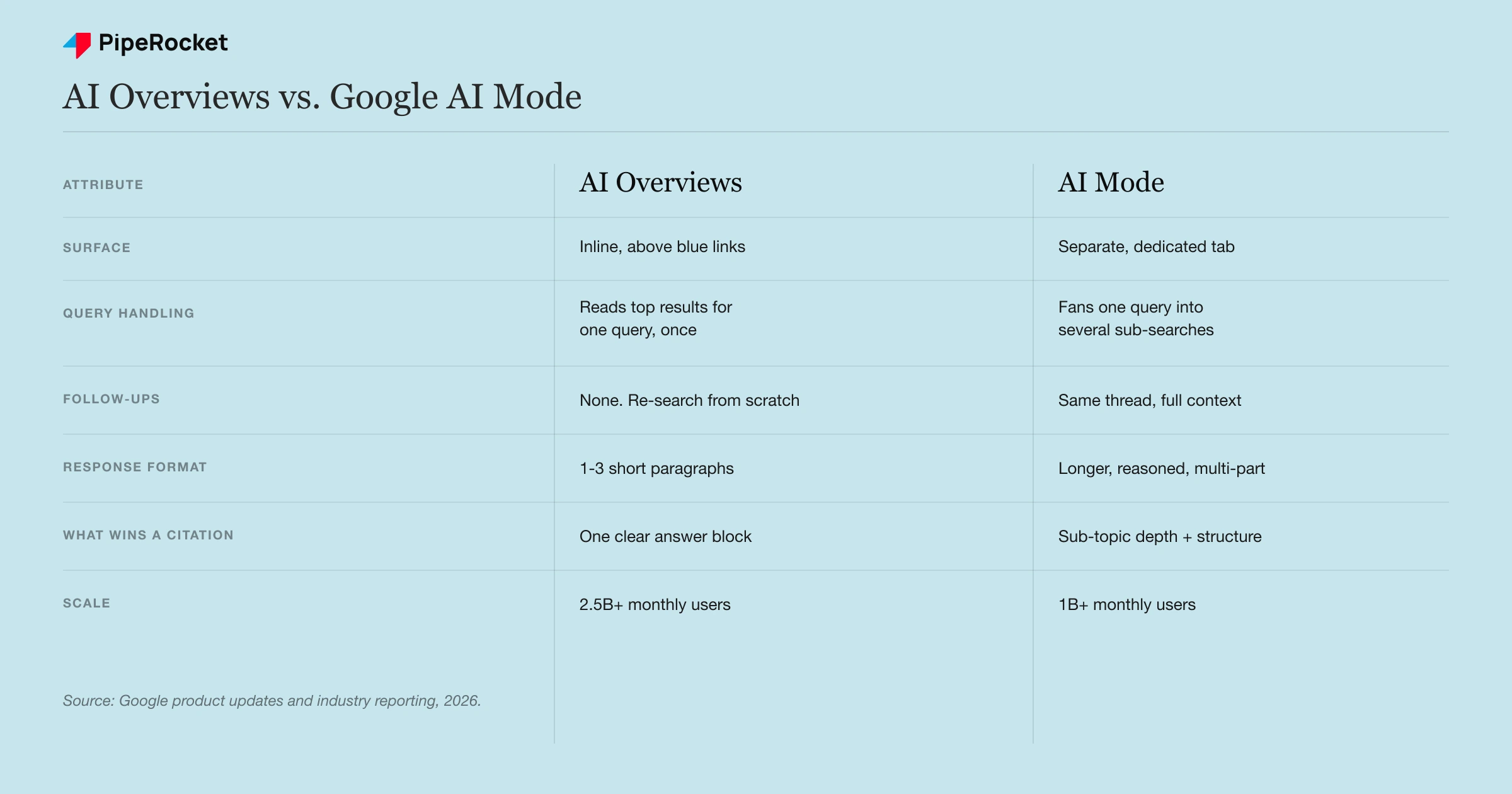
Most SaaS teams are still optimizing for AI Overviews when they should be optimizing for something structurally different. AI Mode is a dedicated tab a user opens on purpose, built for complex, multi-step questions, and it keeps the conversation going instead of handing back one summary and closing the loop.
That distinction changes everything downstream. An AI Overview reads the top-ranking pages for one query and writes a short paragraph.
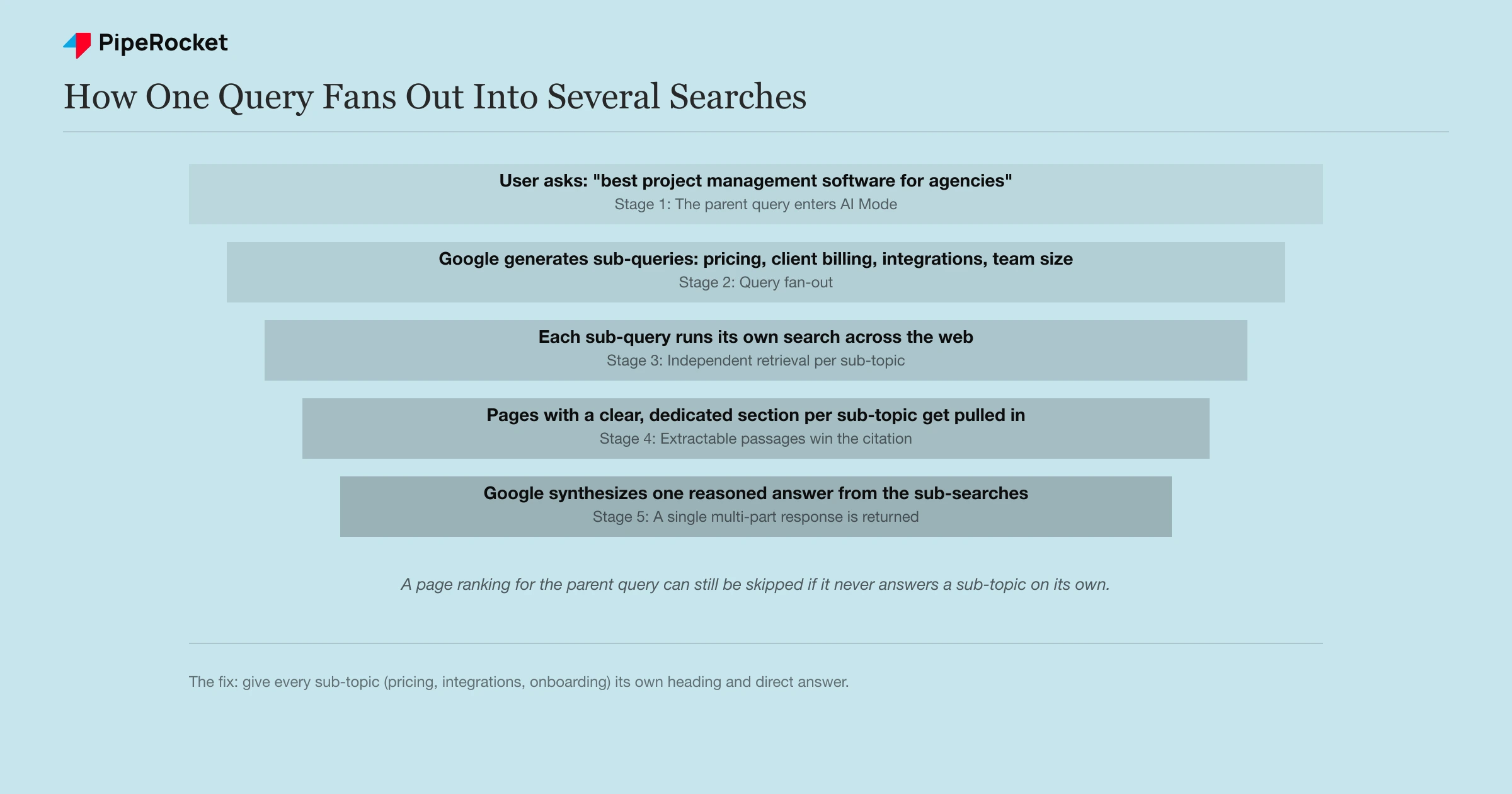
AI Mode runs query fan-out instead: it takes the user’s question, generates a set of related sub-queries behind the scenes, searches each one, and stitches the results into a longer, reasoned response.
One query becomes five searches
If someone types “best CRM for a 20-person sales team” into AI Mode, Google isn’t running that search once. It’s likely fanning out into sub-queries like pricing tiers for small teams, integration support, and onboarding time, then pulling a different set of sources for each piece.
Your page might rank for the parent query and still get skipped, because it never answers the pricing sub-query in an extractable way. I’ve seen this exact gap on client pages that rank fine in classic search and still don’t surface in AI Mode responses.
The conversation doesn’t end at the first answer
AI Overviews are a dead end by design. The user reads the summary and either clicks through or rephrases the search from scratch.
AI Mode is a live thread instead. The user can ask “what about the free trial” right after the first answer, in the same box, with full context carried over.
That means a page optimized only for the opening question is optimized for a third of the interaction. If a competitor’s page answers the follow-up better, AI Mode pulls from them mid-conversation, and your earlier citation doesn’t carry you through the rest of the session.
Structure Your Content to Survive Query Fan-Out
Fan-out rewards breadth before it rewards polish. Before you touch a sentence, map every sub-question a real buyer would ask around your primary topic, and make sure each one has its own clearly labeled section.
Map the sub-queries before you write
Start by listing the adjacent questions your keyword implies. For “project management software for agencies,” that’s pricing, client billing features, integrations, and team size limits.
Each sub-query needs its own heading and a self-contained answer in the first sentence or two under it. Don’t bury the pricing answer three paragraphs into a features section; give it a dedicated ### H3 that a fan-out sub-search can grab on its own.
Give Each Sub-Topic Its Own Section
A section that tries to cover pricing, onboarding, and integrations in one flowing paragraph is exactly the kind of content fan-out struggles to extract cleanly. Split it.
- Pricing gets its own heading and its own direct answer
- Onboarding time gets its own heading
- Integration support gets its own heading
Each becomes a chunk Google can pull independently, which matters because AI Mode isn’t grabbing your whole page. It’s grabbing the passage that answers the specific sub-query it generated.
Build for the Second and Third Question, Not Just the First
Multi-turn survival is the biggest structural difference between writing for AI Mode and writing for classic search. A page that nails the opening query and goes silent on the obvious follow-up gets replaced mid-conversation.
Anticipate the natural next question
For almost every commercial query, there’s a predictable next question. “Best accounting software for freelancers” is almost always followed by “is there a free plan” or “does it handle invoicing.”
Building an FAQ block or a dedicated section that answers that predictable follow-up, right on the same page, means AI Mode can stay on your source for turn two instead of switching to a competitor’s page that happened to cover it.
Comparison tables outperform comparison prose
When a follow-up question is “how does X compare to Y,” a markdown table with clear criteria in the left column and each option in its own column gets pulled far more reliably than two paragraphs of prose describing the same comparison.
| Approach | Best for the first question | Best for the follow-up |
|---|---|---|
| Dense prose paragraph | Weak. Buries the specific answer inside surrounding sentences | Very weak. No isolated passage to re-cite mid-conversation |
| Dedicated H3 per sub-topic | Strong. Each sub-answer is self-contained and extractable | Strong. Google can re-pull the exact section for the next turn |
| Comparison table | Strong for “vs” and pricing-tier queries | Strong. Rows map directly onto the natural next question |
We’ve watched this play out on client comparison pages built for a fintech compliance tool: the H2 sections that isolated one buyer question each kept showing up across a longer AI Mode session, while a wall-of-text competitor page only ever got cited once, on the opening turn.
Write Passages That Read Like a Direct Answer, Not a Pitch
AI Mode is assembling an answer under conversational pressure. It needs a clean, self-contained sentence it can lift, not a paragraph that opens with three lines of setup before it gets to the point.
Lead every section with the answer, then support it
The first sentence under any heading should be the direct answer to that heading’s implied question. Save the reasoning, the caveats, and the examples for the sentences after it.
This is the same discipline that drives citations in Google AI Overviews : answer first, context second. AI Mode applies that same extraction logic across a whole set of sub-queries instead of just one.
Match the Buyer’s Real Words, Skip the Internal Category Name
A compliance SaaS for fintech teams that calls itself a “Regulatory Intelligence Platform” internally is invisible to a fan-out sub-query phrased as “SOC 2 audit prep tool.” Match the language a buyer would actually type, section by section, not just in your title.
Keep supporting proof close to the claim
If a section claims a feature saves time or reduces cost, put the specific detail right next to that claim instead of three paragraphs later. Fan-out sub-searches often pull a narrow window of text, and separating a claim from its proof means only half of it survives extraction.
Build Off-Page Signals AI Mode Trusts Under Time Pressure
AI Mode is stitching together a multi-step answer fast, and it leans on sources it already has some confidence in when it’s working under that pressure. A brand with zero presence outside its own site is a bigger risk to cite mid-conversation than one that shows up consistently elsewhere.
Third-party listicles carry more weight in a fan-out response
When AI Mode fans out into a “best tools for X” sub-query, it’s drawing on the same kind of third-party roundup pages that AI Overviews already favor.
If your brand consistently shows up across two or three credible SaaS listicles, that’s a trust signal Google can lean on across multiple turns of the same conversation.
Reviews and community mentions do double duty
G2 and Clutch profiles, plus real mentions in Reddit threads or community forums, feed the same trust layer.
A user asking a multi-turn AI Mode question about “is this tool reliable” is effectively asking Google to vouch for you. Google is more comfortable doing that for a brand it has seen confirmed elsewhere.
Common Mistakes to Avoid
Optimizing only for the exact keyword phrase
Writing a page that answers “best CRM for small teams” and nothing adjacent means you’re optimized for one sub-query out of the five or six AI Mode might generate. Map the fan-out before you write, not after you notice you’re missing citations.
Writing one long section instead of separable sub-answers
A page can have great information and still fail extraction if pricing, features, and support are all tangled into the same three paragraphs. Split by sub-topic even when it feels like over-structuring the page.
Ignoring the predictable follow-up question
Most commercial queries have an obvious next question a buyer asks. Skipping it means AI Mode has to leave your page mid-conversation to answer the next turn, and it may not come back.
Treating off-page presence as optional
A page can be structurally perfect and still get passed over if Google has no independent confirmation the brand is real and trusted. Off-page signals aren’t a nice-to-have layer on top of good content. They’re part of what makes AI Mode comfortable citing you across a multi-turn thread.
How PipeRocket Helps SaaS Teams Get Cited in AI Mode
At PipeRocket, we map the fan-out for a client’s priority queries before we touch a page, then restructure content so each sub-question gets its own clean, extractable answer.
We pair that with the off-page work (listicle placements, review profiles, community presence) that gives Google a reason to keep citing a source across a full conversation.
If you want this run across your site as part of our broader AEO and GEO work , or want a second opinion on how you compare with other agencies focused on AI visibility , reach out and we’ll walk through your current AI Mode gaps together .
Frequently Asked Questions
What is Google AI Mode?
Google AI Mode is a separate, conversational search experience that lets users ask multi-step questions and follow up in the same thread, powered by a more advanced reasoning model than the one behind AI Overviews. Instead of returning one static summary, it fans a query out into several sub-searches, synthesizes the results, and keeps context across however many follow-up questions the user asks. It’s opened as its own tab rather than appearing automatically inside standard search results.
How is Google AI Mode different from AI Overviews?
AI Overviews sit inside regular search results and generate a short, one-shot summary from the top-ranking pages for a single query, with no memory of prior turns. AI Mode is a dedicated space the user chooses to open, built specifically for complex or multi-part questions, and it retains context so a user can ask a follow-up without starting over. AI Overviews reach a far larger share of everyday searches; AI Mode is built for the smaller set of sessions where a user wants to dig deeper.
Does ranking well in Google organic search guarantee visibility in AI Mode?
No. A page can rank on page one and still miss AI Mode citations if it doesn’t answer the specific sub-queries the fan-out generates for that topic. AI Mode is pulling extractable passages for each piece of a broken-down question, not just crediting whichever page already ranks highest overall. A lower-ranking page with cleanly separated, direct sub-answers can get cited over a higher-ranking page that buries the same information in dense prose.