
Picture your content library. A few pages quietly produce most of your marketing-qualified leads, and the rest pull sessions that never become anything. Generating MQLs is the easy part. The hard part is knowing which content actually does it, so you can build more of that and stop funding the pages that don’t.
Most teams can name their top posts by traffic in five seconds and can’t name a single post by MQLs. That’s the gap this guide closes, at the page level, not the channel level.
TL;DR
- The real split is page-level: A small set of pages produce your MQLs while the rest produce traffic, and confusing the two is what keeps content from earning its budget.
- Tag content by the job it does: Score each page-type by how likely it is to create an MQL versus assist one, so you stop judging a comparison page and a definition post by the same bar.
- Find the MQL-producing pages: Work backwards from MQLs in your CRM to the content each one touched, and the same few pages keep showing up.
- Score leads by what they read: Weight your lead score with the content a person consumed, because reading a pricing page and reading one blog are not the same buying signal.
- Build from the pattern, not the traffic: Once you know which content makes MQLs, your next content decision writes itself.
Why Traffic Reports Hide Which Content Makes MQLs
Your traffic report ranks content by sessions, and sessions are the wrong unit for this question. A post with 8,000 monthly visitors can produce zero MQLs while a page with 200 visitors produces six. Rank by traffic and you’ll celebrate the first page and ignore the second, which is exactly backwards.
Here’s the part most teams get wrong. They assume the content-to-MQL connection lives in their analytics. It doesn’t. Analytics tells you what got viewed. It can’t tell you that the person who became an MQL last Tuesday had read your integration page three weeks earlier. That link only exists once you’ve connected the page a lead touched to the lead record itself.
This guide assumes that connection is already in place. If your leads don’t carry the source and the pages they viewed into your CRM, that’s the prerequisite, and the mechanics of wiring organic search to your CRM pipeline are a separate method. Here, we’re past the plumbing. We’re answering a different question: of the content you already have, which pieces make qualified leads?
That question splits your library into two piles, and both have value:
- one pile creates MQLs
- the other creates an audience
They are not the same content, and treating them as one number is why content programs stall.
Step 1: Sort Your Content by the MQL Job It Does
Start by accepting that different page types create MQLs at wildly different rates. A “what is X” definition post almost never produces an MQL directly. A pricing or comparison page produces them all day. If you score both against the same expectation, you’ll cut the wrong things.
So before you measure anything, classify your content by the job it’s built to do. We sort pages into three buckets:
- MQL-producers: pricing, comparison, alternative, use-case, and product pages. High intent. The reader is close to a decision.
- MQL-assisters: how-to guides, deeper strategy posts, and middle-funnel content that a lead reads on the way in but rarely converts on alone.
- Audience-builders: definitional and top-of-funnel posts that bring people in early and almost never produce an MQL on the same visit.
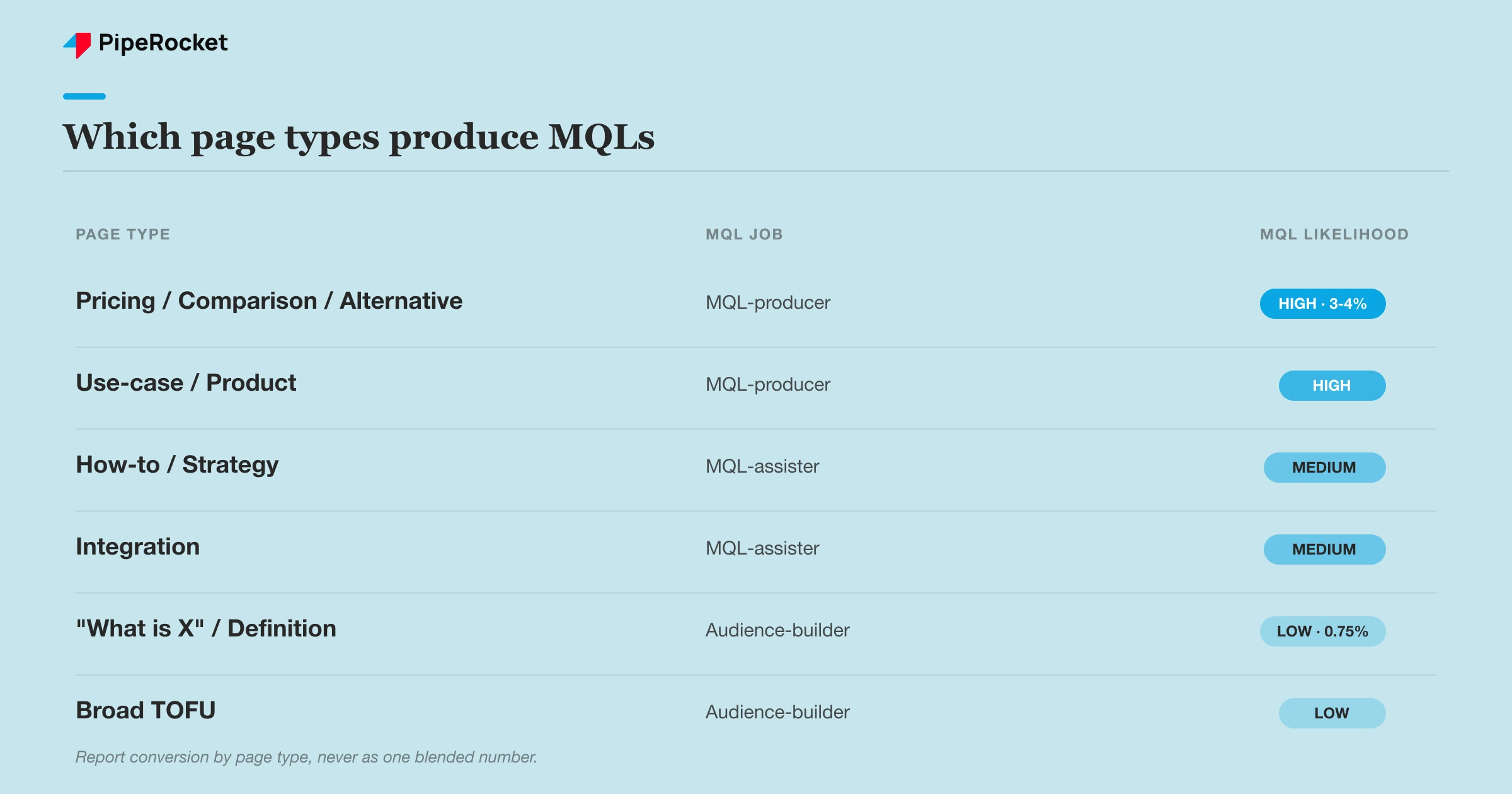
Here’s the same split as a working reference, with the conversion benchmark and lead-score weight each page type earns:
| Page type | MQL job | Typical conversion | Lead-score weight |
|---|---|---|---|
| Pricing / comparison / alternative pages | Produces MQLs (high intent) | ~3-4% | Heavy |
| Use-case / integration pages | Mid-funnel, demo-led | Moderate | Moderate |
| How-to / strategy posts | Assists the MQL | Lower | Light |
| Definition / top-of-funnel posts | Builds audience | ~0.75% | Light |
The reason this matters is benchmarking. Our team reports conversion by page TYPE, never as one blended number, because the benchmarks are so different. A high-intent comparison or alternative page might convert at 3 to 4%. A general top-of-funnel page often sits near 0.75%, and frequently on an asset download rather than a demo request.
Judge a definition post by a comparison page’s bar and you’ll kill content that was doing its actual job. The job of an audience-builder isn’t to make MQLs today. It’s to feed the page that does.
Here’s the trade-off to be honest about. Tagging every page by job takes a real afternoon, and for a library under 30 pages it can feel like overkill. For anything past 50 pages, it’s the only way to stop averaging your best and worst content into a meaningless middle.
Step 2: Work Backwards From MQLs to the Pages That Made Them
The fastest way to find your MQL-producing content is to start at the MQL and trace back, not start at the content and project forward. Pull your last 90 days of MQLs from the CRM, and for each one, look at the content that lead touched before they qualified.
Two things show up almost immediately:
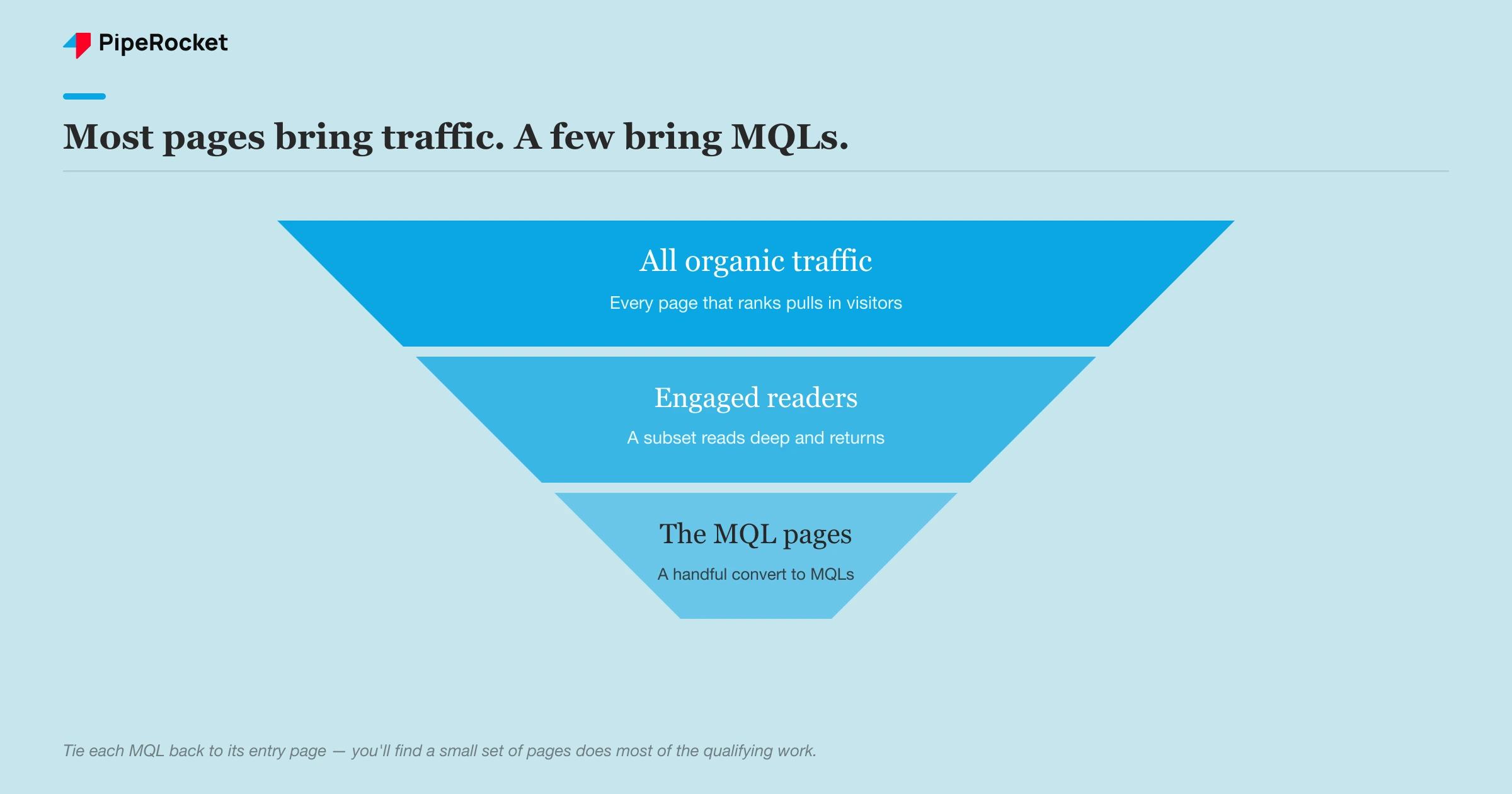
- A short list of pages appears again and again across your MQLs. That’s your MQL engine, usually 5 to 10 pages out of hundreds.
- A lot of high-traffic content barely appears at all. It’s pulling sessions that never enter a buying motion.
Take a compliance SaaS for fintech teams. Their highest-traffic post was a regulation explainer pulling thousands of visitors a month. When they traced MQLs back, that post touched almost none of them. The MQLs had read a quiet use-case page and the pricing page, each pulling a fraction of the traffic.
That pattern is the whole point. We once helped a client go from 3 sales opportunities to 15 in two quarters with no extra content and no bigger budget. The shift was the question. They stopped asking “what gets the most searches?” and started asking “what does someone search when they already have the problem and need a fix now?”
Most of those pages had near-zero search volume, but the few visitors were decision-makers, and that’s where the qualified pipeline actually came from.
Note: don’t over-trust a single touch. A lead that became an MQL right after a pricing-page visit may have been warmed up by a how-to they read a month earlier. That’s why the next step weighs the whole content path instead of the last click alone.
Step 3: Score Leads by the Content They Actually Read
Stop treating every lead as equal the second they fill a form. The content a person consumes before they raise their hand is one of the cleanest qualification signals you have, and most teams leave it sitting in their analytics unused. If you want a dollar figure to weight leads against, our free lead value calculator works from your own conversion and deal-size data.
The framing our team keeps coming back to: stop chasing traffic, start chasing signals. The work isn’t to maximise sessions. It’s to feed lead-scoring signals, who visited, which pages, how often, into how you qualify and prioritise a lead.
In practice that means content-weighting your lead score, using the same weights from the table above:
- Heavy weight: pricing, comparison, alternative, and demo-adjacent pages signal active evaluation.
- Moderate weight: repeat visits to use-case or integration pages that match your ICP ’s problem.
- Light or zero weight: a single visit to a top-of-funnel definition post is awareness, not intent.
This changes who sales calls first. A lead who downloaded one checklist looks identical to a lead who read your pricing page three times and your main competitor comparison once, until you let the content weight pull them apart. The second lead is an MQL with a clear story. The first is a name on a list.
Treat content consumption as a leading indicator of fit, and your MQL definition gets sharper without adding a single new field to the form. The content itself is doing the qualifying.
Step 4: Build From the Pattern, Not the Traffic Chart
Once you know which content makes MQLs, your content roadmap stops being a guessing game. The instinct is to look at your traffic winners and write more like them. The better move is to look at your MQL winners and build around them, because those are the pages connected to pipeline.
Concretely, that means three different jobs for three different findings:
- Strengthen the MQL-producers. If five pages make most of your MQLs, those get your best CRO attention, your sharpest CTAs, and internal links pointing into them.
- Build feeders for them. Map which audience-builders actually pass readers into your MQL pages and write more of those, not more of whatever happens to rank.
- Stop over-investing in dead traffic. A page with huge sessions and zero MQL involvement isn’t a priority, no matter how good the traffic chart looks.
This is where content earns the right to be treated as a system, not a publishing schedule. Content compounds when it’s built as a connected set of pages that keeps returning pipeline, instead of one-off posts that spike and decay. The connection between a feeder post and the MQL page it warms up is the system.
The honest trade-off: this rewards depth over volume, which is a hard sell when leadership measures the team on posts shipped. A program that publishes four pages a month tied to MQLs will out-earn one publishing twelve tied to nothing. Owning the outcome, not the output, is the whole game here.
Common Mistakes That Break the Content-to-MQL Link
The most common mistake is measuring content-to-MQL on last touch only. The form-fill page gets all the credit and the post that did the convincing three weeks earlier gets none, so you defund the content that was actually working.
A close second: judging every page by one conversion benchmark. A definition post converting at 0.7% looks like a failure next to a comparison page at 4%, but they have completely different jobs. Hold each page type to its own bar or you’ll cut your funnel’s top off to make a spreadsheet look tidy.
Two more that quietly cost MQLs:
- Chasing the traffic winner. The highest-traffic post is rarely the highest-MQL post, and writing ten more like it just grows an audience that never buys.
- Letting content signals sit unused. If you know which pages a lead read and your lead score ignores it, you’re throwing away your cleanest qualification data.
Warning: don’t act on a 90-day pattern from a handful of MQLs as if it were settled science. With low MQL counts, one big deal can skew which page looks like the hero. Treat the pattern as directional, and re-check it as volume builds.
How PipeRocket Ties Content to Pipeline
We build SaaS SEO programs around the pages that make qualified leads, not the ones that make traffic charts look good. That means tracing MQLs back to the content that produced them, weighting your content roadmap toward those pages, and feeding content-consumption signals into how leads get scored. If your blog pulls traffic but your pipeline isn’t moving, talk to our team or see how we approach SaaS SEO . We work to a simple standard: own the outcome, not the output.
Frequently Asked Questions
How do you connect a specific blog post to an MQL?
You connect them through your CRM, not your analytics. The page a lead viewed has to be captured on the lead record, so when that lead becomes an MQL you can look back and see every piece of content they touched. Analytics alone shows you page views, but it can’t tie a specific post to a specific qualified lead. Once the source and viewed-pages data flow into the CRM, you trace each MQL backwards to the content path that produced it.
What’s the difference between content that drives MQLs and content that drives traffic?
MQL-driving content is usually high-intent: pricing, comparison, alternative, and use-case pages that a reader hits when they’re close to a decision. Traffic-driving content is usually top-of-funnel, like definition posts and broad guides that bring people in early.
A page can have huge traffic and produce zero MQLs, or tiny traffic and produce many. The only way to know which is which is to trace your actual MQLs back to the pages they touched, rather than reading the traffic report.
How should content factor into lead scoring?
Weight your lead score by the intent of the content a person consumed, rather than only whether they filled a form. Visits to pricing, comparison, and demo-adjacent pages signal active evaluation and should score heavily. A single visit to a top-of-funnel blog is awareness, not buying intent, and should barely move the score.
This way two leads who look identical on the form get pulled apart by what they actually read, and sales calls the one with the stronger content signal first.