SaaS Sales Pipeline: Stages, Metrics, and How to Build One That Doesn't Stall
 Omar Sheriff
Last updated on
Omar Sheriff
Last updated on
A SaaS sales pipeline refers to the staged view of every prospect moving from first contact toward a signed subscription, and unlike a one-time retail sale, it keeps going past the close into renewal and expansion.
Quick Answers Before You Build One
- A SaaS sales pipeline tracks prospects from first contact through the signed deal and into renewal, which makes it different from a retail sales process that ends at checkout.
- Most SaaS pipelines run through 7 stages, from prospecting to renewal, though some teams compress that to 5 by merging discovery with qualification.
- Building a pipeline from scratch starts with a specific ICP and exit criteria for every stage, defined before the CRM gets set up.
- Pipeline stages break down most often at the handoff between marketing and sales, not inside the CRM stages themselves.
- Coverage ratio, stage conversion rate, and pipeline velocity tell you more about pipeline health than total pipeline value does.
- The most common mistakes are counting unqualified leads as pipeline, letting deals sit in a stage with no next step, and never agreeing on what “qualified” means between marketing and sales.
What Is a SaaS Sales Pipeline?
A SaaS sales pipeline is the structured path a prospect moves through, from the moment they’re identified as a potential buyer to the moment they sign, and then through renewal and expansion. Each stage should map to a specific, observable buyer action, not a rep’s gut feeling about how a call went.
That last part matters more in SaaS than in most other sales motions. A one-time software sale that closes and disappears from view isn’t really the target state. The subscription model means the pipeline doesn’t end at the signature. Annual recurring revenue, retention, and expansion all still run through the same pipeline logic after the deal closes.
This is also why SaaS pipelines are usually managed differently from retail or transactional B2B sales. A retail pipeline optimizes for one conversion. A SaaS pipeline optimizes for a conversion plus everything that keeps that customer paying, which is why stages like onboarding and renewal belong on the same board as prospecting and qualification.
The 7 Stages of a SaaS Sales Pipeline
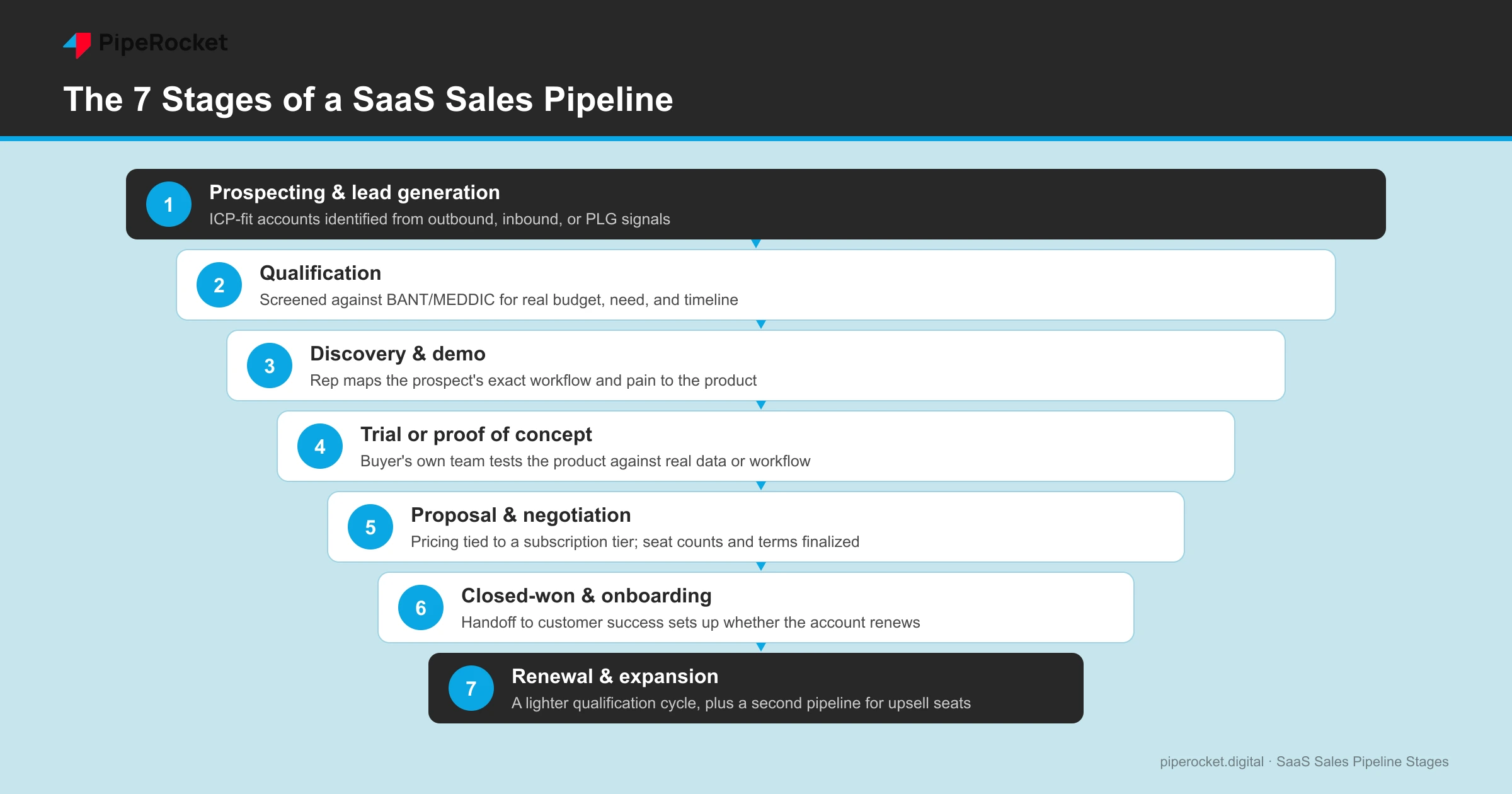
Most B2B SaaS pipelines run through seven stages, though the exact labels vary by team. Some collapse discovery into qualification and end up with five stages instead. The stage count matters less than making sure every stage has a clear entry and exit condition.
Stage 1: Prospecting and lead generation
This stage identifies accounts that fit the ideal customer profile, using outbound research, inbound signals like a trial signup, or product-led growth activity such as a free-tier user hitting a usage limit. The goal here is a list of accounts worth a conversation, not a list of names.
Teams that skip a real ICP definition end up prospecting broadly and pushing volume into stages that were never built to filter it. That shows up later as a bloated pipeline that looks healthy on a dashboard and closes almost nothing.
Stage 2: Qualification
Qualification screens a lead against a framework like BANT or MEDDIC to confirm there’s a real budget, a real need, and a real timeline, not just interest. A prospect who downloaded a whitepaper isn’t qualified. A prospect who confirmed a budget line and a target go-live date is.
This is usually where SDRs hand a deal to an account executive, and it’s the single most common place a SaaS pipeline gets inflated. If the bar for “qualified” is low, everything downstream inherits that weak signal.
Stage 3: Discovery and demo
Discovery is where the rep maps the prospect’s specific workflow and pain to the product, usually through a live demo. A generic demo that walks through every feature loses the prospect. A demo built around the exact problem uncovered in discovery holds attention because it looks like a solution, not a tour.
Stage 4: Trial or proof of concept
Many SaaS deals include a trial or proof-of-concept stage, where the buyer’s own team tests the product against their real data or workflow. This stage exists because software claims are cheap and a live test is not. It’s also where technical buyers, not just economic buyers, get a vote in the deal.
Stage 5: Proposal and negotiation
At this stage, pricing gets tied to a specific subscription tier and contract terms get finalized. In SaaS, this often means negotiating seat counts, usage tiers, or multi-year discounts rather than a single flat price, which makes this stage longer than it looks on a pipeline report.
Stage 6: Closed-won and onboarding
The deal signs, but the pipeline work isn’t done. Onboarding hands the new customer to a customer success or implementation team, and how well that handoff goes has a direct effect on whether the account renews. A sale that closes and then churns in month four was never really a win.
Track the losses here too. Every deal that reaches this stage resolves as closed-won or closed-lost, and logging a lost reason (price, timing, a competitor, no decision) is what turns a dead deal into a forecasting signal instead of a blank row. A pipeline that only records wins hides its own biggest pattern.
Stage 7: Renewal and expansion
This is the stage that separates a SaaS pipeline from almost every other kind. The same account cycles back through a lighter version of qualification and proposal at renewal time, and a healthy account often generates a second, smaller pipeline for expansion seats or upsell tiers. Ignoring this stage is why so many SaaS revenue teams are surprised by churn they should have seen coming.
How to Build a SaaS Sales Pipeline From Scratch
Build a SaaS sales pipeline by settling four things before any CRM setup: define the ICP, map each stage to one observable buyer action, set an exit criterion and a maximum duration per stage, and assign one owner at every handoff. The CRM columns come last.
A pipeline built before that groundwork is in place just becomes a set of columns in a CRM that nobody trusts. Each of those four steps below has to happen before a single deal gets logged.
Define the ideal customer profile first
Every stage downstream depends on the ideal customer profile (ICP). If the ICP is vague, “mid-market SaaS companies” instead of “50 to 200 employee vertical SaaS companies using a legacy on-premise tool for compliance tracking,” then prospecting fills the top of the pipeline with accounts that will fail qualification anyway.
A compliance SaaS selling to fintech operations teams learns this fast: a generic “B2B software company” ICP pulls in retailers and agencies who never had the underlying regulatory problem in the first place.
Map each stage to one observable buyer action
A stage should be defined by something the buyer did, not something the rep believes. A confirmed budget line and a named decision date qualify a deal; a rep’s optimism after a good call does not. Write the exit criteria for every stage down before building the CRM view, not after.
Set an exit criterion and a maximum stage duration for every stage
Without a time limit, deals sit in “proposal” for months while looking technically active. Give each stage a realistic maximum stage duration based on historical data, and flag anything that overstays it for a manager review, not an automatic removal.
Assign explicit ownership at every handoff
The riskiest point in any pipeline is the handoff, marketing to SDR, SDR to AE, AE to customer success. Each handoff needs one person accountable for confirming the receiving stage’s entry criteria are actually met, not just that a task got reassigned in the CRM.
Once those four are in place, the actual CRM setup is mechanical: create the stages, wire up automation for stage-change notifications, and start logging real deals. Teams that reverse this order, building the CRM view first and hoping the definitions catch up, are the ones re-doing their pipeline structure every two quarters.
Why Most SaaS Pipelines Stall
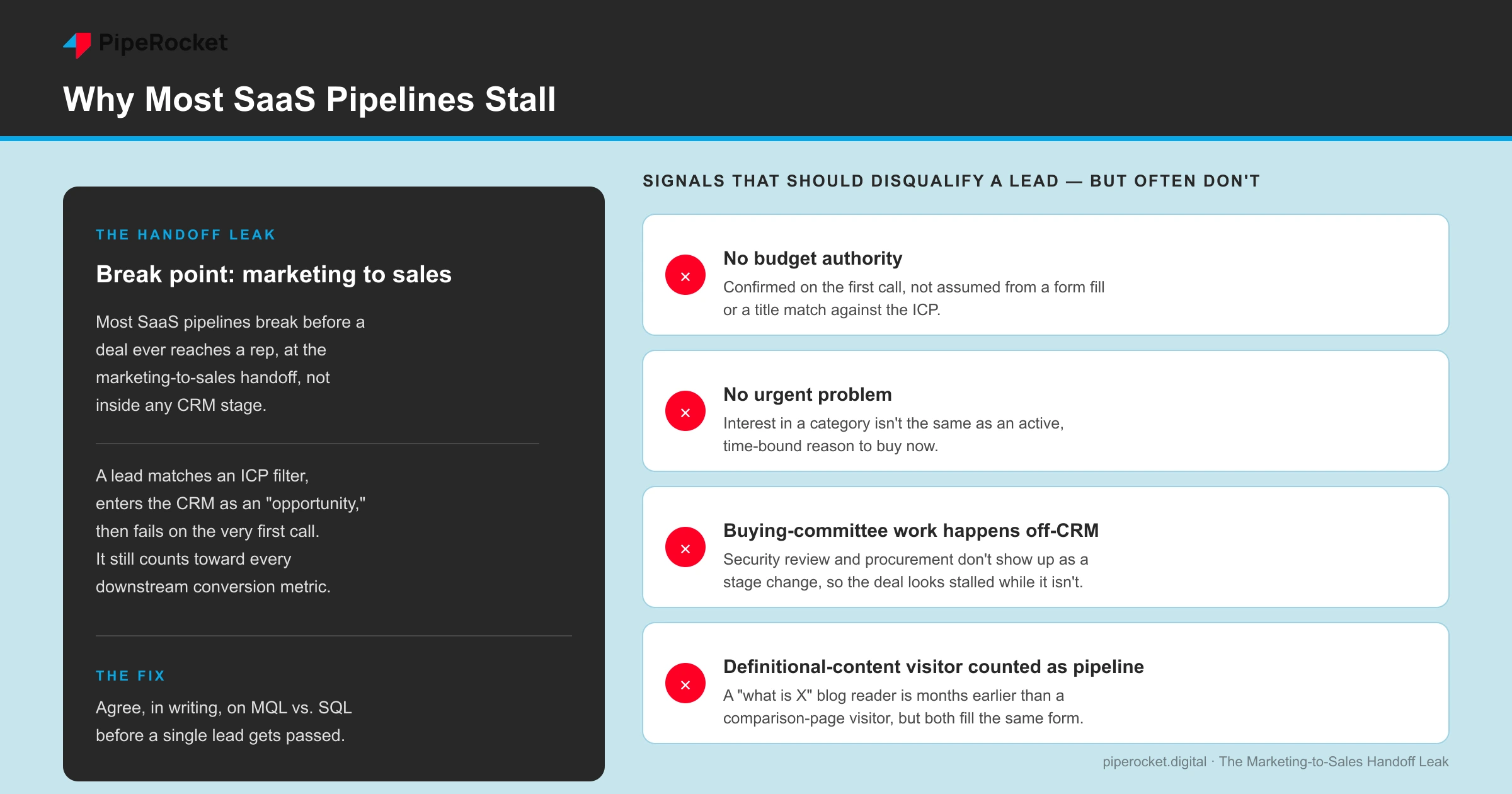
Most SaaS pipelines break at the marketing-to-sales handoff, before a deal ever reaches a rep, not inside any CRM stage. Most of the SaaS pipeline content floating around treats this as a purely sales-team topic: name the stages, plug them into a CRM, done. That framing misses where the breakage actually happens.
Marketing hands over a lead that technically matches an ICP filter, sales opens the account, and within one call it’s clear the deal isn’t real. The concrete signals show up fast:
- No budget authority. The contact can’t confirm a budget line or point to who owns the decision.
- No urgent problem. There’s category interest but no active, time-bound reason to buy now.
- Buying-committee work happening off-CRM. Security review or procurement is underway, but none of it shows up as a stage change.
- Definitional-blog visitors counted as pipeline. A “what is X” reader gets logged as the same opportunity type as a comparison-page visitor who’s already evaluating vendors.
That lead still shows up in pipeline reporting as an “opportunity.” It inflates every conversion metric downstream while contributing nothing real.
A CRM-only view of pipeline health works fine when deals are simple, inbound, and single-threaded through one buyer. It breaks the moment a deal involves a buying committee , a security review, or a procurement process, because none of that shows up as a CRM stage change. The pipeline looks stalled on paper while real work is happening off-screen.
The fix is agreeing, in writing, on what counts as a marketing-qualified lead versus a sales-qualified opportunity before a single lead gets passed. No CRM field can do that job. Teams that skip this conversation end up arguing about pipeline numbers instead of building pipeline.
Content and demand generation feed this same stage. A prospect on a comparison page is close to a qualification conversation, while one on a definitional post is months earlier, and treating both as equally “in pipeline” at the form fill is where reported pipeline value turns to fiction.
The Metrics That Actually Tell You If Your Pipeline Is Healthy
Pipeline coverage ratio and stage conversion rate tell you the most about pipeline health because they are leading indicators: they flag a problem before it becomes a missed quarter. Total pipeline value, the number executives ask for first, tells you the least.
A pipeline can show a healthy dollar figure while every deal in it is stuck, under-qualified, or months from closing. A handful of other metrics say more with less room to hide.
| Metric | What it tells you | Watch for |
|---|---|---|
| Pipeline coverage ratio | Whether there’s enough pipeline in flight to hit the revenue target, usually 3x to 4x quota | A ratio near 1x means the team will miss the number even if every deal closes |
| Stage conversion rate | The percentage of deals that move from one stage to the next | A sharp drop at one stage points to exactly where the process is broken |
| Pipeline velocity | How fast deals move from creation to close, factoring in deal count, win rate, and deal size | Slowing velocity with flat deal count usually means deals are stuck, not that fewer are coming in |
| Average sales cycle length | Days from first qualified opportunity to close | A cycle that’s stretching quarter over quarter often means a new buying committee or procurement step appeared unnoticed |
| Win rate by source | Close rate segmented by how the deal originated | Shows which channels produce pipeline that actually closes, not just pipeline that gets created |
| Weighted pipeline value | Total pipeline value with each deal multiplied by its stage’s historical win probability | A raw total treats a stage-2 deal like a signed one; the weighted figure is the more honest forecast number |
Coverage ratio and stage conversion rate matter more than the other rows for one reason: they surface a problem before it becomes a missed quarter. A dropping win rate is a lagging signal. A collapsing conversion rate between qualification and demo is a leading one, and it gives a team time to fix the actual bottleneck instead of just reporting on it after the deal is lost.
Pull these numbers by segment, not just in aggregate. A pipeline dashboard that blends a self-serve PLG motion with an enterprise sales-assisted motion will average out two very different velocities and coverage needs into one misleading number. A 30-day PLG upgrade cycle and a 6-month enterprise procurement cycle should never share the same coverage target.
Tools SaaS Teams Use to Manage the Pipeline
Most teams run pipeline management through whatever CRM already holds their contact and deal data, most often HubSpot or Salesforce, since the pipeline view is a native feature rather than a separate purchase. The tool matters less than whether the stage definitions inside it match how the team actually sells.
Beyond the core CRM, a few categories show up repeatedly in SaaS pipeline stacks:
- Sales engagement tools for sequencing outbound at the prospecting stage
- Intent data platforms that flag accounts researching a category before they fill out a form
- Forecasting and revenue intelligence tools that sit on top of CRM data to flag deals at risk of slipping
- Contract and quoting tools (CPQ) for the proposal stage, particularly once pricing has more than one tier or usage-based component
None of these fix a pipeline built on bad stage definitions. A forecasting tool layered on top of inflated, unqualified pipeline data just produces a more confident-looking wrong number.
Common Mistakes to Avoid
Counting every lead as pipeline
A form fill or a trial signup isn’t a pipeline opportunity until it clears a real qualification bar. Counting it earlier inflates every downstream metric and makes forecasting worse, not better, because leadership starts planning against a number that was never real.
Letting deals sit with no defined next step
A deal without a scheduled next action is a deal that’s already stalling, even if it’s still technically “open” in the CRM. Reps should be able to say, for any open deal, exactly what happens next and by when. If they can’t, that deal shouldn’t still be counted as active pipeline.
Skipping a shared definition of “qualified”
When marketing and sales each have their own private definition of “qualified,” every pipeline number becomes a negotiation instead of a fact. This gets fixed once, in a real conversation between both teams, not through a form field that only one side agreed to.
Ignoring the renewal stage until it’s a churn problem
Teams that treat renewal as an afterthought usually find out about churn risk the same week the contract is up for renewal, which is too late to do anything about it. Renewal deserves its own pipeline stage with its own health checks, starting well before the contract date.
Reporting pipeline value without segmenting by stage
A single pipeline total tells leadership almost nothing about risk. Two pipelines can carry the same total value while one is stacked with early-stage deals that will mostly evaporate and the other is stacked with late-stage deals close to signing. Segment every pipeline report by stage before anyone reads the total.
How PipeRocket Digital Helps SaaS Teams Fill the Pipeline
We build the demand engine that feeds the top of this pipeline with prospects who actually clear qualification, not just form fills. That means SEO built around buying-stage intent and paid search that targets people already evaluating a category.
Sales spends time on real opportunities instead of chasing volume. If your pipeline looks full but keeps stalling before close, talk to us about where the leak actually is.
Frequently Asked Questions
What is a SaaS sales pipeline?
A SaaS sales pipeline is the staged process that tracks a prospective customer from first contact through a signed subscription and into renewal and expansion. Unlike a retail sale, it doesn’t end at the signature; it keeps running through onboarding, renewal, and upsell because the revenue itself is recurring. Each stage represents a specific, verifiable step the buyer has taken, not an internal guess about how close they are to closing.
What’s the difference between a sales pipeline and a sales funnel?
A sales pipeline tracks individual deals as they move through defined stages, showing where each specific opportunity sits right now. A sales funnel is an aggregate view, showing what percentage of all prospects make it from one stage to the next across the whole customer base. Think of the pipeline as deal-by-deal and the funnel as the statistical shape those deals form in total. Teams use both together: the pipeline for managing today’s deals, the funnel for spotting where the whole process leaks over time.
What’s a good pipeline coverage ratio for a SaaS company?
Most SaaS revenue teams target a coverage ratio between 3x and 4x quota, meaning there’s three to four dollars of qualified pipeline in flight for every dollar of quota still owed. A lower ratio usually means the team will miss its number even if it closes every deal currently in motion, since not every deal closes. The right ratio also depends on the sales cycle and historical win rate; a team with a 40% win rate needs less coverage than one closing at 15%.
Does a SaaS sales pipeline have 5 stages or 7?
Both are valid. The full model runs 7 stages, from prospecting to renewal. Teams that merge discovery into qualification and stop counting at the close land on the common 5-stage version instead.
What’s the best sales process for a SaaS company?
Match the qualification framework to deal size. Enterprise deals above roughly $50K ACV suit MEDDIC or MEDDPICC, mid-market deals suit SPIN or SPICED, and simple self-serve motions rarely need more than BANT.
Is a sales pipeline the same as a sales cycle?
No. The pipeline is the stage structure a deal moves through, while the sales cycle is the time it takes to move through it. One describes the steps; the other measures the days.