Voice Search SEO for B2B SaaS: What Actually Works in 2026
 Sabari Rohith
Last updated on
Sabari Rohith
Last updated on

Voice search SEO means optimizing content to match how people phrase spoken queries, full questions instead of clipped keyword fragments, and structuring the answer so it can be read aloud or lifted whole by an assistant. For B2B SaaS, that skill now matters more inside AI chat tools than on any smart speaker.
TL;DR
- Smart speaker voice search is not a B2B SaaS channel. No finance director is asking Alexa to compare accounts payable software, so chasing literal voice-assistant traffic here is a waste of hours.
- The underlying skill still matters, just somewhere else. Conversational, question-shaped queries typed into ChatGPT and Perplexity reward the exact same writing style voice search always rewarded.
- Write full questions as headings, then answer them in the first sentence. That structure is what gets lifted into AI Overviews, snippets, and chatbot answers alike.
- Structure beats length. Short, self-contained, well-labeled answers extract cleanly. Long unbroken paragraphs don’t, no matter how accurate they are.
- Track AI Overview and chatbot citations as the real success metric. Google Search Console can’t see voice queries directly, and neither can most rank trackers, so the old voice-search KPIs never worked anyway.
Smart Speakers Aren’t Where Your Buyers Search
Nobody evaluating a compliance platform or a CRM migration asks Alexa to compare vendors. The buying committee is reading G2 reviews, pulling up pricing pages on a laptop, and typing long questions into a search bar or a chat window. That’s the actual behavior, and it has been for years.
Most voice search advice was written for restaurants and retail, and it shows. It assumes someone is standing in their kitchen asking a speaker where to find a plumber, then tries to apply that same logic to enterprise software procurement. It doesn’t hold up.
Did You Know: Google Trends interest in “voice search” as a topic has been flat to declining for years, right alongside smart speaker adoption plateauing across most markets. If you’re building a 2026 SEO plan around Alexa and Google Home traffic for a B2B SaaS product, you’re optimizing for a channel your buyers don’t use.
The writing skill behind voice search didn’t become useless when smart speaker growth stalled, though. Answering in full sentences and structuring content so it can be read aloud cleanly is the exact skill AI Overviews, ChatGPT, and Perplexity now reward when deciding which page to quote. That convergence is the real story, and it’s the one this article is actually about.
Write for the Full Questions Buyers Actually Type
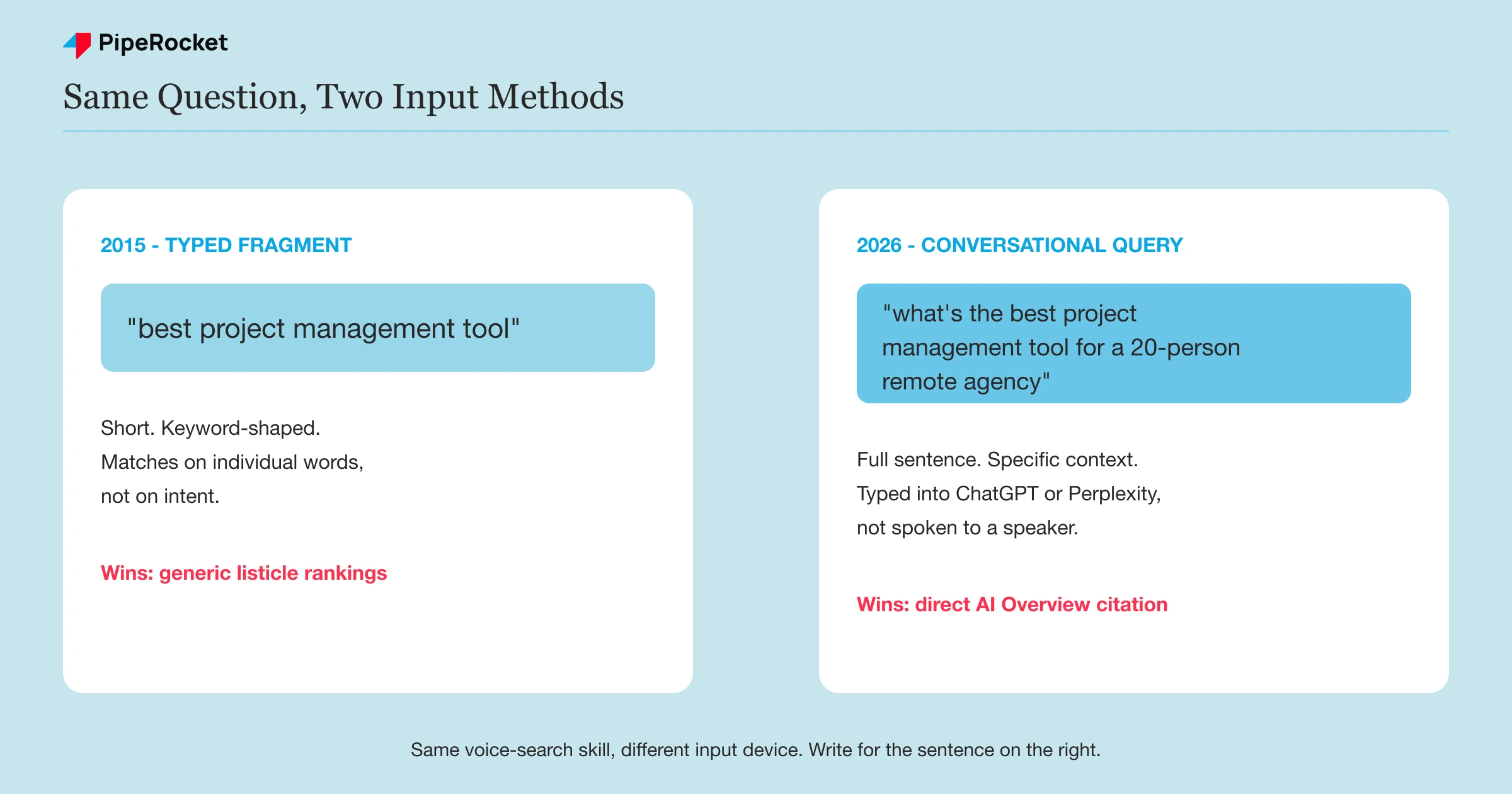
Start by matching real phrasing instead of clipped keyword fragments. Someone typing “best project management tool” into Google in 2015 and someone typing “what’s the best project management tool for a 20-person remote agency” into ChatGPT today are both voice-search-shaped queries. One just happens to be spoken and the other typed. Both are full, specific, natural-language questions, and that’s what changed.
Mine your own sales calls and support tickets for real phrasing
The fastest way to find these questions isn’t a keyword tool. It’s your own sales and support transcripts. Pull the last twenty discovery calls and note how prospects actually describe their problem out loud. They rarely say “workflow automation software.” They say things like “how do I stop my team from manually copying data between our CRM and our billing tool.”
That second phrase is a real query pattern now, whether it gets spoken to a phone assistant or typed into an AI chat tool. Write the page that answers it directly, using close to that exact phrasing in a heading.
Target question-shaped long-tail keywords, even at low volume
A keyword tool showing “10 searches a month” for a specific question is undercounting badly, because it can’t see the equivalent volume happening inside ChatGPT, Perplexity, or a spoken query to Siri. Treat a specific, well-formed question as worth targeting even when the visible volume number looks small.
We’ve seen this pattern repeatedly with B2B SaaS clients: a page built around one precise, oddly-phrased question outperforms a page built around a generic high-volume keyword, because the specific page is the only thing on the internet that actually answers what was asked.
Answer the Question in the First Sentence, Every Time
The single highest-leverage change most SaaS content teams can make is moving the answer to the first sentence of every section. Voice assistants, AI Overviews , and chatbots all pull the most direct, self-contained sentence they can find, and if that sentence sits three paragraphs deep, it doesn’t get pulled.
Open every H2 and H3 with a direct answer
If a heading poses a question, “What does implementation actually cost?”, the next sentence has to answer it in plain language, no throat-clearing, no “there are a few factors to consider here.” State the number, the range, or the answer, then explain the nuance after.
Keep the answer sentence short enough to quote whole
An assistant lifting a sentence into a spoken response or a chat answer needs that sentence to stand alone, under about 40 words, with no unresolved pronoun referring back to an earlier paragraph. Write it so it reads correctly even ripped completely out of context, because that’s exactly what happens to it.
Use the exact phrasing of the question in the answer
If the heading asks “does this integrate with Salesforce,” the answer should include the words “integrates with Salesforce” rather than a paraphrase like “yes, it connects to most major CRMs.” Assistants match on phrasing overlap. A near-exact echo of the question in the answer gets selected over a technically-correct but differently-worded answer.
Structure the Page So an Assistant Can Pull One Piece Cleanly
A page can have the right answer and still lose the citation if the structure buries it. Assistants and snippet algorithms favor content they can extract as one clean unit: a short paragraph, a table row, a numbered step, not a sentence stitched into the middle of a 200-word block.
| Format | Extracts well | Extracts poorly |
|---|---|---|
| One question as a heading, answer as the next sentence | Yes | |
| A comparison laid out as a table | Yes | |
| A numbered list of steps | Yes | |
| An answer buried mid-paragraph after two sentences of setup | Yes | |
| A single paragraph covering three unrelated sub-questions | Yes |
Break multi-part answers into their own labeled sections instead of one long paragraph trying to cover pricing, setup time, and support in the same breath. If a reader would want to ask three separate follow-up questions, give each one its own heading.
That’s also what makes a page eligible to get pulled into an AI Overview for more than one related query, instead of just the one it was originally written for.
Build Around Clusters of Related Questions, Not One Keyword
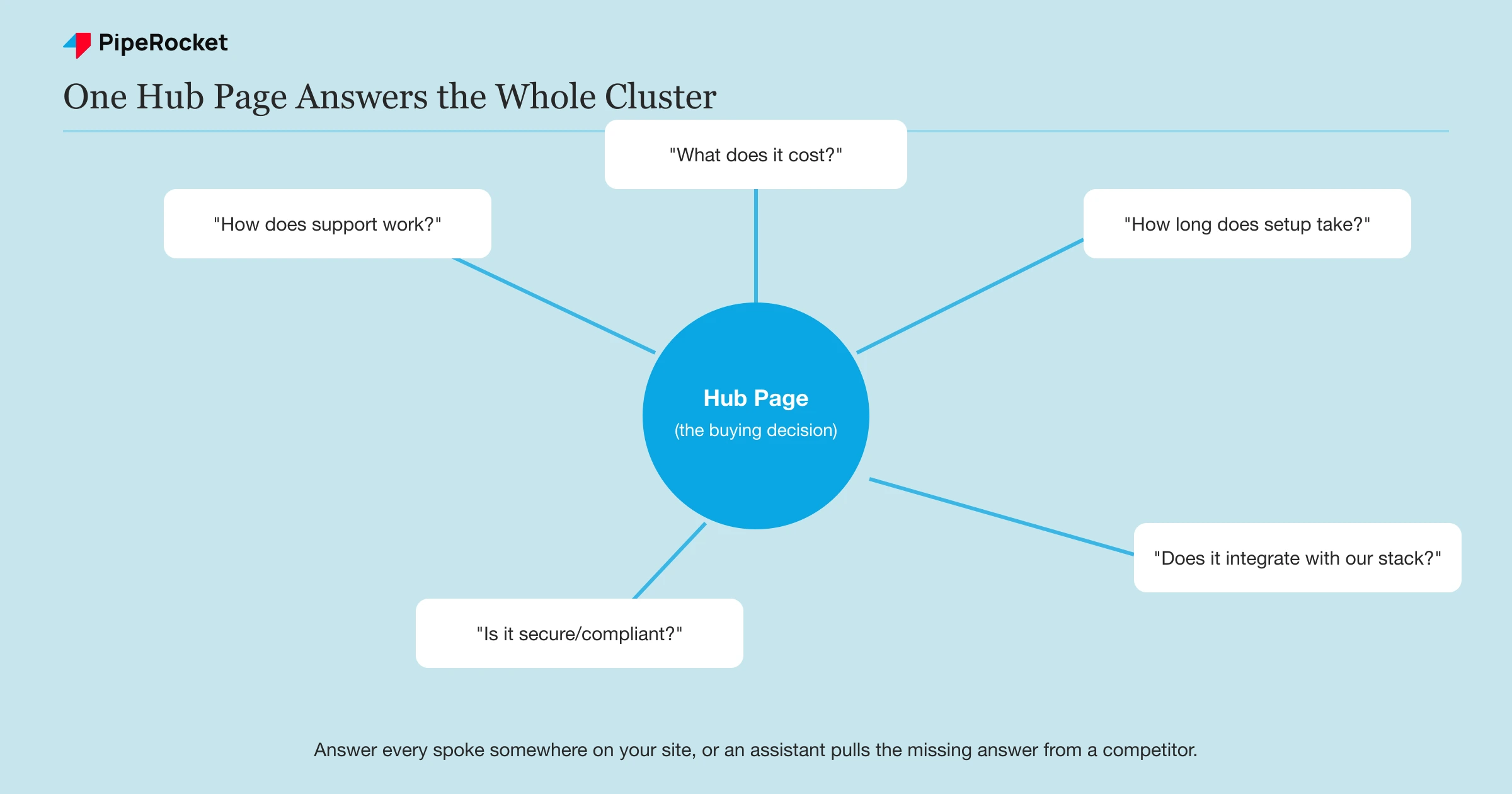
A single page rarely wins visibility for a whole topic anymore. Buyers ask a cluster of related questions across one research session, pricing, setup time, integrations, security, and if your site only answers one of those, an assistant will happily pull the pricing answer from you and the security answer from a competitor.
Map the five or six real questions a buyer works through for a given decision, then make sure your site answers every one of them somewhere, ideally cross-linked from one hub page. That coverage, not any single keyword’s ranking position, is what makes a domain a repeat source an assistant keeps returning to.
Common Mistakes to Avoid
Chasing smart speaker traffic that doesn’t exist for your product
Building an entire content plan around “voice search optimization” phrased as literal Alexa and Google Home targeting is the single biggest waste of effort here. If your ICP is a VP of Engineering or an RevOps lead, they aren’t asking a speaker to compare your product to a competitor. Redirect that energy toward conversational query structure instead.
Writing the answer after three sentences of setup
A page that opens a section with “when it comes to pricing, there are a lot of factors that go into the final number” before ever stating a number loses the citation to a competitor who just states the number first. Fix it two ways:
- Cut the setup sentence entirely.
- Lead with the number or the direct answer, then add the nuance after.
Treating FAQ schema as a substitute for actually answering the question
Adding FAQ structured data to a page whose actual prose answer is vague or hedged doesn’t help. The schema tells Google what the question is, but if the answer text underneath doesn’t actually resolve it in one clean sentence, there’s nothing worth extracting. Fix the answer first, schema second.
Ignoring how the same content performs across AI Overviews and chatbot citations
Some teams still only check Google Search Console rankings and call the job done. That misses whether ChatGPT or Perplexity are citing the page at all, which is a different, growing surface with its own visibility question worth checking separately.
How PipeRocket Digital Helps SaaS Teams Win This
We build B2B SaaS content around the real questions buyers ask across a sales cycle, not around vanity keyword volume, and structure every page so assistants can lift a clean answer. If you want a SaaS SEO agency to run this alongside your technical and content work, or want us to benchmark you against the best B2B SEO agencies already doing it, reach out to us . We’ll show you the gaps first.
Frequently Asked Questions
What is voice search SEO?
Voice search SEO refers to writing and structuring content so it matches how people phrase spoken, conversational questions, so it can be lifted directly as a full answer by an assistant. In practice for B2B SaaS, it means optimizing for natural-language, question-shaped queries rather than short keyword fragments. Those queries show up spoken to a phone, typed into ChatGPT, or asked of an AI Overview.
Does voice search still matter in 2026?
Literal smart speaker voice search has been flat or declining for years, and it was never a meaningful channel for B2B software buyers in the first place. What matters now is the same conversational, natural-language optimization skill voice search always required, because AI Overviews and chat tools like ChatGPT and Perplexity reward that exact writing style when deciding what to cite.
How is voice search SEO different from regular SEO?
Regular keyword-fragment SEO optimizes for short phrases like “CRM pricing,” while voice search SEO optimizes for the full question behind that phrase, like “how much does CRM software cost for a 50-person sales team.” The core difference is writing complete, direct answers to natural questions instead of stuffing a page around a short keyword. That’s also exactly what wins featured snippets and AI Overview citations today.