What Is Pain Point SEO, and Does It Actually Work for SaaS?
 Ranjeeth Kumar
Last updated on
Ranjeeth Kumar
Last updated on
Pain point SEO is a content strategy that prioritizes high-intent, problem-solving keywords over high-volume search terms, starting with a customer’s actual frustration or blocker instead of a generic topic, to drive leads and sales rather than raw traffic.
TL;DR
- Pain point SEO starts from a customer’s specific problem, not a broad topic, then targets the exact long-tail language they use when they’re stuck.
- Traditional SEO chases high monthly search volume and low competition. Pain point SEO deliberately targets lower-volume, high-intent terms instead.
- The goal is fewer total visitors who convert at a meaningfully higher rate, not maximum traffic.
- Pain point keywords surface through support tickets, sales call transcripts, and community forums, not just a keyword research tool.
- This works best for MoFu and BoFu content, where the reader already knows they have a problem and is actively evaluating a fix.
How Pain Point SEO Works, Compared to Traditional SEO
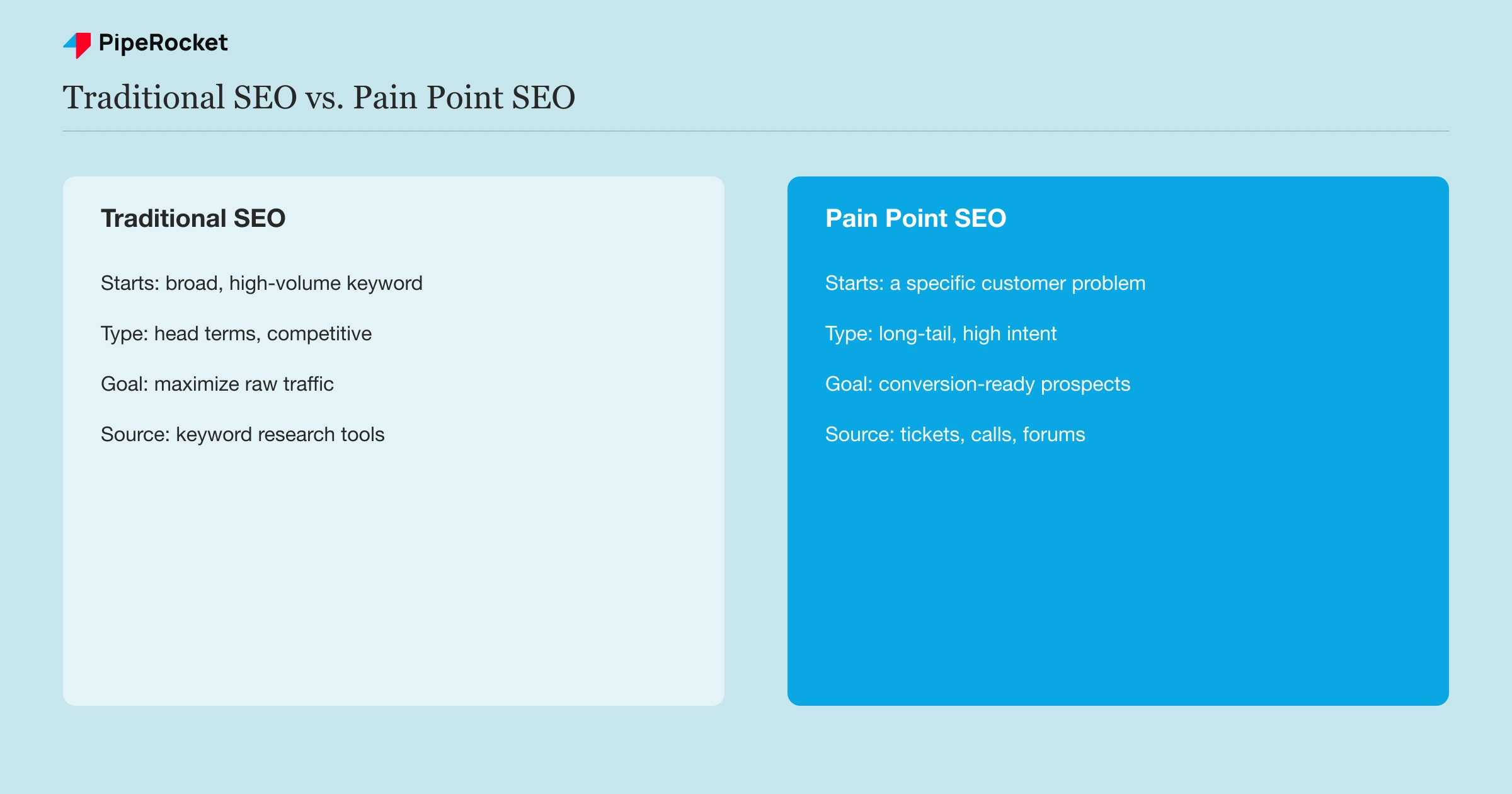
Traditional SEO and pain point SEO start from opposite ends of the same funnel. Traditional SEO usually starts by finding broad keywords with high monthly volume and workable competition, aiming to boost raw traffic. Pain point SEO starts with the customer’s actual problem and works backward to the specific language they use while stuck in it.
| Traditional SEO Approach | Pain Point SEO Approach | |
|---|---|---|
| Starting point | Broad keyword with high search volume | A specific, real customer problem |
| Keyword type | Head terms, competitive, high volume | Long-tail, lower volume, high intent |
| Primary goal | Maximize raw website traffic | Attract conversion-ready prospects |
| Research source | Keyword research tools | Support tickets, sales calls, forums |
The goal underneath both approaches is different too. Traditional SEO optimizes for reach. Pain point SEO optimizes for a smaller, far more qualified pool of visitors who are actively looking for a solution to the exact thing your product fixes.
Consider a project management SaaS company that noticed the same complaint recurring across support tickets: “why does my team keep missing handoffs between departments.” That specific phrase had almost no measurable search volume in a standard keyword tool.
The page built around it converted at a meaningfully higher rate than the company’s broader “project management software” content, illustrating the pattern.
Core Benefits of Pain Point SEO
- Higher conversion rates on lower traffic volume. A visitor who searched their exact frustration is further along in their buying journey than one who searched a generic category term, which shows up directly in conversion rate.
- Lower keyword competition. Because pain point phrases are specific and often don’t show up in standard keyword tools, fewer competitors are actively targeting them, which makes ranking meaningfully easier.
- Content that doubles as sales enablement. A page built around a specific customer pain point often answers the exact objection a sales rep hears on calls, giving the sales team a resource they can actually reuse, similar to how a strong meta description earns the click once the ranking already exists.
- Stronger alignment between marketing and support/sales teams. Sourcing pain points from tickets and call transcripts forces regular cross-team conversation that pure keyword-tool research skips entirely.
How to Find and Target Pain Point Keywords
How to Build a Pain Point SEO Content Plan, Step by Step
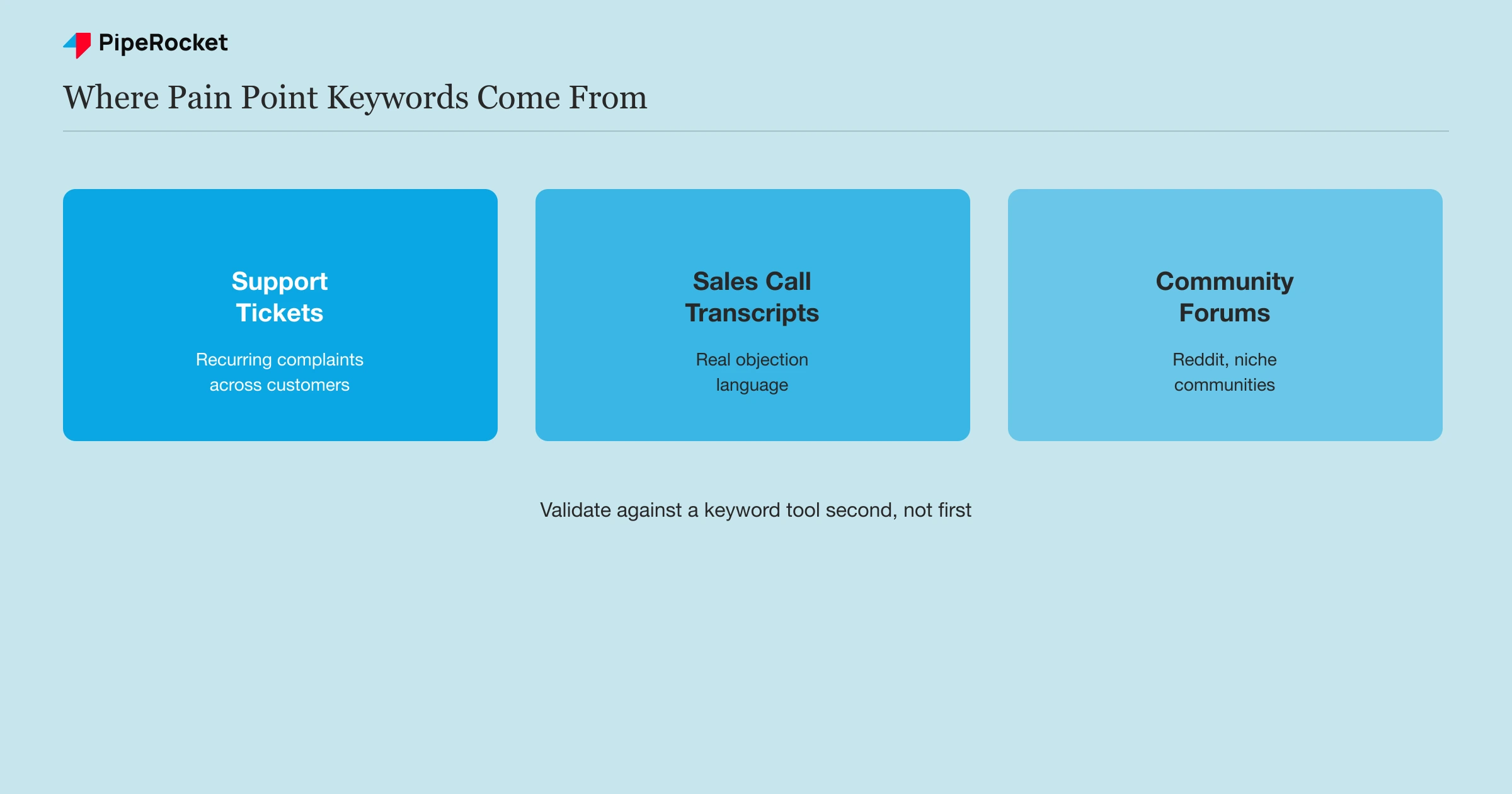
- Mine support tickets for recurring language. Search your helpdesk for phrases that show up repeatedly across different customers, since a complaint appearing dozens of times signals a genuine, widespread pain point worth a dedicated page.
- Review sales call transcripts and objection logs. The specific phrasing a prospect uses to describe why they haven’t solved a problem yet is often more precise and more searchable than anything a keyword tool surfaces.
- Search community forums and Reddit threads in your category. Users describing a frustration in their own words, rather than industry terminology, frequently reveals the exact phrase worth targeting, the same kind of raw language Reddit SEO work surfaces for content ideas.
- Validate with a keyword tool second, after the qualitative signal. Once you’ve identified the pain point language, check for any measurable search volume and related long-tail variants, but don’t let a zero-volume result stop you from writing the page if the qualitative signal is strong.
- Write the page around the solution, beyond just the sympathy. A pain point page needs to resolve the problem directly and specifically, going past a simple acknowledgment that the reader is frustrated, or it reads as filler rather than genuine help.
- Place the content at MoFu or BoFu, not ToFu. Pain point content works best for readers who already know they have a problem and are actively comparing solutions, which is a different intent than someone just learning a category exists.
Common Mistakes to Avoid
Chasing Pain Points With No Real Search Behavior Behind Them
Not every internal complaint translates into something people actually search for. Cross-checking a pain point against some measurable search interest, even a small amount, helps avoid building pages nobody finds.
Writing Sympathetically Without Actually Solving the Problem
A page that acknowledges a pain point but doesn’t clearly resolve it wastes the qualified attention it earned. The reader came looking for a fix, not validation.
Ignoring Support and Sales as Research Sources
Relying only on keyword research tools misses the richest source of genuine pain point language, since a tool can’t surface a phrase that has real customer frustration behind it but low measurable search volume.
Treating Pain Point SEO as a Replacement for Broader Keyword Strategy
Pain point content converts well but rarely drives significant volume on its own. It works best layered onto a broader SaaS SEO content plan that builds the traffic pain point pages alone can’t generate.
Pain Point SEO is a named methodology rather than a loose idea, and the agency that coined it appears in our SaaS SEO agency shortlist alongside teams that work the same way.
How PipeRocket Digital Uses Pain Point SEO
We mine support tickets and sales call transcripts for recurring customer language before building a content plan, treating pain point pages as a MoFu and BoFu conversion layer alongside broader keyword strategy. This is part of how we approach SaaS SEO content planning generally, and it connects directly to how we think about B2B SEO content for teams selling into a considered purchase.
Get in touch if your support tickets are surfacing the same complaint repeatedly and you’re not sure it’s being addressed in your content.
Frequently Asked Questions
What is pain point SEO?
Pain point SEO is a content strategy that prioritizes keywords built around a customer’s specific problem or frustration over broad, high-volume search terms, aiming to attract fewer but more conversion-ready visitors. It sources keyword ideas from support tickets, sales calls, and community forums rather than relying solely on keyword research tools.
Is pain point SEO the same thing as intent-based SEO?
They overlap heavily but aren’t identical. Intent-based SEO is a broader concept covering any keyword targeting aligned to a searcher’s underlying goal, informational, navigational, commercial, or transactional. Pain point SEO is a more specific application of that idea, focused narrowly on problem-and-frustration language sourced from real customer conversations rather than general intent categories.
How do I know if a pain point is worth targeting with a dedicated page?
Look for the phrase or complaint recurring across multiple independent sources: several support tickets, more than one sales call, a recurring forum thread, rather than a single isolated mention.
A pain point that shows up repeatedly across different customers signals a genuine, widespread problem worth the dedicated content investment, even if a keyword tool shows minimal measurable search volume for the exact phrase.