B2B SEO is the practice of ranking a business’s website for the terms its buyers and researchers search, with the goal of generating qualified leads rather than raw traffic. It differs from consumer SEO because B2B buying involves multiple stakeholders, longer research cycles, and lower search volume per keyword.
TL;DR
- B2B SEO targets the people who research and approve a purchase, not a single impulse buyer, which changes what “ranking well” even means.
- The core difference from B2C SEO comes down to audience size, funnel length, content type, and how a conversion gets defined.
- Search volume in B2B is naturally low because the buying group is small, so chasing volume alone leads to the wrong keywords.
- Content has to serve multiple roles at once: the researcher, the champion pitching internally, and the final approver signing off.
- A conversion in B2B SEO is a qualified lead or a booked call, not a purchase, so tracking has to go past the click.
- A real B2B SEO program also needs technical fundamentals, backlink-driven authority, and now visibility inside AI answer tools, not just good content.
- Building an actual B2B SEO program (keyword mapping, content cadence, link strategy) is its own deeper topic worth a dedicated breakdown.
Why B2B SEO Isn’t Just Smaller-Scale SEO
Most teams treat B2B SEO like B2C SEO with fewer keywords. That’s wrong because the entire mechanics of the search, not just the volume, are different.
In B2C, one person searches, compares two or three options, and buys within days or even minutes. In B2B, the person who searches “project management software for agencies” is rarely the person who signs the contract.
Did You Know: A 6sense study found the average B2B buying committee includes around 10 people, each weighing in from a different angle: budget, security, integration, day-to-day usability.
That means a page ranking #1 for a B2B keyword isn’t done once it ranks. It has to hold up when a security reviewer skims it, when a manager forwards it to their boss, and when a champion pastes a link into a Slack thread to make their case. B2C SEO never has to survive that many readers with that many different jobs.
The Buying Group Isn’t One Person
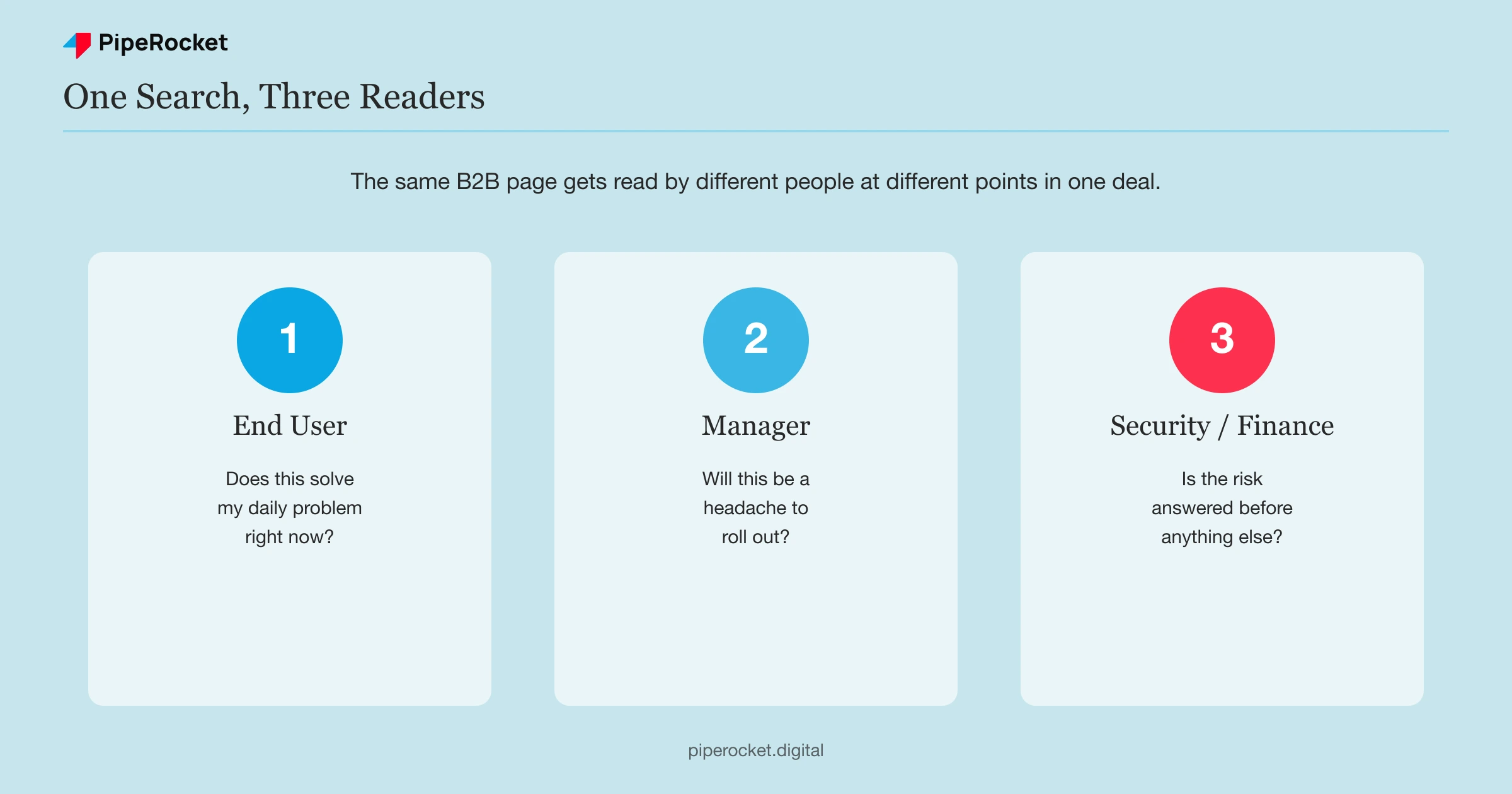
A B2B page gets read by several stakeholders in the same deal, each with a different question, so design each page assuming three different readers will land on it at different points.
- The end user wants to know if the tool solves their daily problem.
- The manager wants proof it won’t be a headache to roll out.
- The finance or security reviewer wants risk answered before anything else.
Write for one of them and the page passes the first read and fails the second. That’s why a strong B2B page mixes a plain-language explanation near the top with detail (security certifications, integration lists, implementation timelines) further down, so each reader finds their answer without wading through someone else’s.
Search Behavior Changes Across the Funnel
The same B2B buyer searches differently at each funnel stage, so one keyword rarely covers a full deal. Early on they type broad, exploratory terms like “how to reduce customer churn.” Closer to a decision, the same person searches “[competitor] vs [your product] pricing” instead.
Those two searches need entirely different pages: one anchors a wide, patient answer, the other rewards specificity, direct comparison, and proof the reader can act on the same day.
How B2B SEO Differs From B2C SEO, Concretely
The gap between B2B and B2C SEO isn’t a matter of degree. It shows up in four places that change how every page gets built.
| Dimension | B2C SEO | B2B SEO |
|---|---|---|
| Audience | One buyer, often deciding alone | A buying group of several stakeholders per deal |
| Funnel length | Hours to days | Weeks to several months |
| Content types that convert | Product pages, reviews, deal-driven landing pages | Guides, comparison pages , case studies, ROI calculators |
| What counts as a conversion | A completed purchase | A qualified lead, demo request, or booked call |
Audience Size Changes What a Keyword Is Worth
A B2B keyword is worth more than a B2C keyword with the same volume, because each search can represent a whole company evaluating a purchase. A B2C keyword with 500 searches a month can carry 500 near-identical intents. A B2B keyword with 50 searches a month might represent 50 different companies, each running its own multi-person evaluation behind that single search.
This is the part most SEO tools get wrong by default: they rank keywords by volume, and volume alone will steer a B2B team toward broad, low-intent terms that never convert. A term like “what is CRM software” pulls plenty of searches, but most of them are students and casual researchers, not buyers with budget.
Funnel Length Changes What “Working” Looks Like
A B2B deal closes over weeks or months of repeat visits, not one session, so a page has to work long after the first read. Two consequences follow:
- The page is a standalone artifact. It has to survive being read out of context, days later, by someone who wasn’t in the room for the first visit.
- Attribution gets harder. If the buyer’s first touch was a blog post in March and the demo request came in June, a last-click report credits the wrong page and makes the post that did the real work look worthless.
Content Types Skew Toward Proof, Not Persuasion
B2C content sells a feeling. B2B content has to survive a skeptical reader who’s going to be asked to justify the purchase to someone else. That shifts the content mix toward comparison pages, case studies with real numbers, and ROI breakdowns the champion can lift directly into an internal deck.
A compliance SaaS for fintech teams, for example, gets far more mileage out of a page comparing SOC 2 automation tools than from a generic “why compliance matters” post. The comparison page hands the champion the exact ammunition they need for their next internal meeting.
Conversion Definition Moves Upstream
In B2C, the conversion is the sale. In B2B, expecting a first-time visitor to book a $30,000 annual contract off one search result is unrealistic. The conversion has to move upstream to a qualified lead, not a purchase, whether that’s a demo booking or a whitepaper download that starts a nurture sequence.
That single shift changes almost everything downstream: what a landing page ’s call to action says, what “success” looks like in a monthly report, and which pages get budget to be built first.
Measurement now stretches past your own analytics too. Buyers increasingly research inside AI answer tools like ChatGPT, Perplexity, and Google’s AI Overviews , so tracking whether your pages get cited or mentioned in those answers is becoming a real B2B SEO metric alongside demos and pipeline.
Why B2B SEO Matters Even With Lower Search Volume
Low volume doesn’t mean low value. B2B keywords convert at a rate B2C keywords rarely touch, because the person searching has already self-selected into a real buying context rather than idle curiosity.
A visitor Googling “SOC 2 compliance software for fintech” has already decided their company needs the category. Compare that to someone searching “best productivity apps,” who might just be curious. The fintech searcher is worth disproportionately more even at a fraction of the traffic.
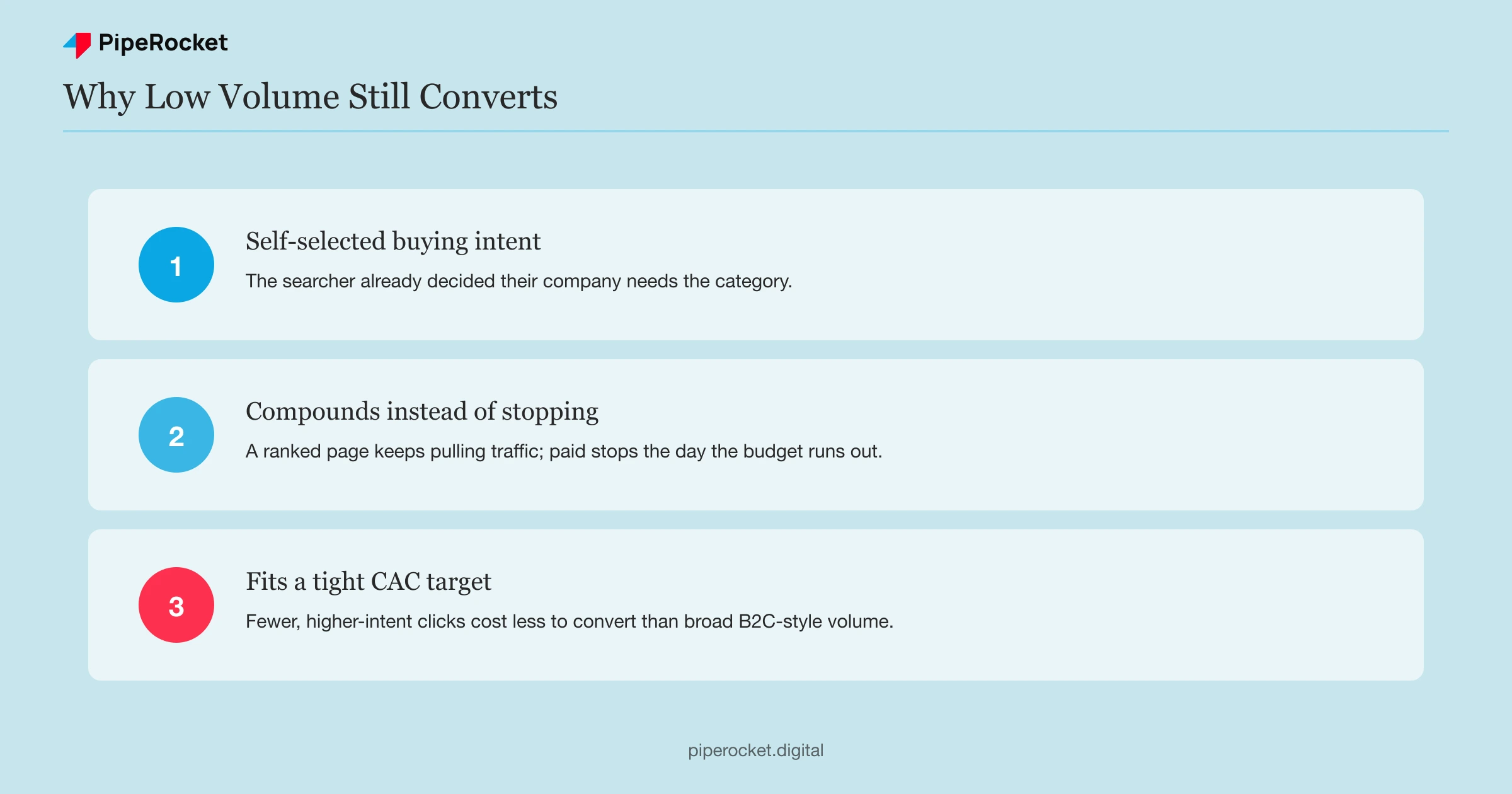
Ranking for B2B terms also compounds differently than paid channels. A comparison page built once keeps attracting the same high-intent searchers every month without new ad spend. A paid campaign stops the moment the budget runs out.
That’s the core reason B2B teams with tight CAC targets still lean on organic search even when it takes longer to show results.
Building the actual program, keyword-to-funnel mapping, a realistic content cadence, and a link-building approach that fits a niche audience, is a different exercise from understanding why B2B SEO works the way it does. For the step-by-step playbook, the deeper strategy breakdown covers how to build that out.
Core B2B SEO Strategies
A working B2B SEO program rests on four things: targeting buyer intent over raw volume, mapping content to the buying committee , getting the technical foundations right, and building authority through backlinks and distribution. Here is what each one means in practice.
| Strategy | What it means |
|---|---|
| Target intent over volume | Pick keywords by who is searching, not how many. A 40-search term used by buyers with budget beats a 4,000-search term used by students and browsers. |
| Map content to the buying committee | Build a content type for each stakeholder: comparison pages and ROI calculators for the champion, case studies for the manager, security and compliance docs for the reviewer. |
| Get the technical foundations right | Clean site structure, fast load times, and a working XML sitemap let search engines crawl and rank the niche pages that carry your intent. |
| Build authority through backlinks and distribution | Earn links from credible industry sources and push content through channels your buyers actually use, like LinkedIn, so pages have the authority to rank against bigger sites. |
This is the condensed version. Mapping every keyword to a funnel stage, setting a content cadence, and running an ongoing link program is a deeper build, and this broad B2B SEO overview stays intentionally wider than the SaaS-specific playbook. The full step-by-step strategy lives in the dedicated breakdown linked above.
Why/How PipeRocket Digital Handles B2B SEO
We build B2B SEO around the buying group, not the keyword list. That means mapping content to the researcher, the champion, and the approver separately, then measuring pipeline instead of pageviews.
If you’re evaluating agencies for this, our breakdown of the best B2B SEO agencies covers how different shops approach it, or you can see PipeRocket’s own B2B SEO service directly. Want to check your own setup first? Our interactive B2B SEO checklist walks through it.
Reach out through our contact page if you want a second read on your current setup.
Frequently Asked Questions
What is B2B SEO?
B2B SEO means optimizing a business’s website so it ranks for the terms its buying committees search, with the aim of driving qualified leads rather than raw traffic volume. It accounts for multiple decision-makers, longer evaluation windows, and content built to survive being shared internally before a deal closes.
How is B2B SEO different from B2C SEO?
The biggest differences are audience size, funnel length, content type, and conversion definition. B2C SEO serves one buyer moving fast toward a purchase, while B2B SEO serves a buying group moving slowly toward a qualified lead. The writing differs too: B2B content leans on proof (comparison pages, case studies, ROI numbers) a champion can reuse internally, rather than the emotional, urgency-driven copy that sells a B2C purchase.
Is SEO worth it for B2B?
Yes. B2B SEO compounds without ongoing ad spend and targets buyers who have already self-selected into a purchase decision, so it converts at rates paid channels rarely match, even at lower search volume.
How long does B2B SEO take to show results?
Most B2B SEO programs need six to twelve months before organic search becomes a reliable lead source, because ranking takes time and the buying cycle itself adds weeks or months after that. Teams expecting B2C-speed results usually pull budget before the compounding effect kicks in.