B2B SEO Strategy: The Framework for Companies Selling to Companies
 Ranjeeth Kumar
Last updated on
Ranjeeth Kumar
Last updated on
B2B SEO strategy means ranking content that a buying committee, not a single consumer, needs to evaluate a purchase. It leans on comparison and technical content, aligns with sales and ABM targets, and treats a single conversion as one step in a multi-person decision.
TL;DR
- A B2B SEO strategy is built for a buying committee, not one shopper, so it prioritizes comparison and evaluation content over consumer-style persuasion.
- The buying committee is the structural difference from B2C, and content has to answer the champion’s, the finance lead’s, and the technical evaluator’s questions separately.
- Keyword targeting works best when it’s mapped to which stakeholder in the deal is searching, not just the topic they’re searching about.
- Technical and comparison content earns trust with a skeptical evaluator in a way that consumer-style blog posts don’t.
- LinkedIn activity and community mentions now feed how B2B buyers vet a vendor before they ever visit your site, so they belong in the strategy, not just in social’s lane.
- ABM and SEO work best paired: SEO builds the content ABM campaigns need to point named accounts at.
- Measuring a B2B SEO program means tracking influenced pipeline across a long cycle, not sessions or single-touch conversions.
Why Most B2B SEO Advice Is Just B2C SEO With a Different Logo
Most B2B SEO guidance gets copied straight from B2C playbooks with the word “consumer” swapped for “business.” That doesn’t work, because the actual buyer isn’t one person making an impulse decision. It’s a group of people with different jobs, different fears, and different questions, all of whom have to agree before a deal closes.
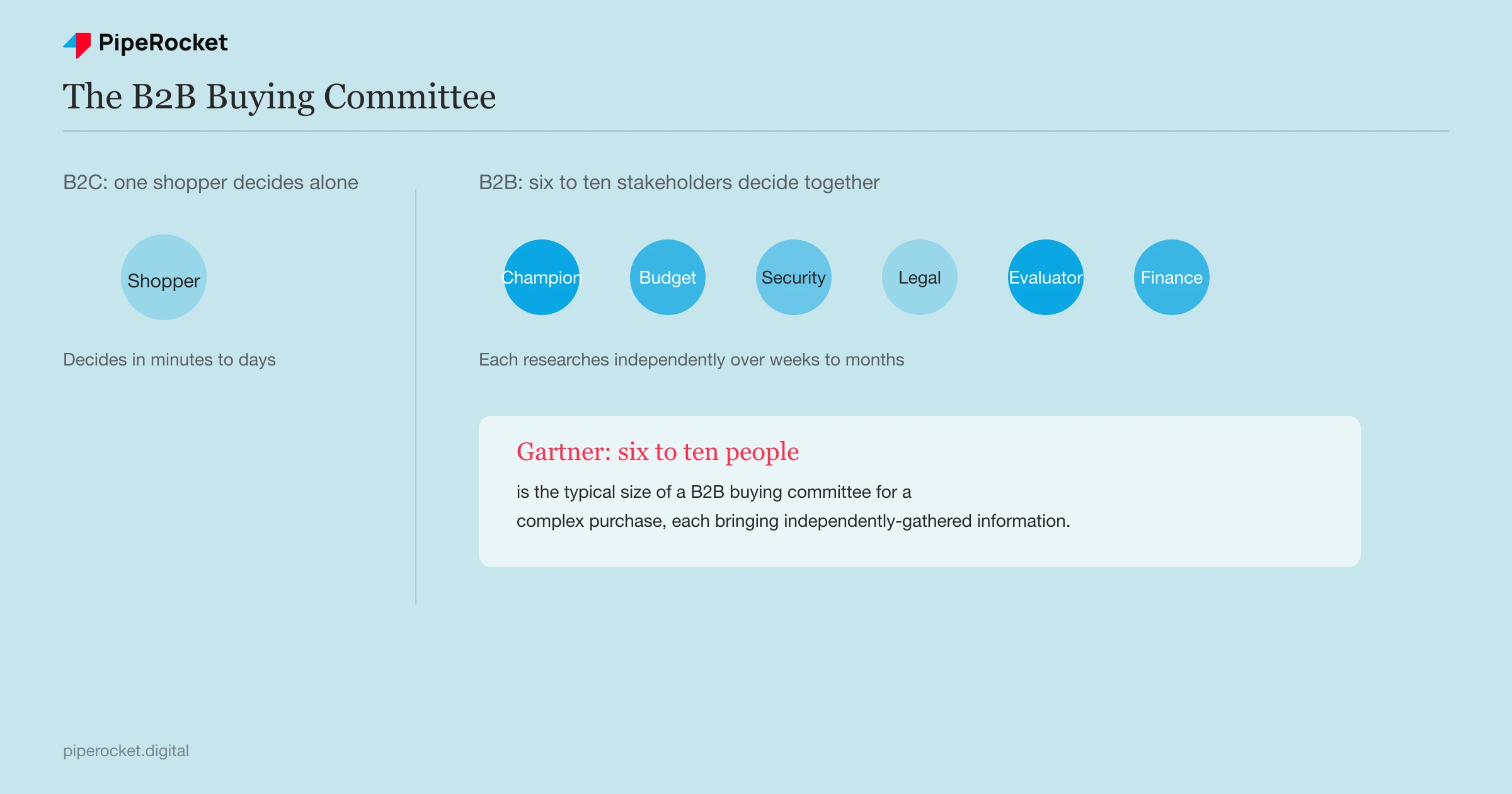
A B2C shopper reads a review, compares two prices, and buys a jacket in one sitting. A B2B buyer for a $40,000-a-year platform pulls in a champion, a budget owner, a security reviewer, and sometimes legal. Gartner’s long-running B2B buying research puts the typical committee at six to ten people, each carrying independently-gathered information into the decision.
| B2C buyer | B2B buying committee | |
|---|---|---|
| Who decides | One shopper | Six to ten stakeholders |
| Research window | Minutes to days | Weeks to months |
| What convinces them | A review, a price, a photo | Documentation, comparisons, peer references |
| What the page must survive | One read | Being screenshotted and forwarded internally |
That single fact changes what “good” content looks like. A B2C landing page needs one persuasive push. A B2B page needs to survive being screenshotted into a Slack channel and forwarded to someone who never saw your ad.
Here’s what most SEO plans miss: ranking for a keyword doesn’t matter if the page can’t do that internal-forwarding job. If a security lead can’t find your compliance page in ten seconds, or a finance lead can’t find a pricing breakdown that doesn’t require a call, the committee moves on to a competitor whose site made their job easier.
The Buying Committee Reads Different Pages, Not the Same Page Twice
Treating every visitor to your site as the same buyer is the single biggest structural mistake in B2B SEO . A champion searching “best [category] software” and a security reviewer searching “[category] SOC 2 compliance” are answering two different questions in the same deal.
Build pages for each distinct role in the committee, not one generic page trying to satisfy all of them. A champion’s page sells the outcome. A technical evaluator’s page proves the integration works. A finance page shows total cost of ownership without a “contact sales” wall in the way.
B2B Buyers Research Anonymously for Longer Before They Convert
B2B buyers do most of their research before a vendor even knows they exist. Forrester and 6sense research on buyer behavior consistently shows that a large majority of the buying journey happens before a first sales conversation, across search, peer reviews, and community discussion.
That means your SEO content is doing sales work with nobody watching. A comparison page, a technical FAQ, or a pricing breakdown page might be read five times by five different people inside one account, weeks before anyone ever books a demo.
Build Content Around the Deal, Not Just the Keyword
Standard keyword research treats every keyword the same: pull volume, pick the highest number, write the page. That approach misses the fact that in B2B, the keyword tells you who in the committee is searching, and that should decide what the page argues.
One industry framework, the “2025 SEO Success Matrix,” scores a program across six dimensions: AI readiness, brand signals, topical authority , intent mapping, technical SEO , and backlink authority. The takeaway holds for B2B strategy generally: teams that win are strong across all six, not maxed out on one. A B2B program that’s all content and no technical foundation, or all backlinks and no intent mapping, stalls the same way a B2C program does, just more slowly and more expensively because the sales cycle hides the problem for months.
Map your keyword list to committee roles before you write anything:
- Champion-stage keywords: “best [category] for [use case]”, “[category] examples”
- Evaluator-stage keywords: “[category] vs [competitor]”, “[category] integrations”
- Finance-stage keywords: “[category] pricing”, “[category] cost calculator”
- Security/legal-stage keywords: “[category] SOC 2”, “[category] data residency”
Each row needs its own page, not a shared FAQ section bolted onto a generic feature page.
Comparison and Alternative Pages Do More Work in B2B Than Almost Any Other Format
A comparison page converts better than most other content types in B2B because it meets the buyer at the exact moment they’re deciding between two named options, not learning that a category exists. That’s a decision-stage question, and decision-stage questions convert.
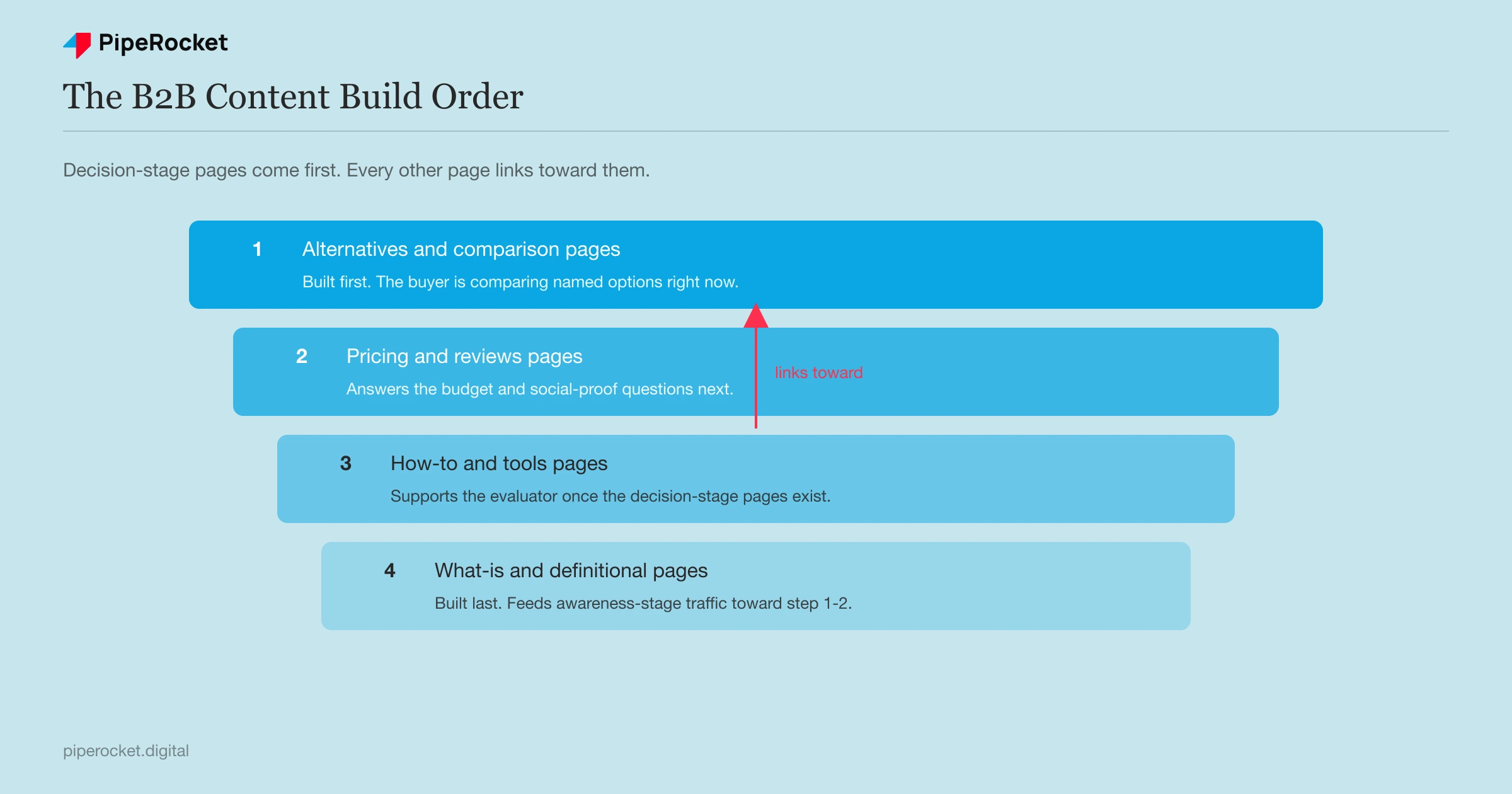
The build order that works runs decision-stage pages first:
- Alternatives and comparison pages
- Pricing and reviews pages
- How-to and tools pages
- What-is and definitional pages
Every page outside step 1 links toward the decision-stage pages, not away from them. That’s the opposite order of how most teams build content, which is usually top-of-funnel first because it feels safer to write.
Technical Content Substitutes for the Trust a Consumer Gets From a Star Rating
A consumer decides based on a star rating and a photo. A B2B evaluator decides based on whether your documentation proves the integration will actually work in their stack. That’s why a technical evaluator’s checklist, an API reference page, or a real architecture diagram earns more trust in B2B than a glossy case study ever will.
Write for the person who has to defend the purchase to their own boss. If your content can’t survive that internal defense, it doesn’t matter how well it ranks.
LinkedIn and Community Signals Now Shape B2B Buying Decisions Before Search Does
A B2B buyer increasingly checks what your company says on LinkedIn, and what other people say about you in a community like a Slack group or a subreddit, before they ever run a Google search for your product. That behavior barely exists in consumer buying, where reviews on the retailer’s own site are usually enough.
This isn’t a call to abandon SEO for social. It’s a call to treat LinkedIn presence, founder visibility, and community reputation as inputs your SEO strategy has to account for, because AI Overviews and answer engines increasingly pull from the same signals a human buyer checks manually: third-party mentions, community sentiment, and named authorship.
| Signal | What it does for B2B trust | Where it shows up |
|---|---|---|
| LinkedIn thought leadership | Puts a named, credible person behind claims your site makes | LinkedIn posts, comments on prospects’ posts |
| Community mentions | Provides unpaid, third-party validation a buyer trusts more than your own copy | Reddit, Slack communities, G2/Capterra threads |
| Named case studies | Proves the outcome happened to a real, checkable company | Case study pages, client-logo sections |
| Author bios with real credentials | Signals the content was written by someone qualified, not outsourced filler | Blog bylines, About page |
If your strategy budget has room for one non-search line item, put it here. A single credible LinkedIn post from a founder or SME often earns more qualified attention from a B2B buying committee than another blog post targeting the same keyword you already rank for.
Align SEO With ABM, Don’t Run Them as Separate Programs
SEO and account-based marketing solve the same problem from opposite directions, and running them apart wastes both budgets. ABM tells you exactly which accounts and roles you’re targeting. SEO builds the content those specific roles need when they search.
If your ABM list has 200 named accounts in fintech, build your comparison pages, case studies, and industry-specific landing pages for that vertical first, ahead of a generic version of the same page.
For teams whose ABM motion is exclusively SaaS-focused, our SaaS SEO strategy framework walks through the full eight-step build sequence for that specific buyer, from pipeline-tied goals through link acquisition. This piece stays at the broader B2B level since not every reader selling to businesses is selling software.
Feed your SEO content calendar from the ABM target list, not the other way around. If a named account in your ABM system is in healthcare, prioritize the healthcare-specific version of your comparison page over a generic one, because that’s the page the actual searcher inside that account will land on.
Sales Should Be Using Your SEO Pages as Sales Collateral
If your sales team isn’t linking prospects to your comparison and pricing pages during live deals, the content isn’t doing its job. B2B SEO content that only exists to rank, and never gets used in an actual sales conversation, is half-finished work.
Check with sales monthly on which pages they’re actually sending. If they’re building their own one-off PDFs instead of linking to your site, that’s a signal your pages aren’t answering the objections they’re hearing live, and it’s worth fixing before writing more content.
Common Mistakes B2B Teams Make With SEO Strategy
Treating a High-Volume Keyword as a High-Value Keyword
A generic keyword with 10,000 searches a month and a buyer-specific keyword with 200 searches a month aren’t comparable in B2B, because the volume figure doesn’t tell you whether the searcher can sign a contract. Chasing the bigger number wastes budget on traffic that never enters a deal.
Writing One Page for the Whole Buying Committee
A single feature page can’t argue the outcome to a champion, prove the integration to an evaluator, and show the total cost to finance all at once. Trying to do all three in one page usually means it does none of them well, and the committee bounces to whichever competitor split the job into separate pages.
Ignoring the Sales Cycle When Setting SEO Timelines
A three-month SEO timeline built for a B2C-length sales cycle collapses against a nine-month enterprise buying cycle. Rankings can climb while pipeline still looks flat for months, and a team that panics and pulls the plug at month four kills a program that was on schedule for its actual cycle length.
Measuring Traffic Instead of Deal Influence
Session counts don’t tell you whether the buying committee that closed last quarter’s biggest deal ever touched your content. Tag and track which pages influenced closed-won deals in the CRM, even when the visit happened weeks before the first sales call, or the SEO program will look worse than it actually is.
How to Know a B2B SEO Strategy Is Working
Rankings and traffic are leading indicators in B2B, not proof of anything. The real test is whether organic content is showing up inside actual deals.
- Are named accounts on your ABM list visiting comparison or pricing pages before a sales call happens
- Is sales referencing specific pages in live deal conversations
- Are multiple people from the same company account visiting different role-specific pages
- Is the sales cycle for organically-sourced deals shorter than it is for cold outbound, because the buyer arrived pre-educated
Pull these from a combination of GA4 multi-touch reporting, CRM attribution, and a straight conversation with sales once a month. None of it shows up cleanly in a rank tracker .
How PipeRocket Helps B2B Teams Build SEO That Reaches the Whole Committee
We build B2B SEO programs around the buying committee, not a single persona, mapping comparison, technical, and finance-stage content to the roles actually involved in the deal. If you want a second read on your current program, our team runs full audits through contact us and is ranked among the best B2B SEO agencies doing this work. To check your own setup against this framework first, run through our interactive B2B SEO checklist .
Frequently Asked Questions
What is a B2B SEO strategy?
A B2B SEO strategy is a plan for ranking and structuring content so it reaches every role in a business buying committee, not just one searcher, and moves that group toward a purchase decision. It typically combines keyword targeting mapped to buyer roles, comparison and technical content, and alignment with sales and ABM targets. Unlike consumer SEO, it has to account for a longer research window and multiple stakeholders reviewing the same content independently.
How is B2B SEO different from B2C SEO?
B2B SEO serves a buying committee across a research window that often runs months, while B2C SEO usually serves one shopper making a faster decision. B2B content leans harder on comparison pages, technical documentation, and case studies because the buyer needs to defend the purchase internally, not just feel persuaded personally. B2B strategy also has to coordinate with sales and ABM targeting in a way B2C rarely requires.
How long does a B2B SEO strategy take to show results?
Most B2B SEO programs take six to twelve months to show measurable pipeline impact, longer than typical B2C timelines, because the sales cycle itself is longer and rankings often climb before a buying committee finishes its research. Technical fixes and quick-win pages can show ranking movement in weeks, but the deals those pages influence may not close for several more months. Judging the program by month-three traffic alone usually leads to killing a strategy that was working on schedule.