Healthtech SEO: The Complete Guide for 2026
 Omar Sheriff
Published on · Last updated on
Omar Sheriff
Published on · Last updated on
Healthtech SEO is search optimization for health technology companies, run under Google’s strictest quality bar and HIPAA’s limits on what you can claim or collect about patients. It shares SaaS SEO’s mechanics, plus a compliance layer that decides what’s publishable at all.
TL;DR
- Healthtech SEO sits at the intersection of Google’s YMYL quality bar and HIPAA’s limits on patient data, which shapes what you can write and how you can prove it.
- Health content gets the harshest E-E-A-T scrutiny in search, so unreviewed, unattributed pages get capped no matter how well they’re optimized.
- HIPAA doesn’t regulate your keywords, but it regulates your case studies, testimonials, forms, and tracking pixels, and getting that wrong is a legal problem, not just an SEO one.
- Medical or clinical review bylines function as both a compliance safeguard and a ranking signal, and most healthtech marketing teams skip them.
- Healthtech buying groups include clinicians, IT, compliance, and procurement, and one generic page can’t answer all four of their questions.
- Case studies still work in healthtech if outcomes are anonymized and framed by category, not by identifiable patient detail.
What Is Healthtech SEO?
Healthtech SEO is the discipline of growing a health technology company’s organic and AI search visibility while operating inside two constraints most SEO programs never face together: Google’s YMYL quality standard and HIPAA’s data-handling rules. It covers the same technical, content, and authority work as SaaS SEO , but every piece of it has to clear a compliance review before it clears a rankings check.
What makes it distinct is where the friction actually lives. In most B2B SaaS categories, a mediocre page just underperforms. In healthtech, a page that overstates a clinical outcome, names a patient without authorization, or drops a tracking pixel that captures protected health information can create legal exposure that has nothing to do with search rank.
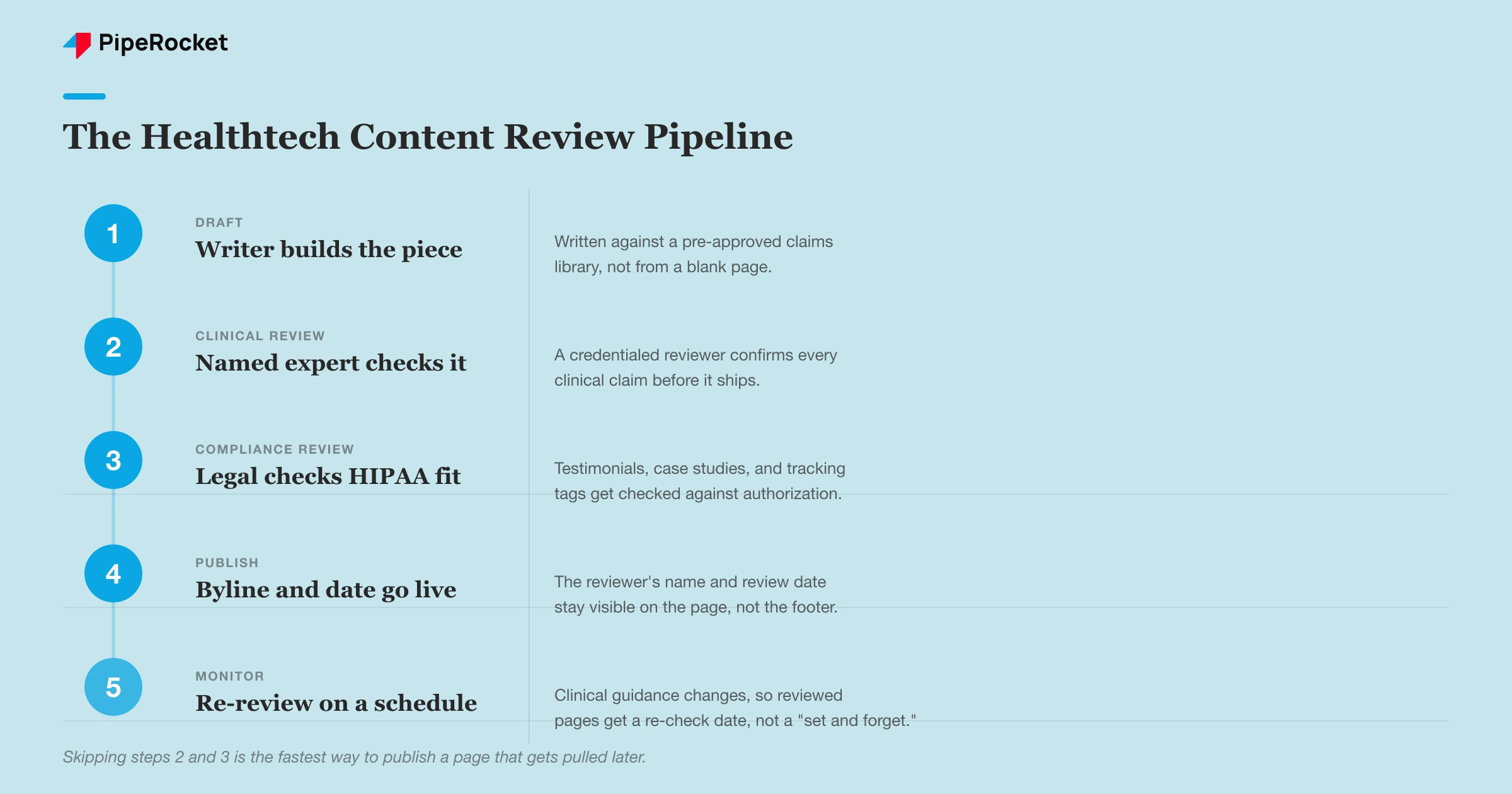
That changes the job. A healthtech marketing team isn’t just optimizing pages, it’s building a review pipeline where legal, clinical, and SEO sign off on the same content before it ships. Skip that step and you either publish something compliance pulls down later, or you play it so safe the content says nothing useful at all.
Why Healthtech SEO Needs Its Own Playbook
Healthtech SEO isn’t just SaaS SEO with a stricter tone. It’s shaped by three forces that don’t show up together in almost any other B2B category: a regulator-grade content bar from Google, a legal framework that limits what you can say and collect, and a buying committee split across four different professional worlds.
Most teams treat it as a writing-style problem: use fewer superlatives, add a disclaimer, move on. That undersells the actual mechanics, and it’s why so many healthtech content programs stall at generic, unreviewed content that neither ranks nor converts.
Google treats health content as the highest-risk YMYL category
Health falls squarely under what Google calls Your Money or Your Life: content that can meaningfully affect someone’s health, financial stability, or safety if it’s wrong. Google’s quality-rater guidelines are explicit that YMYL pages get judged more harshly on expertise, authority, and trust than ordinary content, and health sits at the top of that list alongside finance.
In practice, that means the same page performs worse in healthtech than it would in a low-stakes niche if it can’t back itself up. An unattributed article on “signs of early sepsis” or “how remote patient monitoring reduces readmissions” reads as a liability to a quality rater, not just thin content. Google wants to see that expertise, or at minimum a credible review process, sits behind the words.
This is a limits framework, not legal advice: we’re not lawyers, and if you’re evaluating your own YMYL or compliance exposure you need your legal and compliance team, not a marketing blog post.
HIPAA decides what you’re allowed to publish and collect
HIPAA doesn’t touch your keyword strategy directly. What it touches is the raw material your content and forms are built from: patient stories, testimonials, contact-form data, and the tracking pixels sitting on your site.
The rule that trips up the most marketing teams is testimonials. If a patient posts a review, comment, or story about their care, that does not waive their privacy rights or count as marketing authorization. Publishing it, or asking a covered entity’s marketing team to use it, still requires a specific, signed HIPAA authorization naming that exact use.
Tracking technology carries the same trap. Analytics scripts, ad pixels, and session-replay tools embedded on a page that touches patient data can transmit protected health information to a third-party vendor without anyone intending it to. Regulators have been explicit that a cookie banner or a general privacy notice does not substitute for HIPAA authorization, so a marketing team that assumes standard consent-management tooling covers it is often wrong.
Your buyer isn’t one person, it’s four
A healthtech deal usually clears four separate desks before it closes.
- A clinician who cares whether it changes patient outcomes
- An IT lead who cares whether it integrates and stays secure
- A compliance officer who cares whether it creates regulatory exposure
- A procurement lead who cares about total cost and vendor risk
Each of them searches differently, and each needs a different kind of proof on the page. A clinician wants evidence tied to outcomes and workflow, an IT lead wants architecture and security documentation, and a compliance officer wants to see how your platform itself handles PHI. One generic “why choose us” page can’t answer all four, which is why healthtech content programs that write for “the buyer” as a single persona keep producing pages nobody in the committee finds convincing.
The Healthtech SEO Playbook
A healthtech program that actually works rests on four things happening together: technical and trust foundations, visible medical or clinical review, HIPAA-aware content and data practices, and content built for each stakeholder in the buying group. Skip one and the others don’t hold.
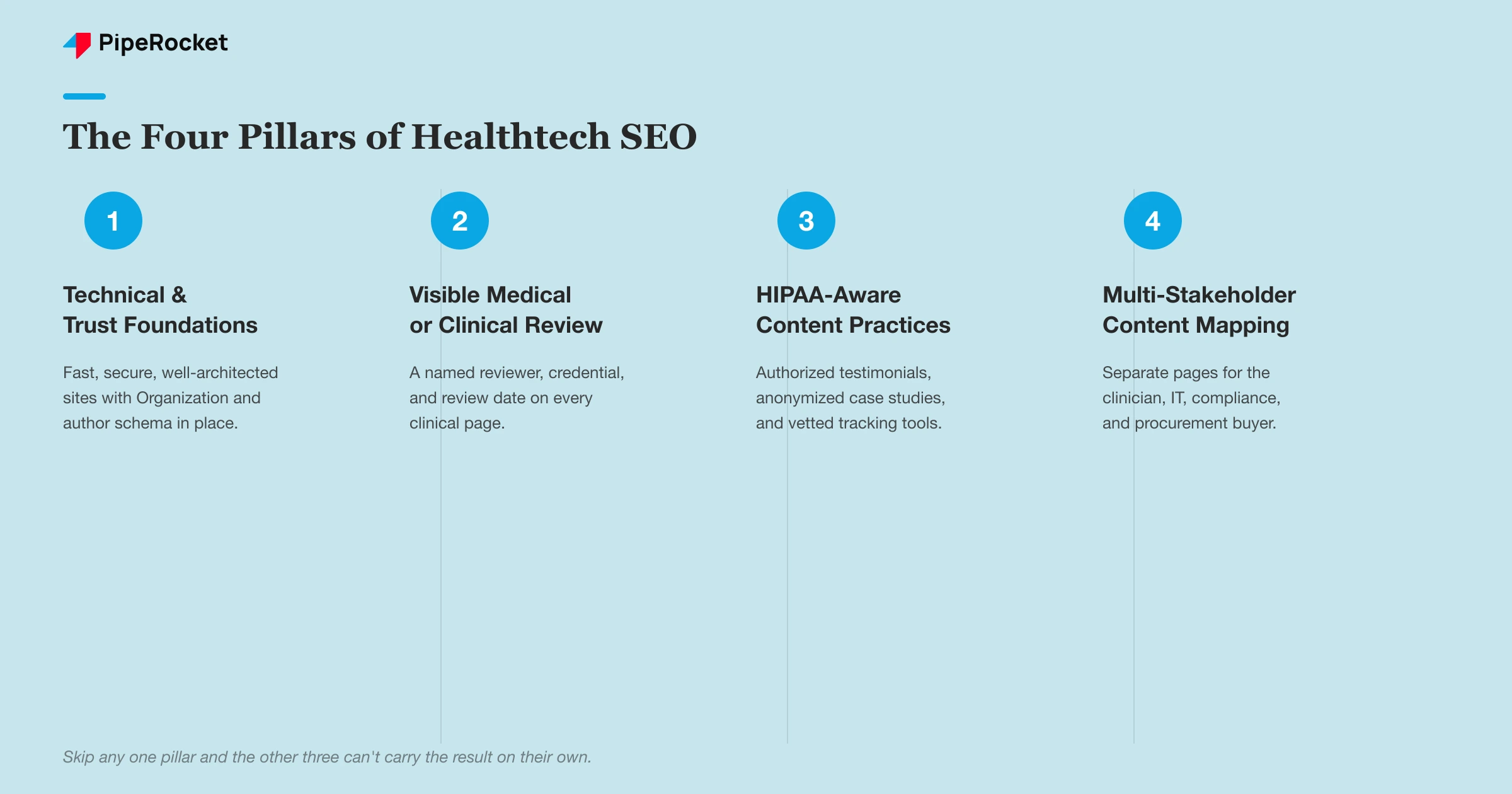
Build the technical and trust foundations Google expects from YMYL content
Technical SEO in healthtech does double duty, it’s also a trust signal that both search engines and a wary buyer read the same way. A slow, unclear site quietly confirms the doubt a health buyer already carries. Get the fundamentals in place first.
- Clean site architecture that puts clinical and compliance pages within a few clicks of the homepage
- Fast, stable performance across mobile, since research often happens between patient appointments
- Full HTTPS with no mixed-content warnings anywhere on the domain
- Organization schema naming your legal entity, with
sameAslinks to verified profiles
Author markup matters more here than in most B2B categories. Attaching content to a named, credentialed person gives Google an entity to attach expertise to and gives a clinician a reason to trust the page at all, far more than a generic “Editorial Team” byline ever will.
Make medical or clinical review visible on the page
A review process only helps if a reader and a quality rater can both see it on the page. The strongest version names the reviewer, their credentials, and the review date directly beneath the byline, in plain view, instead of leaving it buried in a footer disclaimer.
This is the single most underused lever in healthtech content. Most teams either skip clinical review entirely to move faster, or they do it internally and never surface it, which means the content gets none of the trust benefit it earned. A visible “Medically reviewed by Dr. [Name], [credential], on [date]” line costs almost nothing to add and does real work on both fronts.
It also changes what you can safely publish. Content reviewed by someone with real clinical or regulatory standing can make more specific, useful claims than an unreviewed piece can, because there’s an accountable expert standing behind the specifics.
Treat HIPAA-aware practices as a content design input
The teams that handle this well decide upfront what a piece of content is and isn’t allowed to include, before a writer starts. That means building a short internal reference: what counts as PHI, what testimonial and case-study formats are pre-approved, and which tracking tools are cleared for pages that might touch patient data.
Three practices come up constantly in healthtech content review.
- Testimonials and patient stories require specific written authorization. A patient posting a public review hasn’t consented to marketing use. If you don’t have that signed authorization for a specific use, the story doesn’t run, however good it is.
- Case studies get anonymized by default. Describe outcomes by category, condition type, and organization size, and keep identifiable patient or clinical-site detail out of the piece entirely.
- Tracking and analytics tools get vetted before they go on any page that could touch PHI. A pixel that’s fine on your pricing page can be a problem on a patient-portal login page.
Warning: none of this is legal advice, and the specifics differ by whether you’re a covered entity, a business associate, or neither. Confirm your actual obligations with counsel before you publish, this is meant as a starting checklist, not a compliance sign-off.
Write separately for each stakeholder actually searching
The fix for the multi-stakeholder problem isn’t one page that tries to satisfy everyone. It’s separate content mapped to each buyer’s real question, cross-linked so a reader can move to the proof that matters to the next person in the deal.
| Stakeholder | What they’re searching for | What convinces them |
|---|---|---|
| Clinician | Does this change outcomes or workflow? | Outcome data, workflow fit, peer validation |
| IT / security | Does this integrate and stay secure? | Architecture docs, uptime, security certifications |
| Compliance | What’s our regulatory exposure? | How the platform handles PHI, audit trail, BAA terms |
| Procurement | What’s the real cost and vendor risk? | Pricing structure, implementation timeline, vendor stability |
A remote patient monitoring platform selling into a hospital system, for instance, needs a clinical-outcomes page for the care team, a security architecture page for IT, and a implementation-and-pricing page for procurement. Trying to fold all three into one “platform overview” page is exactly what leaves every stakeholder underserved.
What a Compliant Healthtech Case Study Actually Looks Like
Case studies are where healthtech content most often goes wrong, either overclaiming to the point of legal risk, or getting so anonymized they say nothing. The middle path is specific about the category, vague about the identity.
Describe the organization by type and scale, not by name, unless you have a signed release: “a 200-bed regional hospital system” instead of naming the hospital. Describe outcomes in aggregate terms with a clear timeframe, not as a single patient’s story: “readmission rates for the monitored cohort dropped over a six-month period” reads very differently, and more defensibly, than a narrative about one named patient’s recovery.
A compliance-focused SaaS selling into telehealth, for example, might publish a case study framed as “a multi-state telehealth provider reduced documentation time per visit,” with the specific percentage sourced and dated, but without naming the provider or any clinician involved. That format gives a reader real proof without creating exposure for anyone in the story.
Keep the review trail visible too. If a case study cites a clinical outcome, note that it was reviewed by a named clinical or compliance reviewer before publication. That single line does the same double duty as the medical-review byline: it’s an E-E-A-T signal for Google and a due-diligence checkbox for the compliance officer reading it before a demo call.
How Healthtech Content Shows Up in AI Search
AI Overviews and chat-based answers are increasingly where a healthtech buyer’s research starts, and the same trust signals that satisfy a human reader are what get a page cited. A model answering “how does remote patient monitoring reduce hospital readmissions” pulls from sources that are clearly attributed, current, and specific, the same qualities Google’s quality raters are trained to reward.
That raises the stakes on medical review bylines and dated content in a way most healthtech teams haven’t caught up to. An AI system summarizing health information has less room for ambiguity than a search results page does, so unreviewed or unattributed content is more likely to get filtered out of the answer entirely, not just ranked lower.
It also means the anonymized, category-level case study format matters even more. A model synthesizing an answer from your content can only cite what’s specific and defensible, so a case study with a real timeframe and a real (if anonymized) outcome is far more useful AI-search material than a vague testimonial.
This isn’t theoretical. Our own Search Console data has shown a sudden traffic spike from AI engines landing directly on BoFu healthcare pages, referral-management, patient-engagement, and appointment-scheduling software, which confirms AI engines are already driving bottom-of-funnel discovery in this vertical, not just awareness-stage browsing. A healthtech team that treats AI visibility as a someday problem is underestimating how close to a buying decision that traffic already sits.
Common Mistakes to Avoid
Most healthtech SEO programs fail for one of a handful of predictable reasons, and each one traces back to treating healthtech like standard B2B SaaS content with a health-shaped keyword list.
Publishing clinical content with no visible review
An unreviewed page making a specific health claim reads as a liability to Google’s quality raters and to any clinician who lands on it. The fix isn’t to soften every claim into vagueness, it’s to get a credentialed reviewer’s name and date on the page before it ships.
Using patient testimonials without proper authorization
Assuming a public review or a patient’s own social post clears you to reuse it is one of the most common HIPAA missteps in healthtech marketing. A testimonial needs a specific, signed authorization for that exact use, not implied consent from the fact that the patient spoke publicly at all.
Letting tracking pixels sit on pages that touch patient data
A standard analytics or ad pixel dropped onto a patient-facing page without checking what data it transmits can create exposure nobody on the marketing team intended. Vet every tracking tool against what the page it sits on could actually collect, not just what your consent banner says.
Writing one page for a four-stakeholder buying group
A single “why choose us” page trying to answer a clinician, an IT lead, a compliance officer, and procurement at once ends up unconvincing to all four. Map content to the specific question each stakeholder is actually searching, and link between the pages so a reader can move between roles as the deal progresses.
Treating anonymization as optional in case studies
Naming a patient, or a clinical site specific enough to be identifiable, in a case study without a signed release is a legal risk dressed up as marketing proof. Describe the organization by category and the outcome in aggregate, sourced and dated terms instead.
How to Know a Healthtech SEO Program Is Working
The clearest signal isn’t raw traffic, it’s whether the right stakeholder is landing on the right page and moving forward from it. Track pipeline by which persona-mapped page a lead first touched, not just total organic sessions.
Watch for a few specific patterns:
- Clinician-facing pages should show engagement from hospital and health-system domains in your analytics, not just general traffic growth.
- IT and security pages should correlate with fewer security-related objections showing up later in the sales cycle.
- Anonymized case studies should get cited or linked by third parties, since that’s a sign the proof itself is credible enough to reference.
If organic traffic is climbing but the sales team still reports the same compliance and security objections every cycle, the content isn’t reaching or convincing the stakeholder who raises them. That’s a mapping problem, not a volume problem, and it means going back to the stakeholder table above before publishing more of the same page type.
Attribution in healthtech also runs on a longer clock than most B2B SaaS categories. A hospital system or health plan evaluating new technology often runs procurement cycles measured in quarters, with security review and legal sign-off happening well after the clinical champion first found your content. A program that only measures first-touch organic conversions will look like it’s underperforming when it’s actually feeding a slow, multi-stakeholder cycle that a 30-day attribution window can’t see.
Track influenced pipeline over a longer window instead. Weight the clinician and IT-facing pages by whether they show up anywhere in that longer path, not just whether they drove a form fill.
Why PipeRocket Digital Runs Healthtech SEO This Way
We build healthtech programs around the review and stakeholder-mapping work most agencies skip: a named, credentialed reviewer on every clinical page, HIPAA-aware handling for testimonials and tracking, and separate content for the clinician, IT, compliance, and procurement stakeholders in a deal.
If you want to see how this fits inside a broader program, our SaaS SEO guide covers the universal fundamentals this builds on, and our best healthtech marketing agencies roundup is a fair place to compare options. If you’d rather have us run it, see our healthtech marketing agency page or get in touch .
Frequently Asked Questions
What is healthtech SEO?
Healthtech SEO refers to growing a health technology company’s organic and AI search visibility inside two constraints most SEO programs don’t face together: Google’s strictest YMYL quality standard and HIPAA’s limits on patient data and claims. It uses the same technical, content, and authority mechanics as any SEO program, but every page has to clear a compliance and, often, a clinical review before it clears a rankings check. The goal is content that’s both credible enough to rank and safe enough to publish.
Does HIPAA apply to a healthtech company’s marketing website?
It depends on whether you’re a covered entity or business associate handling protected health information, which is a determination for your legal team, not a marketing blog. What’s broadly true is that patient testimonials require specific signed authorization, tracking pixels on pages touching patient data need to be vetted for what they transmit, and a cookie banner or general privacy notice doesn’t substitute for HIPAA authorization. Treat this as a starting checklist and confirm your specific obligations with counsel.
Why does Google treat health content more strictly than other topics?
Google classifies health content as Your Money or Your Life because inaccurate health information can materially affect someone’s wellbeing, and its quality-rater guidelines explicitly instruct raters to judge YMYL pages more harshly on expertise, authority, and trust. That means an unattributed or unreviewed health article underperforms a similar article in a lower-stakes category, even with identical on-page optimization. A visible, credentialed reviewer and clearly sourced claims are what close that gap.