How to Beat Ad Fatigue in SaaS Paid Campaigns
 Sabarish Chandrasekar
Last updated on
Sabarish Chandrasekar
Last updated on
Rising frequency, falling CTR, and a CPC that keeps climbing on the same audience: that’s what ad fatigue looks like in a SaaS account before anyone names it. Most teams react by pausing the campaign or bumping the budget, and both make it worse. The real problem is that a narrow, high-value B2B audience has seen your same ad too many times, and the platform is charging you more to keep forcing it in front of them.
TL;DR
- What ad fatigue actually is: It’s an audience-frequency problem. The same people have seen the same ad too often, so CTR drops and CPC climbs.
- How to diagnose it: Read frequency, CTR, and CPC together over time on a fixed audience. Rising frequency with falling CTR is the signature to watch for across weeks.
- Fix the creative first: Ship a deep enough creative pool and rotate on performance, because on small B2B audiences one or two ads burn out fast.
- Fix the audience next: Rotate who sees the ads with exclusions and expansion, so you’re not hammering the same 30 accounts while the rest never see you.
- Keep it from coming back: Build a refresh cadence into the account instead of waiting for the metrics to crash, and measure the channel by incremental lift.
Ad Fatigue Is a Frequency Problem, and the Campaign Is Usually Fine
Ad fatigue is what happens when a fixed audience sees the same creative so many times that it stops responding, and the platform raises your costs to keep serving it anyway. The campaign structure is usually fine. The targeting is usually fine. What’s broken is the ratio of creative variety to audience size, and in SaaS that ratio goes bad faster than anywhere else.
Here’s why SaaS gets hit harder than B2C. Your addressable audience is tiny. If you’re selling a $40k-ACV platform to VPs of Engineering at 500-to-5,000-employee fintechs, you might be talking to a few thousand people total. On LinkedIn especially, you’re paying by impression against that small pool, so every extra showing of a tired ad is money spent annoying someone who already ignored it twice.
The platforms don’t help. LinkedIn only shows the same ad to the same person twice before it starts suppressing your reach, which is our team’s read from running these accounts. So a single creative doesn’t just fatigue the audience, it caps your own delivery. Google Search hides it differently: fatigue shows up as a slow CTR decline that drags Quality Score down and quietly raises CPC on the same keywords.
The mistake most teams make is treating a CTR dip as a targeting or bidding problem. They rebuild the audience or change the bid strategy, the numbers move for a week because the account is relearning, then they slide back. You optimised the wrong layer. The audience was right. The ads were tired.
How to Tell Ad Fatigue From a Normal Bad Week
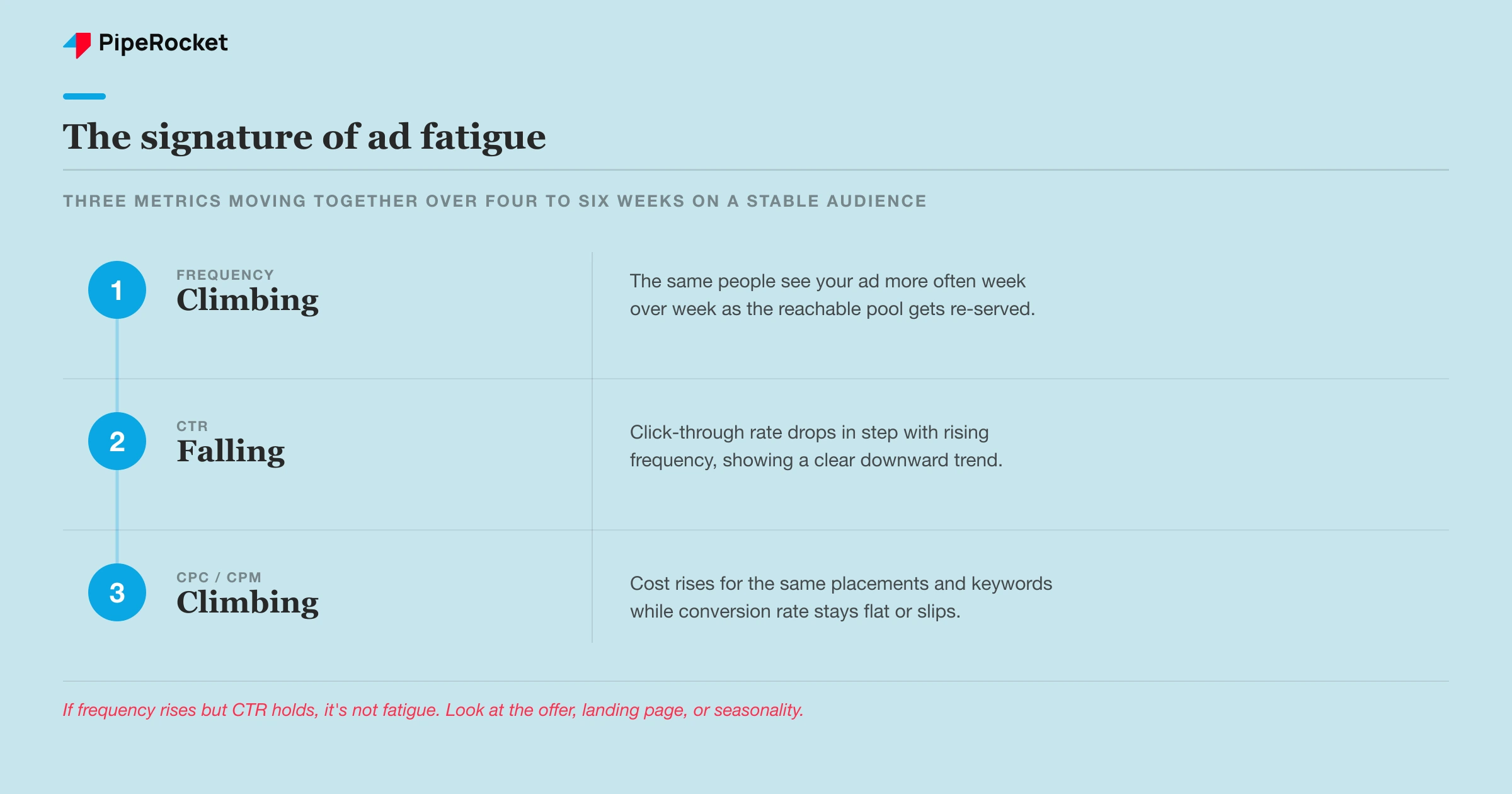
Ad fatigue has a signature, and it’s three metrics moving together over time. One metric having a rough week is something else. Before you touch anything, pull frequency, CTR, and CPC for the same campaign against a stable audience and look at the trend line across four to six weeks.
The pattern that confirms fatigue:
- Frequency climbing week over week on the same audience
- CTR falling in step with it week over week, showing a clear downward trend
- CPC or CPM rising for the same placements and keywords
- Conversion rate flat or down while spend holds steady
If frequency is rising and CTR is dropping in lockstep, that’s fatigue. If CTR dropped but frequency didn’t move, look elsewhere, because that’s usually a landing-page, offer, or seasonality issue rather than tired creative.
One caution before you act. A single bad week is just noise. B2B has real seasonality, holidays kill engagement, and a competitor launching a campaign can dent your CTR for a fortnight. Fatigue is a trend, so give it the four-to-six-week window before you call it. Overreacting to noise means you rebuild creative that was fine and reset the learning phase for nothing.
Always Read Frequency Against Audience Size
A frequency of 4 means nothing on its own. On a 1,000-account ABM list it can be healthy pressure, and on a 50-account 1:1 program it means you’ve been shouting at the same handful of buyers for weeks. Always read frequency next to how many people you’re actually reaching.
The trap we see most on LinkedIn is a budget too big for the audience. When you point real spend at a small, tightly filtered list, the algorithm cycles through the reachable people fast and then just keeps re-serving the same ones. Frequency spikes, penetration stalls, and it reads as fatigue when the underlying issue is a budget-to-audience mismatch. Fix the audience size and the “fatigue” often disappears on its own.
Fix the Creative First: Give the Rotation Something to Work With
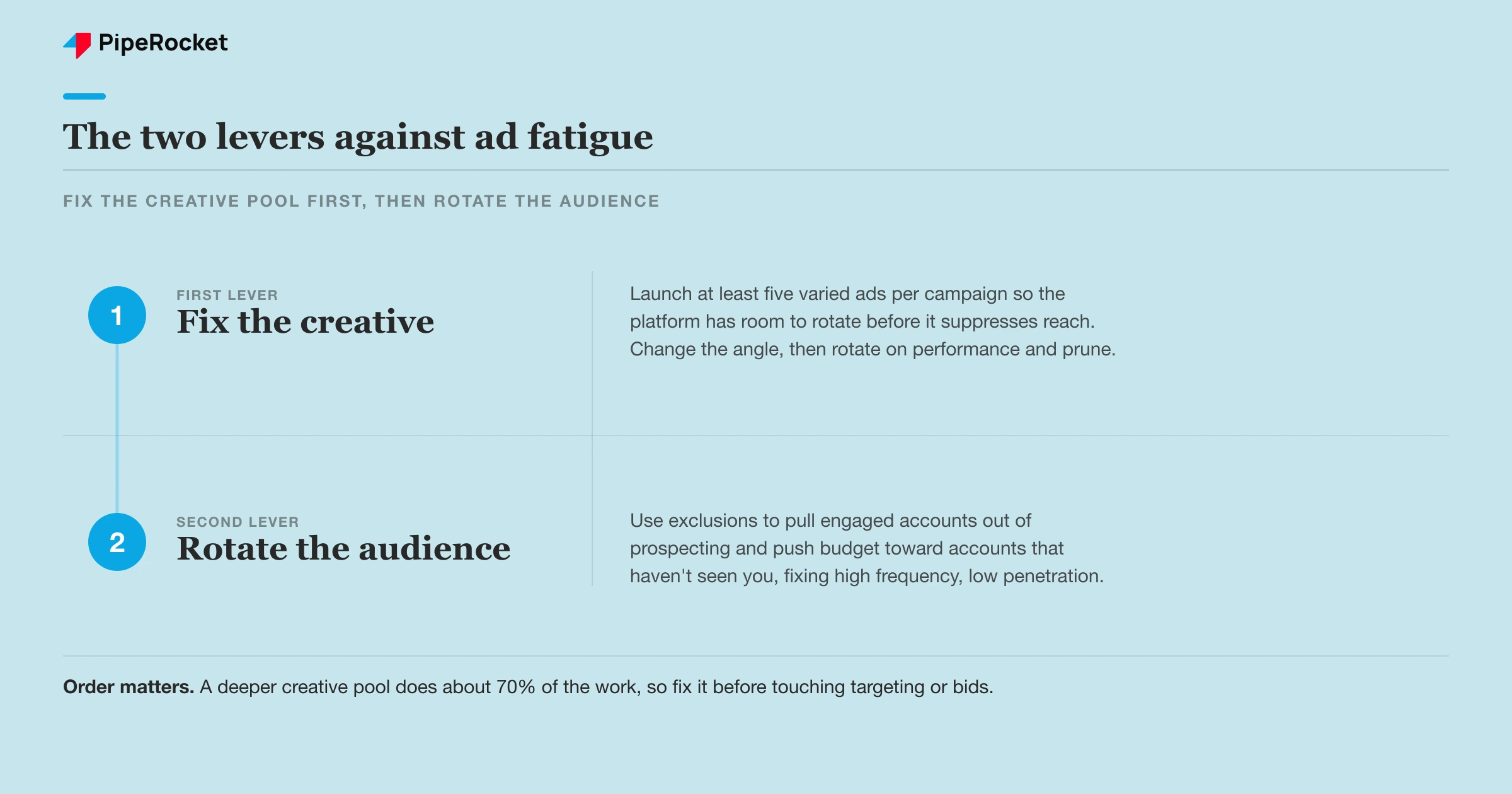
The fastest lever against ad fatigue is a deeper creative pool, because you can’t rotate your way out of trouble with two ads. On a small B2B audience, one or two creatives burn out in days. Launch with at least five per LinkedIn campaign so the platform has room to rotate before it starts suppressing your reach, and keep a similar bench ready on Search.
Variety has to be real, though. Five near-identical headlines with the word order shuffled is really just one creative wearing hats. The audience registers the same message and fatigues just as fast. Change the angle itself, and leave the punctuation tweaks alone:
- Speed angle: “Live in a week, not a quarter”
- Security angle: “SOC 2 and SSO on day one”
- Cost angle: “Replace three tools with one”
- Proof angle: a real customer result or a recognisable logo
- Job-title angle: copy written for the exact persona (“Built for RevOps ”)
Creative does about 70% of the work in a paid B2B program. That’s the single biggest factor we’ve seen in scaling accounts without fatigue killing them.
One SaaS client we worked with scaled LinkedIn spend from roughly $2,000/month to around $60,000/month over a year, and the thing that made that possible was feeding the machine enough varied creative that no single ad ever had to carry the audience. We ran different content for each stage of the buyer journey: thought-leadership ads to build awareness, then cost-effective image and video to keep frequency healthy as the awareness CPMs rose.
The lesson that stuck: when an account starts fatiguing, the answer is almost always more and more varied creative before it’s anything to do with targeting or bids.
Rotate on Performance, Then Prune the Weakest
Don’t let the platform pick a winner off the first few random clicks, and don’t leave five ads running forever. Rotate them evenly for a week or two to get honest data, then cut the lowest-CTR creative and replace it with a fresh variation of your best performer. That keeps every ad in the group competing against your strongest numbers instead of coasting.
This is a continuous loop that never really ends. Each prune-and-replace cycle resets the novelty for the audience and keeps average frequency-per-creative low even when total campaign frequency is high. It’s the difference between an account that needs a rescue every quarter and one that stays healthy on maintenance.
Fix the Audience Next: Stop Hammering the Same 30 Accounts
Even a great creative pool fatigues if it’s always hitting the same faces, so the second lever is rotating who sees the ads. On LinkedIn especially, the algorithm doesn’t spread evenly across your list. Give it 100 target accounts and it’ll keep serving the ~30 that engage while 70 never see you at all, which is exactly how you get high frequency and low penetration at the same time.
The fix costs nothing extra. Use dynamic audience exclusions to pull your already-engaged accounts out of the prospecting campaign and push that budget toward the accounts that haven’t seen you yet. LinkedIn builds this automatically now under the Companies tab. Run two campaigns with two jobs: a prospecting campaign for reach, and a small, separate campaign to nurture the accounts already engaging.
| Symptom | Fatigue reading | Move |
|---|---|---|
| High frequency, low penetration | Same accounts, over-served | Exclude engaged accounts, redirect budget to unreached ones |
| Audience too small for budget | Forced re-serving | Widen ICP filters or lower spend to match reach |
| Broad audience, wrong titles | Wasted impressions | Tighten to job function, seniority, company size |
| Engaged pool going cold | Nurture stage burning out | Fresh creative for the remarketing segment only |
The other audience move is matching the creative to where someone is in the journey. Showing a hard testimonial or demo ad to an account that’s never heard of you is like proposing on a first date, and it fatigues fast because it’s the wrong ask. Cold prospecting audiences need awareness-level creative, and only the warm, engaged segment should see the direct demo push.
Keep Fatigue From Coming Back: Build a Cadence, Don’t Wait for the Crash
The teams that don’t fight ad fatigue every quarter aren’t lucky. They’ve built refresh into the account as routine maintenance instead of waiting for CTR to fall off a cliff and then scrambling. A fixed cadence beats a rescue every time, because by the time the metrics crash you’ve already spent weeks paying premium CPCs on ads nobody wanted.
Bake these into the account’s operating rhythm:
- Audit frequency and CTR trends every two weeks, long enough for real data, short enough that fatigue can’t compound on a cost-per-click channel.
- Refresh the weakest creative on that same cadence so there’s always a new ad entering rotation before an old one dies.
- Track net-new accounts reached each month alongside total impressions, so you catch penetration stalling early.
- Rotate the engaged pool out of prospecting continuously as accounts warm up.
There’s a measurement trap here worth naming. On influence-heavy channels like LinkedIn, last-click attribution will tell you a campaign is failing right when it’s working, because the platform plants demand that Google closes later. If you judge fatigue purely on last-click conversions, you’ll kill campaigns that are still doing their job. Read the lift instead: are brand searches rising, is direct traffic up, is total pipeline growing even when LinkedIn isn’t claiming the credit? A campaign can look fatigued on last-click and be perfectly healthy on lift.
How PipeRocket Fixes Ad Fatigue in SaaS Accounts
We treat ad fatigue as a systems problem to engineer against. When we audit a stalling account, we read frequency, CTR, and penetration together before touching anything, then rebuild the creative pool and audience rotation so no single ad or segment carries the load. Our SaaS PPC team runs Google and LinkedIn on a fixed refresh cadence so campaigns stay healthy on maintenance instead of needing a rescue every quarter. If your CTR is sliding and your CPCs keep creeping up, talk to us and we’ll diagnose what’s actually fatiguing.
Frequently Asked Questions
What is ad fatigue in paid advertising?
Ad fatigue is when your target audience has seen the same ad so many times that they stop engaging with it, so click-through rate falls while your cost per click or impression rises. The platform is effectively charging you more to keep serving a message people have already tuned out. It’s most acute on small, high-value B2B audiences, where the reachable pool is tiny and a single creative gets over-served quickly. The signature is rising frequency and falling CTR moving together over several weeks.
How do you know if your ads are fatigued or just underperforming?
Look at frequency, CTR, and CPC together over a four-to-six-week window on a stable audience. If frequency is climbing while CTR falls in step with it, that’s fatigue. If CTR dropped but frequency stayed flat, the cause is usually something else, like a weak offer, a landing-page problem, or seasonality, and rotating creative won’t fix it. The key is the trend across weeks. A single bad week is almost always noise rather than fatigue.
How often should you refresh ad creative for SaaS campaigns?
Build creative refresh into a fixed cadence rather than waiting for performance to crash, and pair it with a full account audit roughly every two weeks. On small B2B audiences, plan to swap out the weakest-performing creative on that same rhythm so a fresh ad is always entering rotation before an old one burns out. Launch each campaign with at least five distinct creatives so the platform has room to rotate, and change the actual angle between them rather than only the wording, because near-identical ads fatigue at the same speed as one.