SaaS Community-Led Growth: How Communities Actually Drive Growth
 Omar Sheriff
Last updated on
Omar Sheriff
Last updated on
Community-led growth means your existing users, not your sales or marketing team, become the main channel for acquiring, supporting, and expanding new customers. It works by giving members a space to help each other, share their setups, and vouch for the product before a rep ever gets involved.
TL;DR
- Community-led growth means letting your engaged users do the acquiring, supporting, and expanding that sales and marketing used to carry alone.
- It runs on five mechanisms: peer support, member-driven acquisition, product feedback, community-driven retention, and free advocacy.
- Community-led, product-led, and sales-led growth solve different problems, and most SaaS companies eventually need a mix of two.
- Not every SaaS company is ready for this motion. It needs a genuine reason for users to talk to each other beyond a Slack channel bolted onto the product.
- Building one takes a real platform choice, a seeded core group, and a reason for people to stay past their first week.
- Most community launches fail from treating the space like a free support desk instead of tracking the metrics that show it’s actually driving growth.
What Is Community-Led Growth?
Community-led growth is a go-to-market approach where a SaaS company builds and nurtures a space for its users to connect with each other, and that space becomes the thing that pulls in new customers, answers their questions, and keeps them around longer.
Instead of a support team and a sales team doing all the work, the users do a good chunk of it themselves.
This isn’t a new idea. Salesforce’s Trailblazer community and Atlassian’s user groups have been running for over a decade. What’s changed is that smaller SaaS companies now have the tools (Discord, Circle, Discourse, even a well-run Slack) to run the same motion without a six-figure community team.
The part that trips people up: a community works more like infrastructure than a marketing channel you switch on. You’re building a place where your users would show up even if you stopped posting in it. If they wouldn’t show up, what you actually have is an email list with a chat window attached.
How Does Community-Led Growth Actually Work?
Community-led growth works through five connected mechanisms, and each one replaces a job your team used to do manually. Skip most of them and the motion stalls at “we have a Slack workspace” instead of becoming a growth channel.
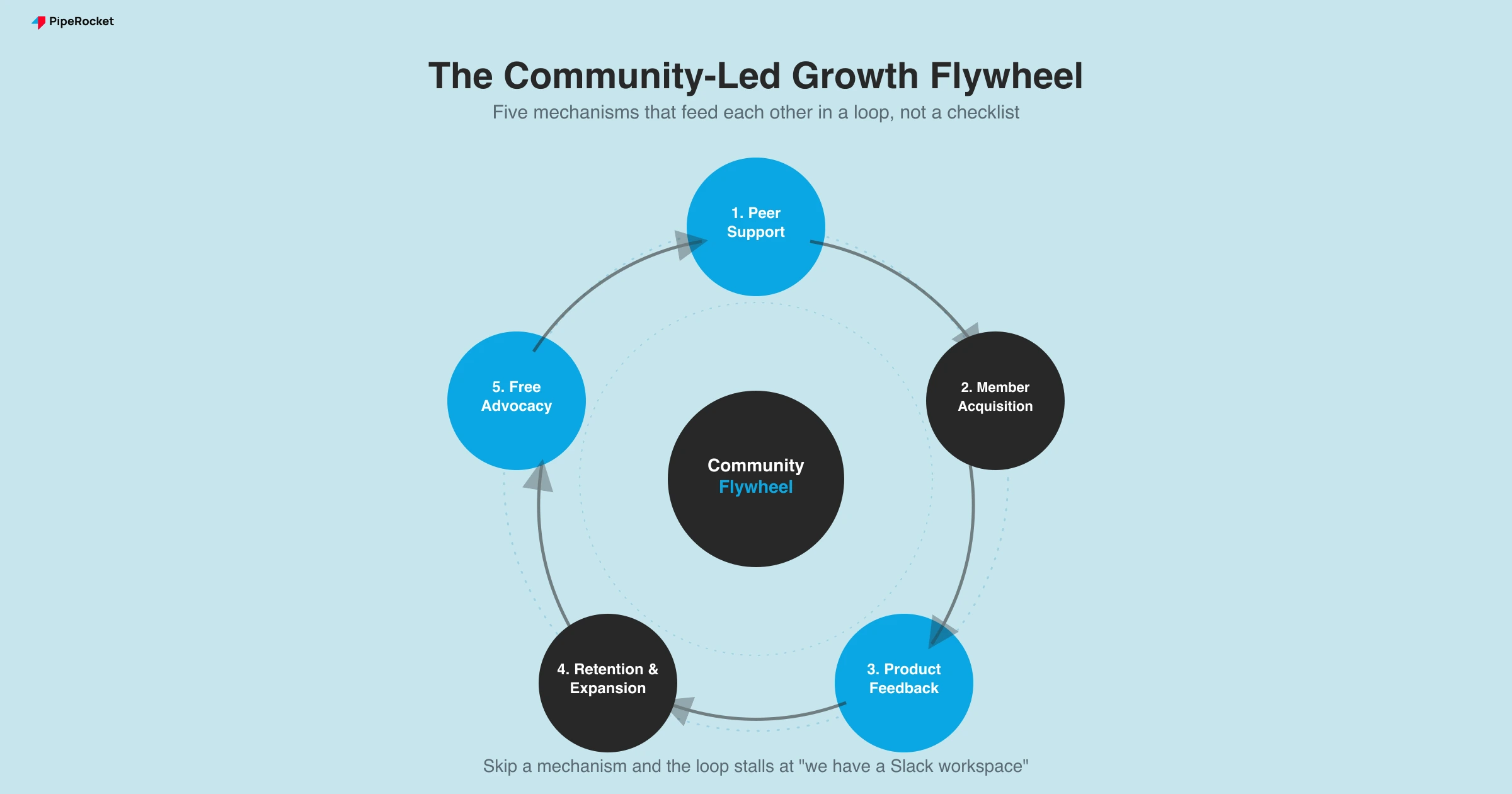
Peer Support Lowers Your Support Costs
Peer support absorbs the questions your support team used to handle one by one. When users answer each other’s questions, your support team stops being the only place people go when they’re stuck. A user who hit the same integration bug last month can answer a new member’s question faster than a support ticket queue can, because they’ve actually lived through it.
This doesn’t replace support. It absorbs the repetitive, low-stakes questions so your support team can focus on the harder tickets that actually need an engineer.
Members Become Your Acquisition Channel
Member-driven acquisition runs on recommendations you never asked for. A user who solves a problem in your community, or gets a genuinely helpful answer from a peer, tells other people about it. Not because you asked them to, but because it’s a natural thing to mention when a friend or colleague asks what tool they use for the same job.
This is why community-led growth shows up so often in developer tools and technical products. A developer recommending a library on a public forum thread carries more weight than the same claim on the product’s own homepage, because the recommendation has no obvious incentive behind it.
The Community Feeds Your Product Roadmap
Product feedback shows up here with context a support ticket never captures. Active members complain, request features, and share workarounds in the open, which gives your product team a live feed of what’s actually broken or missing. A feedback form only gives you the complaint itself. A community thread gives you the context around it: what the user tried first, what almost worked, and what they built as a workaround while waiting for a fix.
Companies like Figma and Notion have used their communities this way for years, as a place to watch real workflows break in public instead of relying only on feature-request tickets that arrive stripped of context.
A plugin author complaining about an API limitation in a public thread tells your product team more, in one post, than a dozen tickets tagged “enhancement request.”
Retention and Expansion Happen Inside the Community
Retention gets harder to break once a user has social ties in the space. A user embedded in a community, with connections to other members and a habit of checking in, is harder to churn than one who only logs into the product itself. The community becomes a second reason to stay, separate from the product’s own value.
This also opens a natural expansion path. Members who share advanced use cases in the community often become the ones who ask about upgrading to unlock the features they’ve seen other people talk about.
Advocates Do Your Case Study Work for Free
Advocacy turns a member’s own results into case study material you didn’t pay for. A member who posts their own results, a workflow they built, or a screenshot of their dashboard is doing unpaid case study work. It’s more credible than a polished case study on your own site because nobody asked them to post it and nobody’s paying them to.
This matters most for SaaS products where the buyer wants proof it works for a company like theirs, not just a generic testimonial. A finance ops lead sharing exactly how they automated a reconciliation workflow answers a prospect’s real question better than a marketing page ever could.
Community-Led Growth vs Product-Led Growth vs Sales-Led Growth
These three motions solve different problems, and treating them as competing choices is where a lot of SaaS teams go wrong. Each one earns growth through a different mechanism, and most mature SaaS companies end up running two of the three together.
| Motion | What drives growth | Works best when | Falls short when |
|---|---|---|---|
| Community-led | Peer trust and member advocacy | The product has a learning curve or a use-case variety worth discussing | The product is simple enough that there’s nothing to discuss |
| Product-led | The product itself, through a free trial or freemium tier | Time-to-value is short and the product sells itself on first use | Onboarding is complex or the buyer isn’t the end user |
| Sales-led | A rep guiding the buyer through evaluation | The deal size is large or the buying decision involves multiple stakeholders | The sales cycle is too slow or expensive for the deal size |
Community-led growth pairs naturally with product-led growth , because both rely on the user experiencing value directly rather than being sold to. A self-serve product with an active community around it gets a second acquisition loop for free: people who tried the product and now talk about it to others considering the same purchase.
It pairs less naturally with a pure sales-led motion, where the buyer and the day-to-day user are often different people. A procurement lead evaluating enterprise security software isn’t hanging out in a community forum, even if their team’s end users are.
That said, community and sales-led growth aren’t mutually exclusive. A community can still feed sales-led motions indirectly, by surfacing the power users who become internal champions during an enterprise deal.
Someone who’s been active in your community for a year is exactly the person who fights for your product in an internal procurement review, even if they never talk to a rep directly.
Is Your SaaS Actually Ready for Community-Led Growth?
Your SaaS is ready for this motion when users genuinely need to talk to each other, beyond needing to talk to you. That’s the single filter that matters more than company size, funding stage, or how many users you already have.
A few honest signals worth checking before you commit:
- Your product has enough depth or configuration options that users compare setups and share tips.
- Support tickets repeat the same handful of questions every week, which means peer answers would actually save time.
- Your users already gather somewhere unofficial (a Reddit thread, a Discord someone else started, a hashtag) whether you built a space for them or not.
- You can name three to five power users today who’d show up in week one without being paid or asked twice.
If none of those are true yet, the honest move is to wait. A community launched too early just becomes a ghost channel, and a dead community is worse for your brand than no community at all. It signals nobody’s using the product enough to have anything to say about it.
How to Build a Community-Led Growth Motion
Building this motion is less about picking software and more about sequencing the first ninety days correctly. Get the order wrong and you’ll spend months trying to revive a space that never had a pulse.
Pick the Platform Your Users Already Use
Don’t make your users learn a new tool just to talk to each other. If your audience already lives in Slack for work, a Slack community has less friction than pulling them into Discord or a branded forum.
If your users are more consumer-facing or want async, searchable discussions, a Discourse forum or Circle space holds up better over time than a chat log that scrolls away.
The platform matters less than most teams assume. What matters is whether it’s a place your specific users would open without a notification pinging them first.
Seed It With Your Power Users Before Launch
Don’t open a community to your full user base on day one. Invite the three to five users you already know are engaged, active in support tickets, or vocal in reviews, and get them talking to each other for two to three weeks before anyone else sees it.
An empty room kills momentum before it starts.
Those early members set the tone. If the first conversations are helpful and specific, that becomes the norm. If the first thing a new member sees is a ghost town or a wall of unanswered questions, that becomes the norm too.
Give Members a Reason to Stay Past Week One
Novelty gets people to join. It doesn’t get them to come back. Members stay when there’s a recurring reason to check in: a weekly thread, early access to a beta feature, direct access to your product team, or simply consistent, fast answers when they ask something.
We’ve seen SaaS teams launch a community, post announcements for a month, and then wonder why engagement flatlined. The announcements were one-directional. Nobody was there to have a conversation, so nobody stayed for one.
Connect the Community Back to Content and Product
The community shouldn’t run in isolation from the rest of your marketing and product work. Real questions and workarounds surfacing in the community are raw material for your content marketing team, and real complaints are a direct line to your product roadmap.
Treat the community as a source, and give it a two-way flow instead of a one-way announcement feed.
A practical version of this: assign someone to scan the community weekly for questions that keep repeating, then turn the strongest ones into a proper blog post or help doc. Link back to that piece the next time the question comes up.
It closes the loop for future members and gives your content team topics you know real users are actually asking about, instead of guessing from keyword volume alone.
Common Mistakes to Avoid
Most community-led growth efforts don’t fail because the idea was wrong. They fail because of a handful of avoidable sequencing and ownership mistakes.
Treating the Community Like a Free Support Desk
A community where your team answers every question is really just an unpaid support channel. If every post in your community is a user asking a question and your team answering it, you’ve built an unpaid support channel with worse response times than your actual support tool. That isn’t a community at all. Members need to be answering each other, not just waiting on you.
Launching Before You Have Real Engaged Users
A community without a pulse from day one rarely recovers from a silent launch. Launching to your entire user base before you’ve seeded it with a handful of genuinely active members means the first visitors see silence, and silence is the fastest way to make sure they never come back.
Measuring Only Member Count
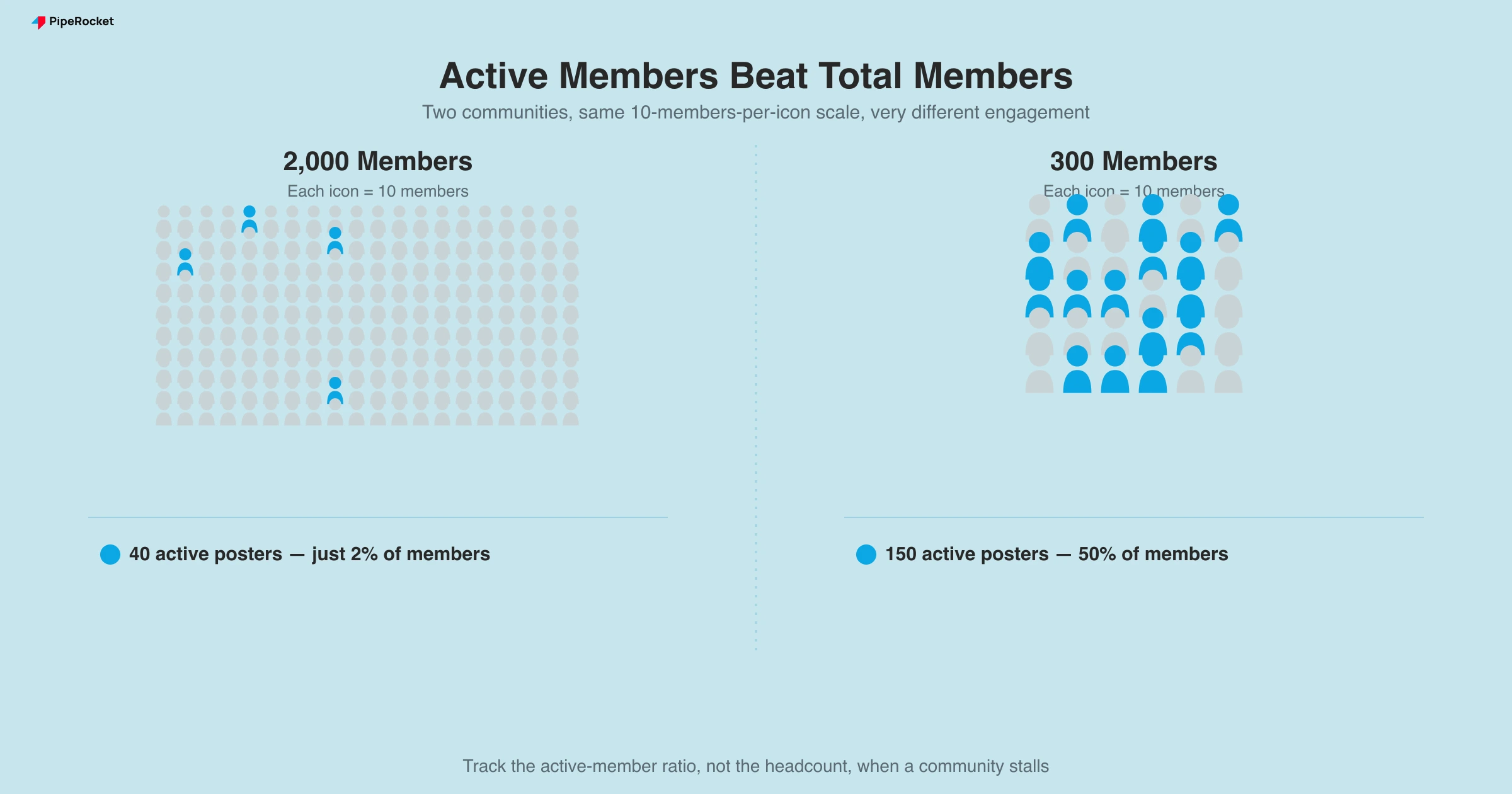
Member count is the easiest number to report and the least useful one to act on. A community with 2,000 members and 40 active posters is weaker than one with 300 members and 150 active posters. Track engagement, not headcount.
Letting the Community Run Without a Dedicated Owner
A community without a named owner drifts into inactivity within a quarter. It needs one person accountable for starting conversations, welcoming new members by name, and flagging product feedback to the right team, even if that’s a part-time responsibility early on.
How to Measure Community-Led Growth
The metrics that matter here track behavior inside the community, not just how many people joined it. Member count tells you almost nothing on its own; it’s the ratio of active-to-total members that shows whether the space is actually working.
Worth tracking on a monthly basis:
- Active member ratio: how many members posted or replied this month, out of total members
- Peer-resolved questions: how many support-style questions got answered by another member before your team stepped in
- Referral or attributed sign-ups: new users who mention the community, a member, or a community thread as how they found you
- Expansion tied to community activity: upgrade or add-on purchases from users who are active in the community versus those who aren’t
That last comparison is often the most convincing one internally, because it directly ties community activity to revenue instead of vague engagement scores. If active community members expand and renew at a noticeably better rate than inactive users, that’s the number that gets a community budget approved for another year.
How PipeRocket Digital Helps SaaS Teams Grow Beyond the Community
A community earns trust with existing users, but it rarely shows up in search on its own. We build the SaaS SEO and content layer that captures the people still searching for a solution, so organic search and community advocacy reinforce each other instead of running as separate efforts.
If you’re comparing agencies for this kind of work, our breakdown of the best SaaS marketing agencies is a fair place to start.
When you’re ready to talk specifics, reach out to us here .
Frequently Asked Questions
What is community-led growth?
Community-led growth is a SaaS growth motion where an engaged group of users, connected through a shared space like a forum or Slack community, drives acquisition, support, and retention instead of leaving those jobs entirely to sales and marketing. It works because peer recommendations and peer support carry more trust than a company talking about its own product.
What is a community-led growth strategy?
A community-led growth strategy is the specific plan for how a company builds, seeds, and sustains that community so it produces measurable business outcomes rather than just being a nice-to-have space. It usually includes choosing the right platform, seeding the space with genuinely engaged early members, setting up recurring reasons for people to return, and tracking metrics tied to acquisition and retention rather than just member count.
What is a product-led growth SaaS company?
A product-led growth SaaS company is one where the product itself, usually through a free trial or freemium plan, does the job of converting and expanding customers with minimal help from a sales team. Users try the product, get value quickly, and upgrade based on that experience rather than a sales pitch. It’s a different mechanism from community-led growth, though the two often work well together since both rely on the user experiencing value directly instead of being sold to.