SaaS Product-Market Fit: How to Find It and Know It's Real
 Ranjeeth Kumar
Last updated on
Ranjeeth Kumar
Last updated on
SaaS product-market fit is the point where your product solves a real, painful problem for a specific group of users so well that the market pulls it from you, not the other way around. You stop convincing people to buy and start keeping up with demand you didn’t have to manufacture.
TL;DR
- Product-market fit shows up as pull, not push. Sales and signups start feeling easy instead of forced.
- Six signals prove it’s real: pull over push, high retention, organic growth, fast time-to-value, a 40%+ Sean Ellis score, and expansion revenue.
- Fast time-to-value counts as its own signal: self-serve users should hit their first real win in minutes, sales-led buyers within days, not weeks.
- A good MVP with early signups is not the same as market fit, and mistaking one for the other is the most expensive error a SaaS team makes.
- Fit isn’t a one-time milestone. It decays as the market shifts, so you have to keep measuring it.
- Spending on growth channels before fit is confirmed just burns cash faster, it doesn’t create the fit you’re missing.
- Finding fit that’s missing usually means narrowing your ICP, not shipping more features.
- Measure the five signals on a quarterly cadence instead of treating fit as a one-time launch checkbox.
What Are the Key Signs of SaaS Product-Market Fit?
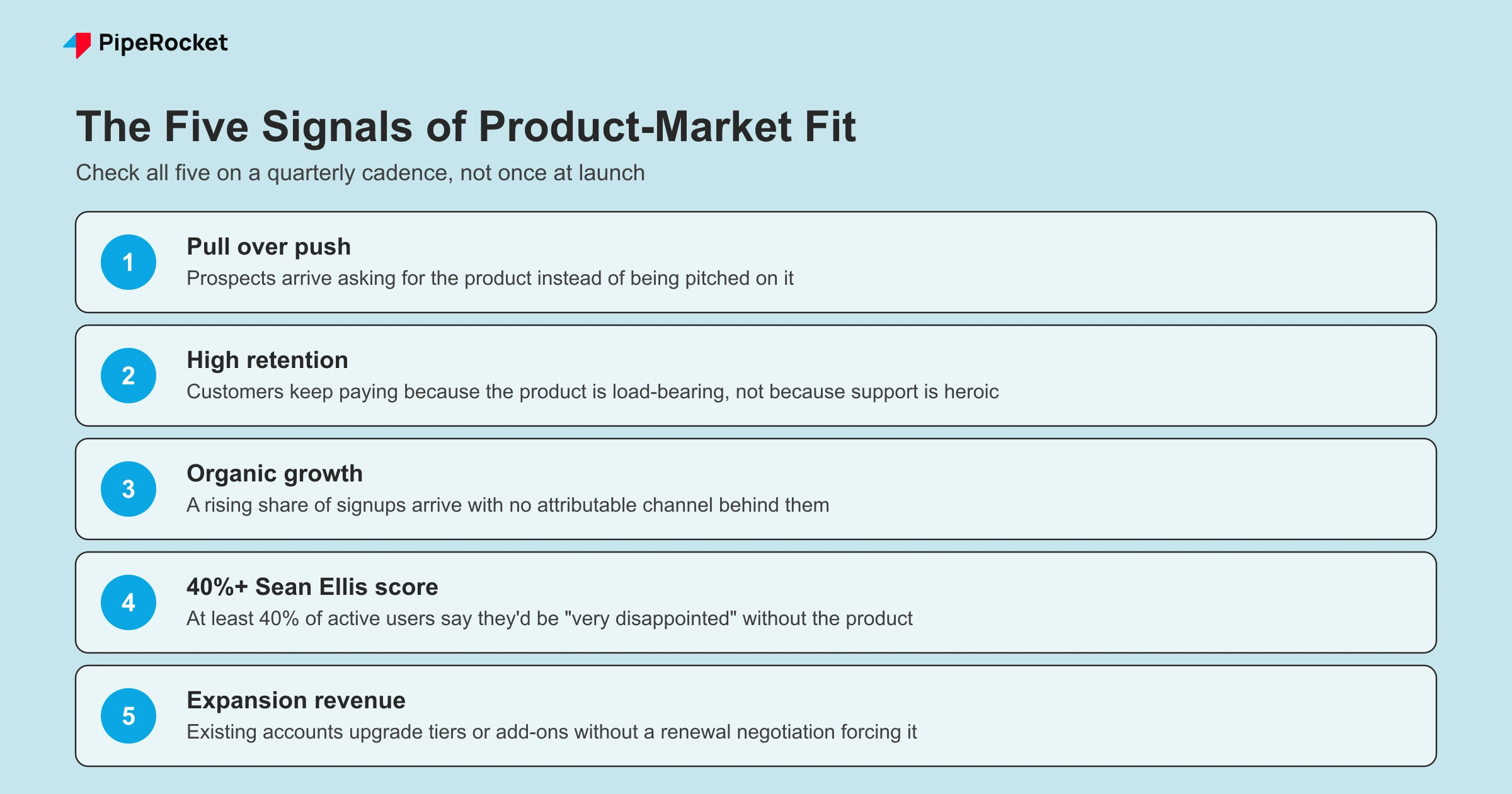
Six signals prove SaaS product-market fit: sales pull replacing push, high retention, organic word-of-mouth growth, fast time-to-value, a Sean Ellis score above 40%, and accounts that expand on their own. Together they show demand is pulling the product rather than your team pushing it.
Product-market fit shows up as a shift in how hard you have to work to get someone to say yes. Before fit, every deal is a fight. After it, prospects start arriving asking for the product instead of being pitched on it.
I’ve watched this shift happen in real time with a client. For eighteen months, every demo needed three follow-up calls and a discount to close. Then usage from one integration partner’s users started converting on their own, no outreach, no discount, just people signing up because a colleague told them to. That’s the tell. Nothing on the sales side changed. The market had started pulling.
The pull replaces the push
Before fit, you’re pushing. Every deal needs outbound, a demo, a follow-up sequence, and usually a discount to close. After fit, prospects start coming in already convinced, asking about pricing and onboarding instead of whether the product solves their problem at all.
This is the cleanest signal because it’s the hardest to fake. You can pay for a demo. You can’t pay someone to refer a colleague because your product is genuinely useful to them.
Customers stick because the product is load-bearing
High retention means customers keep paying month after month because your software is embedded in how they get their job done, not because switching feels inconvenient. If churn stays low without you working overtime on customer success calls, the product is doing the retaining, not your team.
The clearest version of this is a flattening retention curve: cohorts stop dropping off and level out at a stable, sticky percentage instead of bleeding down to zero. As a rough benchmark, Week-4 retention holding above 30% to 40% is the sign the curve has flattened rather than kept sliding.
Contrast that with a product where retention only holds because support is heroic. There, the support team is quietly compensating for a product gap, and the churn shows up the moment you stop over-serving.
Growth starts happening without your marketing budget
Organic growth is users referring others or sharing the tool without you spending more to make it happen. It shows up as a rising share of signups with no attributable channel, people just heard about you and showed up.
This is different from a viral feature. It means the core value proposition is strong enough that using the product creates its own advocates.
Users hit real value fast
Fast time-to-value means a new user reaches their first genuine win quickly: minutes for a self-serve tool, days for a sales-led enterprise platform, not weeks of setup before anything pays off. When fit is real, the product proves itself before the user’s patience runs out.
If activation drags on and users churn during onboarding, that’s a fit signal failing early. The gap between signup and first value is where most weak-fit products lose the people who would otherwise have stayed. Shortening that gap is often the fastest way to lift retention and referrals at once.
The 40% disappointment test gives you a number
Sean Ellis, who ran early growth at Dropbox and LogMeIn, built a single-question survey to cut through the noise: “How would you feel if you could no longer use this product?”
Benchmarking it across close to a hundred startups, he found that once at least 40% of active users answer “very disappointed,” the company almost always has real traction. Below that line, growth stays a grind no matter how much budget you throw at it.
Run this survey against your active users, not your entire signup list. A trial user who tried the product once and never came back will skew the number down and won’t tell you anything useful about the users who actually rely on it.
Existing accounts start growing on their own
Expansion revenue looks like this:
- Accounts upgrade tiers or buy add-ons without a renewal negotiation forcing it
- Customers ask what the next tier unlocks because they’ve already gotten value from the first one
- Finance teams care about this signal most, since it means growth math stops depending entirely on new-logo acquisition, the expensive lever
Is a Good MVP the Same Thing as Product-Market Fit?
No, and this is the mistake that costs teams the most time. A working MVP with a handful of early signups only proves problem-solution validation, meaning people agree the problem is real and your first attempt at solving it is plausible. It does not prove the market will pull the finished product at scale.
I get it. Ten paying customers from a launch feels like validation, and it’s tempting to read that as fit. But ten people saying yes to a founder they know personally is a different signal than a stranger finding your product through a colleague’s referral and paying full price with no relationship to lean on.
The 3-3-2-2-2 rule is a useful reality check here. It describes the growth pace venture-backed SaaS companies are expected to hit after fit is confirmed: roughly tripling ARR for two years, then doubling it for three, starting from around $1M ARR.
Teams that try to run that pace before fit exists usually just burn through a funding round proving the model doesn’t work yet. Confirmed fit is what earns you the right to pour money into a SaaS go-to-market strategy ; before that, the pace is a bet, not a plan.
Does Spending More on Growth Fix Weak Product-Market Fit?
No. Pouring money into ads, outbound, or a bigger sales team before fit is confirmed does not create fit, it just burns cash faster while the underlying problem stays exactly where it was.
We turn SaaS companies away from SEO engagements more often than people expect. Without product-market fit and a clear ICP, SEO just scales your confusion faster across a wider audience. The same logic applies to every acquisition channel, not just organic search.
Growth spending before fit behaves like pouring fuel into an engine that isn’t running yet. You’ll go through more fuel, but you won’t move. The fix is to slow down long enough to find out why the current spend isn’t converting, because a bigger budget just gets you the same result faster.
Fit is the thing a SaaS growth strategy gets built on top of, so it has to come first. It’s also worth knowing that fit alone isn’t the whole picture. Brian Balfour’s “four fits” framework argues you need market-product, product-channel, channel-model, and model-market fit to line up before growth compounds, so a product that fits its market can still stall if the channel or pricing model doesn’t fit too.
Does Product-Market Fit Ever Go Away Once You Have It?
Yes, and this is the part most teams forget once they’ve hit their first strong quarter. Fit decays as market conditions shift, competitors ship faster, or your buyer’s priorities move on, so the checks that proved it in year one need to keep running in year three.
A market can change under you even when your product hasn’t changed at all. A new regulation reshapes what buyers need. A well-funded competitor ships the feature your customers have been asking you for. Your own best customers grow into a different set of problems than the ones you originally solved for.
This is why the signals above aren’t a one-time checklist. Run the disappointment survey on a cadence, watch expansion revenue for a slowdown, and treat a dip in organic referrals as a signal worth investigating rather than a rounding error.
How Do You Find Product-Market Fit If You Don’t Have It Yet?
Finding fit is less about building more features and more about narrowing who you’re building for until the pull shows up. Most teams try to fix weak fit by adding functionality. Usually the fix is the opposite: cut the audience down until you find the group the product already works for.
Narrow the ICP until the pull shows up somewhere
Look at your existing customers and find the segment with the least churn and the fastest activation, even if that segment is small. That’s usually where fit already exists in miniature, and it’s a stronger starting point than trying to serve everyone adequately.
A vertical payments SaaS I’ve seen work through this had customers across five industries. Retention in one vertical, logistics, sat well above the rest. Everything after that, the roadmap, the messaging, the onboarding, got rebuilt around logistics buyers specifically instead of staying generic.
Talk to the users who almost left
Exit interviews and near-miss conversations tell you more than satisfaction surveys. A user who considered leaving and stayed can usually articulate exactly what almost pushed them out, and that gap is often the same gap holding back everyone else who’s still on the fence.
Ship the smallest version of the fix, then re-run the test
Once you’ve narrowed the ICP or found the gap, resist the urge to rebuild the whole roadmap around it at once. Ship the smallest change that addresses the gap, then re-run the disappointment survey on the same cohort. If the score doesn’t move, the gap wasn’t the real issue, and you’ve saved months by finding that out early instead of after a full rebuild.
How Do You Actually Measure Product-Market Fit Going Forward?
You measure it the same way you found it: the same signals, checked on a schedule instead of once. The table below is the difference between a one-time gut check and a system you can trust.
| Approach | What it tells you | Where it breaks |
|---|---|---|
| One-time launch survey | Whether your first version resonated with early adopters | Early adopters forgive rough edges that a mainstream buyer won’t |
| Quarterly Sean Ellis test on active users | Whether the disappointment score is holding above 40% | Only useful if you exclude one-time trial users who never activated |
| Expansion revenue trend | Whether existing accounts still see growing value | Lags behind actual fit decay by a quarter or two |
| Support ticket themes | Early warning that the product is drifting from what users need | Easy to dismiss as “normal” complaints until the pattern is obvious in hindsight |
Set a cadence, not a single date. Quarterly is usually tight enough to catch decay before it shows up in your growth numbers, and loose enough that you’re not chasing noise from a single bad week.
Common Mistakes to Avoid
Testing on the wrong audience
Running the disappointment survey against your entire signup list instead of active, engaged users dilutes the score with people who never gave the product a fair shot. A trial user who logged in once will always answer “not disappointed,” and that answer says nothing about whether your real users see the product as essential.
Confusing a launch spike with lasting fit
A good product launch drives a burst of signups from your existing network, and that burst can look like traction for a few weeks. The real test is whether people who have no personal connection to your team are still finding and paying for the product three months later.
Scaling the sales team before the pull exists
Hiring aggressively for outbound before the product shows any pull just multiplies the push. More reps making more calls against a product that isn’t creating its own demand gets you a bigger burn rate, not a faster path to fit.
Ignoring the disappointment test’s honest failure
When the Sean Ellis score comes back under 40%, the instinct is to explain it away, wrong sample, bad survey timing, unlucky quarter. Usually the number is telling the truth, and the fix is going back to the users who said “somewhat disappointed” and finding out specifically what’s missing for them.
How PipeRocket Digital Helps SaaS Teams Time Their Growth Right
At PipeRocket, we check for product-market fit and a clear ICP before we take on an engagement, because SEO or paid spend before that point just scales confusion faster instead of fixing it.
Once fit is confirmed, we build SaaS SEO and SaaS PPC programs around the ICP that’s actually converting, not a guess at who might.
If you want a straight read on whether your team is ready to scale acquisition, reach out to us here .
Frequently Asked Questions
What is SaaS product-market fit?
SaaS product-market fit means your software solves a real problem for a specific group of users well enough that the market pulls the product toward it, instead of your team pushing it out through cold outreach and discounts.
It shows up as easier sales conversations, low churn, organic referrals, and accounts that expand on their own. It’s a state you reach and then have to keep proving, not a one-time milestone you check off.
What is the 40% rule for product-market fit?
The 40% rule comes from a survey built by Sean Ellis: ask active users how they’d feel if they could no longer use the product. If at least 40% answer “very disappointed,” the company almost always has real organic traction.
Companies below that threshold tend to struggle no matter how much they spend on acquisition. The key is running it against genuinely active users, not your full signup list.
What is the 3-3-2-2-2 rule of SaaS?
The 3-3-2-2-2 rule describes the growth pace venture-backed SaaS companies are expected to hit after fit is confirmed: roughly tripling ARR for two years, then doubling it for three, starting from around $1M ARR.
It’s a post-fit benchmark, not a way to find fit. Teams that chase that pace before fit exists usually just burn through a funding round proving the model isn’t ready yet.
What is the Rule of 40 in SaaS?
The Rule of 40 says a healthy SaaS company’s revenue growth rate plus profit margin should add up to at least 40%. It’s a financial-health metric and a different thing from the Sean Ellis 40% product-market fit test above.
Both use “40%,” but the Rule of 40 measures the balance between growth and profitability, while the Sean Ellis rule measures how disappointed users would be to lose the product. Source: SaaS Capital .
Can you give an example of product-market fit?
A clear example is a SaaS tool that starts converting through unpaid referrals inside a customer’s network: one security lead at a fintech tells a peer at another company, and that peer signs up without ever seeing a sales deck.
Existing customers upgrading tiers without a renewal negotiation forcing it is another clear example, since it means the product earned that expansion on its own rather than the sales team pushing for it.