SaaS Usage-Based Pricing: How It Works and How to Get It Right
 Sabari Rohith
Last updated on
Sabari Rohith
Last updated on
SaaS usage-based pricing means charging customers for what they actually consume, like API calls, seats, or compute, instead of billing a flat monthly fee. Costs rise and fall with usage, so the price tracks the value a customer gets that month.
TL;DR
- Usage-based pricing refers to billing tied to consumption instead of a flat seat count, so revenue scales with how much a customer actually uses the product.
- Most SaaS companies use one of four models: pure pay-as-you-go, a hybrid subscription with overage, prepaid credit bundles, or tiered usage bands.
- The value metric you pick, volume, capacity, time, or outcome, decides whether customers trust the bill or fight it every month.
- Usage-based pricing and flat subscriptions solve different problems, and most companies end up needing a blend of both.
- Rolling out metered billing is a product, finance, and sales problem first, not a billing-system settings change.
- The mistakes that break usage-based pricing almost always trace back to a metric customers can’t predict or control.
- Real-time usage dashboards and alerts prevent more billing disputes than any tweak to the pricing structure itself.
- AI features are accelerating adoption because compute cost scales per generation, not per seat, which flat pricing can’t track fairly.
- Snowflake, Twilio, AWS, and Stripe all run usage-based models, billing per credit, per message, per metered resource, and per transaction.
What Is SaaS Usage-Based Pricing?
SaaS usage-based pricing is a billing model where the price a customer pays moves with a specific usage metric, like API calls, data processed, or active seats, instead of staying fixed every month. The customer’s invoice reflects what they did with the product, not just that they had access to it.
Usage-based pricing, flat subscriptions, and freemium solve different billing problems:
- Usage-based pricing. The invoice reflects what the customer actually did with the product that month.
- Flat subscription. A customer on the $499/month plan pays $499 whether they used the product once or every day.
- Freemium. The free tier exists purely to convert people to a paid plan; it isn’t built to meter usage over time.
Usage-based pricing works well when a product’s cost to serve scales with customer activity. A compliance SaaS for fintech teams that runs identity checks pays for each verification call it makes to a data provider, so pricing customers per verification lines the bill up with the actual cost structure underneath it.
The model has grown fast because AI features made it necessary. A tool that burns compute on every AI-generated output can’t price that fairly with a flat seat fee. Someone running 50 generations a day and someone running 5,000 are consuming wildly different amounts of infrastructure, and a flat price either overcharges the light user or undercharges the heavy one.
What Are the Common Usage-Based Pricing Models?
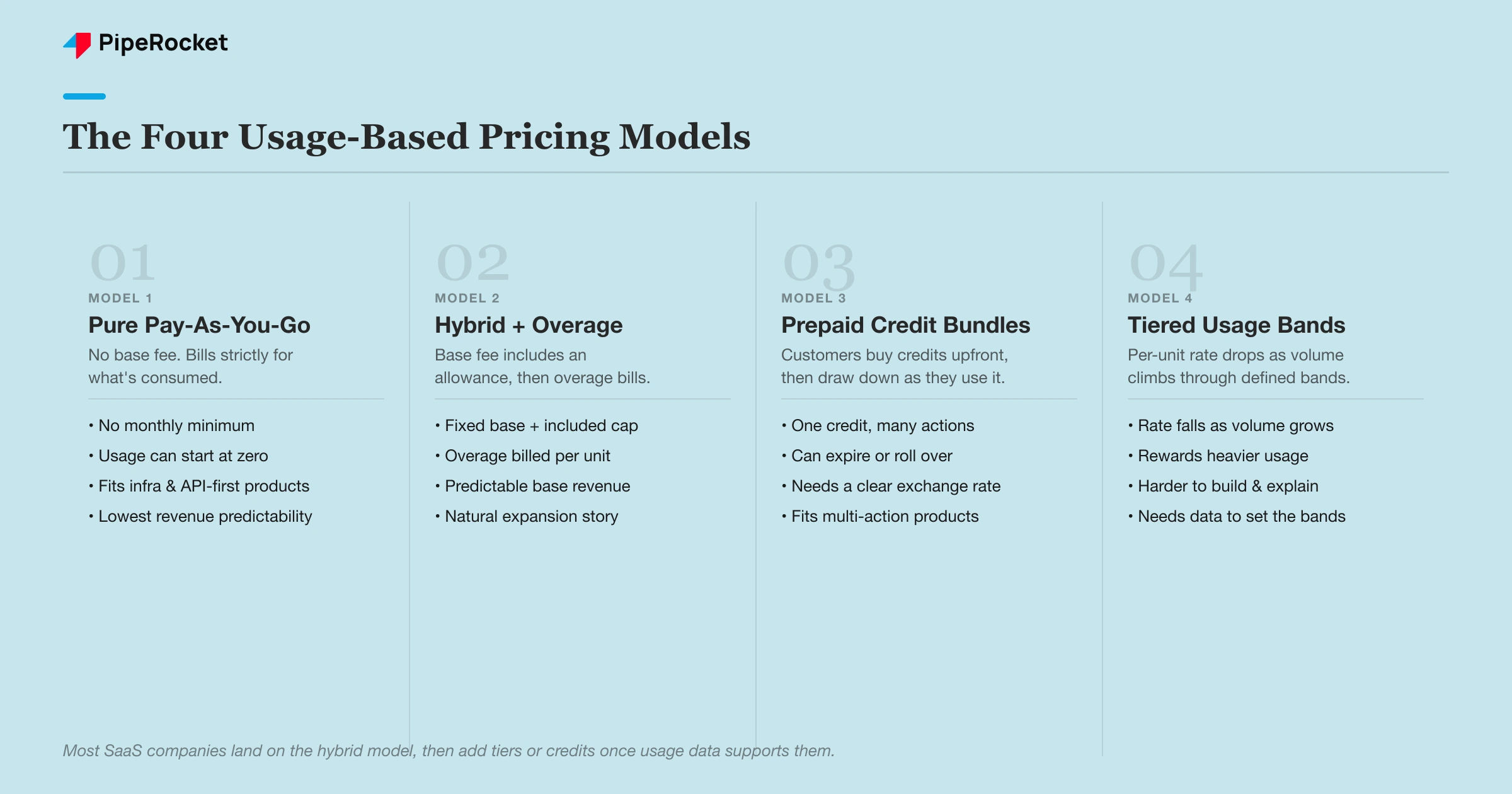
Most usage-based SaaS pricing falls into four structures, and picking the wrong one is usually why a metered plan feels either too risky for the customer or too unpredictable for the vendor.
Pure pay-as-you-go
There’s no base fee here. The customer pays strictly for what they consume, with no minimum commitment and no included allowance. This is the purest form of usage-based pricing, and it’s common for infrastructure and API-first products where usage can start at zero and scale to millions of calls.
The tradeoff: almost no revenue predictability. Pay-as-you-go removes the barrier to trying a product, since a new customer risks nothing beyond what they actually use. But a customer can churn to zero usage without ever technically canceling, which is why finance teams push back on this model as a company’s sole billing structure.
Hybrid subscription plus overage
Also called a three-part tariff, this model charges a fixed base fee that includes a set allowance of usage, then bills overage past that cap at a per-unit rate. A plan might include 10,000 API calls for $299/month, with additional calls billed at $0.01 each.
This is the model most SaaS companies land on eventually. It keeps the predictable base revenue finance teams need, lets heavy users pay more as they grow, and gives sales a simple story: start on the base plan, expand naturally as usage grows.
Prepaid credit bundles
Customers buy a block of credits upfront, then draw down from that balance as they use the product. A marketing automation platform might sell 100,000 email-send credits for a flat price, with credits expiring or rolling over depending on the plan.
Credits work well when a single product does several different billable actions:
- One credit type can cover email sends, SMS, and API calls at different exchange rates
- Customers pay once and stop thinking about billing until the balance runs low
- Unused credits can roll over or expire, depending on the plan
The catch is that customers need to understand the exchange rate, or the pricing page turns into a math problem nobody wants to solve.
Tiered usage bands
Instead of billing every unit at the same rate, tiered pricing charges different rates depending on which usage band a customer falls into, rewarding customers for growing usage with you since the effective per-unit price falls as volume climbs.
Worked example: the first 1,000 units cost $0.05 each, the next 9,000 cost $0.03 each, and everything past 10,000 drops to $0.01. It’s harder to build and explain than flat per-unit pricing, so it usually only makes sense once you have enough usage data to know where the real bands should sit.
What Are Real-World Examples of Usage-Based Pricing?
The clearest usage-based pricing examples are Snowflake (per compute credit), Twilio (per message or API call), AWS (metered infrastructure), and Stripe (per transaction). Each bills a specific consumption unit instead of a flat seat fee, so the invoice tracks what the customer actually ran.
- Snowflake bills on compute credits consumed when queries run, plus separate storage charges, so a customer running heavy analytics pays more than one querying occasionally.
- Twilio charges per message sent and per API call made, so a product sending a few SMS notifications pays a fraction of what a high-volume messaging app pays.
- AWS meters infrastructure by what you provision and run: compute time, storage held, and data transferred, billed after the fact rather than as a fixed plan.
- Stripe takes a per-transaction cut, so its revenue rises directly with the payment volume its customers process.
Across all four, the value metric maps to the underlying cost to serve, which is why the model holds up as customers scale.
How Do You Choose the Right Value Metric?
Choosing a value metric means picking the specific unit of consumption a customer’s bill is based on, and it decides whether usage-based pricing feels fair or feels like a trap. Get the metric wrong and customers either stop trusting the pricing page or start gaming the number.
Volume-based metrics
Volume metrics count discrete actions: emails sent, API requests made, messages delivered, or records processed. These work best when each action has a roughly consistent cost to serve, so a customer sending 10,000 emails genuinely costs you more than one sending 100.
The risk with volume metrics is picking a unit customers can’t predict in advance. If a customer doesn’t know how many API calls a typical workflow will generate until after they’ve built it, the bill feels like a surprise instead of a plan.
Capacity-based metrics
Capacity metrics bill on what a customer stores or holds, not what they actively do: gigabytes of data stored, number of contacts in a database, or seats provisioned. These metrics tend to be stickier and more predictable than volume, since storage tends to grow slowly and steadily rather than spiking.
A CRM billing per stored contact is using a capacity metric. It’s easy for a customer to estimate (“we have 40,000 contacts, so we’ll be on this tier”), which makes budgeting simpler on both sides.
Time-based metrics
Time metrics bill on duration: compute hours, minutes of audio or video processed, or hours a resource stayed active. These fit products where the underlying infrastructure cost is genuinely tied to how long something ran, like transcription tools or rendering platforms.
Outcome-based metrics
Outcome metrics bill on the result the product delivered, not the action it took: leads generated, deals closed, or tickets resolved. This is the hardest model to build and the strongest one to sell, because the customer is only paying when the product actually produced value.
We’ve seen SaaS companies chase outcome-based pricing too early, before they have the attribution data to prove the outcome was actually caused by their product and not by something else the customer’s team did. Attribution has to be airtight before outcome billing works, or disputes eat the sales team’s week.
What Are the Benefits and Challenges of Usage-Based Pricing?
Usage-based pricing lowers the barrier to entry, aligns price with the value a customer gets, and grows revenue as usage grows. Its main challenges are revenue volatility and billing shock, since a variable invoice is harder to forecast and easier for customers to distrust than a flat fee.
Key benefits
- Lower barrier to entry. A customer can start small and pay only for what they use, which suits product-led growth where people try before they commit.
- Price aligned with value. The invoice reflects what the customer actually did with the product, so light users aren’t overcharged and heavy users aren’t undercharged.
- Natural expansion. Revenue grows automatically as a customer consumes more, without needing a manual upsell conversation.
Common challenges
- Revenue volatility. Usage moves with customer behavior, so revenue is harder to forecast than a fixed subscription, especially without historical data.
- Billing shock and friction. A customer who can’t see usage in real time meets the cost only when the invoice lands, which breaks trust even when the pricing was fair.
- Metric dependence. A metric customers can’t predict or control turns every bill into a dispute, so the model lives or dies on choosing the right value metric.
Usage-Based vs Subscription Pricing: Which Should You Use?
Usage-based pricing and flat subscriptions solve different problems, and the honest answer for most SaaS companies is that they need both, not one instead of the other.
| Dimension | Usage-Based Pricing | Flat Subscription |
|---|---|---|
| Revenue predictability | Lower, moves with customer activity | Higher, fixed per customer per period |
| Expansion revenue | Grows automatically as usage grows | Requires a manual upsell or plan change |
| Customer cost perception | Feels fair, but can feel unpredictable | Feels stable, but can feel wasteful for light users |
| Sales complexity | Higher, reps need to model usage scenarios | Lower, one number to quote |
| Best fit | Infrastructure, API, and AI-heavy products | Workflow tools with steady, seat-based usage |
| Forecasting difficulty | Hard without historical usage data | Straightforward |
A subscription-first company adding usage-based pricing usually isn’t replacing the subscription. It’s adding a metered layer on top, charging a base fee for access and layering usage charges for the parts of the product that scale unevenly across customers, like AI features or heavy API use.
When Should a SaaS Add Usage-Based Pricing?
Add usage-based pricing once your cost to serve scales with customer activity, you can log the billable event accurately, and a clear value metric exists that customers can predict. If those three aren’t true yet, a flat or hybrid plan usually fits better.
A few signals that the timing is right:
- Cost to serve tracks usage. Compute, API calls, or infrastructure costs rise with what customers do, so a flat fee either overcharges light users or erodes margin on heavy ones.
- The event is measurable. Your product already logs the usage event cleanly and auditably, so a bill can be defended when questioned.
- A predictable metric exists. Customers can estimate the unit ahead of the invoice, so pricing feels like a plan rather than a surprise.
The a16z rule of thumb holds well here: usage-based pricing works best when the end user is other software, since machine consumption scales predictably in a way human seat counts rarely do. Products aimed at API and infrastructure buyers fit the model earlier than seat-based workflow tools.
How Do You Roll Out Usage-Based Pricing Without Breaking Revenue Predictability?
Roll it out in order: fix instrumentation so the billable event logs cleanly, model revenue under best-case, expected, and worst-case usage, then realign sales and success comp toward expansion. The billing platform itself is the easy part.
Most SaaS teams treat a usage-based pricing launch as a billing-system configuration project. That’s the part that breaks it. The billing platform is the easiest piece. The hard parts are getting product, finance, and sales aligned before a single customer sees the new invoice.
Pick a metric your product can log accurately from day one
If your product can’t reliably track the usage event you want to bill on, don’t launch on that metric yet. We’ve seen teams pick a metric that sounded right strategically, then spend the first two months fielding billing disputes because the underlying event logging had gaps or double-counted actions.
Fix the instrumentation first. A metric with clean, auditable logs going back months gives both your team and the customer a shared source of truth when a bill gets questioned.
Instrumentation also decides your billing cycle. Most usage-based plans track consumption in real time but bill in arrears, invoicing at the end of the period for what was used, so the meter has to be trustworthy well before the invoice is generated.
Model revenue under a few different growth scenarios
Before flipping the switch, build a simple model of what your revenue looks like if usage grows the way you expect, grows twice as fast, or barely grows at all. Usage-based revenue is genuinely harder to forecast than subscription revenue, so finance needs these scenarios in hand before board conversations, not after a surprise quarter.
- Run the model against your top 20 accounts by revenue, since that concentration usually drives most of the swing
- Check what happens to gross margin if usage spikes on infrastructure-heavy accounts
- Confirm collections can handle variable invoice amounts instead of the same number every month
Give sales and success a reason to grow usage after the deal closes
Sales compensation built around flat ACV doesn’t automatically reward a rep for helping a customer expand usage after the deal closes. If usage-based revenue is going to matter, comp plans need a component tied to expansion, or reps will keep optimizing for the close and ignore what happens to the account afterward.
Customer success needs the same shift. A team measured on renewal alone has no incentive to help a customer use the product more. A team with visibility into usage trends can flag accounts heading toward an overage before it becomes a support ticket.
Common Mistakes to Avoid
Picking a usage metric customers can’t predict or control
If a customer can’t estimate their bill before the invoice arrives, they’ll assume the worst and start shopping for alternatives. A metric tied to something the customer directly controls, like seats added or reports generated, builds more trust than one tied to backend infrastructure they can’t see.
Ignoring how usage-based pricing changes sales compensation
A rep paid purely on new-logo ACV has no reason to care whether a customer’s usage grows after close. If the pricing model depends on expansion revenue, the comp plan has to reward the behavior that drives it, or the sales team will keep closing small and moving on.
Not forecasting revenue before switching
Usage-based revenue swings with customer behavior in a way flat subscriptions never did. Switching without a model of best-case, expected, and worst-case revenue means finding out how volatile the number is during a live board meeting instead of beforehand.
Treating the free tier or onboarding period as an afterthought
New customers on a usage-based plan need room to explore the product without a bill scaring them off in week one. Skipping a usage allowance during onboarding, or making the free tier so small it can’t demonstrate real value, kills adoption before customers ever get a chance to see the product work.
How Do You Know If Usage-Based Pricing Is Working?
Usage-based pricing is working when net revenue retention climbs because existing customers are consuming more, not because prices went up. That’s the single clearest signal, since it means the model is capturing organic growth inside your existing base instead of relying purely on new logos.
Track a few numbers alongside net revenue retention:
- Overage frequency. If most customers never touch their included allowance, the base plan is probably priced too generously, or the metric isn’t tied to real usage growth.
- Billing disputes per month. A rising number of disputes usually points to a confusing metric or invoice presentation, more often than customers deliberately trying to cheat the system.
- Time to first overage. How long it takes a new customer to exceed their included allowance tells you whether the product is delivering value fast enough to justify the spend.
- Revenue concentration. If 80% of usage revenue comes from 5% of accounts, a single account’s usage drop can swing the whole quarter, which is a forecasting risk worth watching closely.
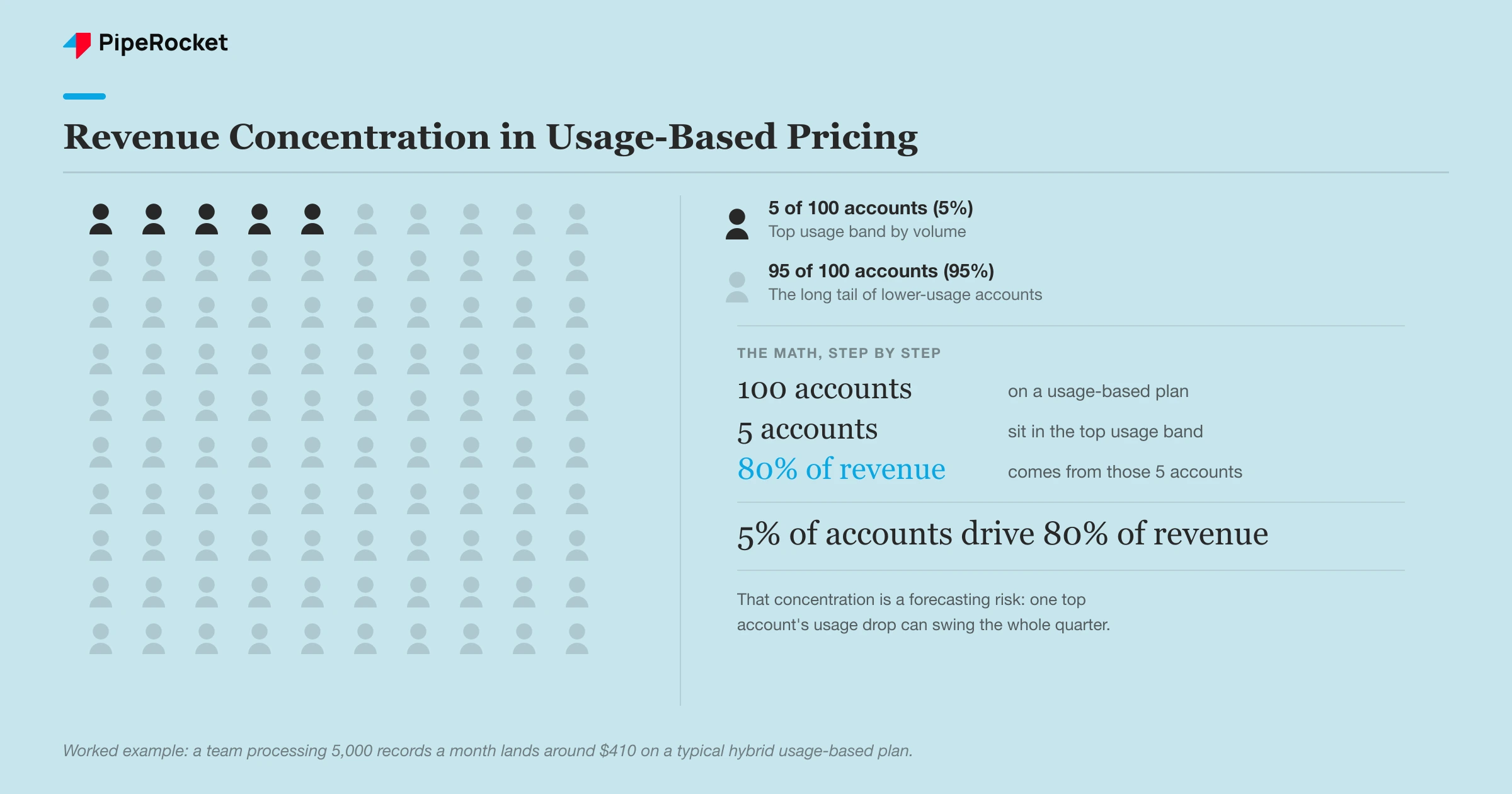
A usage-based model that’s working shows expansion revenue climbing steadily across the base, not a few whale accounts propping up the number while everyone else sits flat on their included allowance.
How Do You Communicate Usage-Based Pricing to Customers?
Communicate usage-based pricing by showing usage in real time inside the product, alerting customers before they hit a cap, and putting worked pricing examples on the page itself. These three tactics prevent more disputes than any change to the pricing math.
Usage-based pricing fails at the communication layer more often than it fails at the math layer. A customer who can’t see their usage in real time has no way to trust the invoice that shows up 30 days later, so the pricing page and the in-app experience have to do as much work as the billing logic itself.
Show usage before you show the bill
Customers need a running total of their usage inside the product, not just on the invoice. A dashboard that shows current consumption against the included allowance, updated in something close to real time, turns a monthly surprise into a number the customer has been tracking all along.
Without this, the first time a customer learns they’re near an overage is the day the charge appears. That’s the moment trust breaks, even if the pricing itself was fair and clearly documented at signup.
Set usage alerts before customers hit the ceiling
Automated alerts give customers time to either adjust behavior or upgrade before an overage lands. This single feature does more to reduce billing disputes than almost any change to the pricing structure itself, because it turns a passive bill into an active decision the customer made.
- Alert at 75% of an included allowance, giving the customer early warning while there’s still room to adjust.
- Alert at 90%, prompting a clear decision to upgrade or throttle usage before an overage charge appears.
Put real worked numbers on the pricing page itself
A pricing page that only explains the model in the abstract, “pay for what you use”, leaves buyers doing mental math during evaluation instead of during the sale. Showing worked examples on the page itself, like “a team processing 5,000 records a month lands around $410”, gives prospects a number to anchor on before they ever talk to sales.
This is also where usage-based pricing pages tend to underperform on search. Buyers actively compare “[category] pricing” and “[competitor] vs [competitor] pricing” before they ever request a demo, and a pricing page built only for existing customers to check their bill misses that entire evaluation-stage audience.
Why PipeRocket Digital Helps SaaS Teams Win on Pricing Pages
Usage-based pricing only pays off if the buyers evaluating it can actually find and understand your pricing page. We build the SEO and paid search programs that get “[product] pricing” and “[product] vs [competitor] pricing” queries in front of the buyers actively comparing options, through our SaaS SEO and SaaS PPC work.
If you’re rolling out a new pricing model and want the traffic to match it, reach out to PipeRocket .
Frequently Asked Questions
What is SaaS usage-based pricing?
SaaS usage-based pricing helps software companies charge based on actual consumption, tying invoices to metrics like API calls, transactions, or compute instead of a flat seat-based fee. The customer’s cost moves up or down depending on how much of the product they used in a given period.
It’s common in infrastructure, API-first, and AI-heavy products where the cost to serve scales directly with customer activity.
Does usage-based pricing increase SaaS revenue?
It can, but only when the product genuinely gets more valuable the more a customer uses it. Usage-based pricing captures expansion revenue automatically as customers grow into the product, without needing a manual upsell conversation.
It can also suppress revenue if the metric is priced too generously or if most customers never cross their included allowance. The effect depends entirely on how the metric and pricing bands are set, not on the model itself.
Can you give an example of usage-based pricing?
A hybrid plan that includes 10,000 API calls for $299/month and bills additional calls at $0.01 each is a common example. Named vendors include Snowflake (per compute credit), Twilio (per message), AWS (metered infrastructure), and Stripe (per transaction).
Can usage-based pricing work alongside a subscription plan?
Yes, and for most SaaS companies this hybrid approach is the more common outcome than pure usage-based billing. A base subscription covers core access and a set usage allowance, then usage-based charges apply once a customer exceeds that allowance or uses a specific metered feature like AI generation.
This gives finance the predictable base revenue subscriptions provide while still letting heavy users pay proportionally more as their usage grows.