150+ Landing Page Statistics (Updated October 2026)
 Kamaraj Mathiarasan (Kim)
Last updated on
Kamaraj Mathiarasan (Kim)
Last updated on
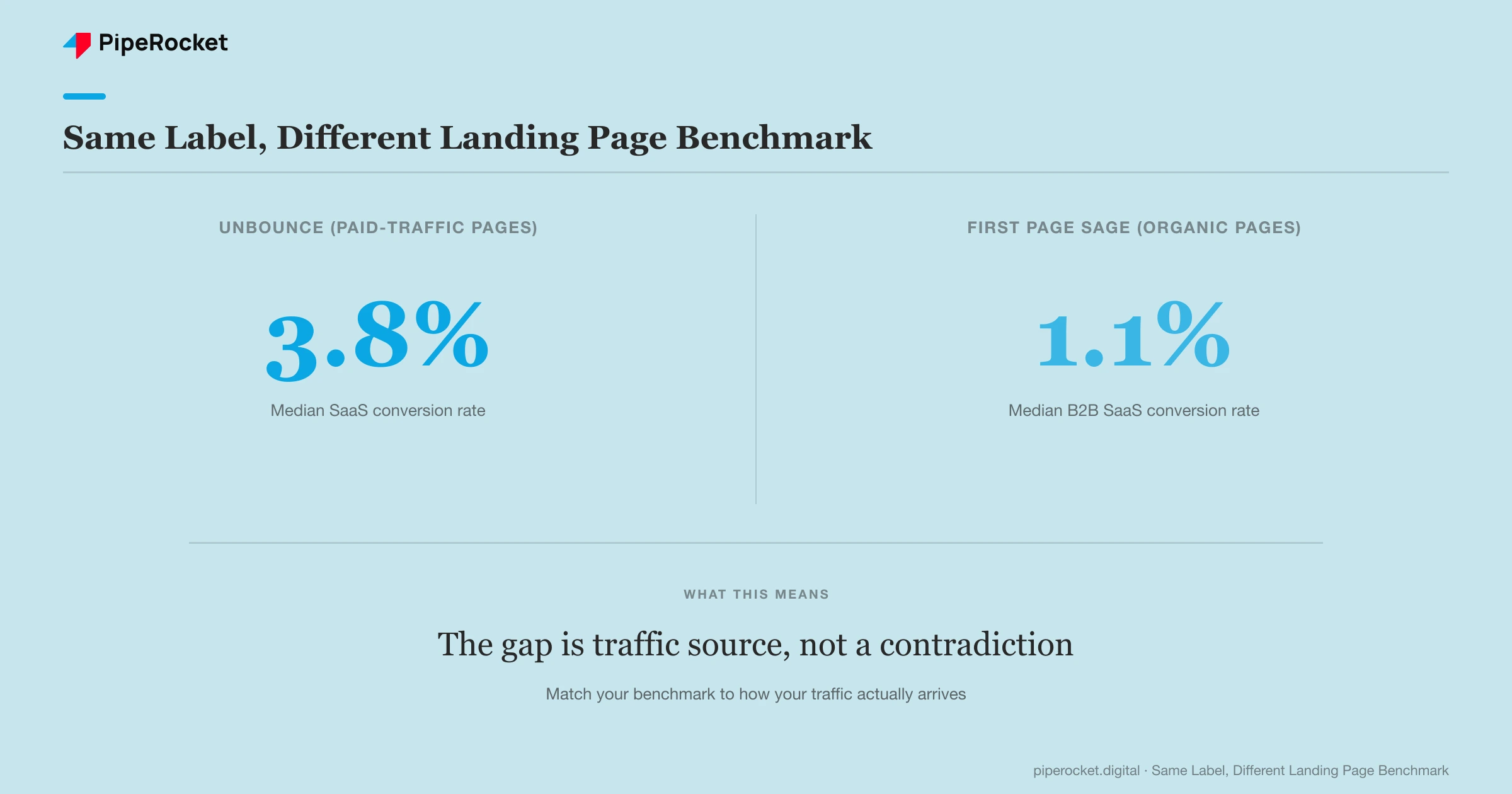
Unbounce puts the median SaaS landing page conversion rate at 3.8%. First Page Sage puts it at 1.1%. Same industry label, a 3.5x gap, because one dataset measures paid-traffic pages built for immediate conversion and the other measures organic-SEO-driven pages with colder intent. Neither number is wrong. They’re measuring different things.
We pulled the most recent named landing page research available, from Unbounce, HubSpot, First Page Sage, and Nielsen Norman Group, and checked every figure against a live, dated source. Several widely repeated stats trace back to studies from before 2020 still being presented as current. We flag those explicitly.
Key Takeaways
- The median landing page conversion rate across industries is 6.6%, per an analysis of 41,000 landing pages, though a separate B2B-specific dataset puts organic-lead-gen conversion closer to 1% to 3.5% by industry.
- A 0.1-second improvement in mobile speed lifted retail conversions by 8.4%, and 53% of mobile visits abandon a page that takes longer than 3 seconds to load.
- Reducing a form from 11 fields to 4 fields produced a 120% increase in submissions in one documented case, though cutting fields without adding clarity can backfire.
- Displaying customer reviews can lift conversion by up to 270%, and 92% of consumers read reviews before purchasing, though fewer than 1 in 4 marketers include social proof on their landing pages.
- Legal and financial-services landing pages convert better on mobile than desktop, directly contradicting the common assumption that desktop always wins for lead-gen pages.
- The classic “40+ landing pages generate 12x more leads” claim traces back to a 101-person survey from 2012 still being recirculated as current.
Landing Page Conversion Rate Benchmarks by Industry
- The median landing page conversion rate across all industries is 6.6%, based on an analysis of 41,000 landing pages, 464 million visitors, and 57 million conversions. A rate of 10% or higher is generally considered good, though the threshold varies sharply by industry. (Unbounce, Conversion Benchmark Report )
- By industry (Unbounce): Ecommerce 4.2% median, SaaS 3.8%, Professional Services 6.1%, Financial Services 8.3%, Entertainment 12.3%. (Unbounce )
- A separate dataset covering 80-plus clients running organic SEO campaigns over 2 to 5 years puts B2B conversion rates much lower by industry: Legal Services 3.4%, Financial Services 1.9%, B2B SaaS 1.1%, Automotive 1.0%. (First Page Sage, Landing Page Conversion Rates by Industry )
- For professional-services landing pages, email traffic converts at nearly 14%, versus 4.4% for paid social traffic on the same page type. (Unbounce )
Our take: the 3.5x gap between Unbounce’s SaaS number (3.8%) and First Page Sage’s B2B SaaS number (1.1%) comes down to a traffic-source difference, not a contradiction. Unbounce measures paid-traffic pages built for immediate action. First Page Sage measures organic, lower-intent lead-gen pages over a multi-year window. There’s no single “good” landing page conversion rate . There’s only the number that matches how your traffic actually arrives.
Page Speed and Load Time Impact on Conversion
- A 0.1-second improvement in mobile site speed lifted retail conversions by 8.4% and average order value by 9.2%, across an analysis of 37 brand sites and 30 million-plus user sessions. (Deloitte x Google, Milliseconds Make Millions )
- 53% of mobile visits are abandoned if a page takes longer than 3 seconds to load. Bounce probability rises 32% as load time goes from 1 to 3 seconds, and 90% at 1 to 5 seconds. (Google/SOASTA mobile speed research )
- A page that loads in 1 second is commonly cited as converting roughly 3x higher than one loading in 5 seconds, in an analysis spanning 94 million page views across 10 ecommerce sites. (Portent site speed study )
Our take: the Deloitte and Google speed studies are both from 2017 to 2020, and they’re still the standard citation for “speed equals revenue” because nobody’s published a fresher large-scale version since. That doesn’t make the finding wrong. It makes it worth remembering that page-speed advice in this industry is running on data that predates most of the AI-generated pages being built today.
Form Length and Field Count Impact on Conversion
- HubSpot’s analysis of over 40,000 landing pages found conversion drops as form fields increase, but not as steeply as expected for simple single-line text fields. Multi-line textareas and dropdown fields hurt conversion far more than plain text fields do. (HubSpot, Which Types of Form Fields Lower Landing Page Conversions )
- Reducing a contact form from 11 fields to 4 fields produced a 120% increase in submitted forms in one documented case study. (Imagescape case study )
- In a separate case, reducing a form from 9 fields to 6 fields caused a 14% decrease in conversions. Restoring all 9 fields, but adding explanatory text to each one, is what actually fixed conversion. (Michael Aagaard/ContentVerve case study, via CXL )
Our take: the second case study matters more than the first. Cutting form fields is the advice every landing page listicle repeats, but the case where cutting fields backfired shows the real lever is clarity, not count. A confusing 4-field form can convert worse than a clear 9-field one.
Landing Page Design Elements That Correlate With Conversion
- An analysis of over 330,000 CTAs found personalized CTAs convert 202% better than generic ones. (HubSpot, CTA statistics )
- Displaying customer reviews can boost conversion by up to 270%, per Northwestern University’s Spiegel Research Center, and 92% of consumers read reviews before purchasing, though fewer than 1 in 4 marketers include social proof on their landing pages. (Spiegel Research Center, Northwestern University )
- Extensive CTA button-color testing, including the widely cited red-versus-green comparison, has never established a universal best color. What determines the effect is contrast with the surrounding page, not the hue itself. (CXL, CTA button color testing )
- Nielsen Norman Group’s eyetracking research, spanning over 500 participants and 750-plus hours of testing across 13 years, found most visitors scan rather than read web content word for word. (Nielsen Norman Group, How People Read on the Web )
Our take: the button-color debate is a solved question that the industry keeps re-litigating. Every serious source agrees there’s no winning color, only contrast with context, yet most “2026 landing page statistics” roundups still run the decade-old red-versus-green anecdote as current best practice.
Mobile Landing Page Performance
- Legal landing pages convert 21% on mobile versus 15.9% on desktop, and financial-services pages convert 27.8% better on mobile than desktop, directly contradicting the assumption that desktop always outperforms mobile for lead-gen pages. (Unbounce )
AI’s Role in Landing Page Creation and Optimization
- 66% of marketers globally use AI in their role, and among those using generative AI for content, 50% use it to write marketing copy and 48% to create images. Only 4% use AI to write entire pieces of content independently, so it’s overwhelmingly an assist tool rather than a replacement. (HubSpot, State of AI Report )
- Unbounce’s AI-driven page-variant routing tool produced a 30% average lift in sales and signups for customers using it. (Unbounce, Smart Traffic )
Number of Landing Pages vs. Lead Volume
- Businesses with 10 to 15 landing pages see conversions 55% higher than businesses with fewer than 10, and businesses with 40-plus landing pages see conversion increases exceeding 500%, per a survey of 101 marketing and advertising professionals. (HubSpot, Why You Need to Create More Landing Pages )
Our take: this stat gets cited constantly with an “updated” timestamp, but the underlying survey behind it is from 2012, with 101 respondents. It’s not necessarily wrong. It’s just worth knowing you’re citing a 14-year-old sample size of 101 when you repeat it.
What This Means for Your Landing Page Strategy in 2026
- Match your benchmark to your traffic source. A paid-traffic conversion benchmark and an organic-lead-gen benchmark for the same industry can differ by more than 3x. Compare against the dataset that matches how your traffic arrives.
- Fix form clarity before cutting form length. A confusing short form can convert worse than a clear long one. Add explanatory text before removing fields.
- Don’t assume desktop wins. Legal and financial-services data show mobile outperforming desktop. Check your own numbers by device before optimizing around an assumption.
- Add social proof if you haven’t. The gap between how many consumers read reviews (92%) and how many landing pages include them (under 25%) is one of the largest, most fixable gaps in this research.
If you want landing pages built around what your own traffic actually converts on, our SaaS SEO agency team can show you where to start. Talk to us .