150+ Marketing Statistics (Updated October 2026)
 Kamaraj Mathiarasan (Kim)
Last updated on
Kamaraj Mathiarasan (Kim)
Last updated on
Gartner says marketing budgets sit at 7.7% of company revenue in 2025. Deloitte says 9.4%, for the same year. That gap alone tells you something most “marketing statistics” roundups won’t: even the most authoritative surveys in this industry disagree by double digits on the most basic benchmark a CMO needs, because they’re surveying different sizes of company.
We pulled the most recent named marketing research available, from Gartner, Deloitte, Spencer Stuart, Salesforce, HubSpot, and Content Marketing Institute, and checked each figure against a live, dated source. Where a widely repeated stat turned out to have no traceable origin, we dropped it instead of repeating it.
Key Takeaways
- Marketing budgets flatlined at 7.7% of company revenue for a second consecutive year in 2025 per Gartner, though Deloitte’s own 2025 survey put the figure at 9.4%.
- Paid media is the single largest budget line at 30.6% of marketing spend, equal to 2.4% of company revenue.
- The average B2B buying committee now runs 6 to 10 stakeholders, up from 5 to 7 in 2017, and can reach 14 to 23 on deals above $1 million.
- 67% of B2B buyers prefer a rep-free buying experience, yet 69% still turn back to a human sales rep specifically to validate AI-generated research.
- Average Fortune 500 CMO tenure is 4.3 years, the shortest of any C-suite role, and 34% of Fortune 500 companies now lack an enterprise-wide CMO at all.
- 75% of marketing organizations use some form of AI, but only 13% use agentic AI specifically.
- The most repeated stat in this entire category, that aligned sales and marketing teams grow revenue 208% faster, has no traceable primary source. We could not verify it and are not repeating it here.
Marketing Budget as a Share of Revenue
- Marketing budgets flatlined at 7.7% of company revenue for a second consecutive year in 2025, per Gartner’s CMO Spend Survey of 402 CMOs and marketing leaders across North America, the UK, and Europe. Half of CMOs reported budgets at 6% of revenue or less. (Gartner, May 2025 )
- 59% of CMOs said they had insufficient budget to execute their 2025 strategy, an improvement of 5 points from 2024. (Gartner, May 2025 )
- Paid media accounts for 30.6% of marketing budgets, equal to 2.4% of company revenue, the single largest allocation category. (Gartner, May 2025 )
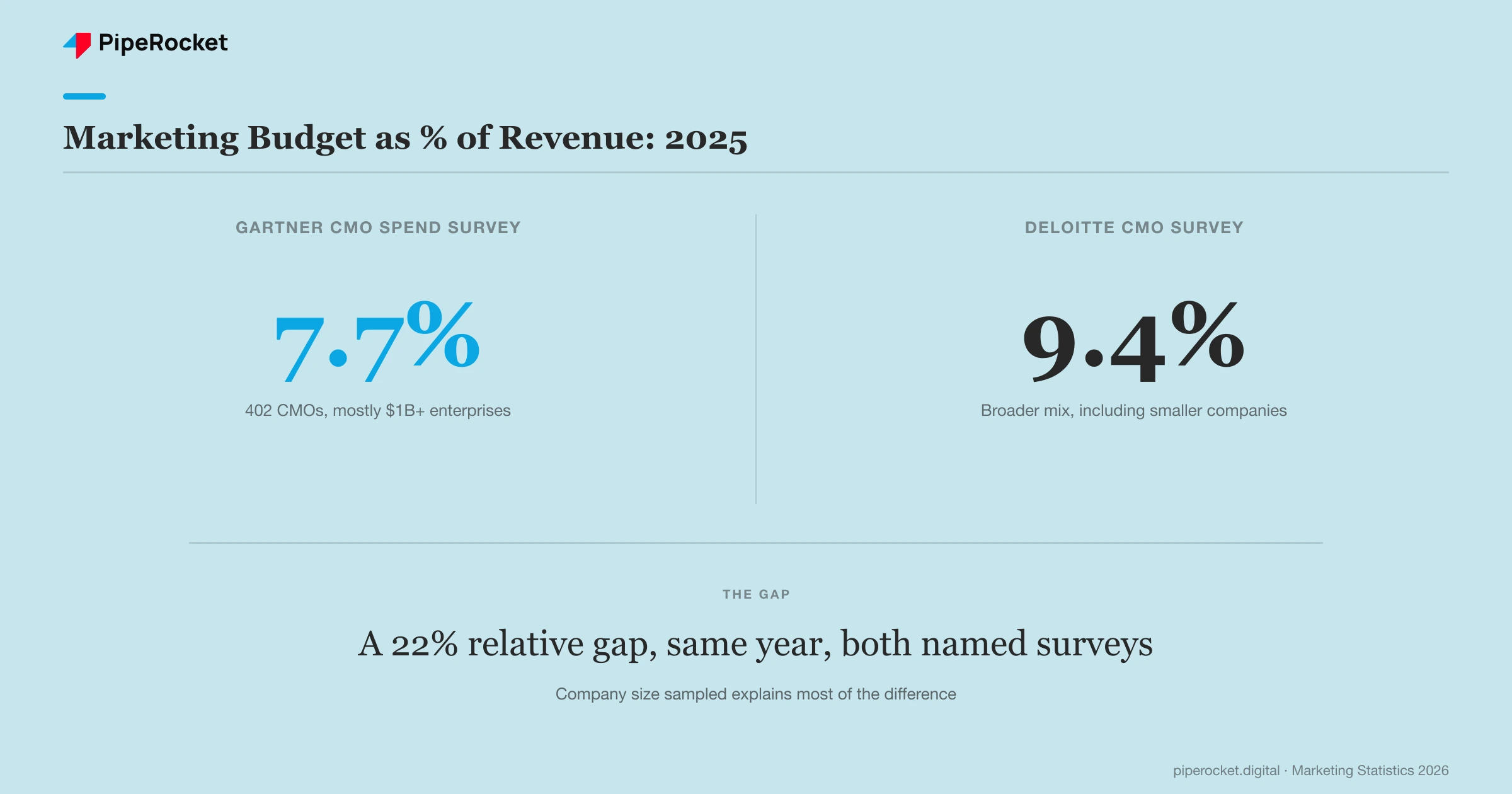
- Deloitte’s own CMO Survey put total marketing budgets at roughly 9.4% of company revenue in 2025. By business type, B2B product companies averaged 6.4%, B2B service companies averaged 9.0%, and B2C product companies averaged 15.5%. (Deloitte Digital, May 2025 )
Our take: Gartner and Deloitte published two “authoritative” 2025 marketing budget numbers that disagree by roughly 22% in relative terms, mostly because Gartner’s respondent pool skews toward $1 billion-plus enterprises while Deloitte’s includes far more smaller companies, whose budgets tend to run higher as a percentage of revenue. There’s no single right answer to “what percent of revenue should marketing get.” There’s only the right answer for a company your size, which neither survey alone will tell you.
Marketing Budget Allocation and Martech Spend
These are the digital marketing statistics behind where budget actually goes once it clears the top-line percentage above: martech tools, AI spend, and content investment.
- 62.1% of martech survey respondents now use more marketing technology tools than they did two years ago, and 68.6% of organizations use generative AI tools as part of their martech stack. (MarTech “State of the Stack 2025,” March 2025 )
- Data integration is the single largest martech challenge, cited by 65.7% of respondents, with budget constraints the top barrier to adopting new tools. Only 56.8% report being satisfied with their current stack. (MarTech, March 2025 )
- 45% of B2B marketers plan to increase AI-powered marketing tool spending in 2026, the top-ranked investment priority, while only 9% plan to increase spending on human headcount, the lowest-ranked priority. (Content Marketing Institute, 2024 fieldwork for 2025 outlook )
- 46% of B2B content marketers expect their content budget to increase in 2025, 41% expect it flat, and 8% expect a decrease. For the full breakdown of content-specific budget, format, and AI-trust data, see our content marketing statistics report. (Content Marketing Institute )
Our take: the 45%-versus-9% split (AI tools up, headcount down) is the clearest signal in this data about where marketing leaders think the next unit of output comes from. Whether that bet pays off depends entirely on trust in the output, which the AI adoption data below suggests is nowhere close to matching adoption yet.
B2B Buying Committee and Buyer Behavior
- The average B2B buying committee now runs 6 to 10 stakeholders, up from 5 to 7 in 2017, and deals above $1 million can involve 14 to 23 stakeholders. (Gartner B2B buying research )
- 67% of B2B buyers prefer a rep-free purchasing experience, per a Gartner survey dated March 2026, up from 61% in the June 2025 wave of the same research. (Gartner, March 2026 )
- 69% of B2B buyers say they turn back to a human sales rep specifically to validate AI-generated research and insights. (Gartner, May 2026 )
- 74% of B2B buyer teams show “unhealthy conflict” somewhere within their own decision-making group during the purchase process. (Gartner, May 2025 )
- B2B buyers spend, on average, only about 17% of their total purchase-journey time actually meeting with potential suppliers. The rest happens independently. (Gartner )
- 60% of B2B “market leader” organizations (growing share 10%-plus year over year) reported double-digit revenue growth in 2025, versus just 21% of laggards, tied to combining AI, personalization, and tighter sales-led account-based marketing governance. (McKinsey, 2026 Global B2B Pulse Survey )
Our take: “buyers don’t want to talk to sales anymore” is the lazy version of this story. The real pattern is that buyers want to self-serve most of the journey and then bring in a human specifically to validate what the AI told them. Building a self-serve research path without a fast, credible human check-in at the end misses the part of the pattern that actually converts.
Marketing Team Structure, Headcount, and CMO Trends
- Average Fortune 500 CMO tenure is 4.3 years, still the shortest average tenure of any C-suite role, against an overall C-suite average of 4.9 years. (Spencer Stuart CMO Tenure Study 2025, March 2025 )
- Only 66% of Fortune 500 companies had a C-suite marketing leader in 2024, down nearly 8 percentage points from 2023, meaning 34% now lack an enterprise-wide CMO. (Spencer Stuart, March 2025 )
- Only 40% of Fortune 500 marketing leaders actually hold the title “Chief Marketing Officer.” 33% carry a marketing title without “chief,” 16% combine marketing with another function, and 11% have no “marketing” in their title at all. (Spencer Stuart, March 2025 )
- 53% of Fortune 500 CMOs are women, up 12 percentage points since 2020. 65% of departing CMOs move to lateral or upward roles, and 10% go on to become CEOs. (Spencer Stuart, March 2025 )
- 39% of CMOs planned to reduce labor costs and cut agency allocations as part of managing their 2025 budget. (Chief Marketer, coverage of Gartner’s 2025 CMO Spend Survey )
Our take: the title data is the underrated stat here. 60% of Fortune 500 marketing leaders don’t carry a clean “CMO” title, and 34% of companies have no enterprise-wide marketing leader at all. Marketing’s seat at the executive table is less standardized than the “CMO” headline suggests, which helps explain why average tenure keeps running shorter than every other C-suite function.
AI Adoption in Marketing Teams
- 75% of marketing organizations now use at least one form of AI, per a Salesforce survey of 4,450 marketing professionals fielded October to November 2025. (Salesforce State of Marketing, 2026 )
- Only 13% of marketers currently use agentic AI specifically. Of those using or planning to use AI agents, 82% expect a major or moderate ROI improvement. (Salesforce State of Marketing, 2026 )
- 98% of marketing teams already using AI still report at least one data-related barrier to personalization, whether data silos, excess volume, or poor quality. (Salesforce State of Marketing, 2026 )
- 81% of B2B content marketers use generative AI tools, up from 72% the prior year, but only 19% have fully integrated AI into daily workflows. Just 4% report high trust in AI outputs, versus 67% reporting only medium trust. (Content Marketing Institute )
- 92% of marketers say AI has already impacted their role in some way, while 54% say they feel overwhelmed by the prospect of implementing it into their processes. (HubSpot State of Marketing 2025 )
Our take: every AI adoption number in this section tells the same story from a different angle: usage is nearly universal, but trust and integration lag far behind. 75% to 92% of marketers have touched AI somewhere in their workflow, yet only 13% use it at the agentic level, only 19% have it fully integrated, and just 4% trust its output highly. Adoption isn’t the bottleneck anymore. Confidence in the output is.
Marketing Attribution and ROI Measurement Challenges
- 56% of B2B content marketers struggle to attribute ROI to their content, and the same 56% struggle to track the customer journey. Only 51% agree their organization measures content effectiveness well. (Content Marketing Institute )
- Only 29% of B2B marketers rate their content marketing strategy as extremely or very effective, and 58% call it only moderately effective. Among underperformers, 42% cite a lack of clear goals as the primary obstacle. (Content Marketing Institute )
Our take: the two most commonly repeated sales-and-marketing-alignment stats in this entire industry, that aligned teams grow revenue 208% faster and that misalignment costs businesses $1 trillion a year, could not be traced to any dated, named primary study. The 208% figure appears to originate with a MarketingProfs post from around 2010 and has been re-cited ever since, sometimes mis-dated to make it look current. The $1 trillion figure gets attributed to IDC, LinkedIn, or Harvard Business Review depending on which page you land on, with no consistent source. We’re not repeating either one, and we’d treat any page that states them as fact with real skepticism.
What This Means for Your Marketing Strategy in 2026
- Pick a budget benchmark that matches your company size, rather than the most frequently cited one. Gartner and Deloitte’s own 2025 surveys disagree by over 20% in relative terms because they sample different company sizes.
- Build the human validation step into any AI-driven buyer journey. Buyers are self-serving more of their research, but a majority still want a person to check the AI’s work before they commit.
- Treat AI trust as the real adoption metric, over raw usage. Usage rates above 75% mean little when trust in output sits near single digits. Measure whether your team’s AI output actually holds up, beyond whether they’re using the tools.
- Stop repeating stats you can’t source, especially the sales-marketing alignment numbers. If a figure has no traceable origin, it undermines the credibility of everything else on the page next to it.
If you want marketing benchmarks built from real B2B SaaS accounts instead of blended cross-industry averages, our SaaS marketing agency team can show you where your own program stands. Talk to us .