150+ Content Marketing Statistics (Updated October 2026)
 Kamaraj Mathiarasan (Kim)
Last updated on
Kamaraj Mathiarasan (Kim)
Last updated on
95% of B2B marketers now use AI somewhere in their content marketing process, yet only 4% report high trust in what it produces. That gap between adoption and trust is the real story in content marketing right now, more than any single “AI is taking over content” headline.
We pulled the most recent named content marketing research available, from Content Marketing Institute, Orbit Media, HubSpot, Wyzowl, and Gartner, and checked each figure against a live, dated source. Several widely repeated ROI stats had no traceable origin. We dropped them rather than repeat them.
Key Takeaways
- 76% of B2B organizations have a dedicated content marketing team, and 54% of those teams run just two to five people.
- Video is the top-performing B2B content format, cited as effective by 58% of marketers, ahead of case studies at 53%.
- 56% of B2B marketers say attributing ROI to content is difficult, and the same 56% struggle to track the customer journey.
- Bloggers now average 1,333 words per post and spend 3 hours 25 minutes writing one, down from over 4 hours in 2022.
- 95% of B2B marketers use AI somewhere in content marketing, but only 4% report high trust in AI-generated output.
- The most-used B2B content channels (organic social, the corporate blog) are not the ones rated most effective (in-person events, webinars), a real mismatch between effort and results.
- The oft-cited “content marketing generates 3x more leads at 62% lower cost than outbound” statistic traces to a decade-old, now-dead infographic. We could not verify it and are not repeating it here.
Content Marketing Budget, Spend, and ROI
- 46% of B2B marketers expected their content marketing budget to increase in 2025, and 41% expected it to stay flat. (Content Marketing Institute, 2024 fieldwork for 2025 outlook )
- Within that growth, 61% planned increased investment in video, and 52% planned increased spending on thought leadership content. (Content Marketing Institute )
- For the 2026 outlook, 45% of B2B marketers named increasing AI-tool investment their top budget priority, while only 9% planned to grow human headcount, the lowest-ranked priority. (Content Marketing Institute, 2025 fieldwork for 2026 outlook )
- 80% of “very successful” companies in a Semrush content marketing survey have a documented content strategy, versus 52% of unsuccessful companies. Very successful companies were also more than twice as likely to put over 10% of total marketing budget toward content. (Semrush, State of Content Marketing )
- 80% of marketers plan to maintain or increase their content budget in 2026. (HubSpot State of Marketing 2026 )
Our take: the gap between successful and unsuccessful companies here isn’t subtle. Companies with a documented strategy outnumber those without one by roughly 3 to 2 among the “very successful” group, and that gap flips almost entirely among unsuccessful companies. A written strategy correlates with success more strongly than almost any tactic choice in this research.
Content Format and Type Performance
- Video is the top-performing B2B content format at 58% reporting effectiveness, ahead of case studies at 53% and ebooks/whitepapers at 45%. (Content Marketing Institute )
- The most-used B2B content types are short articles or posts at 92%, video at 76%, and case studies at 75%. (Content Marketing Institute )
- 62% of B2B marketers say gated content, whitepapers and case studies specifically, is their highest-converting format. (Semrush, State of Content Marketing )
- Short-form video delivers the highest marketing ROI of any format cited by marketers, at 49%, ahead of long-form video at 29%. (HubSpot State of Marketing 2026 )
- 91% of businesses now use video as a marketing tool, and 93% consider it a strategically important part of their marketing. (Wyzowl, State of Video Marketing 2026 )
- 82% of video marketers say video gives them good ROI, down from 93% the year before. Businesses using video grow revenue 49% faster than those that don’t. (Wyzowl, 2026 )
- Videos under 60 seconds generate 2.5x more engagement per impression than any other video length. 71% of video marketers say 30 seconds to 2 minutes is the most effective length. (Wyzowl, 2026 )
- 73% of Americans age 12 and up have consumed a podcast, an estimated 210 million people, and 55% are now monthly podcast consumers. Among 18 to 34 year olds, weekly podcast reach now equals weekly TV reach at 52% each. (Edison Research, The Infinite Dial 2025 )
Our take: podcasts closing the reach gap with TV among 18 to 34 year olds is the most underused stat in this whole category. Most B2B content budgets still treat video as the default growth format and audio as an afterthought, but the reach data no longer supports treating them that differently for a younger buyer.
B2B Content Marketing and Buyer Content Consumption
- B2B buyers used an average of seven information sources during a recent purchase, and 45% used generative AI, primarily to research vendors. (Gartner, survey of 645 B2B buyers, 2025 )
- 69% of B2B buyers still want to validate AI-generated insights with a human sales rep before deciding, while a separate survey wave found 61% prefer a completely rep-free buying experience. (Gartner, 2025 to 2026 )
- 78% of B2B buyers say they place more emphasis on the trustworthiness of a content source than they did a year prior, and 65% consciously prioritize content from credible industry influencers. (Demand Gen Report )
- 95% of “hidden” B2B buyers (influential but not the named decision-maker) say strong thought leadership makes them more receptive to sales and marketing outreach, and 79% say they’re more likely to support proposals from vendors publishing it regularly. (Edelman-LinkedIn, 2025 B2B Thought Leadership Impact Report, 1,934 respondents )
- 71% of hidden buyers say thought leadership is more effective than traditional marketing materials at demonstrating a vendor’s value. More than 40% of B2B deals stall due to internal misalignment within the buying committee . (Edelman-LinkedIn, 2025 )
Our take: the “hidden buyer” data matters more than most content strategies account for. 95% of people who influence a deal without being the named decision-maker respond to thought leadership , yet most B2B content programs write exclusively for the person who signs the contract and ignore everyone else in the room who has to be convinced first.
Content Marketing Team Structure and Publishing Frequency
- 76% of B2B organizations have a dedicated content marketing team or person, and 54% of those teams run just two to five people. (Content Marketing Institute )
- 27% of B2B content teams expected to grow headcount in 2025, rising to 38% among self-identified top performers. (Content Marketing Institute )
- Bloggers now average 1,333 words per post and spend 3 hours 25 minutes writing one, down from 4 hours 10 minutes in 2022. 50% publish two to four times per month. (Orbit Media, 2025 Blogging Statistics, 808 respondents )
- Only 9% of bloggers publish posts longer than 2,000 words, but 39% of those who do report strong results, versus a 21% baseline strong-results rate across all respondents. (Orbit Media, 2025 )
- Posts edited by a dedicated human editorial team report strong results 24% of the time, versus 21% for AI-assisted editing alone. (Orbit Media, 2025 )
Our take: the writing-time drop (over 4 hours to 3 hours 25 minutes since 2022) tracks almost exactly with AI-tool adoption, but the strong-results rate hasn’t climbed to match. Teams are producing faster without producing meaningfully better, the same adoption-versus-output gap showing up across every content stat in this research.
AI’s Impact on Content Creation
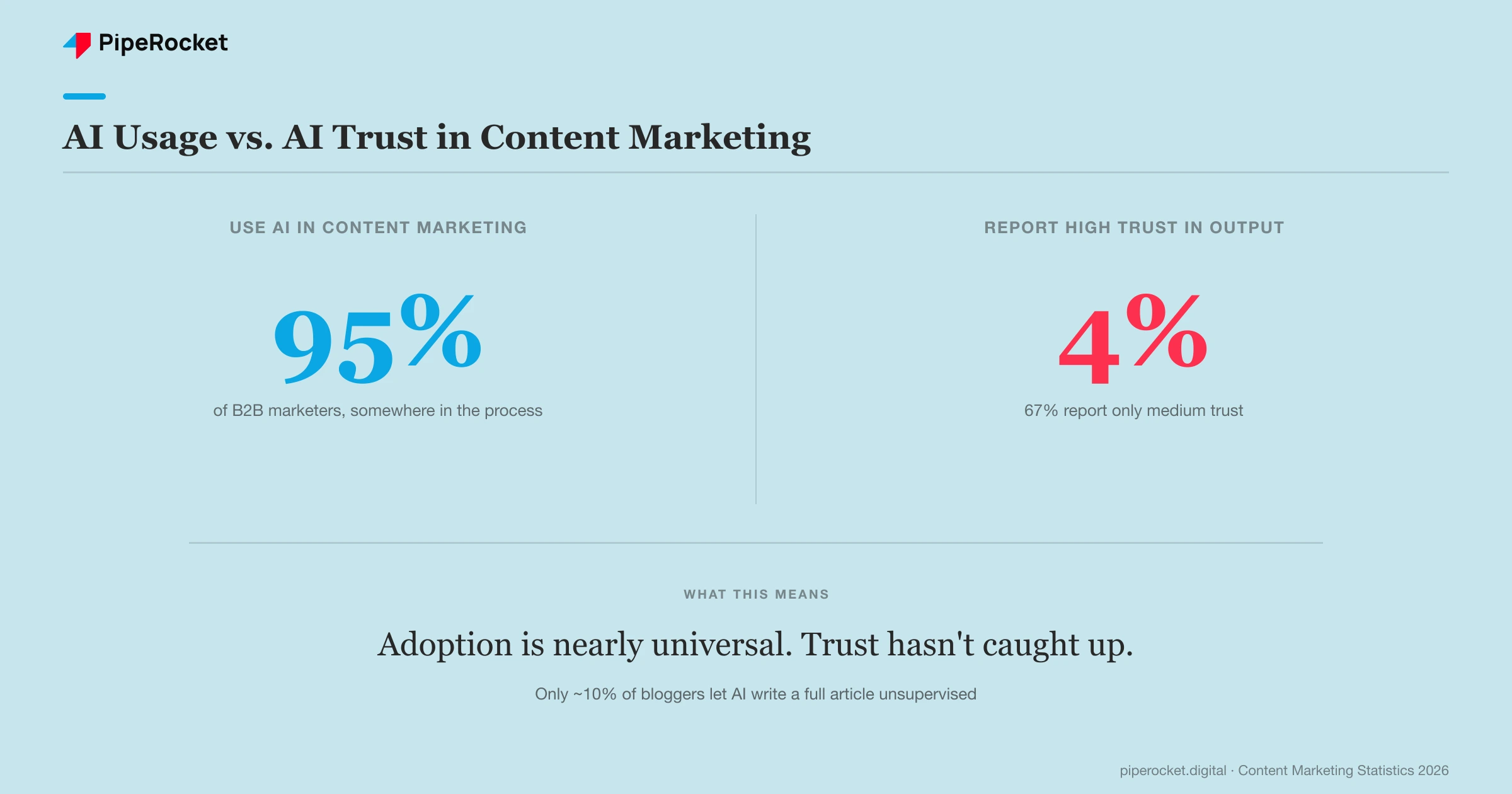
- 95% of B2B marketers now use AI somewhere in their content marketing program. (Content Marketing Institute, 2025 fieldwork for 2026 outlook )
- 81% of B2B marketers use generative AI tools, up from 72% the prior year, but only 19% say AI is fully integrated into daily workflows versus 54% using it ad hoc. (Content Marketing Institute )
- Only 4% of B2B marketers report high trust in AI-generated content, and just 17% rate its quality as excellent or very good. (Content Marketing Institute )
- AI use among bloggers reached 95%, up from 35% just 24 months earlier, but only about 10% use it to write a complete article outright. Most use it for idea generation and edit suggestions instead. (Orbit Media, 2025 )
- 80% of marketers now use AI for content creation and 75% use it for media production, per HubSpot, though 71% say they still struggle to make AI-assisted content perform well. (HubSpot State of Marketing 2026 )
- An analysis of 20,000 URLs found AI-written content ranks almost identically to human-written content in Google’s top 10, appearing in 57% of top-10 results versus 58% for human-authored content. (Semrush analysis )
Our take: the trust gap is the headline most competitor roundups miss. 95% of marketers use AI somewhere in content, but only 4% trust its output highly, and only about 10% of bloggers let it write a full article on its own. Near-universal usage and near-universal distrust are coexisting right now, not trading off against each other.
Content Measurement, Attribution, and Effectiveness Challenges
- 56% of B2B marketers say attributing ROI to content is difficult, and the same 56% struggle to track the customer journey. Only 51% agree their organization measures content performance effectively. (Content Marketing Institute )
- Only 29% of B2B marketers rate their overall content strategy as extremely or very effective, and 58% call it only moderately effective. (Content Marketing Institute )
- Top-performing content teams (22% of respondents) attribute their success to understanding their audience (82%), producing high-quality content (77%), and demonstrating industry expertise (70%). (Content Marketing Institute )
Distribution and the Usage-Versus-Effectiveness Gap
- LinkedIn is rated the most valuable social platform for B2B content distribution by 85% of marketers, far ahead of Facebook at 28%. 68% increased their LinkedIn usage year over year. (Content Marketing Institute )
- The most-used B2B distribution channels are organic social at 89%, the corporate blog at 84%, and email newsletters at 71%. But the channels rated most effective are in-person events at 52%, webinars at 51%, and email at 42%, a real mismatch between usage and effectiveness. (Content Marketing Institute )
| Most-used channels | Rated most effective |
|---|---|
| Organic social (89%) | In-person events (52%) |
| Corporate blog (84%) | Webinars (51%) |
| Email newsletters (71%) | Email (42%) |
Our take: this usage-versus-effectiveness gap is the single most useful finding in this research. Teams are pouring effort into organic social and blogging, the two most-used channels, while rating in-person events and webinars as more effective and using them less. Before adding another channel, check whether you’re already over-invested in one that isn’t working as well as it feels.
What This Means for Your Content Strategy in 2026
- Write your content strategy down. Documented-strategy companies dominate the “very successful” tier in every survey that measured it, and the correlation is stronger than any single format or channel choice.
- Build content for the whole buying committee, beyond just the signer. Hidden buyers respond strongly to thought leadership, and over 40% of B2B deals stall on internal disagreement your content could be addressing.
- Don’t confuse AI usage with AI-ready output. Trust and full workflow integration both lag adoption by a wide margin. Check quality before you scale volume.
- Audit your channel mix against effectiveness, rather than habit. The channels B2B teams use most (social, blog) aren’t the ones they rate as most effective (events, webinars). Rebalance toward what actually works over what’s already easiest to keep doing.
- Stop repeating ROI stats you can’t source. The “3x more leads at 62% lower cost” claim traces to a dead, decade-old infographic. If you can’t find the study, don’t cite the number.
If you want a content program built around what actually converts for B2B SaaS instead of a generic content calendar , our content marketing agency team can show you where the gaps are. Talk to us .