The Ultimate Guide to B2B Content Marketing
 Kamaraj Mathiarasan (Kim)
Last updated on
Kamaraj Mathiarasan (Kim)
Last updated on
Do you feel like you’re spending more on ads but getting less in return?
It is a brutal reality for modern businesses. B2B buyers have become almost immune to anything that looks or sounds like traditional marketing. They’ve stopped picking up calls, they scroll past ads, and they only talk to sales when they’ve already made their decision.
So if you aren’t influencing them during this invisible research phase, you have already lost the deal. This is where B2B content marketing comes in.
Done right, it turns your website into a salesperson that works 24/7, attracting better leads, shortening sales cycles, and lowering acquisition costs. In this guide, let’s see a concrete b2b content marketing plan to turn strangers into high-value customers.
TL;DR
- B2B content marketing creates and shares valuable content to attract, educate, and convert business buyers over long sales cycles.
- It builds trust, supports multi-stakeholder decisions, and delivers higher long-term ROI than paid ads.
- The five core strategy pillars are clear goals, defined buyer personas, funnel-mapped content, regular content audits, and a real distribution plan.
- The five core content types are blog posts, whitepapers and eBooks, case studies, webinars and video, and email newsletters.
- Best practices: prioritize quality over quantity, back claims with data, write to real buyer pain points, and measure and iterate monthly.
- AI Overviews and zero-click search mean content now needs a distinct point of view that goes beyond plain definitional coverage.
What Is B2B Content Marketing?
B2B content marketing is the strategic creation of valuable content designed to attract and convert business buyers.
Unlike consumer marketing (B2C), which often drives impulse purchases, B2B marketing focuses on building long-term trust, educating multiple decision-makers, and demonstrating clear ROI.
In short, it is the art of helping your customers solve their problems so they eventually hire you to solve the biggest one.
Why Does B2B Content Marketing Matter?
B2B content marketing matters because it builds trust, keeps months-long deals moving through complex buying committees, delivers higher long-term ROI than paid ads, and pulls in qualified leads who are already searching for a solution.
You might be thinking, “Do we really need a blog? Can’t we just run more ads?” Sure, you could. But when trust is low and skepticism is high, content is the thing that effectively earns customer trust.
Here’s why it’s so essential:
1. Builds Trust and Thought Leadership
In B2B, nobody chooses a vendor they’ve never heard of. By publishing deep, expert insights and original data, you position your brand as the safest bet, making it easier for buyers to trust your paid product.
The way I get that expert insight onto the page is the Interview Method: find a subject-matter expert, your own founder, a colleague, someone on LinkedIn, offer them credit, record a 30-minute conversation asking the hard questions (“does this actually work, give me an example of when it failed”), then turn the transcript into the piece. AI can process real experience once you feed it the conversation, but it can’t hallucinate that experience from a keyword alone. Treat every B2B piece as a 1-on-1 with the exact person reading it, not a broadcast to a crowd.
2. Supports Long Sales Cycles & Complex Decisions
B2B deals take months. You can’t call a prospect every day without being blocked. Content keeps the conversation alive, answering objections and guiding stakeholders through the “messy middle” of the decision process without being intrusive.
3. Higher ROI than Many Paid Channels
Ads are rent; content is ownership. The second you stop paying for ads, traffic stops. But a high-quality article written today can drive leads for years at zero incremental cost, significantly lowering your long-term cost-per-acquisition (CPA ).
4. Helps Generate and Nurture Qualified Leads
Cold outreach is grueling because you are interrupting people. Content marketing flips the script by pulling in buyers who are actively searching for solutions to specific pain points. These “hand-raisers” are far easier for sales teams to close than cold prospects.
B2B vs B2C Content Marketing: What Is the Difference?
B2B content marketing targets logical, multi-stakeholder buying decisions over long sales cycles, while B2C content marketing appeals to individual emotion and impulse for faster purchases. The audience, the intent, and the timeline are what set them apart.
In B2B, one purchase often needs sign-off from several people (an end user, a director, and a budget holder), and the content has to satisfy each of them. In B2C, you are usually persuading one person to act now.
| Factor | B2B Content Marketing | B2C Content Marketing |
|---|---|---|
| Audience | Buying committee (multiple roles) | Individual consumer |
| Primary driver | Logic, ROI, risk reduction | Emotion, desire, convenience |
| Sales cycle | Months to years | Minutes to days |
| Content depth | Deep, educational, proof-heavy | Short, entertaining, aspirational |
| Typical formats | Whitepapers, case studies, webinars | Social posts, short video, promotions |
If you want the wider view beyond content specifically, our guide to B2B marketing covers the full discipline, of which content is one part.
What Are the Core Elements of a B2B Content Strategy
The five core elements of a B2B content marketing strategy are clear business and content goals, defined buyer personas , content mapped to the buyer journey, regular content audits with editorial planning, and a real distribution plan.
Most companies don’t fail at content because of bad ideas; they fail because there’s no strategy. To see real ROI from content marketing for B2B, you need a documented strategy. Here are the five pillars you need to build.
1. Define Clear Business and Content Goals
Before creating anything, ask yourself: What is the job of this content? You need to link your content to actual business KPIs.
- Awareness: Metric = Organic traffic, social shares.
- Lead Generation : Metric = Form fills, demo requests, whitepaper downloads.
- Customer Retention: Metric = Help center usage, newsletter open rates.
Your goals dictate your topics. If you need leads now, writing a 5,000-word “history of the internet” won’t help, but a “Buyer’s Guide to [Your Software]” will.
2. Understand Your Audience & Buyer Personas
Stop creating generic personas. In B2B, you need to understand the job role and the buying committee . For eg,
- The Researcher (End User): Needs “how-to” guides and tactical lists.
- The Decision Maker (VP/Director): Cares about strategy, implementation speed, and efficiency.
- The Budget Holder (CFO): Cares strictly about ROI and cost savings.
3. Map Content to the Buyer Journey
A CEO isn’t going to watch a 45-minute product demo the first time they hear about you. You have to match the content format to their stage in the funnel:
| Funnel Stage | Buyer Mindset | Best Formats |
|---|---|---|
| Awareness (Top of Funnel) | Has a problem but doesn’t know the solution | Blog posts, educational videos, social media threads |
| Consideration (Middle of Funnel) | Comparing solutions | Comparison guides, webinar replays, whitepapers |
| Decision (Bottom of Funnel) | Ready to buy but needs reassurance | Case studies, ROI calculators, live demos |
| Retention (Post-Sale) | Already a customer, wants to succeed | Onboarding guides, newsletters, customer success stories |
4. Content Audit & Editorial Planning
Don’t just churn out new posts. First, run a content audit to find existing assets that can be refreshed for quick wins. Once you know what you have, build an editorial calendar. Plan topics one month ahead to ensure a healthy mix of SEO articles, thought leadership , and product updates.
5. Distribution & Amplification Strategy
This is where most B2B marketers fail. They follow the “publish and pray” method. The Golden Rule: Spend 40% of your time creating content and 60% distributing it.
- Lead with LinkedIn. It is the primary B2B distribution channel. Reshape each asset into a native carousel or post and share it from both the brand and individual employee accounts.
- Repurpose every asset. Turn one report or webinar into a Twitter/X thread, a set of short video clips, and several email sends, so a single piece of work reaches multiple audiences.
- Send it to your email newsletter. Deliver value directly to subscribers who aren’t ready to buy yet.
- Use paid ads to boost it to your exact target accounts when organic reach is slow.
What Are the Common Content Types in B2B Marketing?
The five core content types in B2B content marketing are blog posts and long-form articles, whitepapers and eBooks, case studies, webinars and video, and email newsletters. Each performs a specific job across the buyer’s journey.
A winning B2B strategy requires a diverse portfolio of assets, each designed to perform a specific job in the buyer’s journey.
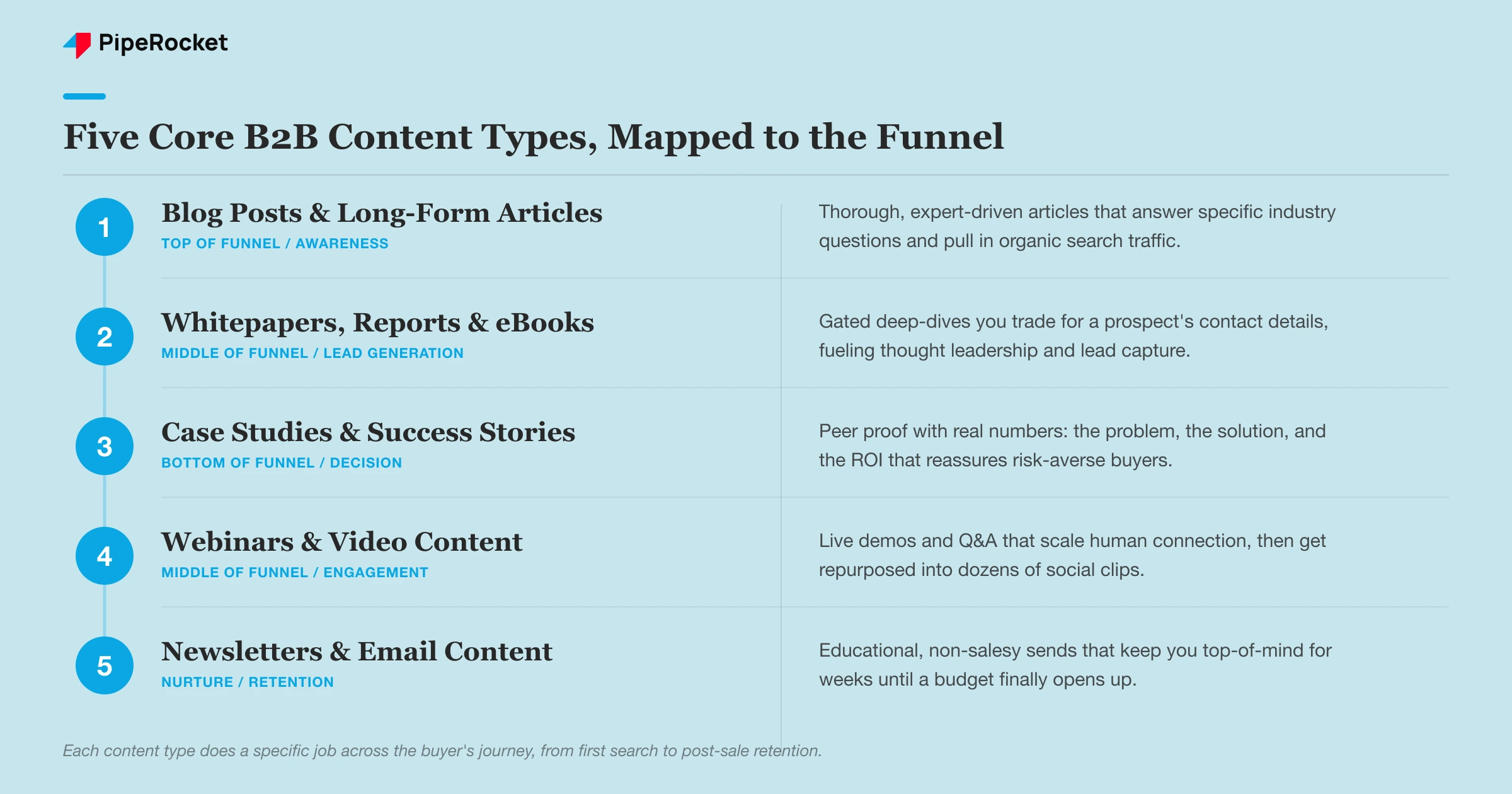
Here are the five core content types you need. If your buyer is technical (devtools, infra, or AI-agent audiences who read like engineers), our content marketing for tech companies piece covers the format and depth adjustments generic B2B advice misses.
1. Blog Posts & Long-Form Articles
This is the foundation of your organic growth. In B2B, “thin” content is dead. To rank now, your articles must be thorough, expert-driven resources that answer specific industry questions better than anyone else.
Best for: Awareness (Top of Funnel), Organic Search (SEO).
2. Whitepapers, Industry Reports & E-books
When a topic is too complex for a blog post, it belongs here. These are typically “gated” (requiring an email to download) and offer deep dives into industry trends or research. They are the currency you trade for a prospect’s contact info.
Best for: Lead Generation (Middle of Funnel), Thought Leadership .
3. Case Studies & Success Stories
Nothing builds confidence like peer-to-peer validation. B2B buyers are risk-averse; they want proof that your solution works for companies like theirs. A strong case study follows a clear narrative: The Problem, The Solution, and The Hard Numbers (ROI).
Best for: Conversion (Bottom of Funnel), Trust Building.
4. Webinars & Video Content
Video is how you scale human connection. Webinars let you demo products and answer questions in real time. Crucially, a single webinar can be repurposed into dozens of social clips, blog posts, and YouTube shorts. Optimizing those shorts to actually get found is a different skill from making them, and our YouTube SEO checklist covers that step.
Best for: Engagement, Explaining Complex Ideas.
5. Newsletters & Email Content
Most leads aren’t ready to buy the day they find you. An educational (not salesy) newsletter keeps you top-of-mind for weeks or months until a budget opens up. The secret is to deliver value directly in the inbox, rather than just forcing clicks.
Best for: Retention, Nurturing.
Real-World B2B Content Marketing Examples
Some of the most-cited B2B content programs work because they give away genuine expertise and tools rather than sell. Here are three widely known examples and the lesson behind each.
HubSpot
HubSpot built much of its inbound engine on a high-volume blog, free certification courses (HubSpot Academy), and free tools. The lesson: educate your market first, and the product becomes the obvious next step.
Mailchimp
Mailchimp publishes deep marketing resources, guides, and courses that help small businesses grow across the board, reaching well past email itself. The lesson: solve the buyer’s broader problem alongside the one your product touches.
American Express
American Express has long run business content aimed at owners and finance leaders, covering trends and insights well beyond its cards. The lesson: serving your audience’s wider goals keeps you top of mind until a buying need appears.
What Are the Best Practices & Pitfalls to Avoid in B2B Content Marketing?
The core B2B content marketing best practices are: prioritize quality over quantity, back every claim with data and proof, align content with real buyer pain points, and measure and iterate monthly. The main pitfall is treating content as a one-time task instead of an ongoing revenue asset.
To actually drive revenue, you need to shift your mindset away from treating content as a checklist item to “get done.”
1. Prioritize Quality Over Quantity
It’s tempting to publish constantly, but quality wins every time. One strong, research-backed article can outperform 10 generic posts. High-value content also earns backlinks , improves search visibility, and builds topical authority (depth across a subject that signals expertise to both search engines and buyers), positioning you as a trusted advisor.
Pitfall to avoid: Publishing for the sake of consistency without offering anything original or useful.
2. Speak Business: Use Data, Proof & Clear Value Propositions
B2B audiences are logical. They need numbers, evidence, case studies, ROI, and efficiency gains. They care about saving money and reducing risk. Use hard numbers, specific percentages, and clear ROI. If you can’t back it up with data, don’t say it.
Pitfall to avoid: Content that leans too much on buzzwords or fluffy messaging without demonstrating measurable value.
3. Align Content With Real Buyer Needs (Not What You Think They Need)
Product-centric content rarely converts. The most effective B2B content starts with the buyer’s pain points, questions, objections, and goals. When you speak to their specific problems, your solution naturally becomes the logical next step.
Pitfall to avoid: Writing content that focuses on features instead of solving real business challenges.
4. Measure, Analyze, Iterate
Track the metrics that matter (leads, time on page, conversion rates) and ignore the ones that don’t (vanity likes). B2B content marketing best practices dictate that your strategy should be living and breathing, adapting based on real-world data.
Pitfall to avoid: Treating content as a “set it and forget it” activity instead of a continuous optimization process.
Advanced & Emerging Trends in B2B Content Marketing
Two trends are reshaping B2B content marketing: the rise of zero-click search and AI Overviews, which push you toward perspective-led content, and AI-assisted personalization, which makes role-specific content the new baseline expectation.
Here is what each trend means for your strategy.
1. The “Zero-Click” Reality & AI Overviews
The era of chasing “blue links” is fading.
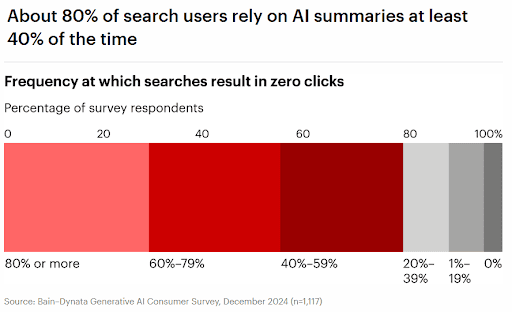
With Google’s AI Overviews now appearing on roughly half of all searches (and even more of informational queries), users increasingly get answers directly on the search results page without ever visiting a website. Bain’s 2025 research confirms just how dramatic this shift is: 80% of consumers rely on AI-based “zero-click” results at least 40% of the time.
And it’s not just traditional search engines; LLM -based search platforms like ChatGPT Search and Perplexity are rapidly becoming primary discovery tools for research, comparisons, and recommendations.
What This Means: Your content strategy can no longer rely solely on “top of funnel” definition terms. You must pivot to “Perspective-Led” content that is deep, opinionated, and experience-based, which an AI summary cannot easily replicate.
2. AI-Assisted Personalization Becomes the New Standard
Personalization isn’t optional anymore; it’s what audiences expect.
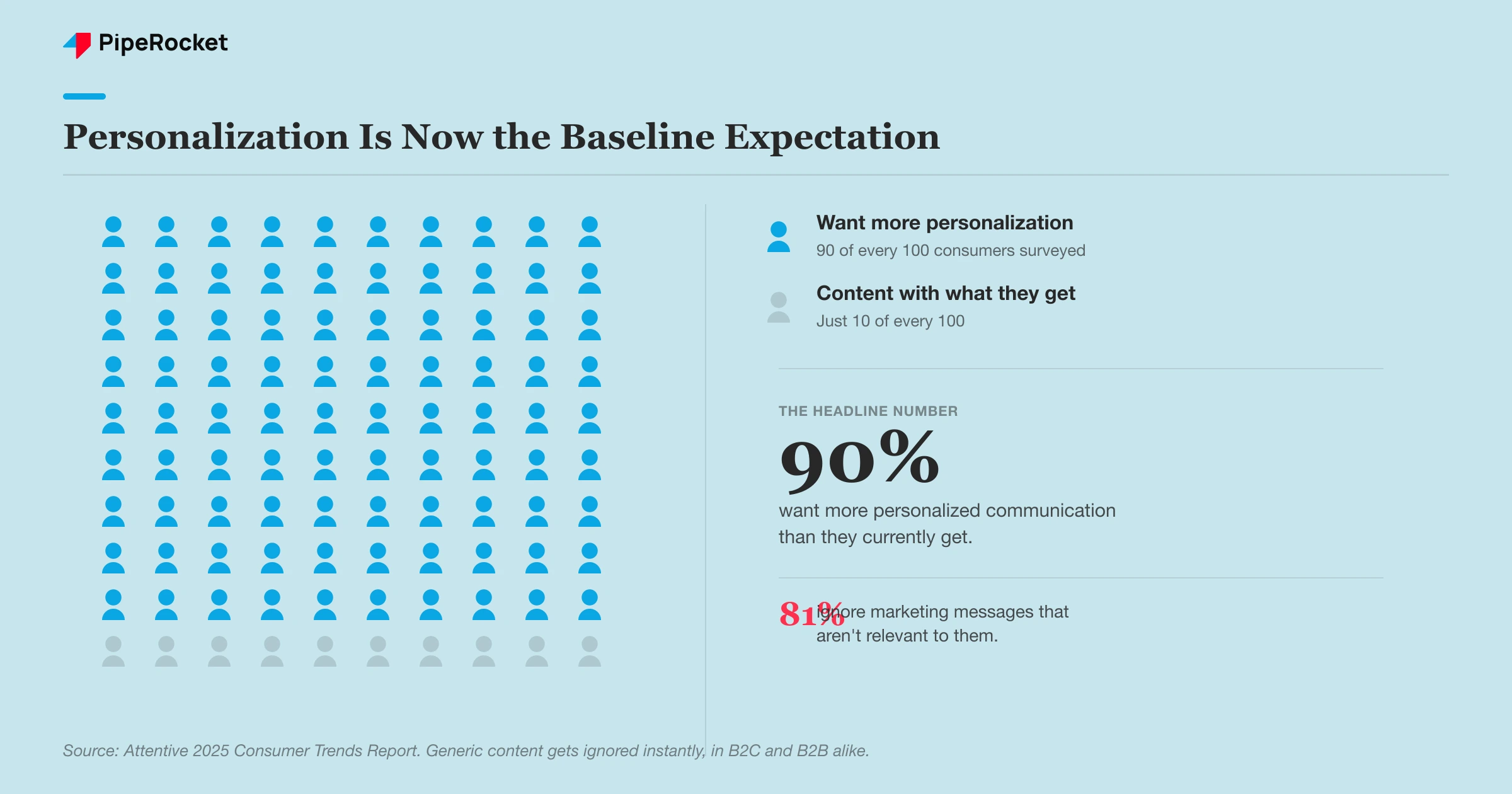
Attentive’s 2025 Consumer Trends Report found that 90% of consumers want more personalized communication than they currently get, and 81% simply ignore marketing messages that aren’t relevant to them. That same expectation is reshaping B2B buying, where generic content is ignored instantly.
With AI, companies can now tailor emails, landing pages , recommendations, and even long-form content to specific roles and industries in real time. What once required huge teams is now accessible to everyone.
What this means for you: If your content doesn’t feel like it was written for a specific person, it will be ignored. AI gives every company the ability to personalize at scale; the only difference is who adopts it first.
Step-by-Step Implementation Roadmap for B2B Content Marketing
If you are starting from scratch or trying to fix your content process, here is a practical 8-step checklist to get moving.
1. Audit Existing Content & Assets
Before you create anything new, run a full audit of your blog posts, whitepapers, and sales decks. Identify which assets are performing (keep them), which are outdated but valuable (refresh them), and which are dragging down your site’s authority (remove them).
2. Define Buyer Personas & Buyer Journey
Stop writing for “everyone.” Define specific roles, like the technical user versus the CFO. Map their unique anxieties to the funnel to ensure every piece of content targets the right decision-maker.
3. Set Clear Goals (Awareness, Leads, Conversions) & KPIs
Vague goals produce vague results. Define success clearly: organic traffic for awareness, downloads for leads, or pipeline influence for revenue. Assign concrete KPIs to every asset to prove real ROI.
4. Build an Editorial Calendar: Plan Content Types & Frequency
Consistency creates trust. Build an editorial calendar that dictates exactly what you will publish and when. Plan for a mix of content types like blog posts for SEO , case studies for trust, and videos for engagement. Decide on a realistic publishing frequency and stick to it religiously.
5. Create High-Quality Content (Data-Driven, Problem-Solving, SEO Optimized)
This is the execution phase. Focus on creating content that is objectively better than your competitors’. Ensure it is data-driven (use original stats), problem-solving (address real pain points, don’t just sell), and SEO optimized (so your audience can actually find it).
6. Distribute via Owned, Earned, and Paid Channels
Don’t rely on just one channel. Use a multi-channel approach to ensure visibility.
- Owned: Publish on your website, blog, and newsletter.
- Earned: Pitch guest posts to industry publications and get featured in organic search.
- Paid: If organic reach is slow, use LinkedIn Ads or PPC to boost your best-performing content to a targeted audience.
7. Promote Through Social, Email, Partnerships, ABM
Once distributed, actively promote your work.
- Social & Email: Share snippets on LinkedIn/X and send to your subscriber list.
- Partnerships: Collaborate with non-competing brands to share content with their audiences.
- ABM : specific high-value accounts, send your content directly to key stakeholders via personalized outreach or ads.
8. Measure Performance → Analyze → Iterate/Refine
Content marketing is a loop, not a straight line. Every month, review your analytics against the KPIs you set in Step 3. Use this data to analyze why something worked, then iterate on your strategy. Ruthlessly cut what isn’t working and double down on what is.
If this all feels a bit overwhelming, you also have the option to consider going with B2B content marketing agencies who specialize in content marketing specifically for the B2B market.
Conclusion
The companies that win this year won’t be the ones with the biggest budgets, but the ones with the most helpful, accurate, and accessible answers.
The best time to start building this asset was five years ago. The second-best time is today. Audit your content, define your goals, and start writing. Your future customers are already searching. Make sure they find you. Our interactive B2B content marketing checklist is a good place to run that audit.
That is where Piperocket Digital can help you. We help you turn these concepts into a publishing schedule that runs like clockwork, bringing you qualified leads while you focus on closing them.
Don’t let this guide just sit in your bookmarks folder. Reach out to Piperocket Digital today, and let’s get to work. Book a call now!
Frequently Asked Questions
1. What is B2B content marketing?
B2B content marketing is the process of creating and sharing valuable, educational content to attract, engage, and convert business buyers. Instead of relying on cold outreach or aggressive sales tactics, it helps companies build trust, demonstrate expertise, and guide prospects through long, complex buying journeys.
2. How is B2B content marketing different from B2C content marketing?
B2C (Business-to-Consumer) marketing often appeals to emotion and impulse for quick purchases. B2B marketing targets logical decision-making, involves multiple stakeholders (like IT, Finance, and Management), and supports a much longer sales cycle that can last months or even years. The main differences lie in the audience and the intent.
3. What types of content work best for different stages of the B2B buyer’s journey?
- Awareness: Blog posts, checklists, industry insights
- Consideration: Whitepapers, webinars, comparison guides
- Decision: Case studies, ROI calculators, demos
- Retention: Onboarding guides, newsletters, customer success stories
The key is to match the content to what buyers are thinking and evaluating at each step.
4. How do I measure the success of my B2B content marketing efforts?
Success is usually measured using KPIs like organic traffic, keyword rankings, engagement metrics, leads generated, MQL-to-SQL conversion rate , pipeline influence, and overall revenue impact. Regular analysis helps you understand what’s working and where to improve.
5. Can small B2B businesses benefit from content marketing too? How?
Absolutely. Content marketing is the great equalizer because it allows small businesses to compete on expertise rather than ad spend. By targeting specific niches and answering highly specific questions, small B2B firms can build deep trust and authority, attracting high-quality leads without a massive budget.
6. What are the four types of B2B marketing?
The four main types of B2B marketing are inbound marketing , outbound marketing (including account-based marketing), digital marketing, and relationship or event-based marketing. Content marketing sits mostly within the inbound and digital categories.
7. How to do B2B content marketing?
Start by auditing your existing content, defining your buyer personas, and setting clear goals tied to business KPIs. Then build an editorial calendar, create data-driven content mapped to each funnel stage, and spend more of your time distributing it than creating it. Review performance against your KPIs every month and iterate.