Fintech SEO: The Trust-First Playbook for 2026
 Sabari Rohith
Last updated on
Sabari Rohith
Last updated on
In fintech, you aren’t really selling software. You’re asking someone to trust you with their money, their identity, or their company’s payroll. And trust is scarce. Your buyers double-check everything: they read reviews, compare alternatives, and hunt for third-party proof before they ever fill in a form.
That changes the job of SEO. Ranking isn’t enough when the click only converts if the page earns trust in the first few seconds, and when Google holds anything touching money to a higher bar than the rest of the web. This is the playbook we use to make fintech SEO actually work, and a real example of what it looks like on the page.
TL;DR
- Fintech SEO is trust-first: it’s an E-E-A-T and compliance discipline before it’s a keyword exercise, because both Google and your buyer are looking for reasons to doubt you.
- Why it’s different: buyers verify before they trust, Google treats fintech as YMYL, and compliance limits what you’re allowed to claim.
- The challenges: regulation, a brutal authority bar, and a split audience make fintech the hardest SEO arena to win.
- The playbook: win on technical trust foundations, visible E-E-A-T, useful compliant content, and authority from sources buyers respect.
- In practice: a suite of trust-engineered utility tools pulled 10,000+ organic visits a month and ranked on page one for a payments client.
- AI search: buyers shortlist in AI and verify in organic, so being citable and being trustworthy are the same project.
- Keyword mapping: map educational TOFU terms and transactional BOFU queries to each stage of the fintech buyer journey instead of to one blended audience.
- How to measure it: track organic conversion rate on trust-critical pages and AI citations as your headline metrics, above rankings.
- The mistakes: generic tactics, volume-chasing, thin E-E-A-T, and salesy copy quietly sink fintech sites.
What Is Fintech SEO?
Fintech SEO is the practice of growing a financial-technology company’s organic search visibility in a way that survives two things at once: Google’s quality bar and a sceptical buyer’s scrutiny. It spans the same technical, content, and authority work as any SEO programme, but every piece of it runs inside a regulated, high-trust environment.
What makes it a distinct discipline is the cost of getting trust wrong. In most industries a weak page just underperforms. In fintech, an unsupported claim or an anonymous author can actively pull a page down, because Google classifies money content as higher-risk and rates it more harshly on expertise and trust.
It also costs you the conversion. A buyer comparing payment providers, lending platforms, or financial tools is specifically scanning for reasons to rule you out. So a fintech SEO programme has two jobs on every page: rank it, and make it credible enough that the person who clicks doesn’t bounce straight back to a competitor.
Why Fintech SEO Is Different
Fintech SEO is different because trust, not keywords, is the binding constraint. You can execute the technical and content work flawlessly and still lose if the page doesn’t convince a cautious buyer and a strict algorithm that you’re credible. Three forces drive that.
Your buyers verify before they trust
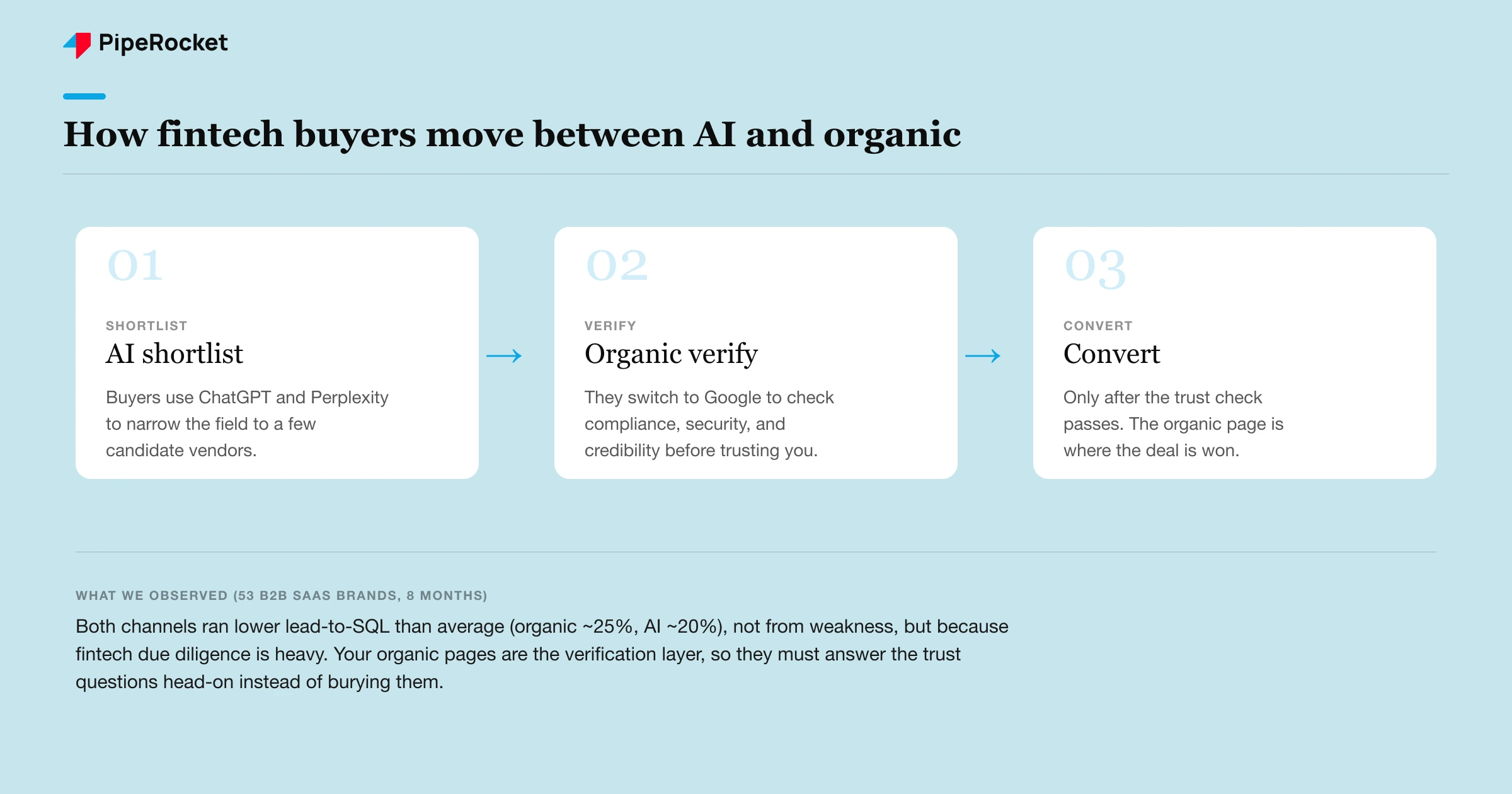
Fintech buyers research in two stages, and your organic pages own the decisive one. In PipeRocket’s analysis of 53 B2B SaaS brands over eight months, fintech behaved unlike every other vertical we looked at. Buyers used AI tools to build a shortlist, then switched to organic search to verify compliance, security, and credibility before they converted.
- 53 B2B SaaS brands, 8 months: fintech was the one vertical where buyers split research across AI and organic by stage.
- ~25% organic lead-to-SQL, ~20% AI: both ran below the cross-vertical average.
- Why: the lower rates reflect the weight of fintech’s due-diligence process. Buyers scrutinise harder before they commit money or data.
The implication is concrete. Your organic pages aren’t just a traffic source, they’re the verification layer where the deal is won or lost. A pricing page, a security page, a comparison page , the exact pages a buyer hits while vetting you, have to answer the trust questions head-on. If they read like marketing instead of proof, the buyer leaves and you never see it in your funnel.
Google treats fintech as YMYL, so the bar is higher
Most fintech content falls under what Google calls “Your Money or Your Life,” pages that can affect someone’s financial wellbeing. Google’s quality-rater guidelines explicitly tell raters to judge YMYL pages more harshly on expertise, authoritativeness, and trust, and a low trust rating alone is enough to cap a page.
In practice, the same words carry less weight without proof behind them. A generic “10 ways to save on transfer fees” article from an anonymous author won’t perform the way it might in a low-stakes niche, because there’s nothing telling Google or the reader why this source should be believed.
This is why the tactics that work in low-stakes SEO can backfire here. Thin AI-spun content, unsourced statistics, and aggressive keyword pages all read as low-trust signals in a YMYL context. In fintech the E-E-A-T bar is the entry fee to rank at all.
Compliance decides what you’re even allowed to say
In fintech, legal and compliance shape the content before SEO ever touches it. A claim that would be harmless marketing elsewhere can be a regulatory problem here. Three things follow from that:
- The claim constraint: you can’t promise returns you can’t guarantee, imply insurance or protections you don’t offer, or describe security in ways that aren’t precisely accurate.
- The keyword constraint: some high-intent phrases carry implied promises you legally can’t make, so chasing them head-on is a dead end. Target the adjacent, answerable version of the query instead, the one you can satisfy with a compliant, useful answer.
- The workflow fix: treat compliance as a design input rather than a final gate. Build a library of pre-approved language, claims, and disclaimers, so writers aren’t starting from zero and legal review becomes a quick check instead of a multi-week bottleneck.
The Real Challenges of Fintech SEO
Fintech is the hardest SEO arena most teams will ever work in, because three forces push against each other at once. Here’s what makes each one hard, and what the teams that win actually do about it.
| Challenge | Why it hurts | What winners do |
|---|---|---|
| Regulation limits your claims | Every page runs through compliance, which slows publishing and narrows what you can say | Treat compliance as a design input, and keep a library of pre-approved language so legal review isn’t from scratch each time |
| The authority bar is brutally high | Fintech SERPs are owned by institutions and well-funded brands with years of link equity | Earn authority in a defensible niche first, then expand, instead of charging head terms on day one |
| Your audience isn’t one person | A developer, a finance lead, and a compliance officer search differently and need different proof | Map content to each persona’s real questions instead of averaging them into something vague |
The authority gap deserves extra emphasis, because it’s where the most budget gets wasted. A new or mid-size fintech that targets “international payments” or “best business bank account” on day one is up against banks and decade-old domains, and no amount of on-page work closes that gap quickly. Win a narrow, defensible cluster first, prove authority there, then expand outward.
Map Keywords to the Fintech Buyer Journey (TOFU vs BOFU)
Fintech keyword strategy means mapping educational top-of-funnel terms and transactional bottom-of-funnel queries to each stage of the buyer journey, then matching the proof each stage needs. A blended keyword list that ignores intent stage under-serves both the early researcher and the ready-to-switch buyer.
The two ends of the funnel ask different questions and need different pages:
- Top of funnel (educational): how-things-work queries (“how is a SWIFT transfer priced,” “what does an IBAN encode”). These build topical authority and feed AI answers, so lead with a clear, sourced explanation.
- Bottom of funnel (transactional): feature, pricing, alternative, and comparison queries ("[competitor] alternative," “best cross-border payment API”). These are where the deal is won, so answer the trust questions head-on with proof rather than marketing copy.
Because each fintech buyer (developer, finance lead, compliance officer) enters at a different stage, map the query to the persona and the funnel position together, then give that page the specific evidence that persona verifies before they trust you.
The Fintech SEO Playbook: 4 Pillars
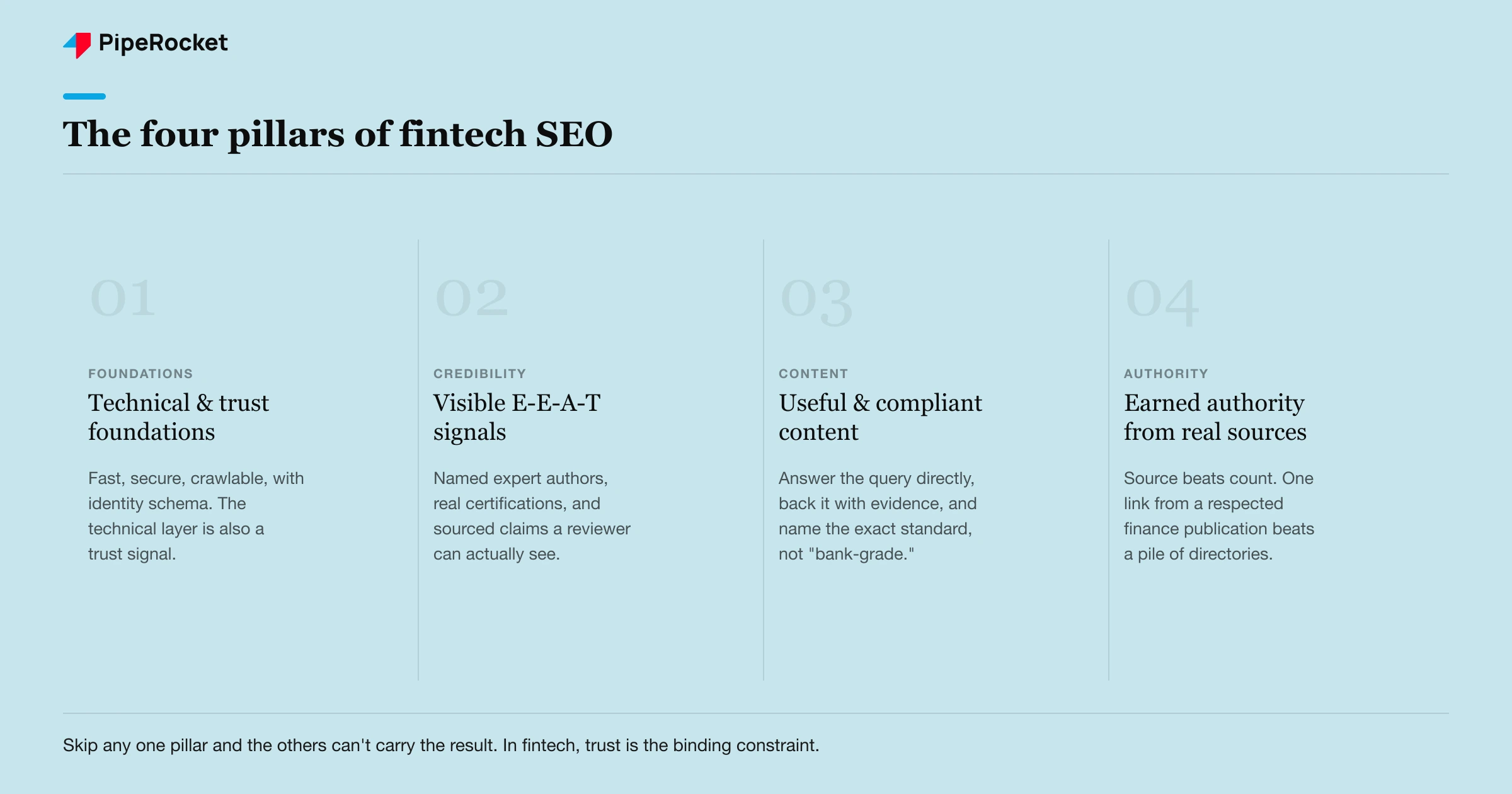
Winning fintech SEO comes down to four pillars working together: technical trust foundations, visible E-E-A-T, useful compliant content, and earned authority. Skip any one and the others can’t carry the result.
1. Get the technical and trust foundations right
Technical SEO in fintech is also a trust signal. A fast, secure, well-structured site tells both Google and a nervous buyer that you’re a serious operation, while a slow or broken one quietly confirms their doubts. Get the fundamentals solid:
- Clean, logical site architecture that keeps important pages a few clicks from the homepage
- Strong Core Web Vitals (LCP, INP, CLS) and full mobile parity, since most early research happens on a phone
- Valid HTTPS across every page, with no mixed-content or certificate warnings
- Structured data that tells search engines exactly who you are
Then pay special attention to the markup that establishes identity, which fintech leans on more than most industries:
- Organization schema with your legal entity, logo, and
sameAslinks to verified profiles - Author markup tying content to a named, credentialed person
- FAQ and product schema where it genuinely matches the page
These entity signals are how search engines connect your brand to a real, accountable company rather than an anonymous site, which matters far more when the topic is money.
2. Build E-E-A-T signals a reviewer can actually see
E-E-A-T only helps if it’s visible on the page. The goal is that both a sceptical human and a Google quality rater can confirm your credibility without leaving the article. Abstract “authority” does nothing; specific, checkable signals do. Here’s how the main ones map to what you actually put on the page.
| Trust signal | How to show it on the page |
|---|---|
| Author expertise | A named author with real credentials and a bio, never “admin” or “team” |
| Institutional credibility | Licences, certifications, and security standards (SOC 2, PCI DSS) where genuinely held |
| Third-party validation | Reviews, press mentions, and regulator or partner references |
| Sourced claims | Every stat or assertion linked to a primary source, not another blog |
The highest-leverage one is usually author identity. A fintech article attributed to a named expert with a real bio, a LinkedIn profile, and a track record will outperform the same words published under “admin.” It gives Google an entity to attach trust to, and gives the reader a person to believe.
3. Write content that’s useful and compliant
The content that wins in fintech answers a real question directly, then backs it with evidence a cautious reader will accept. Three moves, in order:
- Lead with the answer, not the build-up, so the page can win featured snippets and zero-click results and stays extractable for AI answers.
- Support it with sourced data, not assertion.
- Write for the specific persona the query belongs to, since a developer and a CFO need different proof.
Warning: avoid vague reassurance. “Bank-grade security” means nothing to a buyer doing due diligence, and it can read as a hollow claim to a quality rater. The specific standard you meet, named and verifiable (SOC 2 Type II, PCI DSS, ISO 27001), means everything.
Compliant doesn’t have to mean dry. The strongest fintech content is genuinely useful about a complex, high-stakes topic, walking a reader through something confusing (how a SWIFT transfer is priced, what an IBAN actually encodes, why an exchange rate moved) without overpromising. That usefulness is what earns the trust that converts, and it’s what gets the page cited.
4. Earn authority from sources fintech buyers respect
In fintech, the source of a link matters more than the count. What actually moves YMYL rankings:
- Counts more: a mention in a respected financial publication, a regulator’s resource page, or a recognised industry analyst.
- Counts less: a pile of generic directory or low-quality links, however large.
Original data and research are the strongest play, because fintech journalists and analysts cite numbers. A study on transfer-fee benchmarks, payment-failure rates, or cross-border volumes earns the kind of authoritative links that move rankings, and it doubles as content AI engines quote. Unlinked brand mentions are the second lever: in a regulated space you often get named without a link, and reclaiming those is some of the cleanest authority you can build.
What a Trust-First Fintech Page Looks Like in Practice
A trust-first fintech page pairs a genuinely useful tool or answer with visible proof: fresh sourced data, a timestamp, named credentials, and honest limits. That combination is what outranks older, higher-authority finance sites. Here’s a pattern we run for a cross-border payments client: a suite of free utility tools, each engineered as a trust object, not just a calculator.
The tools target high-intent, transactional queries at programmatic scale:
- Currency converters: one page per pair (USD to INR, GBP to INR, and so on), each with a live rate, a “last updated” timestamp down to the minute, and a 7-day rate-trend chart.
- A SWIFT/BIC code finder: a hub plus programmatic pages by country and by bank, covering long-tail “SWIFT code for [bank] in [country]” searches.
- An IBAN checker: Europe and SEPA focused, validating format and checksum.
What makes them rank in a YMYL space isn’t the tool itself, it’s the trust layer wrapped around it:
- Freshness you can see. The converter stamps the exact minute the rate updated; the lookup tools show a “last reviewed” date. For money data, a visible recent timestamp is both a ranking and a conversion signal.
- Sourced data over assertion. Rates are labelled mid-market and attributed; the SWIFT data is described as cross-checked against public banking references.
- Hard credibility on the page. SOC 2 and ISO badges, the registered legal entity, and a named grievance officer sit in plain view near the top, well above the footer.
- Honest limitations. The IBAN checker openly says it verifies format but can’t confirm an account is live, and tells users to check with their bank. In YMYL, admitting what a tool can’t do builds more trust than overclaiming.
- One interlinked hub. Each tool cross-links the others (a SWIFT transfer often needs an IBAN too), which keeps users moving and concentrates topical authority around payments.
The lesson generalises beyond tools: a page that shows fresh, sourced, accountable data wins fintech queries, because that is exactly what a cautious buyer and a cautious algorithm are both looking for.
Fintech SEO in the AI-Search Era
Fintech SEO now includes generative engine optimization (GEO): structuring content so it gets cited inside AI Overviews and answer engines as well as ranked in blue links. Fintech feels this early, because its buyers are exactly the careful researchers who lean on AI to narrow options before they commit. Two shifts matter most.
Optimise to be cited as well as ranked
Being the source an AI answer cites is now its own goal, separate from ranking.
AI Overviews now appear on more than half of US searches, with Advanced Web Ranking data putting it above 60% (60.32% as of late 2025), per xponent21’s analysis .
Those answers pull from content that’s clearly structured, directly answers the question, and comes from a credible source. The same E-E-A-T and clarity work that earns trust with a human buyer is what makes you citable to a model, which is why the trust-first approach pays off twice.
The freshness signals on those utility tools, the live rate and the timestamp, are precisely the kind of current, structured data an AI answer reaches for when someone asks “what’s the USD to INR rate.”
This connects straight back to how fintech buyers behave. They shortlist in AI, so you need to get cited in AI Overviews, then they verify in organic, so your pages have to close the trust gap the AI answer can’t.
Search is fragmenting across engines
Google is no longer the only gatekeeper. Buyers research across several engines, and each builds its answers from a different mix of sources. A page cited in one is often absent from another, so visibility now means showing up across surfaces, not just one results page:
- ChatGPT, Perplexity, Gemini: each pulls from a different source set, so a citation on one does not guarantee one on another.
- Reddit and YouTube: these appear disproportionately in AI answers, so an active, useful presence there feeds AI visibility on top of direct traffic.
- Authoritative third-party publications: finance-specific outlets carry extra weight in a YMYL context.
For a fintech brand, being named in a respected community thread or analyst piece increasingly does double duty as both reputation and AI-citation fuel. This is where getting the GEO layer right pays off, and where studying how specialist fintech GEO agencies structure content for AI answers can shortcut the learning curve.
How to Measure Fintech SEO Performance
Measure fintech SEO by conversion and trust signals, not rankings alone: organic-sourced pipeline, conversion rate on trust-critical pages, and AI-citation share matter more than position for a query. Because buyers verify before they convert, a page can rank well and still fail the trust test, so the win shows up in conversions, not just visibility.
Track a small set of metrics that reflect how fintech buyers actually behave:
- Organic conversion rate on trust-critical pages: pricing, security, and comparison pages are where the deal is verified, so watch their conversion rate alongside their traffic.
- Organic-sourced pipeline and SQLs: tie rankings to revenue, since fintech’s due-diligence process runs lower lead-to-SQL rates that raw traffic hides.
- AI-citation share: how often you’re cited in AI Overviews and answer engines for your target queries, since buyers shortlist there first.
- Non-brand impressions and position for defensible clusters: growth here shows your authority is compounding in the niche you chose to win first.
Rankings are an input. The output is whether cautious buyers convert, so weight the measurement toward proof of trust, not position alone.
Common Mistakes to Avoid
Most fintech SEO programs fail in predictable ways. Each mistake below has the same root cause: treating fintech like a low-stakes niche where trust is optional. Here’s what each one looks like, and the fix.
Using generic SEO tactics in a regulated space
The playbook that works for a low-stakes blog can read as untrustworthy, or outright non-compliant, when the topic is someone’s money. Mass-produced content, unsourced claims, and aggressive keyword pages all register as low-trust signals in a YMYL context.
The fix is to make compliance and proof a design input, not an afterthought. Every tactic should pass two tests before it ships: would a strict rater trust it, and would legal sign off on it?
Chasing high-volume head terms too early
Targeting “international payments” or “best business bank account” on day one means competing with banks and decade-old domains for the same SERP . You burn budget on terms you have no authority to hold, and you have little to show for it months later.
Win a narrow, defensible cluster first, prove authority there, then expand outward toward the bigger terms once you have the link equity to compete.
Treating E-E-A-T as optional
Anonymous authors and unsourced claims cap your ceiling no matter how sharp the writing is. In a YMYL space, Google has nothing to attach trust to, and a cautious buyer has no reason to believe you over a competitor who shows their credentials.
Attribute every page to a named expert with a real bio, cite primary sources, and make your security and compliance posture visible. Treat trust signals as a feature you build, not copy you add at the end.
Writing salesy or fluffy copy
Overpromising fails two audiences at once: the buyer scrutinising you for reasons to walk away, and the algorithm rating you on trust. In fintech it can fail a third, because a claim you can’t substantiate can also be a compliance problem.
Write in proof, not adjectives. Replace “the most secure platform” with the specific certification, the specific control, the specific number you can stand behind.
Letting data go stale
A money page with an old or missing “last updated” date loses trust fast. When a buyer is checking a rate, a fee, or a regulatory detail, stale data doesn’t just look careless, it reads as a reason to doubt everything else on the page.
Treat freshness as part of the product, not an afterthought. On utility and rate pages especially, a visible, accurate timestamp is one of the cheapest trust signals you can ship.
Why PipeRocket Digital Runs Fintech SEO This Way
We treat fintech SEO as a trust problem with a search component, not the other way round. That means we build the technical and E-E-A-T foundations first, map content to the developer, finance, and compliance buyers separately, and earn authority from the sources fintech buyers actually believe.
If you’d rather see who else does this well, our best fintech SEO agencies list is a fair starting point. If you want a partner to run it, see how we approach SaaS SEO and our fintech SEO agency page, then talk to us .
Frequently Asked Questions
What is fintech SEO?
Fintech SEO is the practice of growing a financial-technology company’s organic search visibility inside a regulated, high-trust environment. It covers the same technical, content, and authority work as any SEO programme, but every page has to satisfy two judges at once: Google’s stricter quality bar for money-related content, and a cautious buyer scanning for reasons to rule you out. The goal isn’t just to rank, it’s to rank and be credible enough to convert.
How is fintech SEO different from standard SEO?
Fintech SEO works inside a regulated, low-trust, YMYL environment, so trust and compliance constrain everything before keywords enter the picture. Google holds money-related content to a higher expertise and trustworthiness standard, and your buyers actively look for reasons to doubt you. The mechanics are the same as general SEO, but the bar for credibility, sourcing, and compliant claims is far higher, which changes what content you can publish and how you have to support it.
What are the biggest technical SEO considerations for a fintech site?
Start with the fundamentals that double as trust signals: fast load times, full HTTPS, mobile parity, and clean crawlable architecture. Then prioritise the markup that establishes identity, including Organization and author schema, clear security and contact information, and consistent business details across the web. Fintech leans heavily on entity and trust signals, so the technical work that confirms who you are matters more here than in most industries.
How do I map fintech keywords to the buyer journey?
Split keywords by funnel stage. Target educational top-of-funnel terms (“how is a SWIFT transfer priced”) with clear, sourced explainers that build authority, and transactional bottom-of-funnel queries (features, pricing, alternatives, comparisons) with proof-led pages that answer trust questions directly. Then map each query to the persona (developer, finance lead, compliance officer) it belongs to, so each page carries the specific evidence that reader verifies before converting.
How is AI search changing fintech SEO?
AI search has split the fintech buyer’s journey in two. Buyers use AI tools like ChatGPT and Perplexity to build a shortlist, then move to organic search to verify compliance and security before they convert. That means you need to be cited inside AI answers, which rewards clear, well-sourced, current content, and you need organic pages strong enough to close the trust gap the AI answer leaves open. The work that makes you citable and the work that makes you trustworthy are now the same work.