YMYL SEO: Categories, E-E-A-T, and the Fixes That Actually Rank
 Vignesh Sampath
Last updated on
Vignesh Sampath
Last updated on
YMYL stands for “Your Money or Your Life.” It’s the label search quality systems use for pages that can affect a person’s health, money, safety, or major life decisions, and because bad advice on these topics causes real harm, they get held to the strictest quality bar in Search.
What You Need to Know About YMYL SEO
- YMYL means “Your Money or Your Life,” the classification for content that can affect someone’s health, finances, safety, or major life choices if it’s wrong.
- The main categories are health and medical, financial, shopping pages that collect payment details, legal and civic, and safety and news.
- YMYL pages face stricter enforcement because search systems are trained to suppress advice that could cause real-world harm.
- Ranking here depends on strong E-E-A-T: content written or reviewed by someone with real, checkable expertise in that specific category.
- The pages that hold up have named author credentials, primary-source citations, findable contact info, visible policies, a visible review cadence, and no unsupervised generic AI text.
What Are the Main YMYL Categories?
YMYL content falls into five categories: health and medical, financial, shopping pages that collect payment information, legal and civic, and safety and news. None of these function as a fixed checklist you match a URL against, quality systems judge the specific harm a page could cause, not just which bucket its domain sits in.
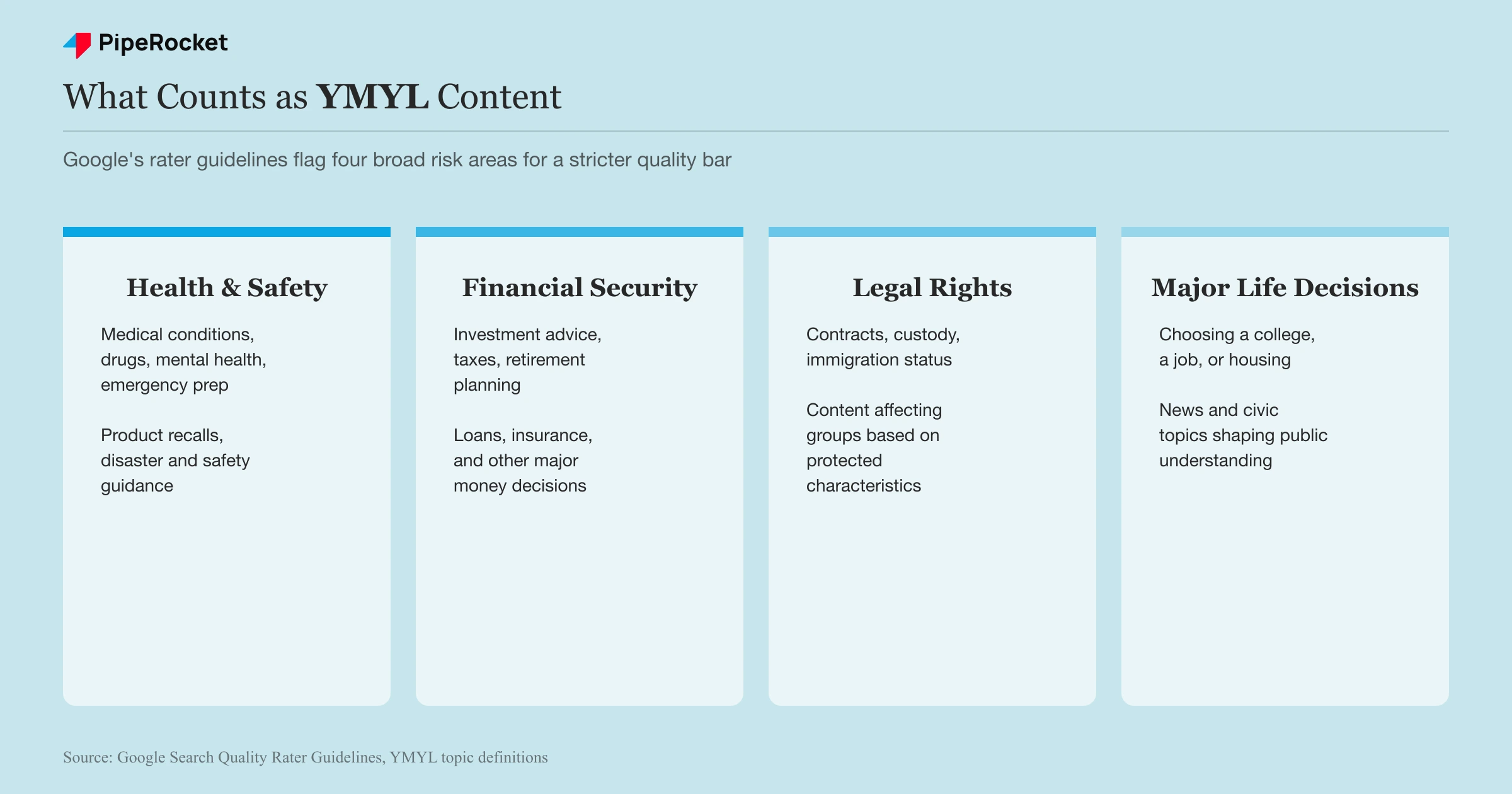
That distinction is why a blog explaining how compound interest works and a page pushing a specific loan product can sit on the same financial domain and still carry very different risk. Raters and ranking systems are trained to treat them differently, and so should your own content triage.
The pattern repeats across every category: general education is lower-risk, specific advice is higher-risk, and the risk jump is what decides how much trust signaling a page needs.
| Category | Lower-risk (education) | Higher-risk (advice) | Trust signal it needs |
|---|---|---|---|
| Health and medical | What causes seasonal allergies | Dosage for an OTC antihistamine | Clinician review credit |
| Financial | How an emergency fund works | A specific loan or investment recommendation | Licensed advisor byline |
| Shopping and e-commerce | General product information | A page collecting payment details | Security certification, clear refund policy |
| Legal and civic | What a power of attorney is | Drafting one for a specific situation | Attorney review, “not legal advice” line |
| Safety and news | General equipment overview | Live crisis or recall instructions | Named regulation source, visible update date |
Health and Medical Content
Health and medical YMYL content covers diet, fitness, diseases, drugs, mental health, and emergency preparedness. The pages that get penalized hardest are the ones making a specific clinical claim, “take X mg,” “this supplement cures Y,” without a clinician’s review anywhere near it.
- Mental health: general stress-management tips are low-risk; walking someone through a mental health crisis needs a visible reviewer credential and a link to an actual crisis line.
- Fitness and nutrition: a general “what is protein” explainer is low-stakes; a page prescribing a specific caloric deficit or supplement stack needs a dietitian or clinician’s name behind it. Generic guidance applied to the wrong person carries real risk.
Financial Content
Financial YMYL content covers banking, investing, taxes, loans, insurance, and credit repair. The failure mode PipeRocket sees most often in fintech clients is a calculator or comparison page that reads as neutral education but functions as a product recommendation, with no licensed advisor anywhere in the byline chain.
Tax, insurance, and investment content carry the same trap. Explaining how a standard deduction works, or what a P/E ratio measures, is education. Telling someone which filing status or insurance rider to pick, or when to buy or sell based on that ratio, is advice. Advice-shaped financial content needs an advisor’s name attached to it.
Shopping and E-Commerce Content
Any page where a user enters payment or personal financial details counts as YMYL, regardless of what the site otherwise sells. This category gets missed constantly because teams associate YMYL only with “serious” topics like medicine and money, but a SaaS billing page or an e-commerce checkout still needs the trust signals the category demands:
- Visible security certifications
- A clear refund and return policy
- Findable support contact right at the point of payment, not buried behind three clicks
- Clear pricing and a visible cancellation path on subscription and billing pages, where trust breaks down fastest
Legal and Civic Content
Legal and civic content covers voting information, government laws, and legal advice. The line that matters most is between general information and something a reader could mistake for actual legal counsel. Explaining what a power of attorney is stays safe; walking someone through drafting one for their specific situation does not.
Civic content, voting deadlines, ballot information, how a specific law applies, carries extra weight during election cycles.
Content touching protected characteristics gets extra scrutiny too, since misinformation here can cause harm at a societal level. Practical legal content should always carry a “this isn’t legal advice, consult a licensed attorney” line placed near the specific guidance a reader would act on, not buried in a site-wide terms page.
Safety and News Content
Safety and news content covers crisis response, heavy machinery and equipment safety, and current events, and the defining trait is time sensitivity. A stale “current events” page that hasn’t been updated in months signals the same neglect an abandoned medical page does.
A visible last-updated date, a link back to the original crisis-response authority (a fire department, a manufacturer’s recall notice, a government agency), and naming the specific standard behind equipment guidance (an OSHA rule, a manufacturer’s safety manual) do more for this category than any amount of additional prose.
What Content Is Not YMYL?
Content that carries no real-world harm if it’s wrong is not YMYL, and it sits at a lower quality bar. A recipe blog, a celebrity net-worth roundup, a hobbyist gear review, or a movie recap can be inaccurate and cost a reader nothing worse than a wasted afternoon.
That lower bar is why these pages can rank on personality, freshness, and useful detail without a credentialed byline or primary-source citations. The moment a topic starts affecting someone’s health, money, safety, or legal standing, it crosses into YMYL and the trust requirements jump.
- General cooking or recipes: low stakes unless the page covers food safety, allergens, or medical diets.
- Celebrity or entertainment content: net worth, gossip, and reviews carry no harm if wrong.
- Hobby and lifestyle gear: camera, gaming, or craft reviews stay outside YMYL unless they touch child or personal safety.
Why Does YMYL Matter for SEO?
YMYL matters for SEO because it changes three things at once: search systems enforce stricter quality rules, they weight E-E-A-T more heavily, and they expect visible expert backing behind the content. Miss any of the three and a well-optimized, well-written page can still get capped below where its keyword targeting alone would predict.
Search Systems Apply Stricter Rules to YMYL Pages
Search systems enforce a higher quality floor on YMYL pages because the downside of bad information scales with the topic. Ranking systems trained on human quality judgments learn to reward pages that visibly reduce that downside.
| Page type | Cost of getting it wrong |
|---|---|
| A mediocre restaurant review | A reader has a bad dinner |
| A mediocre page on drug interactions or debt consolidation | Someone loses their health or their savings |
That’s the mechanism behind a page that ranks fine for a low-stakes keyword but gets suppressed the moment its topic shifts into YMYL territory. The keyword targeting didn’t change, the risk profile did.
Technical fixes alone rarely rescue a struggling YMYL page for the same reason. Faster load times and cleaner markup help every page rank, but they don’t answer the question a stricter enforcement bar is actually asking: why should anyone trust the information on this page.
On a fintech utility suite I worked on, the currency-converter pages and the SWIFT-code tool pull more than 10,000 organic visits a month. The converter pages rank on page one and the top of page two. The SWIFT tool ranks on page one.
None of that came from outranking bigger finance sites on domain authority . It came from freshness and trust signals: current rates, sourced data, a visible update cadence. That’s exactly what a cautious buyer and a cautious ranking system are both screening for on YMYL-adjacent pages.
YMYL Pages Need Stronger E-E-A-T
YMYL pages need visibly stronger E-E-A-T (Experience, Expertise, Authoritativeness, and Trustworthiness) than almost any other content type, because quality requirements scale directly with potential harm. A recipe blog can rank on personality and photos alone; a page about drug interactions cannot.
That’s why a page can be well-written, well-structured, and still underperform. It’s rarely a keyword gap, it’s an unresolved trust problem: nothing on the page proves who wrote it, what backs the specific claims, or that anyone is accountable if it’s wrong.
The gap shows up fastest in a side-by-side comparison. Take two pages targeting the same financial keyword, similar length and structure: the one with a named CFP in the byline and linked primary sources consistently outperforms the one without.
Off-page reputation counts too. Citations and backlinks from reputable, topically-relevant sites (a medical association, a financial regulator, a recognized industry publication) are a trust signal quality raters weigh when judging whether a YMYL page and its publisher deserve to rank.
YMYL Content Needs Expert Backing
YMYL content needs to be written or reviewed by someone with real, checkable expertise tied to the specific category, a clinician for health claims, a licensed advisor for financial recommendations, an attorney for legal information. Generic “content writer” bylines don’t clear this bar no matter how accurate the underlying research is.
Reviewer credit matters as much as authorship. A generalist writer can still produce a YMYL page, as long as a named expert in that category reviewed it and their name and credential appear on the page, not just in an internal sign-off nobody outside the company ever sees.
Note: This is general search guidance, not legal, medical, or financial advice. Evaluating actual risk on your own content is a decision for your compliance and legal team, not an SEO checklist.
What Are the Best Practices for YMYL SEO?
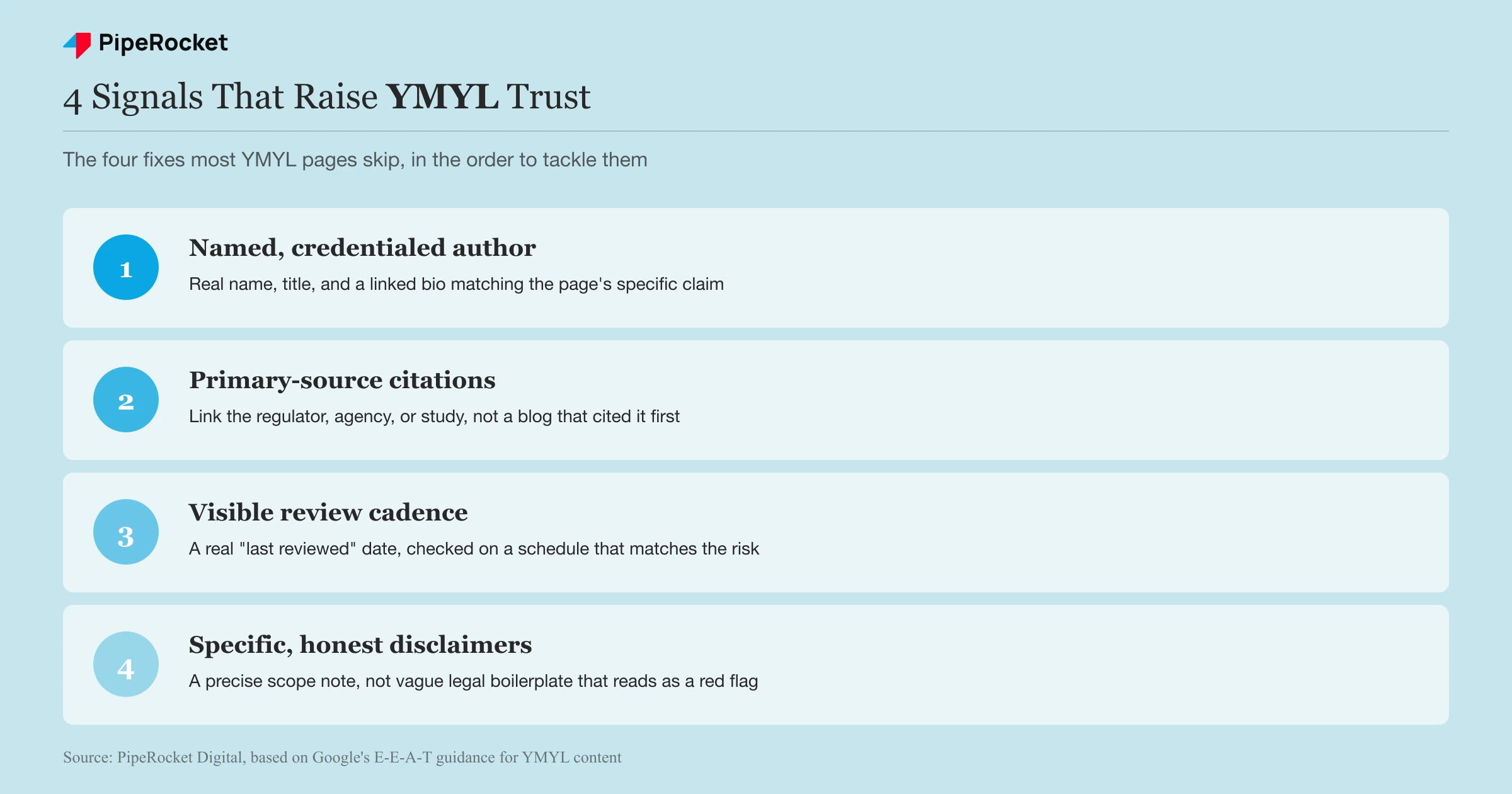
The best practices that move YMYL rankings are concrete: put a named, credentialed author on the page, cite primary sources instead of secondhand summaries, make contact information and policies easy to find, and write a specific disclaimer instead of generic boilerplate.
Use a Named Author With a Credential That Matches the Category
Put a named author on the page whose credential matches the specific claim being made. A page about mortgage refinancing doesn’t need a doctor’s byline, and a page about post-surgical recovery doesn’t need a CFA. The credential has to fit the topic, not just sound impressive in general.
- Financial content: a CFP, CFA, licensed advisor, or someone with direct lending or underwriting experience
- Health content: a licensed clinician, or content reviewed by one with a visible reviewer credit
- Legal content: a licensed attorney, or a clear statement that the content is general information reviewed by counsel
A bio that just says “Jane Smith, Financial Writer” proves nothing on its own. Link the name to a LinkedIn profile, a professional license lookup, or a bio page listing real background, so both a reader and a rater can verify it in under a minute.
Build this into the content process itself, not as a post-publish patch. Assign a named reviewer per YMYL category before a brief goes out, so the credential match happens at planning time.
Cite the Primary Source, Not a Secondhand Summary
Every specific number or clinical claim needs a link to the study, agency, or regulator that generated it, not a blog post that cited it first:
- Financial content: the SEC, FINRA, CFPB, or the actual filing
- Health content: the CDC, NIH, FDA, or the peer-reviewed study itself
- Paywalled or dense sources: summarize accurately in plain language and still link to the original
This also stops the slow drift where a stat gets reworded at each step until the fifth blog to cite it barely resembles the original. Linking straight to the primary source cuts that chain before it starts.
Make Contact Information and Policies Easy to Find
A phone number, a physical address, and a real support channel signal there’s an accountable organization behind the content, not an anonymous site that could vanish if something goes wrong. Pair that with a visible privacy policy, terms of service, and, where it applies, a corrections policy.
These signals matter more on YMYL sites than anywhere else. They answer the question a rater or a wary reader is actually asking: who’s responsible if this is wrong, and can I reach them?
Put this information where it’s actually findable, a footer link buried behind three clicks doesn’t count. Contact details and policy links belong in the main navigation or footer of every page, not a standalone “About” page nobody lands on directly.
Write a Specific Disclaimer, Not Generic Boilerplate
A disclaimer works as a trust signal only when it says something specific: what the page does and doesn’t cover, and when a reader should talk to a licensed professional instead. A vague “not financial advice” line at the bottom of the page reads as a red flag, not a safeguard.
The strongest disclaimers name the boundary directly: “this covers general loan terminology, not a recommendation for your specific financial situation” does more work than any generic legal template. It belongs near the claim it qualifies, not buried in a footer or a separate legal page.
Keep a Visible Review and Update Cadence
A published date without a review date tells both readers and raters the page might be years out of date on rules, rates, or clinical guidance that changes constantly. Put a clear “Last reviewed” or “Last updated” date near the top of the page, not buried in a footer, and mean it, a cosmetic date change without an actual content check is worse than no date at all.
Set an actual cadence instead of updating reactively. Health content is worth checking whenever the underlying clinical guidance changes, which a subject-matter reviewer, not the SEO team, is best positioned to flag.
| Cadence | Best for | Who should trigger the review |
|---|---|---|
| Quarterly | Rate-sensitive financial content, tax guidance | Compliance or finance SME |
| On guidance change | Clinical or drug-interaction content | Licensed medical reviewer |
| Annually | Evergreen legal or “how X works” explainers | Content owner + legal spot-check |
Common Mistakes to Avoid
Treating a Disclaimer as the Whole Compliance Strategy
A vague “this is not financial advice” line at the bottom of the page does nothing for E-E-A-T if the rest of the page has no author credential, no sourcing, and no review date behind it. Disclaimers work as one signal among several, not a replacement for the others.
Publishing Thin Content on a High-Stakes Query
A 400-word page answering “how much life insurance do I need” without a named expert, without sourcing, and without nuance for different life situations is exactly the kind of page that gets flagged as insufficient for the risk involved. Depth has to match the stakes of the query.
Letting AI-Generated Content Skip Human Review on YMYL Pages
Unreviewed AI content on a YMYL topic is a liability twice over: it risks a factual error in a high-stakes category, and it gives raters nothing to attribute expertise to. Any AI-assisted YMYL draft needs a named subject-matter reviewer before it ships, not just an editor checking for tone.
Reusing the Same Generic Author Bio Across Every Vertical
A byline that reads identically on a mortgage page and a wellness page tells a rater the credential is decorative. If the same writer covers multiple YMYL verticals, the bio needs to state which parts of their background actually apply to each topic.
Why This Matters More in Fintech and Healthtech
Fintech and healthtech companies operate at the intersection of YMYL scrutiny and their own regulatory frameworks, which is why generic content advice runs out fast in both.
If you’re marketing a financial product, the fintech marketing guide covers how SEC and FinCEN rules shape what you can claim before compliance even reviews it. If you’re marketing a health technology product, the healthtech SEO guide covers how HIPAA limits what patient stories and testimonials you can publish at all.
How PipeRocket Digital Handles YMYL SEO
PipeRocket is a SaaS SEO agency with hands-on experience in the verticals where YMYL scrutiny hits hardest. We build author-attribution, sourcing, and review-cadence directly into the brief for every client operating in a regulated vertical, not as an afterthought after a draft is written.
For fintech SEO , we build content briefs that are compliance-aware from the first draft, not fixed after legal review. For health tech marketing , our team already works inside HIPAA constraints on messaging, patient stories, and clinical claims. Either way, if your content keeps stalling despite good targeting, talk to us about what a proper E-E-A-T pass actually looks like for your pages.
FAQs
What Is YMYL?
YMYL stands for “Your Money or Your Life.” It’s the classification for pages that can affect a person’s health, finances, safety, or major life decisions if the information is wrong.
What are some examples of YMYL content?
Each of these can cause real harm to a reader if the information is wrong:
- A page recommending a dosage for a specific drug
- A page pushing a particular loan or investment product
- A checkout flow collecting payment details
- A page walking someone through filing a specific legal form
- Safety instructions during an active product recall or crisis
What is Google’s YMYL policy?
Google’s Search Quality Rater Guidelines direct raters to hold YMYL pages to a stricter E-E-A-T bar than other content, since a wrong or misleading page in this category can cause real-world harm. A 2022 revision moved the guidelines away from a fixed list of YMYL topics toward judging the specific harm a page could cause.
What are the differences between YMYL and non-YMYL content?
YMYL content carries real downside if it’s wrong, a bad health, financial, legal, or safety claim can hurt someone. Non-YMYL content, like a recipe blog or a movie review, has low stakes if it’s inaccurate. That gap is why YMYL pages need visible author credentials and primary-source citations that non-YMYL content can get away without.
Does Google penalize YMYL pages directly?
No direct penalty is tied to the YMYL label itself. YMYL status raises the quality bar a page needs to clear to rank well, since raters are trained to judge expertise, authority, and trust more strictly on these topics. A YMYL page without credible authorship or sourcing tends to underperform not because it was flagged, but because it never cleared that higher bar in the first place.
Is YMYL a Google algorithm update?
No. YMYL is not a single algorithm update. It’s a standing classification in Google’s Search Quality Rater Guidelines that has applied since at least 2014 and was most recently revised in 2022. It raises the E-E-A-T bar for high-stakes pages rather than acting as a one-time ranking change.