Fintech Marketing: The Complete Guide for 2026
 Vignesh Sampath
Published on · Last updated on
Vignesh Sampath
Published on · Last updated on
Fintech marketing is the discipline of promoting financial-technology products through content, paid media, ABM, and PR, where every claim and testimonial clears a compliance filter most B2B playbooks never had to build.
TL;DR
- Fintech marketing runs the same channel mix as any B2B program, but compliance shapes what you’re allowed to say before a single ad gets written.
- The buyer scrutinizes your security and compliance posture as hard as your product, which makes trust content the actual conversion mechanism, not a nice extra.
- Content, paid, ABM, and PR each carry their own regulatory tripwires, from testimonial rules to performance-claim disclosures.
- A pre-approved claims library turns legal review from a bottleneck into a fast checklist, and it’s the single highest-leverage process fix most teams skip.
- Trust content and demand content aren’t separate workstreams. The best fintech programs treat them as one system.
- Beyond content, paid, ABM, and PR, event-driven messaging and partnership tactics (referral, influencer, community, gamification) all fall under the same claims-disclosure rules.
What Is Fintech Marketing?
Fintech marketing means running the full B2B marketing mix, content, paid acquisition, account-based marketing, and PR, for a financial-technology company operating under regulatory oversight that most software categories never face.
It covers demand generation the same way any B2B SaaS program does: build awareness, generate pipeline, close deals. What’s different is the layer sitting on top of every channel.
- A testimonial your PPC team wants to run past might trigger SEC marketing-rule disclosure requirements.
- A case study your content team wants to publish might need a compliance sign-off before it mentions a specific outcome.
- A LinkedIn ABM sequence might need every claim traced back to a source before legal will approve it.
That’s why fintech marketing isn’t “B2B marketing plus finance.” It’s a discipline where the regulatory constraint is load-bearing, not decorative. Teams that treat it as an afterthought either get flagged by a regulator or lose the deal to a competitor whose site actually proves what it claims.
Why Fintech Marketing Needs Its Own Playbook
Fintech marketing needs its own playbook because compliance sits upstream of every channel, the buyer treats your site as evidence, and a single deal usually has three buyers who each demand different proof. A generic SaaS playbook misses all three.
Most B2B marketing teams import their SaaS playbook wholesale into fintech and wonder why conversion rates stall. The playbook is incomplete, built for a category where the worst outcome of a bad claim is an annoyed customer rather than a regulatory inquiry.
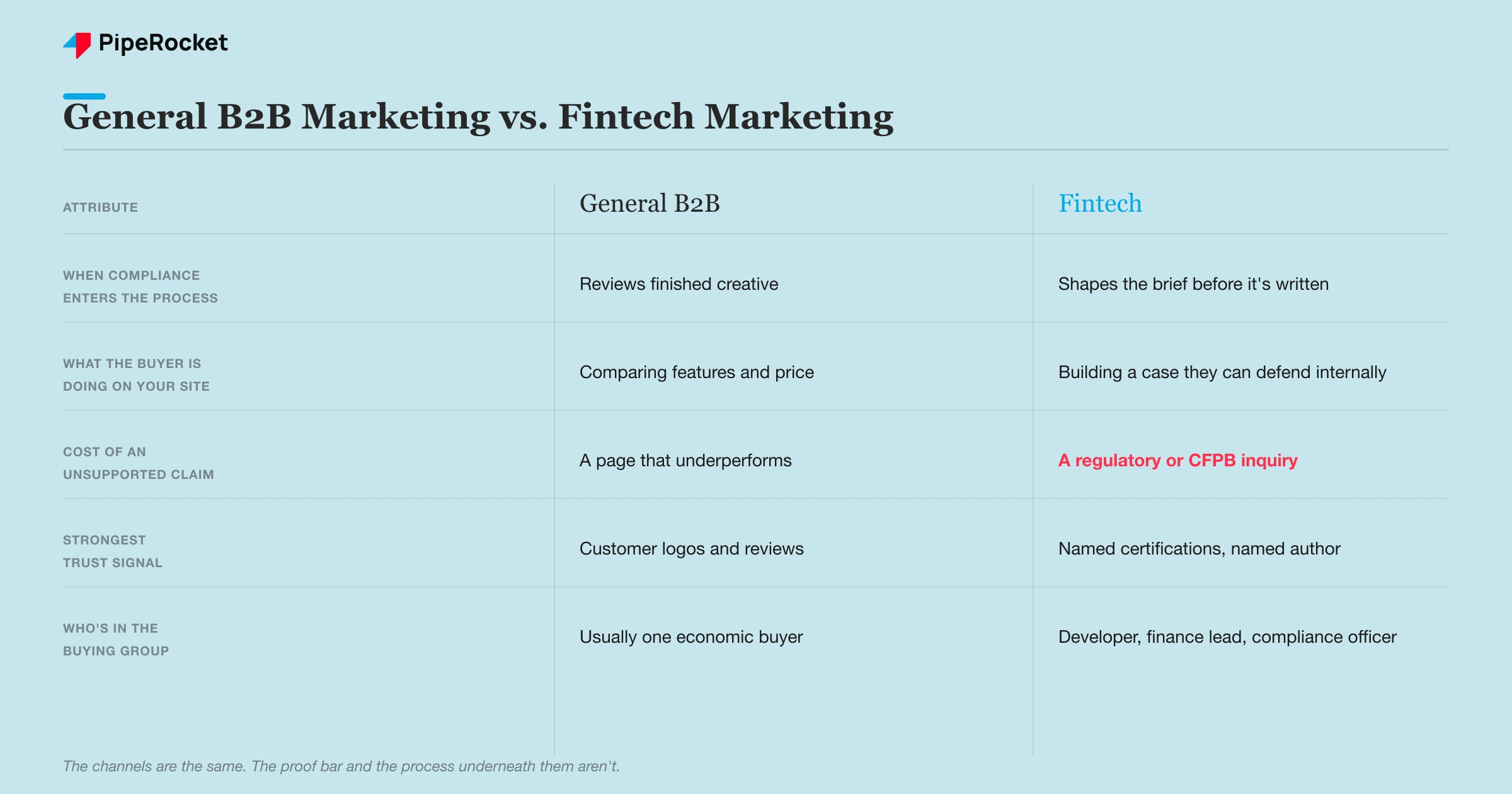
Compliance sits upstream of every channel decision
In most B2B categories, legal reviews finished creative. In fintech, legal and compliance shape the campaign before the first draft exists. A paid ad promising “guaranteed returns” or a case study implying deposit insurance you don’t carry is a regulatory problem, not a copywriting one.
- SEC Marketing Rule (Advisers Act Rule 206(4)-1): governs how registered advisers use testimonials, endorsements, and performance claims, requiring net performance to sit alongside any gross performance figure, shown with equal prominence.
- FinCEN: requires many fintechs to register as Money Services Businesses and run an anti-money-laundering program, which shapes how onboarding and KYC claims get marketed.
- CFPB: has repeatedly cited marketing language, including disclosures that were technically present but effectively invisible, in enforcement actions against banks, fintechs, and banking-as-a-service arrangements.
None of that means marketing stalls. It means the constraint has to enter the process at the brief stage, not the approval stage.
The buyer treats your site as evidence for an internal decision
A fintech buyer, whether it’s a CFO evaluating a payments platform or a compliance officer vetting a KYC tool, treats your site as evidence in a decision they’ll have to defend internally. Before they ever book a call, they scan for reasons to rule you out:
- The security page: encryption standards, data handling, and breach-response process spelled out.
- The certifications: SOC 2, PCI DSS, or ISO 27001 named and dated, with the actual standard spelled out.
- The named leadership: real people with real track records instead of an anonymous “our team.”
- The claims: every performance or security statement backed by a checkable source.
That changes what “good marketing” produces. A campaign that generates clicks but lands on a page with no named author, no compliance posture, and vague claims about security converts worse than the traffic numbers suggest. The marketing has to do double duty: generate the click, and survive the scrutiny once the click lands.
Multiple buyers with different proof requirements
A fintech deal rarely has one buyer. A developer evaluating an API cares about documentation and uptime. A finance lead cares about pricing and ROI. A compliance officer cares about SOC 2, data residency, and audit trails. Running one generic campaign at all three means none of them gets the proof they specifically need.
The Fintech Marketing Channel Mix
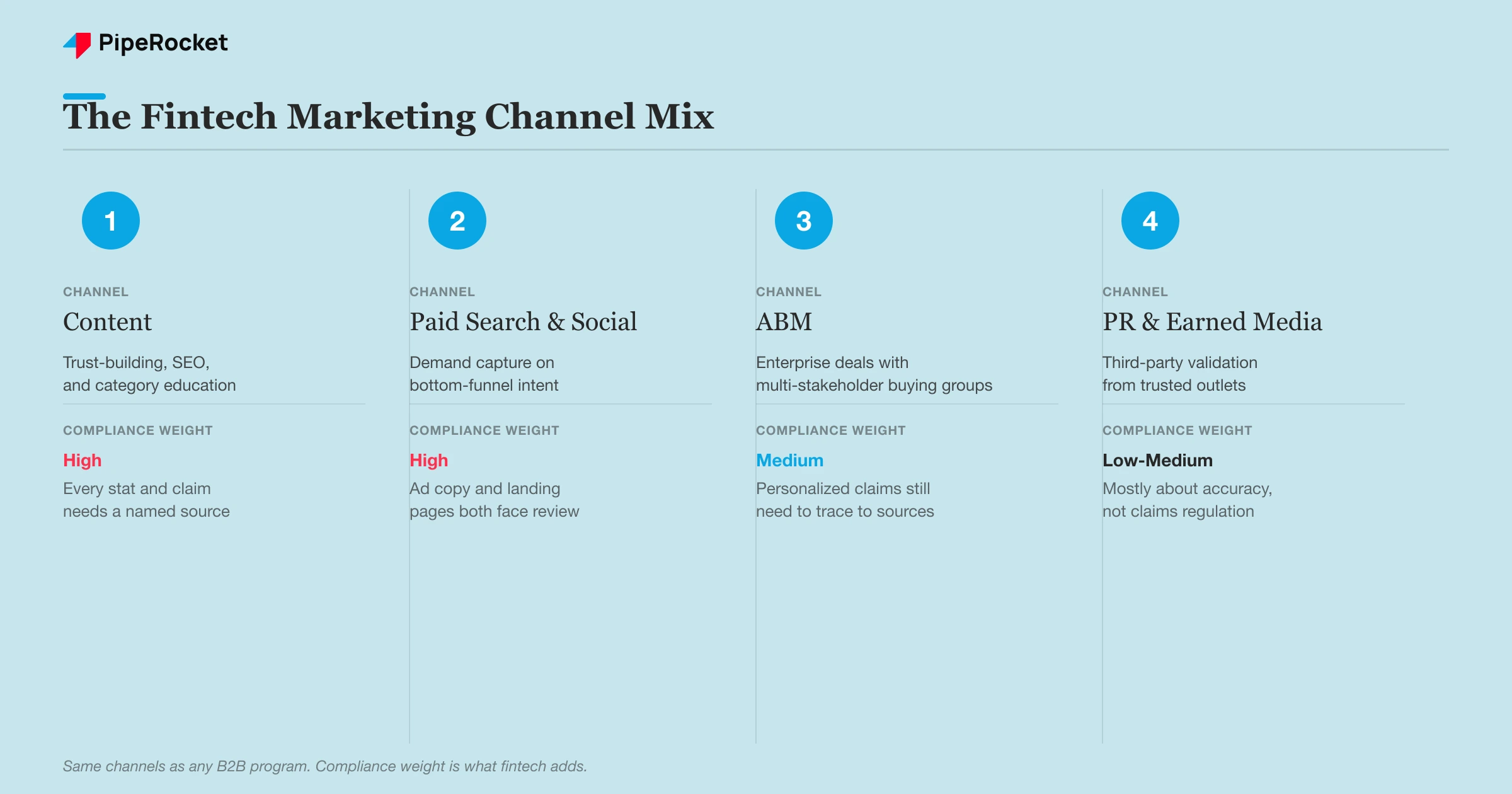
Fintech marketing runs five core channels: content, paid search and social, ABM, PR, and partnership-driven tactics (influencer, referral, community, gamification). The channels are familiar; what changes is how much compliance weight each one carries and where the highest-leverage effort goes.
| Channel | What it’s for in fintech | Compliance weight |
|---|---|---|
| Content marketing | Trust-building, SEO, and category education | High: every stat and claim needs a source |
| Paid search and social | Demand capture on high-intent, bottom-funnel terms | High: ad copy and landing pages both face review |
| ABM | Enterprise deals with compliance officers and finance leads in the buying group | Medium: personalized claims still need to trace to sources |
| PR and earned media | Third-party validation from outlets a cautious buyer already trusts | Low-medium: mostly about accuracy, not claims regulation |
| Influencer, referral, and community | Reach and social proof through partners, advocates, and user networks | High: partner and user claims still fall under the same disclosure rules |
Build content that proves trust while it ranks
Fintech content has to do two jobs at once: earn organic visibility and survive a skeptical reader’s scrutiny. That means three disciplines run together:
- Content and SEO are one program. The same trust-first discipline that governs fintech SEO governs the content, so the content strategy and the SEO strategy are really one program with two names.
- Name the standard, skip the reassurance. “Bank-grade security” convinces no one doing due diligence. “SOC 2 Type II certified, with annual third-party audits” does the actual work. Every stat needs a named, checkable source, because an unsourced number in a YMYL space reads as a red flag to both the reader and to Google.
- Only publish case studies you can defend. A results claim tied to a named client is strong evidence. An invented number attached to a fictional scenario is worse than no claim at all, because a diligent buyer will ask for it in a sales call and you won’t have it.
We’ve watched trust outrank raw authority directly on a fintech utility suite we’ve worked on: the currency-converter pages and a SWIFT-code lookup tool pull more than 10,000 organic visits a month between them, with the converter pages ranking on page one and the SWIFT tool close behind, beating older, far higher-authority finance sites for the same queries. In a YMYL category, freshness and visible trust signals do work that domain authority alone can’t.
Write for the developer, the finance lead, and the compliance officer separately
A single content calendar rarely serves all three buyers well. A developer wants API documentation, uptime history, and integration guides. A finance lead wants total cost of ownership and case studies with real numbers. A compliance officer wants audit trails, data residency answers, and a clear breach-response process.
Mapping content to persona doesn’t mean tripling the content budget. It means auditing the existing plan and asking which of the three buyers each piece is actually written for, then filling the gap for whichever one has nothing. Most fintech content calendars, when audited this way, turn out to be 80% finance-lead content and almost nothing for the other two.
Keep the definitional content genuinely useful
The strongest fintech content explains something confusing, why an interchange fee gets charged, how a chargeback dispute actually resolves, what a SOC 2 Type II report covers that a Type I doesn’t, without overpromising on either side of the explanation. That usefulness is what earns the trust that converts, and it doubles as the kind of clear, well-sourced material that gets pulled into AI-generated answers.
Run paid acquisition inside the compliance lane
Paid search and social are still the fastest way to capture bottom-funnel intent, someone searching “payment orchestration platform pricing” or “KYC API for fintech” is close to a decision. The catch is that ad platforms and regulators both scrutinize financial services copy harder than most verticals.
Two things go wrong most often. Ad copy implies a guarantee (“never miss a fraud case”) that the product can’t actually back, and the landing page it points to makes a claim the ad didn’t, creating a mismatch a reviewer or a regulator can flag independently. The fix is treating the ad and the landing page as one reviewed unit, not two separate assets approved by two separate teams on two separate timelines.
Retargeting has its own wrinkle in fintech. A visitor who bounced off a pricing page is a warm lead, but retargeting them with a specific numeric claim (“save 40% on transaction fees”) without a documented basis for that number is exactly the kind of unsupported claim that draws CFPB attention when a competitor or a customer complains.
Match the landing page to the exact claim the ad made
The fastest way to fail a platform’s ad review, or worse, a compliance audit, is a mismatch between what the ad promises and what the landing page can back up. If the ad says “reduce fraud losses,” the landing page needs the specific mechanism and, ideally, a named client outcome, not a broader pitch about the platform in general. Treat ad copy and landing page copy as one asset reviewed together, never two assets approved on separate timelines by separate teams.
Use ABM for the deals where the buying group actually needs individual proof
Account-based marketing earns its budget in fintech more than in most B2B categories, because enterprise fintech deals genuinely have three or four stakeholders who each need a different kind of proof before they’ll sign off. A generic nurture sequence talking to all of them at once talks to none of them well.
Give the compliance officer their own content track
Most B2B ABM programs are built around the economic buyer and treat everyone else as a secondary audience. In fintech, the compliance officer can kill a deal the CFO already approved, which means they need their own content track: audit trail documentation, data residency specifics, a clear answer to “what happens in a breach.”
Personalize the proof behind the pitch
ABM personalization in fintech usually means swapping in a company name and calling it done. Real personalization means matching the proof to the account’s actual risk profile, a crypto-adjacent account needs different security proof than a traditional lending platform, even if the product pitch is identical.
Use Event-Driven Messaging Instead of Static Campaigns
Event-driven messaging triggers communication off a user’s actual behavior (a stalled application, a first transaction, an unused feature) rather than a fixed calendar send. In fintech it converts better because the message arrives at the moment of intent and stays tied to what the user actually did.
A one-size batch email tells a user who abandoned KYC verification the same thing it tells a power user, which is why neither acts on it. A behavior-triggered journey reaches each user at the point where a nudge changes the outcome:
- Onboarding drop-off: a stalled verification or funding step triggers a specific, compliant prompt naming the exact next action instead of a generic “come back” email.
- Activation milestones: a first transaction or first payout triggers education on the next feature, deepening usage before churn risk sets in.
- Dormancy signals: a drop in login or transaction frequency triggers a re-engagement sequence early, while the account is still recoverable.
The compliance layer still applies. Any triggered message that references a balance, a rate, or a performance figure has to pull from the same pre-approved claims library the rest of the program uses, so automation never becomes a back door for an unsourced claim.
Where Gamification, Referral, and Community Programs Fit
Gamification, referral and affiliate programs, influencer partnerships, and community building are the growth tactics that sit alongside the core four channels, and they carry the same disclosure rules. They work in fintech when they reinforce trust, and backfire when they push users toward risky behavior.
- Gamification: progress streaks, savings goals, and rewards can drive engagement, but a mechanic that nudges users toward more trading or borrowing than they intended is exactly the pattern the CFPB scrutinizes. Keep the reward tied to healthy behavior.
- Referral and affiliate programs: a referred user arrives pre-trusted by someone they know, which is powerful in a category built on trust. Any incentive language and any affiliate’s claims still fall under the same marketing-rule disclosure standards as your own copy.
- Influencer and partnership marketing: a creator or partner vouching for the product carries third-party weight, but every claim they make on your behalf is a claim you’re responsible for, so brief them from the pre-approved claims library.
- Community marketing: a user or developer community (forums, events, industry networks) compounds trust and surfaces the real questions your content should answer, without the compliance load of a paid claim.
Earn Third-Party Validation Through PR
PR earns fintech the one thing your own site can’t manufacture: third-party credibility from outlets a cautious buyer already trusts. Original research and reclaimed unlinked mentions are the two highest-leverage plays.
PR does something in fintech that it doesn’t do as reliably in other B2B categories: it supplies the third-party credibility a buyer can’t get from your own site, no matter how well you write it. A mention in a respected financial trade publication or a quote from your compliance lead in an industry roundup carries weight your own case study can’t match.
The highest-leverage PR play is original research. A fintech company that publishes real data on payment-failure rates, cross-border transfer costs, or fraud patterns gives journalists and analysts something to cite, which earns coverage in outlets a cautious buyer already trusts. It’s also the kind of citable, sourced data that AI answer engines pull into their own responses when someone asks a related question.
The second-highest-leverage play is reclaiming unlinked mentions. Regulated companies get named in articles, forum threads, and comparison pieces constantly without a link back, because the writer didn’t think to ask. Monitoring for those mentions and following up for attribution is some of the cheapest authority-building available, and it doesn’t require producing new content at all.
How to Build a Compliant Claims Process
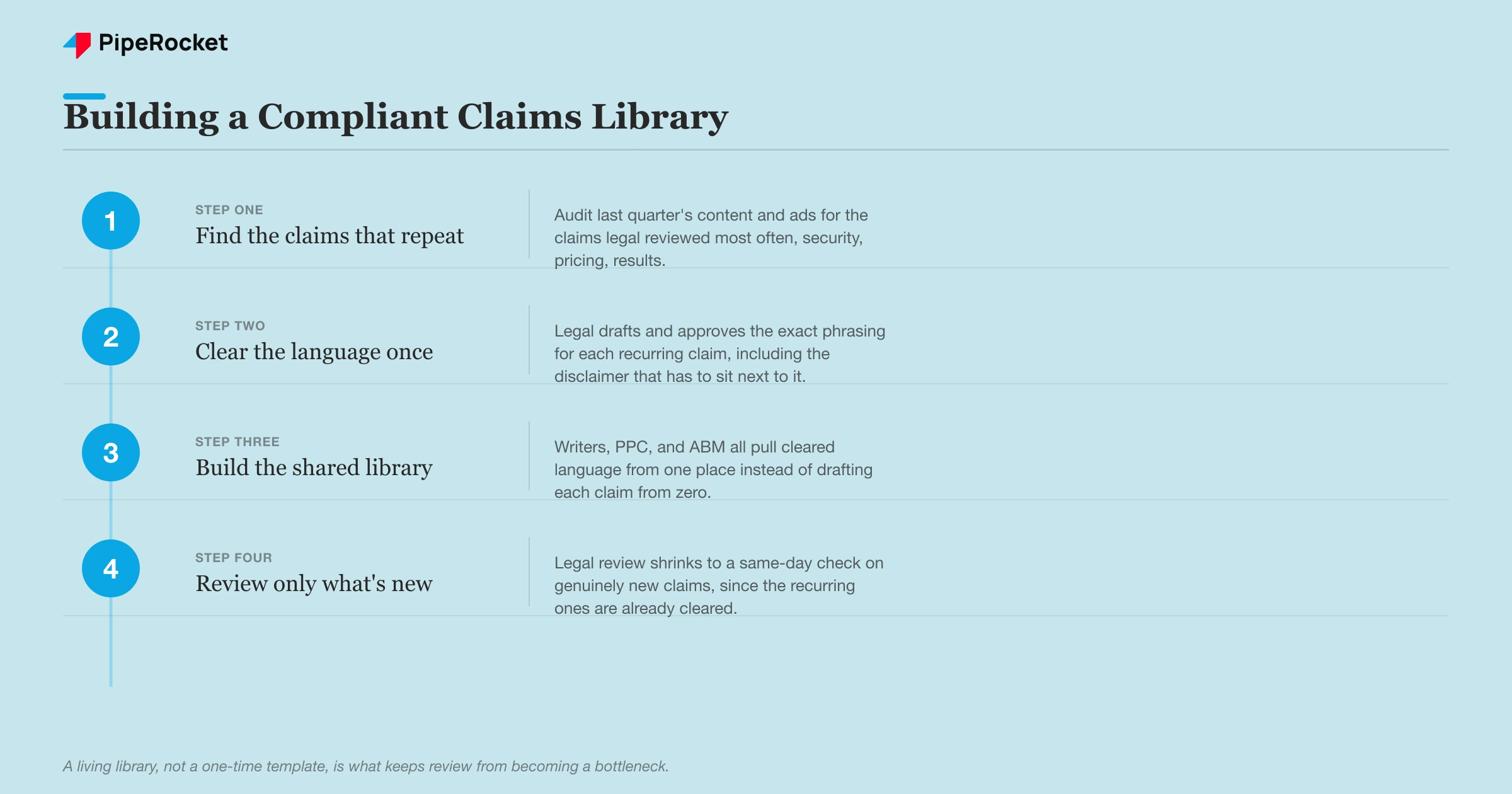
A compliant claims process runs on a pre-approved claims library: cleared language and disclaimers writers pull from directly, so legal reviews only what’s genuinely new and the cycle drops from weeks to a same-day check. Build compliance into the brief, not the final gate.
The teams that move fast in fintech marketing aren’t the ones with the least compliance oversight. They’re the ones who built the compliance step into the process early enough that it stops being a bottleneck. This overview covers the shape of that process; our deeper walkthrough of the claims library and why fintech content gets watered down lives in our fintech content marketing guide.
A pre-approved claims library is the single highest-leverage fix. Instead of every writer starting from zero and every claim going through a full legal review, the library holds language and disclaimers that are already cleared: how to describe your security posture, how to phrase a results claim, what disclaimer has to sit next to a pricing statement.
Writers pull from the library, legal reviews only what’s genuinely new, and the review cycle drops from weeks to a same-day check.
Build the library around the claims your marketing actually needs to make, not a generic legal template. If your content repeatedly needs to describe encryption standards, pricing guarantees, and integration timelines, those three categories get pre-cleared language first. Everything else stays a case-by-case review until the pattern repeats often enough to warrant its own entry.
Treat the library as living, not fixed. Every time legal approves new language for a first-time claim, that language goes into the library so the next writer doesn’t start from zero either.
Common Mistakes in Fintech Marketing
The most common fintech marketing mistakes are treating compliance as a final gate, making vague security claims, running one message across a multi-stakeholder buying group, chasing broad head terms too early, and publishing case studies with no checkable outcome.
Most failed fintech marketing programs trace back to one of a handful of repeatable mistakes. Each one looks like an efficient shortcut and each one costs more than it saves.
Treating compliance as a final gate instead of a design input
Writing the campaign first and sending it to legal last means every rejected claim triggers a full rewrite on a deadline. Building compliance into the brief means the campaign that reaches legal review is already close to clean.
Making vague security claims instead of naming the standard
“Enterprise-grade security” tells a compliance officer nothing they can verify. Naming the actual certification, SOC 2 Type II, PCI DSS, ISO 27001, whichever you genuinely hold, gives them something to check and gives your content something Google’s stricter YMYL bar can actually credit.
Running one generic message across a multi-stakeholder buying group
A developer, a finance lead, and a compliance officer are evaluating different things. A single message tuned to the loudest stakeholder leaves the other two with no reason to sign off, and enterprise fintech deals die in exactly that silence.
Chasing broad head terms before earning niche authority
Targeting “business banking” or “payment processing” on day one puts a new fintech brand up against banks and decade-old domains with years of link equity. Winning a narrow, defensible cluster first and expanding from there is slower to start and faster to actually rank.
Publishing case studies without a real, checkable outcome
A results claim without a named client or a documented basis is worse than saying nothing, because a buyer doing diligence will ask for it directly, and an unanswerable question at that stage kills more deals than a modest but honest number ever would.
How to Measure a Fintech Marketing Program
The right metrics in fintech marketing track pipeline and trust, not raw traffic or click volume. A campaign that drives visits to a page nobody trusts enough to convert on is producing activity, not results.
Start with the standard funnel metrics: qualified leads, pipeline contribution, and CAC by channel. Then layer in the trust-specific signals that predict whether those numbers hold up:
- Conversion rate on trust-critical pages (security, compliance, pricing) compared to the site average
- Time-to-close on deals that touched a compliance-specific content asset versus deals that didn’t
- Unlinked brand mentions reclaimed per quarter, since that’s a direct measure of PR-driven authority
- Content that gets cited in AI answer engines for compliance and security queries, since that’s now a leading indicator of buyer shortlisting
Watch for the gap between traffic and pipeline specifically. If organic and paid traffic are both healthy but pipeline isn’t moving, the pages those channels feed usually aren’t clearing the trust bar once the visitor arrives, rather than the channel itself being broken.
Run this diagnostic quarterly rather than waiting for a board review to surface it. A trust-page conversion rate that’s drifted below the site average for two consecutive quarters is an early warning that a security or compliance claim has gone stale, or that a competitor has published something more current on the same topic. Catching that drift early is cheaper than rebuilding the page after pipeline has already stalled.
Fintech Marketing Across Content, Paid, ABM, and PR Together
The channels above work best as one system, not four separate budgets competing for credit. Content earns the organic visibility and supplies the proof pages ABM and paid both point to. PR supplies the third-party validation content can’t manufacture on its own. Paid captures the intent that content and PR create awareness for.
A fictional example: a compliance-software vendor selling to mid-market banks runs an ABM sequence targeting compliance officers at 40 named accounts. The sequence links to a content asset explaining SOC 2 audit trails in plain language, itself built on data the same team pitched to a regulatory trade publication two months earlier.
The paid retargeting that follows a site visit points back to that same asset instead of a generic demo page. One proof point gets reused across three channels, rather than three teams each building their own.
Why PipeRocket Digital Runs Fintech Marketing This Way
We treat compliance as a brief-stage input, not a final review, and build content, paid, and PR around the same proof points instead of three disconnected campaigns. This guide is the channel-mix overview; for the step-by-step sequencing of a fintech marketing strategy (positioning, then proof, then spend), that framework goes deeper than this pillar can. If you want the SEO-specific execution layer this program sits inside, our fintech SEO guide covers that in depth. If you’d rather compare specialist agencies first, our best fintech marketing agencies roundup is a fair place to start. If you want us to run the program, see how our fintech marketing agency and fintech PPC agency teams work, or talk to us directly .
Frequently Asked Questions
What is fintech marketing?
Fintech marketing refers to the full B2B marketing program, content, paid acquisition, ABM, and PR, run for a financial-technology company under regulatory oversight most software categories don’t face. It uses the same channels as any B2B marketing program, but every claim, testimonial, and piece of creative has to clear a compliance filter before it ships, which changes what can be promised and how fast a campaign can move.
How is fintech marketing different from general B2B marketing?
Fintech marketing carries a regulatory layer that shapes campaigns before creative gets written, not after. Rules like the SEC’s Marketing Rule, FinCEN’s AML requirements, and CFPB enforcement on deceptive marketing language mean claims about performance, security, and compliance have to be sourced and defensible. The channels look the same as any B2B program; the review process and the proof bar underneath them don’t.
What compliance rules affect fintech marketing the most?
The SEC’s Marketing Rule governs testimonials, endorsements, and performance claims for registered advisers, requiring net performance alongside any gross figure. FinCEN’s Money Services Business registration and AML program requirements shape how onboarding and KYC messaging can be framed. The CFPB has cited marketing language directly in enforcement actions against fintechs and banks, including disclosures that were present but not genuinely visible to the reader, so surfacing disclosures clearly matters as much as including them at all.
What channels does fintech marketing use beyond content and paid?
Beyond content and paid, fintech marketing uses ABM for multi-stakeholder enterprise deals, PR for third-party credibility, event-driven messaging for behavior-triggered journeys, and partnership tactics like referral, influencer, and community programs. Each still clears the same compliance filter.