Most SaaS teams open LinkedIn Campaign Manager, pick an objective, and start spending inside twenty minutes. Then they judge the whole channel on last-click leads a month later and quietly turn it off. LinkedIn Ads for SaaS is a program you plan in full before you ever touch the interface.
I’ve spent over a decade running paid acquisition for B2B SaaS, and the accounts that work treat LinkedIn as a system with a targeting layer, a format layer, a budget layer, and a measurement layer that all agree with each other. This guide walks the whole program.
TL;DR
- LinkedIn is a full program: Plan targeting, formats, budget, and measurement as one system before you open Campaign Manager, or you’ll burn budget fast.
- The objective locks everything: Your campaign objective decides which formats and bid types you get, so pick it against the job you’re hiring the campaign for.
- Targeting is your real lever: LinkedIn bills by impression, so layer function, seniority, and skills (not job title alone) plus ABM lists to reach buyers instead of junior scrollers.
- Formats map to funnel stage: Single image, document, thought-leader, conversation, and carousel ads each do a different job, so match the format to where the buyer sits.
- Budget and bidding protect the spend: LinkedIn has a real cost floor, and manual bidding plus Audience Network off keep you from overpaying.
- Measure on lift and pipeline: LinkedIn influences buyers who convert later through brand search, so track pipeline movement instead of last-click dashboard conversions.
- LinkedIn earns its place beside capture channels: It creates demand that Google and brand search then capture, so fund it as one part of the wider paid mix.
Why LinkedIn Ads Need Their Own Playbook for SaaS
LinkedIn is a demand-creation channel wearing a performance-ad interface, and treating it like Google is the single most expensive mistake I see. Nobody on LinkedIn is in buying mode. They’re scrolling between meetings, catching industry news, checking who changed jobs. Your ad interrupts that. It plants a seed.
Weeks later, when that VP actually needs the software, they don’t search a generic term. They search your brand on Google and convert there. Our team’s shorthand for the whole channel is simple: Google is for capture, LinkedIn is for influence.
That difference changes the economics. LinkedIn charges a premium for professional context, which only pays off when your average contract value can absorb it. If you’re selling a $20-a-month tool to freelancers, the cost per click will eat you alive, so stay on Meta or Google.
LinkedIn Bills You Per Impression, So Waste Is Baked In
LinkedIn charges for impressions as well as clicks, which means a sloppy audience costs you money the moment your ad serves. On Google, a bad keyword mostly wastes the click you paid for. On LinkedIn, you pay to show your ad to every wrong person you failed to exclude.
That flips the priority order. Before creative, before budget, before bidding, the audience decides whether the money reaches buyers or evaporates on junior employees who can’t sign a check. Most of the budget waste I audit traces back to this one setting being left loose.
The Buying Cycle Is Long, So the Metrics Have to Wait
A SaaS deal influenced by LinkedIn can take months to close, and any team judging the channel on a 30-day window is measuring the wrong thing. The person who saw your ad isn’t the only decision-maker, and they rarely act the week they see it.
That patience has to be designed in from the start. If leadership expects LinkedIn to post Google-style conversion numbers by week two, the channel gets killed before it ever pays back. Set that expectation before the first dollar goes out.
Start With the Campaign Objective, Because It Locks Your Options
The objective you choose isn’t a label, it’s the setting that dictates which ad formats and bidding options LinkedIn will even let you use. Pick it against the specific job the campaign is doing, because you can’t change it later without rebuilding.
I map objectives to the funnel stage the campaign serves. A brand-awareness objective is for keeping your name in the feed when you’re announcing funding or entering a new market, not for chasing conversions. Website visits fits promoting a report or a feature page. Lead generation uses LinkedIn’s native forms that auto-fill from the user’s profile, so friction drops and form fills climb.
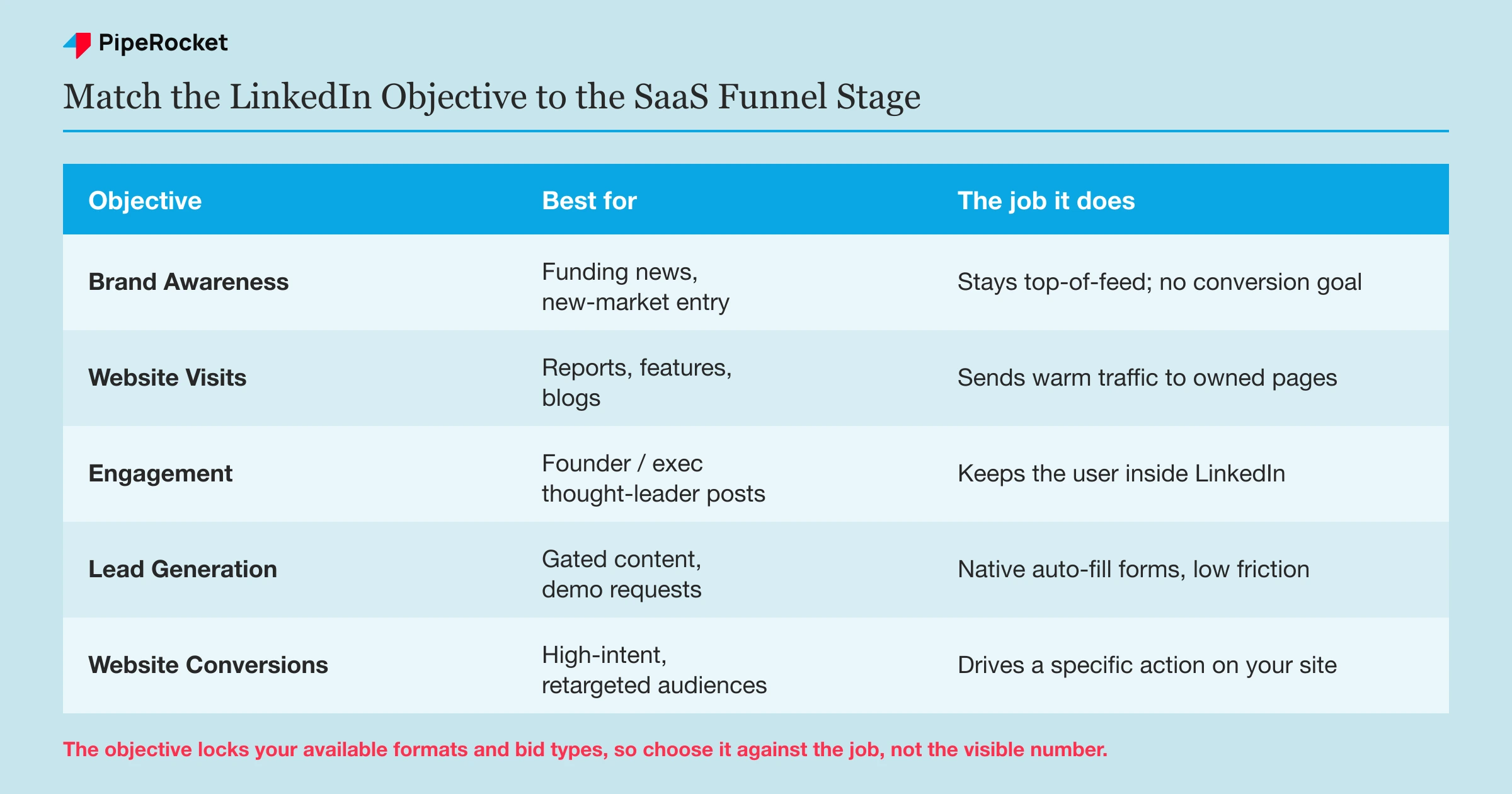
Here’s how I match objectives to intent:
| Objective | Best for | The job it does |
|---|---|---|
| Brand Awareness | Funding news, new-market entry | Stays top-of-feed; no conversion expectation |
| Website Visits | Promoting reports, features, blogs | Sends warm traffic to owned pages |
| Engagement | Boosting founder or thought-leader posts | Keeps the user inside LinkedIn, builds reach |
| Lead Generation | Gated content, demo requests | Native auto-fill forms, low friction, high fill rate |
| Website Conversions | High-intent, retargeted audiences | Drives a specific action on your own site |
The trap is defaulting to lead generation everywhere because it produces a visible number. A cold audience served a lead-gen form gives you cheap contacts who never had intent. Match the objective to how warm the audience actually is.
Targeting and ABM Are Where the Money Is Won or Lost
Your targeting decides whether every paid impression lands on a buyer or a bystander, and on LinkedIn that’s the difference between a channel that pays back and one that quietly bleeds. Because you pay by impression, I always run against an account list so the spend hits companies that can actually afford the product.
The deep execution of committee mapping, tier design, and retargeting lives in dedicated guides. This section frames the layer so you know what to build and where each piece fits.
Layer Function, Seniority, and Skills When You Build the Audience
Targeting on job title alone is the trap, because LinkedIn’s title field is noisy and misses buyers who own the problem under a different label. Layer job function, seniority, and skills together so the audience resolves to the person who actually feels the pain, then let company size and industry filter the rest.
Start from the problem your product solves, then find the people who own that problem. The intuitive target is often wrong. A content-repurposing tool feels like a demand-gen play, but the person who genuinely cares is a Head of Content or a content marketing manager, so layer the content function with a manager-plus seniority and skills like editorial or content strategy.
Company size and seniority do the heavy filtering. If you sell enterprise software, filter to larger headcounts and exclude the junior roles LinkedIn will otherwise pad your reach with. The buying committee for SaaS on LinkedIn is rarely one person, so plan to reach the champion, the economic buyer, and the blockers.
Layer ABM Lists So Spend Matches Account Value
Not every account deserves the same treatment, so I tier the account list by how much the company is worth to you. This is the backbone of any serious LinkedIn account-based marketing program, and it keeps a broad campaign from turning into a broad waste.
| Tier | Account set | How you run it |
|---|---|---|
| 1:1 | A handful of must-win “whale” accounts | Tailored campaigns aimed only at the CXOs, VPs, and directors there |
| 1:Few | 10 to 20 similar companies | One shared angle for a tight, look-alike cluster |
| 1:Many | 1,000 to 5,000 ICP -fit companies | Scaled coverage across the full addressable list |
Retargeting Is a Layer, Not an Afterthought
Most teams stop retargeting at website visitors, which leaves the highest-intent audiences on the table. Warmer segments convert far better: people already in your sales pipeline , engaged video viewers, and accounts your team is actively working. A full LinkedIn retargeting setup sequences these into a story instead of firing the same ad at everyone who touched the site once.
Serve warm audiences proof, not another cold pitch. Case studies, named-client results, and G2 or review-site ratings are the creative that moves someone who already knows you toward a demo, because they answer the “does this actually work” question the buyer is now asking.
Retargeting doesn’t stop at the signup either. Build audiences of existing users and closed accounts, then run expansion and upsell ads at them: a new feature, a higher tier, a seat expansion. Post-signup retargeting keeps LinkedIn earning after the first deal instead of only chasing new logos.
Match the Ad Format to Where the Buyer Sits
Each LinkedIn ad format does a different job, so the format is a funnel decision, not a design preference. A single image ad and a conversation ad speak to buyers in completely different moments, and using the wrong one wastes the impression you paid for.
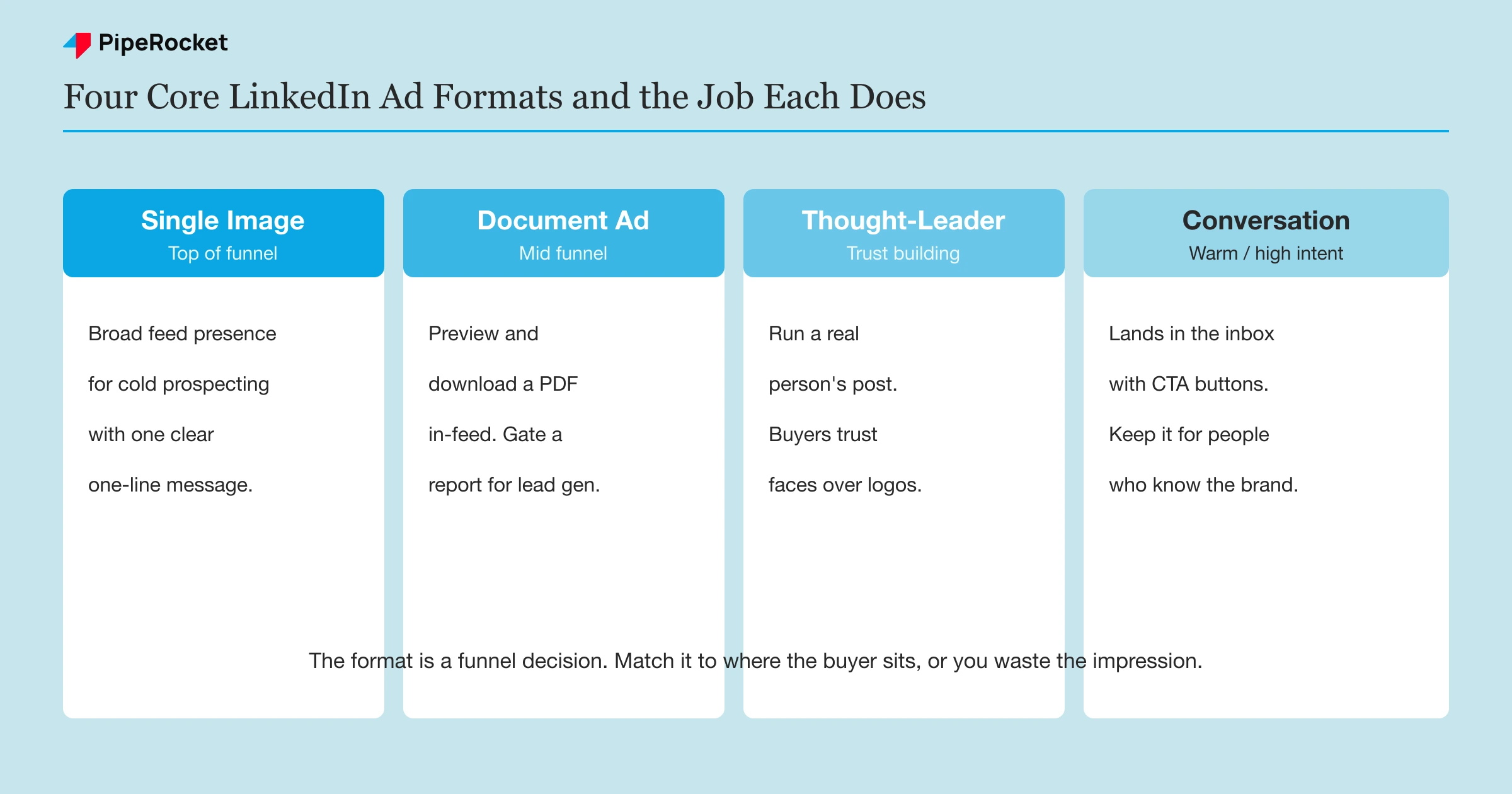
Here’s how I map the main formats to their job:
| Format | Funnel job | When I reach for it |
|---|---|---|
| Single image | Broad feed presence | Cold prospecting, clear one-line message |
| Document ad | Mid-funnel value | Gating a report or checklist for lead gen |
| Thought-leader ad | Trust and credibility | Running a founder or exec’s real post as an ad |
| Conversation / message ad | Direct, high-intent nudge | Warm audiences, event invites, demo offers |
| Carousel ad | Step-by-step workflow | Walking a buyer through a feature or a multi-step use case |
A carousel ad lets you tell a sequence in swipeable cards, so it suits SaaS products where the value only lands once a buyer sees the workflow. Use one card per step, or one card per feature, and keep the last card the offer. It earns its place when a single image can’t carry the story.
Thought-Leader Ads Borrow a Face the Feed Trusts
A thought-leader ad runs a real person’s post rather than a company page’s, and it lands because buyers trust people more than logos. When your founder posts a genuine insight, you can put paid weight behind it so it reaches the exact ICP instead of just their existing connections.
This format fits the influence job LinkedIn does best. The reader isn’t being sold to, they’re reading a point of view from someone in their field, which lowers the guard that a polished brand ad raises. Keep the post authentic, because the moment it reads like an ad wearing a person’s photo, the trust evaporates.
Document and Conversation Ads Do the Quiet Heavy Lifting
Document ads let a buyer preview and download a PDF straight from the feed, which makes them one of the better mid-funnel lead-gen units for SaaS. A whitepaper or a benchmark report earns the email without dragging the user to a landing page first.
Conversation ads land in the inbox with clickable buttons, so they suit warm, high-intent audiences and time-bound offers like event invites. They’re intrusive by design, which is why I keep them for people who already know the brand. Fire them at a cold list and you train that audience to ignore you.
Creative and Copy: Write for the Scroll, Not the Search
LinkedIn copy has to earn attention from someone who wasn’t looking for you, which is the opposite of search copy that answers an active query. Lead with the buyer’s problem, name their job in the copy so the right person self-selects, and save the feature list for the landing page.
The full craft of hooks, angles, and testing lives in our SaaS LinkedIn ad copy guide, so I’ll keep this to the principles that hold across every campaign. The ad’s job is to win the click, not close the deal.
- Open with the pain the buyer feels, before any product claim.
- Put the exact job title in the copy so the right reader self-selects.
- Write to the outcome in plain language, and cut the category jargon and acronyms that make a reader scroll past.
- Keep one clear idea per ad, not a stack of features.
- Ship at least five creatives, because LinkedIn suppresses a single ad fast.
Treat those five creatives as an A/B test, not just a rotation. Change one variable at a time (the headline, the CTA, the visual) so you can read which hook, which offer, and which format actually earns the click, then feed the winner back into the next round.
That variety matters more than teams expect. LinkedIn shows the same person the same ad only a couple of times before it throttles your reach, so launching with one “perfect” creative caps your own audience. Give the algorithm variety to rotate.
Budget and Bidding: Protect Every Dollar From the Platform
LinkedIn has a real cost floor and a set of default settings that quietly spend faster than they should, so budgeting is as much about defense as about how much you commit. The channel rewards patience and punishes autopilot.
Come In With Enough Budget to Actually Learn
A campaign starved of budget never gathers enough data to tell you anything, so underfunding is its own failure mode. LinkedIn enforces a minimum daily spend per campaign, and a budget too small to reach your audience meaningfully just produces noise you can’t read.
The honest version is that LinkedIn suits companies past product-market fit that know their ICP and can absorb a real monthly test. If the budget can’t sustain a proper test window, the smarter move is to wait, not to run a thin campaign and conclude the channel doesn’t work.
Kill the Default Settings That Burn Cash
Two default settings quietly drain SaaS budgets, and both are easy to fix. Max Delivery bidding hands LinkedIn permission to spend as fast as possible with no regard for efficiency, so I switch to manual bidding and start at the low end of the suggested range, nudging up only if delivery stalls.
The second is the Audience Network, which serves your ads on third-party sites outside the feed. You pay LinkedIn’s premium for professional context, so paying it to show up on a random app sidebar makes no sense. Turn it off. Use Classic campaigns over the AI-driven Accelerate mode when you need this level of control.
Here are the four settings that decide whether the budget works for you or against you:
| Setting | What to do |
|---|---|
| Minimum daily spend | Fund enough to clear LinkedIn’s per-campaign minimum and reach a real test window; a starved budget only produces noise |
| Bid type | Switch off Max Delivery, use manual bidding, start at the low end of the suggested range and nudge up only if delivery stalls |
| Audience Network | Turn it off so you don’t pay LinkedIn’s premium to serve ads on random third-party sidebars |
| Campaign type | Choose Classic over the AI-driven Accelerate mode when you need control over targeting and bids |
Measure LinkedIn on Lift, Because It Skips Last-Click
LinkedIn is an influence channel, so your attribution tool will hand the credit to “direct” or “organic” for leads the ad actually started. Judging it on last-click will make you pause campaigns that were working, which is how good programs die.
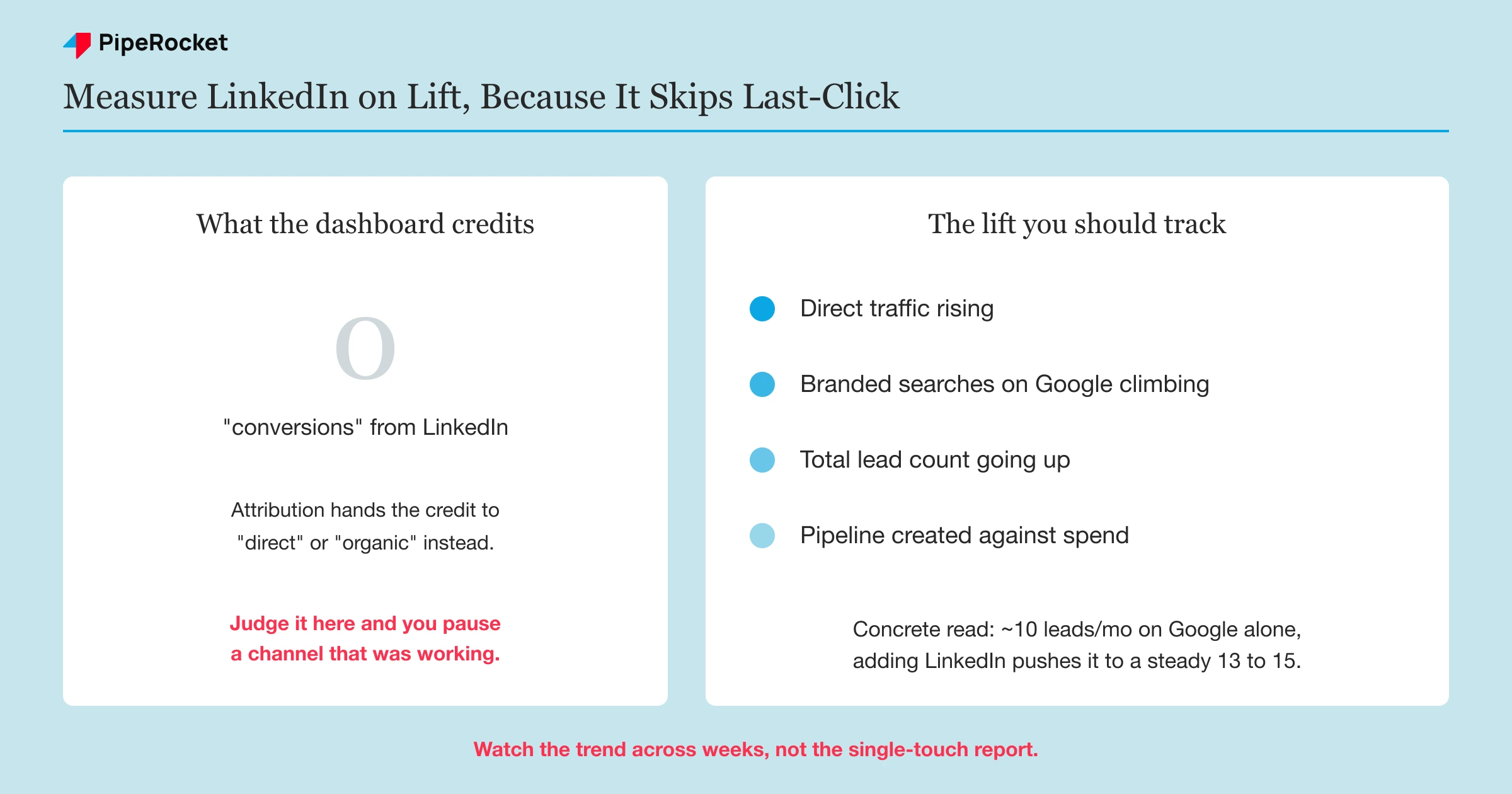
Instead of chasing dashboard conversions, I read the lift after a heavy campaign launches:
- Did direct traffic to the site rise?
- Did branded searches for your name on Google go up?
- Did total lead count climb, even when LinkedIn isn’t claiming credit?
A concrete read makes this real. If you were getting around 10 leads a month on Google alone, and adding LinkedIn pushes you to a consistent 13 to 15, the channel is working even though the LinkedIn dashboard looks quiet. Watch the trend across weeks, not the single-touch attribution report.
The deeper measurement story is pipeline. A verified decision-maker seeing your ad is worth more than a cheap click from a stranger, so the ratio that matters is pipeline created against spend over the real sales cycle, not cost per lead in the first month.
To read pipeline properly you have to connect the data. Pipe your CRM into LinkedIn with the conversions API or offline conversion imports, so closed-won revenue and signups flow back against the ad exposures that touched them. Without that link, the platform only sees the click, and you never see which impressions turned into deals months later.
Where LinkedIn Fits in the Broader Paid Mix
LinkedIn creates demand that other channels then capture, so it belongs beside your capture spend rather than in a silo competing with it. The mistake is pitting LinkedIn against Google on the same cost-per-lead scorecard, when they’re doing opposite jobs at opposite ends of the funnel.
I fund the capture layer first. Search ads and branded search catch buyers already looking, which is the cheapest pipeline you’ll ever buy, so that demand gets funded before you spend a dollar creating new demand. Once capture is covered, LinkedIn’s job is to fill the top of that funnel with the accounts you want searching for you later.
The two reinforce each other when you connect them. Retarget your high-intent Google visitors on LinkedIn with proof and case studies, and retarget your LinkedIn engagers back toward a demo. Run in isolation, each channel looks weaker than it is. Run together, LinkedIn’s influence shows up as cheaper, warmer capture downstream.
Common Mistakes to Avoid
The failures I see auditing SaaS LinkedIn accounts repeat with almost boring consistency, and every one of them is a setup decision, not a bad-luck outcome.
Treating LinkedIn Like Google Ads
The root mistake is expecting immediate, last-click conversions from a channel built for influence. Teams import a search mindset, judge LinkedIn on week-two lead counts, and pause it before the delayed pipeline ever arrives. Set influence expectations before launch, or the channel never gets the runway it needs.
Leaving the Audience Too Broad
A budget spread across hundreds of thousands of people reaches almost no one meaningfully, because your audience penetration collapses. Narrow the audience to match the budget using seniority, industry, and company-size filters so you actually saturate the accounts that matter instead of dusting a huge list.
Running Only One Creative
Launching with a single ad caps your own reach, because LinkedIn suppresses a repeated creative fast. Ship at least five variants so the platform has something to rotate, and you keep reaching the same buyer without fatiguing them into ignoring you.
Sending Ad Traffic to a Mismatched Page
A demo-focused ad that dumps the click onto a generic homepage breaks the promise the ad made. The landing page has to continue the exact message and offer the ad set up, or the warm click you paid a premium for cools instantly.
How PipeRocket Digital Runs LinkedIn Ads for SaaS
We run LinkedIn as the influence half of a full paid program, not a standalone lead machine. That means building tiered ABM lists so every impression hits a company that can afford you, setting objectives and formats against real funnel stage, and defending the budget with manual bidding and the right settings.
We measure on lift and pipeline, then connect LinkedIn to your capture spend so the whole SaaS PPC program compounds. If you’d rather hand this to a specialist team, reach out and let’s plan your pipeline .
Frequently Asked Questions
Are LinkedIn ads worth it for B2B SaaS?
For high-ACV SaaS, yes, as long as your expectations fit the channel. LinkedIn puts your brand in front of the exact decision-makers who approve your deals, and those buyers live on the platform. The cost per click runs high because you’re paying for verified professional context, so it only pays back when your contract value can absorb it. If you sell a low-price tool to individuals, Google or Meta will serve you better.
How much should a SaaS company spend on LinkedIn ads?
Enough to gather meaningful data, which is more than most teams expect. LinkedIn enforces a minimum daily spend per campaign, and budgets too thin to reach your audience just produce noise you can’t read. The channel suits companies past product-market fit that can commit to a real monthly test over a proper window. If the budget can’t sustain that, wait rather than run an underfunded campaign and wrongly conclude the channel fails.
What makes LinkedIn ads powerful for SaaS?
LinkedIn reaches the exact decision-makers who approve SaaS deals and plants your brand before they buy. That influence shows up later as branded search and direct traffic, which is why it works for high-ACV products that can absorb the premium cost.
How much do LinkedIn ads cost?
LinkedIn runs a real cost floor, with cost per click commonly landing in the $8 to $15 range and higher for competitive audiences. It enforces a minimum daily spend per campaign, so budget enough to reach a proper test window rather than run a thin campaign.
Why are my LinkedIn ads getting zero conversions in the dashboard?
Because LinkedIn is an influence channel, and your attribution tool usually credits the eventual conversion to direct or organic traffic instead. A busy VP won’t stop scrolling to book a demo, but they’ll remember you and search your brand weeks later. Before pausing, check your lift: is direct traffic rising, are branded searches climbing, is total lead count up? If those trends are green, the ads are doing their job even when the dashboard looks empty.