
LinkedIn B2B Lead Generation: The Full-Funnel Playbook
 Sabarish Chandrasekar
Last updated on
Sabarish Chandrasekar
Last updated on
LinkedIn B2B lead generation means turning business profiles into sales opportunities through profile optimization, thought-leadership content, targeted Sales Navigator searches, personalized outreach, and paid ads. Industry surveys consistently show LinkedIn as one of the top pipeline sources B2B marketers rely on.
TL;DR
- LinkedIn B2B lead generation runs on five strategies: an optimized profile, Sales Navigator targeting, value-first outreach, thought-leadership content, and paid lead-gen ads.
- A profile written like a landing page (a benefit-led headline, not a job title) makes every other strategy convert better, since prospects check it before they reply to anything.
- Sales Navigator’s saved searches and lead lists replace generic prospecting with filters built for account fit, not just job title.
- Value-first outreach means a short, specific message tied to the prospect’s recent activity or pain points, sent before any pitch, not alongside one.
- Thought-leadership content earns organic trust and becomes a lead source only when a comment or profile visit triggers a real follow-up.
- Paid ads scale a message that’s already converting manually, rather than testing a brand-new offer.
What Is LinkedIn B2B Lead Generation?
LinkedIn B2B lead generation is using an optimized profile, Sales Navigator search, connection and DM sequencing, organic content, and paid lead-gen forms together to move a business buyer from a cold profile to a qualified sales conversation.
It works best as a connected system where each motion feeds the others, rather than as separate campaigns judged on their own metrics. A profile earns the click, Sales Navigator builds the account list, outreach opens the conversation, content warms the room, and paid scales whatever is already converting.
Is This for a B2B Product or a Service, and What’s Your ICP?
Answer two questions before you start: are you selling a product or a service, and who exactly is the ICP you’re targeting? Product sales lean on Sales Navigator filters and paid forms; service sales lean on content and outreach. Both shape every strategy below.
Every strategy below executes differently depending on those two answers.
| Product sale (SaaS, tool, platform) | Service sale (consulting, agency, implementation) | |
|---|---|---|
| Buyer evaluates | A demo or free trial, largely without back-and-forth | The person or team behind the offer |
| Leans harder on | Sales Navigator firmographic filters, paid lead-gen forms | Thought-leadership content, outreach |
Your ICP determines which Sales Navigator filters matter and what “value-first” actually means in outreach. An ICP defined only by title (“VP of Marketing”) is too broad to act on.
A useful ICP instead combines: title, company size, industry, and a buying signal (recent funding, a leadership change, a relevant job posting). That combination is specific enough to build every other strategy in this piece around.
The Core Strategies for LinkedIn B2B Lead Generation
LinkedIn B2B lead generation runs on five strategies: an optimized profile, Sales Navigator targeting, value-first outreach, thought-leadership content, and paid lead-gen ads.
- Optimize your profile so it reads like a landing page: a benefit-led headline instead of a job title, checked before any outreach or ad sends someone to it.
- Target with Sales Navigator by stacking firmographic and signal-based filters into saved searches instead of running one-off title searches.
- Lead with value in outreach by sending a short, specific message tied to the prospect’s recent activity or pain points instead of a pitch on first contact.
- Publish thought-leadership content tied to a comment-to-DM or profile-visit trigger, turning engagement into a conversation instead of a vanity metric.
- Scale with paid lead-gen ads built from a message that’s already getting replies manually instead of a new offer nobody has tested.
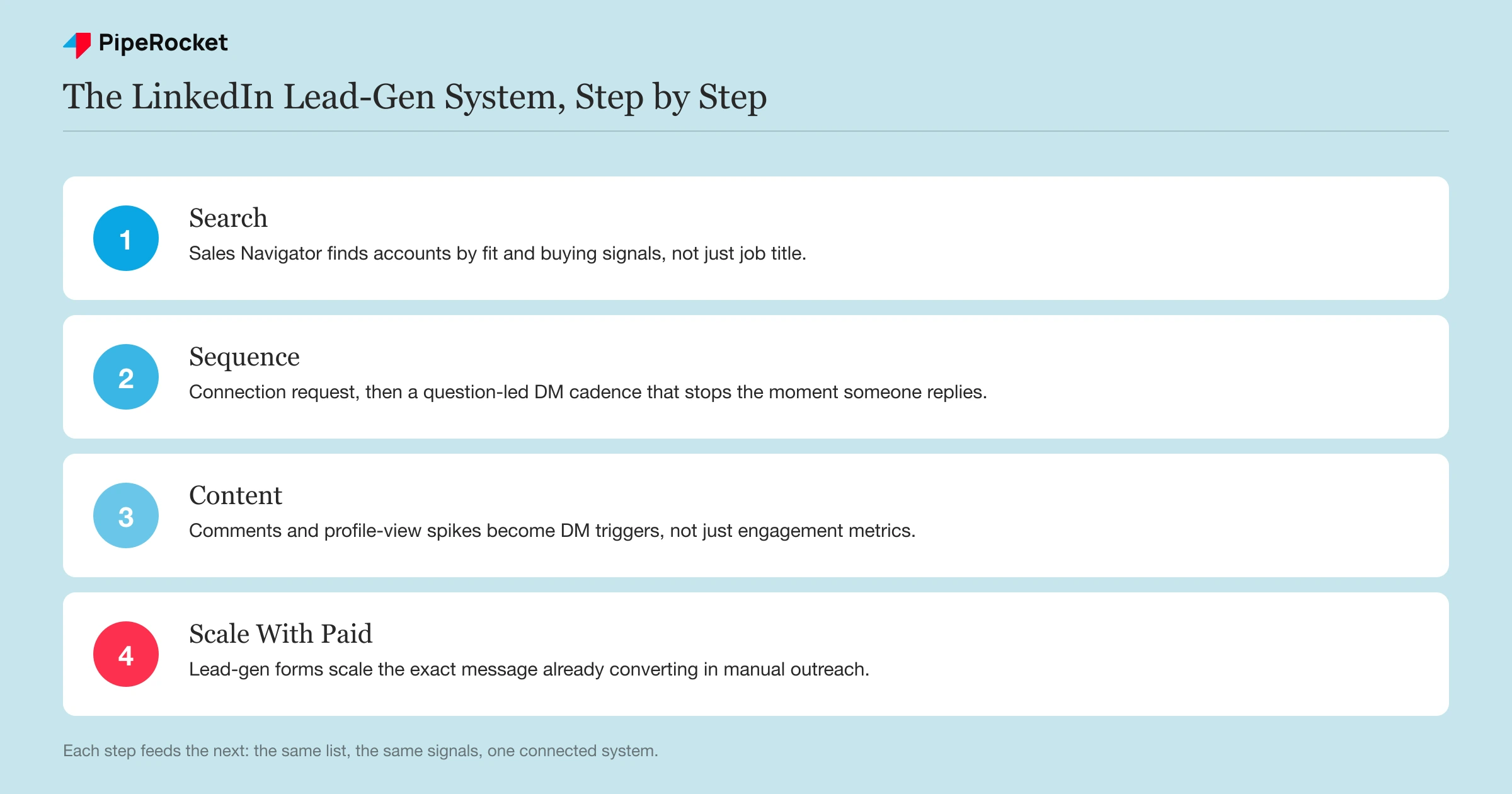
Most teams execute each of these as its own disconnected project: one person on content, another on outreach, sales running its own searches, marketing buying ads separately. The five sections below go deep on each strategy individually, in the order above, but they stay one system: every strategy reads from and updates the same shared account list.
Strategy 1: Optimize Your Profile Before You Send a Single Message
A profile that reads like a resume gets skipped. A profile that reads like a landing page gets checked before someone decides whether to reply, which is why it’s the first thing to fix, not an afterthought.
Replace the default “Title at Company” headline with a specific benefit statement tied to who you help and what changes for them, something closer to “Helping SaaS CTOs cut onboarding time by 50%” than “VP of Customer Success.” A prospect who clicks through from a comment, a connection request, or an ad lands on this profile first. A generic title gives them no reason to keep reading.
A strong headline with an empty “About” section and no recent activity reads as staged. Use the About section for two or three concrete outcomes you’ve helped people get, and keep the activity feed active enough that a visitor can see you’re a real, engaged person before they decide to reply to anything.
Strategy 2: Target the Right Accounts With Sales Navigator
Sales Navigator’s job in this system is to replace guesswork with a filtered, saved list of accounts that actually matches your ICP instead of a job title search.
Job title alone is a weak filter. “VP of Marketing” catches a 15-person startup and a 3,000-person enterprise with the exact same query, and those two people buy nothing alike. Sales Navigator lets you stack firmographic filters together, then save the combination as a persistent search that refreshes as new people match it:
- Company headcount
- Industry
- Seniority
- Geography
Layer buying-readiness signals on top of those firmographic filters, since a plain title-and-industry search misses them entirely:
- Recent job changes
- New posts
- Company growth signals (headcount change, funding, hiring spikes)
A prospect who just moved into a VP role at a company that’s hiring aggressively is a stronger target than a VP who’s been static in the role for three years.
This filtered, account-fit targeting is account-based marketing (ABM) applied to LinkedIn specifically: you pick the accounts that match firmographics and buying signals, then work them deliberately. It implements ABM principles inside one channel rather than running a full cross-channel ABM program, so account-based marketing on LinkedIn stays one input to the wider motion, not the whole thing.
Turn saved searches into shared lead lists with clear ownership: who’s responsible for touching each account this week, and what the first move is. Assign lists by territory or segment so there’s no overlap.
Review the list weekly to remove accounts that have gone cold or already converted.
If broader multi-channel lead generation (email, SEO , paid search, and LinkedIn together) is the goal, our B2B lead generation guide covers the full channel mix this piece treats as one input. And if the buyer is specifically a SaaS company with a founder-led motion, the SaaS LinkedIn marketing strategy playbook covers that narrower execution layer in more depth than this piece does.
Strategy 3: Lead With Value in Your Outreach Messages
A connection request followed by a specific, low-pressure DM outperforms a request that leads straight into a pitch, because the prospect needs a reason to engage before they’re asked for anything.
Sending a pitch in the same message as a connection request reads as spam regardless of how well it’s written, because the prospect hasn’t agreed to a conversation yet. The request itself should stand alone, ideally with a one-line note referencing something specific: a shared connection, a recent post, a role change.
Once the connection is accepted, the first DM works better as a genuine question tied to a problem their role would recognize, not a feature pitch. “Curious how your team is handling [specific problem]” gets replies. “We help companies like yours do X” gets ignored, because it reads as a template regardless of personalization tokens.
Space the sequence out to avoid feeling like a drip campaign:
- Connection request with a one-line personal note
- A genuine question, three to four days later
- A resource or insight, a week after that, if there’s still no reply
The moment someone actually replies, the automated cadence stops. Continuing a scheduled sequence on top of a real reply is the fastest way to make an interested prospect feel like they’re talking to a bot.
Strategy 4: Publish Thought-Leadership Content Tied to a Follow-Up Trigger
Content only counts as lead generation when it’s tied to a specific trigger that moves a viewer into outreach, not when it’s judged on likes and impressions alone.
Most organic content sits disconnected from the outreach motion. A post gets engagement, and nobody follows up with the people who engaged, because there’s no process connecting the two. That’s the gap that turns content into a vanity exercise instead of a lead source. Two signals close it:
- A substantive comment. Someone who comments has raised their hand more clearly than someone who just liked the post. A short, specific follow-up DM referencing what they said converts at a meaningfully higher rate than cold outreach, because the context already exists.
- A profile-view spike. LinkedIn shows who’s viewed your profile, and a spike from people matching your ICP after a post goes out is worth acting on directly. A low-pressure connection request lands warmer than a cold Sales Navigator match, since they’ve already shown curiosity.
Build this into the weekly process: whoever posts checks comments and profile views within 24 hours and follows up with anyone showing real engagement, not just a generic “great post” reaction.
| Signal | What it means | Next action |
|---|---|---|
| Substantive comment on a post | Actively engaged with the specific topic | DM referencing their comment within 24 hours |
| Profile view spike after a post | Curious enough to check who’s behind it | Low-pressure connection request |
| Cold Sales Navigator match | Fits the ICP filters, no engagement yet | Standard connection + question sequence |
Strategy 5: Scale With Targeted Paid Lead-Gen Ads
Paid LinkedIn lead-gen forms work best when they scale a message and offer that’s already converting manually, not when they’re built from scratch as a separate campaign.
Building a paid campaign around a message nobody has tested in DMs is a common way to burn budget. If a specific question or offer is getting real replies in manual outreach, that’s the proven message to turn into an ad. Paid is where you scale a message that’s already proven, not where you go to discover one.
LinkedIn’s native lead-gen forms auto-fill from a prospect’s profile, which removes friction, but every additional field past name and email drops completion rate:
- Match the form to the next step. A demo booking needs a scheduling link; save qualifying questions for the sales call itself.
- Skip pre-qualifying fields. Company size, budget range, and a phone number before a first conversation tend to filter out the exact busy decision-makers this system is trying to reach.
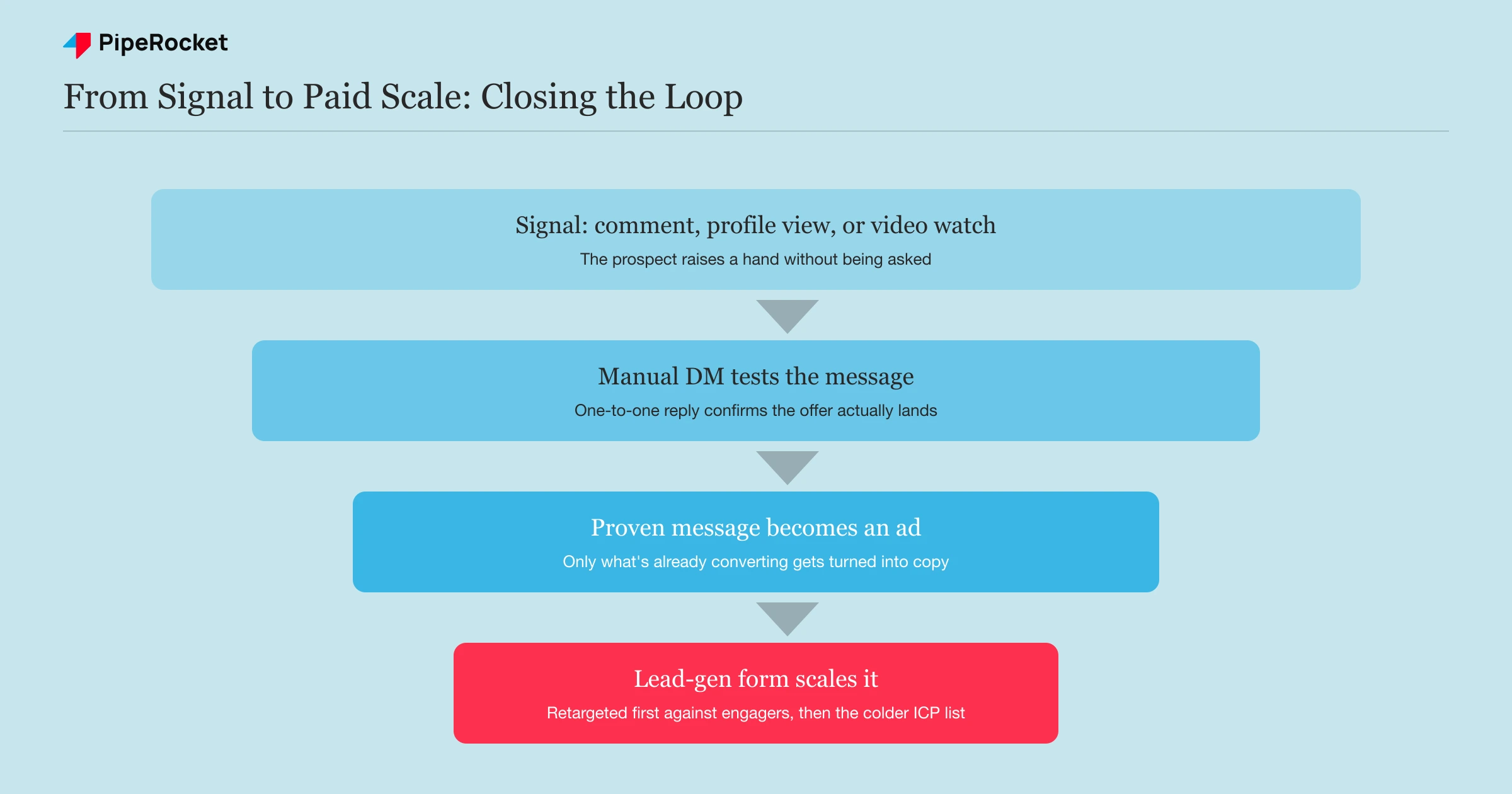
Retargeting people who already commented on or watched a video from your organic content converts at a different rate than retargeting a cold audience that’s never interacted with the brand. Build a retargeting audience specifically from content engagers and run the lead-gen form against that group first, before expanding to a colder ICP list. This is also where the loop closes: the same signals that triggered a manual DM in outreach (comments, profile views, video watches) become the paid retargeting audience here. Teams that want retargeting-ads execution depth beyond this one tactic can follow a dedicated LinkedIn retargeting ads playbook for the full campaign build.
What Practitioners Agree Actually Works
Across LinkedIn’s own B2B marketing community and Reddit discussions on the topic, the consensus lands on the same combination: value-first organic outreach paired with tightly targeted Sales Navigator search consistently outperforms cold, unfiltered prospecting.
That’s not a claim about any single strategy above being the “best” one. It’s a claim about combination: a Sales Navigator list built on real signals, contacted with a specific, low-pressure message instead of a generic pitch, converts at a meaningfully higher rate than either tactic run alone. Teams that treat Sales Navigator as a targeting tool and outreach as a separate, generic-message step miss the compounding effect of doing both well together.
Does LinkedIn Actually Work for B2B Lead Generation?
Yes, when the five strategies above run as a connected system, and the audience-penetration result above shows why: the same account list that was largely invisible at 1.7% penetration became reachable at 19.2% penetration through better filtering alone, with no extra budget. That’s the mechanism behind LinkedIn working or not working for a given team, not a verdict on the platform itself.
Most of the skepticism around LinkedIn lead generation traces back to one pattern: a team runs cold outreach, generic content, or broad ad targeting in isolation, gets weak results, and blames the channel. A specific ICP, a profile that earns the click, outreach tied to a real signal, and content with a follow-up trigger is a fundamentally different setup than posting occasionally and blasting connection requests, even though both get labeled “LinkedIn lead generation.”
Note: LinkedIn’s cost per click runs higher than most channels, and its targeting precision only pays off on a deal size that can absorb it. A $20-a-month tool selling to individual freelancers will lose money on LinkedIn no matter how well the system is built. A B2B deal with a real buying committee and a five- or six-figure contract value is where this actually works.
Where to Start If You’re Running None of This Yet
Start with the profile fix and one saved Sales Navigator search, then run outreach manually for two to three weeks before adding content or paid. These first steps cost nothing but time and tell you what message works. Building all five strategies at once from zero is how most first attempts stall.
- Fix the profile first. It’s free, takes an afternoon, and every other strategy sends people to check it.
- Run one manual Sales Navigator search. Pick the tightest ICP filter combination you’re confident in, save it, and build a list of 50 to 100 accounts before touching outreach.
- Send outreach manually for two to three weeks. No sequencing tool yet. Just connection requests with a one-line note and a genuine follow-up question, so you learn what actually gets replies before automating anything.
- Post content only once outreach reveals what resonates. The questions or offers that get real replies in Step 3 are the raw material for a first post, not the other way around.
- Add paid last, and only to scale a message that’s already converting in Steps 3 and 4. Paid budget spent before that point is budget spent discovering what manual outreach would have told you for free.
A small team can run Steps 1 through 3 in the first month without any paid tools beyond a Sales Navigator seat. Content and paid are additions once the manual motion proves a message works, not parallel tracks to start alongside it.
How Do You Measure LinkedIn B2B Lead Generation?
Measure LinkedIn B2B lead generation on downstream conversion, not impressions or likes. Track comment-to-DM conversion rate , profile-view-to-connection rate, connection-to-reply rate, and reply-to-meeting rate. Those show whether the system moves people toward a conversation.
Vanity metrics (likes, impressions, follower count) tell you a post traveled, not that it generated a lead. A post with modest reach but three comments that each turned into a booked call outperforms a viral post nobody followed up on. Set the metric at the handoff between motions:
| Motion | Metric that matters | Vanity metric to ignore |
|---|---|---|
| Content | Comment-to-DM conversion rate | Likes, impressions |
| Profile visits | Profile-view-to-connection rate | Total profile views |
| Outreach | Connection-to-reply, reply-to-meeting rate | Connections sent |
| Paid | Cost per qualified lead | Form impressions, raw lead count |
Review these weekly against the shared account list so the number ties back to real pipeline, not activity for its own sake.
Common Mistakes to Avoid
Running Profile, Search, Outreach, Content, and Paid as Separate Owners With No Shared List
When different people or teams run these motions independently, the same account gets contacted multiple times with conflicting messages, and nobody notices until a prospect mentions it.
- Fix: assign one shared account list that every motion reads from and updates, even if different people execute each piece.
Pitching in the Connection Request
A pitch attached to a connection request gets ignored or reported as spam at a much higher rate than a plain request with a one-line personal note. Save the ask for after the connection is accepted and a reason to talk has been established.
Letting Automated Sequences Keep Running After a Reply
A sequencing tool that keeps firing scheduled messages after someone has already replied manually is the single fastest way to make an engaged prospect disengage. Any reply should trigger an immediate stop on the automated cadence.
Judging Content by Likes Instead of Downstream Replies
Content that gets strong engagement but never converts to a DM or a call is usually just being measured wrong. Track comment-to-DM conversion and profile-view-to-connection rate as the real content metrics, not impressions.
Testing New Messages in Paid Instead of Manual Outreach First
Launching a paid lead-gen campaign around an untested offer means paying to find out what a few DM conversations would have told you for free.
- Fix: validate the message manually first, then scale the version that’s already getting replies.
How PipeRocket Digital Builds LinkedIn Lead-Gen Systems
We build LinkedIn lead generation as one connected system: a profile and content presence that earns the click, Sales Navigator search feeding a shared account list, connection and DM sequencing tied to content signals, and LinkedIn Ads scaling only the messages already converting manually.
If your team is running these motions in isolation and the pipeline shows it, reach out to us and we’ll show you where the handoffs are breaking.
Frequently Asked Questions
What is LinkedIn B2B lead generation?
LinkedIn B2B lead generation is the practice of using an optimized profile, Sales Navigator search, connection and DM sequencing, organic content, and paid lead-gen forms together to move a business buyer from a cold profile to a qualified sales conversation. It works best as a connected system where each motion feeds the others, rather than as separate campaigns judged on their own metrics.
Is LinkedIn actually worth it for B2B lead generation?
LinkedIn is worth it for B2B lead generation when the buyer is a business decision-maker with a reasonably high deal size. Its targeting precision and professional context outweigh the higher cost per click compared to other channels.
It performs poorly for low-ticket, high-volume products where the audience and price point don’t justify LinkedIn’s typical CPCs. It also underperforms when teams run cold outreach or ads without any sequencing or content behind them to build trust first.
How do you get B2B leads from LinkedIn for free?
Free LinkedIn lead generation relies on organic content, manual connection requests, and comment-to-DM outreach instead of paid ads or Sales Navigator’s premium search tools. Post content that speaks to a specific buyer problem, follow up with anyone who comments meaningfully, and send personalized connection requests to prospects found through LinkedIn’s standard search filters. It takes more manual time than a paid or tool-assisted approach, but it costs nothing beyond the hours spent.
What is the 4-1-1 rule on LinkedIn?
The 4-1-1 rule is a content-mix ratio: for every 6 posts, share 4 pieces of useful content from other people, publish 1 original post of your own, and post only 1 self-promotional or sales message. It keeps a feed value-first so promotion stays welcome instead of feeling like a pitch.
What LinkedIn lead generation strategies actually move the needle for B2B SaaS?
For B2B SaaS specifically, the strategies that move the needle combine founder or executive-led content with ICP-layered outreach and ads, since SaaS buyers evaluate the product and the people building it together. Our SaaS LinkedIn marketing strategy playbook covers the founder-first content approach and tech-stack ad targeting that make the biggest difference for a SaaS-specific motion.

