SaaS LinkedIn Marketing Strategy: A Founder-First Playbook
 Omar Sheriff
Last updated on
Omar Sheriff
Last updated on
A SaaS LinkedIn marketing strategy uses founder and executive presence, job-title-and-tech-stack-layered ad targeting, and product-specific proof points to turn LinkedIn attention into demo requests and trial signups, not just impressions.
TL;DR
- Your founder’s personal profile earns more trust and reach than your company page ever will, so build the strategy around a person, not a logo.
- LinkedIn Ads for SaaS work best when you layer job title, company size, and tech stack together instead of targeting any single filter alone.
- Organic thought-leadership content should teach the exact problem your product solves, not general industry commentary.
- Every SaaS LinkedIn post and ad should end at a demo or trial, not a generic “learn more” link.
- Track pipeline from LinkedIn on lift and account engagement, not last-click credit.
Most SaaS Teams Run B2B LinkedIn Playbooks, Not SaaS Ones
Most SaaS marketing teams borrow a generic B2B LinkedIn playbook: post from the company page, boost a few posts, run some sponsored content, and call it a strategy. That playbook works fine for a services firm selling relationships. It falls flat for SaaS, where the buyer is evaluating a product, not just a vendor.
SaaS buyers do something a services buyer usually doesn’t: they check who’s building the product before they book a call. They look at your founder’s profile, not just your company page. They want proof the product works for a company that looks like theirs, and they want a fast path to try it, not a “contact us” form that dumps them into a generic sales queue.
That’s the gap a general B2B LinkedIn marketing strategy doesn’t close. It covers company pages, content pillars, and paid campaigns at a level that fits any B2B business. A SaaS company needs sharper choices in three places: who’s posting, how the ads are filtered, and what the CTA asks for. That’s what this playbook covers.
Make Your Founder’s Profile the Primary Channel
Your founder’s LinkedIn profile will outperform your company page on trust and reach, so treat it as the main channel and the company page as the supporting one.
Company pages get algorithmic reach roughly comparable to a cold outbound email. People connect with people, and SaaS buyers specifically want to see the person behind the roadmap before they trust the product.
A founder post explaining why a feature exists carries more weight than the same claim on a company page, because it comes from someone who can be held accountable for it.
Post from the Founder, Not the Brand
Route your most important announcements, product decisions, and lessons-learned through the founder or a named executive first, then let the company page reshare it. A pricing change explained by the CEO in their own words reads as a decision. The same words on the company page read as a policy update.
This isn’t about ghost-writing generic thought leadership . It’s about giving the founder real material: what a customer told them last week, what a competitor got wrong, what the team debated and why they picked one option.
If the founder has never posted, start with something they’ve said in an internal meeting or a customer call. That’s usually more interesting than anything a content calendar would produce.
Use Execs to Cover the Buying Committee, Not Just the CEO
A single founder voice covers one angle. SaaS deals get influenced by a buying committee spanning the CxO, the economic buyer, and the day-to-day user, so put a second or third exec on LinkedIn covering the angle the founder doesn’t.
If the founder talks vision and roadmap, have the Head of Customer Success post about implementation and support. If the founder talks strategy, have a sales leader post about what objections keep coming up in deals. Different roles reach different members of the same buying committee without duplicating each other’s content.
Layer LinkedIn Ads for Your Actual ICP
LinkedIn Ads for SaaS work best when you stack job title, company size, and tech stack together, because any single filter alone reaches too many people who can’t buy or can’t use the product.
Job title alone catches every “VP of Marketing” regardless of company size, which means your ad reaches a five-person startup VP and a 2,000-person enterprise VP with the same message and the same budget. Company size alone catches the right size company but the wrong person inside it.
Tech stack signals (does this account already run a tool your product integrates with, or replaces) is the layer most SaaS teams skip entirely, and it’s the one that actually predicts fit.
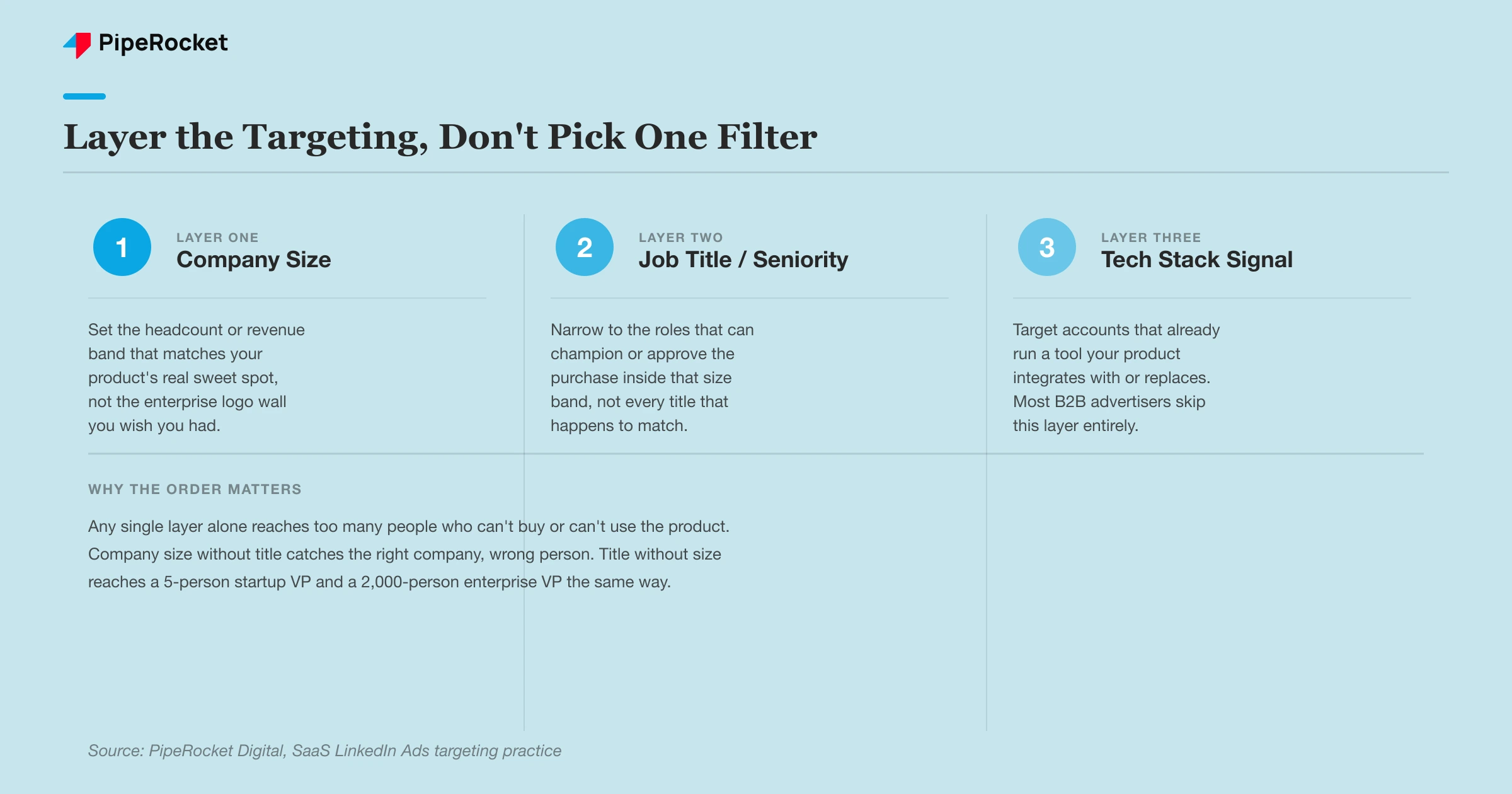
The order to layer these in:
- Company size first. Set the headcount or revenue band that matches your product’s actual sweet spot, not your aspirational enterprise logo wall.
- Job title or seniority second. Narrow to the roles that can champion or approve the purchase inside that size band.
- Tech stack or skills third, where available. If your product integrates with or replaces a specific tool, targeting accounts that already use that tool filters out a huge share of poor-fit traffic before it ever sees the ad.
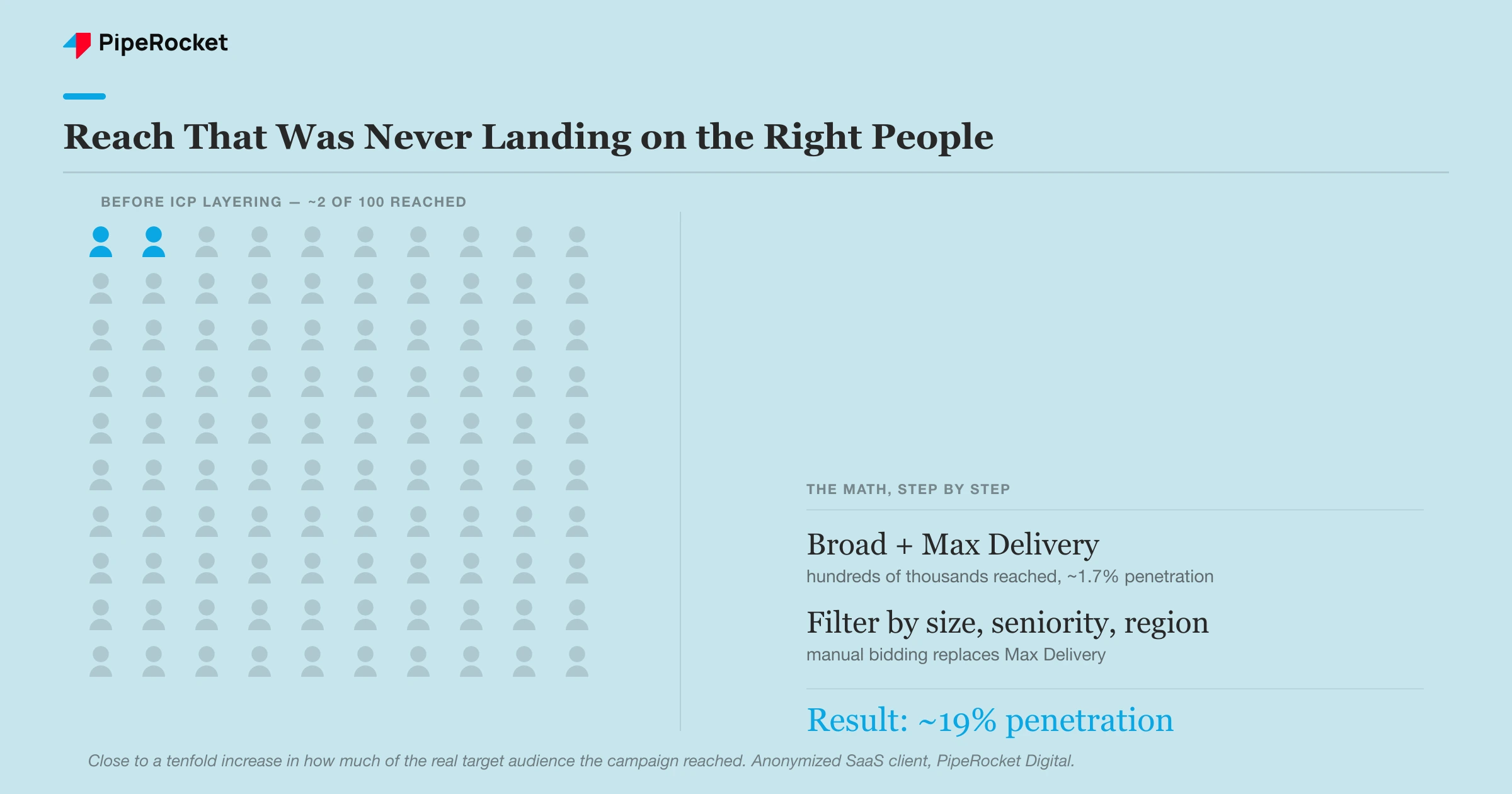
We’ve watched a SaaS client run LinkedIn on a broad audience of hundreds of thousands of people with Max Delivery bidding, hitting under 2% audience penetration and mostly junior, irrelevant impressions.
Restructuring by region and product, applying strict company-size and seniority filters, and switching to manual bidding changed that fast. Audience penetration moved from roughly 1.7% to over 19%, close to a tenfold increase in how much of the real target audience the campaign actually reached.
Treat LinkedIn as an Influence Channel, Not a Capture Channel
Judge LinkedIn Ads on last-click conversions and you’ll pause campaigns that were quietly working. Nobody on LinkedIn is in buying mode. They’re scrolling, and an ad plants a seed that shows up weeks later when that VP actually needs the solution and Googles your brand by name.
The read that actually works is lift. If an account was generating a steady stream of leads from Google alone, and adding a layered LinkedIn campaign pushes that number up consistently, LinkedIn is working even if the platform never claims direct credit. Watch branded search volume and direct traffic after a LinkedIn push starts. Both should move if the targeting layer is right.
Build Organic Content Around Your Product’s Actual Problem
Organic SaaS thought leadership works when it teaches the exact problem your product solves, not general industry commentary that any competitor could have posted.
A generic “the future of AI in SaaS” post gets likes from other marketers and does nothing for pipeline. A post that walks through how a specific type of buyer diagnosed a specific problem, and what changed once they fixed it, reaches the person who has that exact problem right now.
Specificity is the entire difference between content that builds a following and content that builds pipeline.
Publish the Workflow, Not the Feature List
Skip the feature-announcement post. Instead, publish the workflow your product replaces or improves, with enough detail that a reader could recognize their own process in it. A compliance SaaS for fintech teams, for example, gets more traction from a post walking through how audit prep used to take three weeks of spreadsheet chasing than from a post announcing a new export button.
Feature lists read like a changelog when posted alone. Workflow posts read like proof you understand the buyer’s day, which is what actually earns a demo click.
Repurpose Sales and Support Conversations Into Posts
Your best organic content already exists inside sales calls, support tickets, and onboarding sessions. Pull the sharpest customer question or objection from the last week and turn it into a post that answers it publicly.
This does two things at once. It gives future prospects an answer before they ask the question. And it shows current customers the team is paying attention to real friction, not just publishing on a schedule.
Point Every CTA at a Demo or Free Trial
Every SaaS LinkedIn post and ad should end at something the buyer can try immediately. That means a demo booking or a free-trial signup, never a generic “learn more” link or a gated whitepaper that adds a step between interest and action.
A services agency’s CTA is “talk to us,” because the relationship is the product. A SaaS company’s CTA can be “try it,” because the product itself is the proof.
Routing every serious CTA to a demo or trial instead of a content download shortens the distance between attention and activation. It also gives sales a much warmer signal than a whitepaper download ever did.
| CTA type | What it signals | Best use |
|---|---|---|
| Free trial | Ready to self-serve, low-touch fit | Product-led motion, lower ACV |
| Book a demo | Wants guided proof before committing | Sales-assisted motion, higher ACV |
| Gated whitepaper | Early research, not yet evaluating | ToFu awareness content only, not BOFU posts |
Match the CTA to where the post sits in the funnel. A workflow-teaching post can end on a trial link. A founder post about a specific customer outcome can end on a demo booking, because the reader is closer to an evaluation decision at that point.
Measure LinkedIn on Lift, Account Engagement, and Pipeline
Measure SaaS LinkedIn performance on branded search lift, account-level engagement, and pipeline contribution, not on impressions or follower count alone.
Impressions and followers tell you the audience is growing. They don’t tell you whether the right accounts are paying attention or moving toward a decision. Three metrics matter more for a SaaS motion specifically:
- Branded search lift. Did direct traffic and brand-name searches rise after a sustained LinkedIn push, even without LinkedIn claiming the click?
- Account-level engagement. Are people from your actual target accounts engaging (not just anyone), and is engagement concentrated in accounts your sales team is already working?
- Demo and trial starts sourced from LinkedIn. Not just form fills. Actual product activations tied back to a LinkedIn touchpoint in your CRM.
Review these monthly against your ICP list, not against a vanity dashboard. If audience penetration inside your real target accounts is climbing and pipeline from those accounts is rising too, the strategy is working. That holds even if the platform-reported conversion numbers look thin.
None of this matters if LinkedIn’s own algorithm and Google aren’t surfacing your posts and profile in the first place. Our LinkedIn SEO breakdown covers the discoverability mechanics this strategy assumes are already working.
Common Mistakes to Avoid
Running the Company Page as the Only Voice
A company page alone reaches a fraction of what a founder or exec profile reaches, and it reads as marketing rather than a person’s real opinion. Route the highest-value content through a named person and let the page amplify it, not originate it.
Targeting Job Title Without Company Size or Tech Stack
A “Head of Marketing” filter alone puts a five-person startup and a 2,000-person enterprise in the same ad set with the same message. Layer company size and, where possible, tech stack signals before you launch, or you’ll burn budget on impressions that were never going to convert.
Sending Every Click to a Gated Whitepaper
A whitepaper gate adds friction a SaaS buyer doesn’t need to feel when a trial or demo link would let them evaluate the actual product instead. Save gated content for genuine ToFu awareness posts, and send anything BOFU-leaning straight to a trial or demo.
Copying B2B-General Tactics Without a SaaS Filter
Employee advocacy, ABM account lists, and posting cadence all matter, and the broader B2B LinkedIn marketing guide covers those mechanics well. Applying them without the SaaS-specific layer (founder presence, tech-stack targeting, trial CTAs) means running a strategy built for a different buyer.
How PipeRocket Digital Runs SaaS LinkedIn Programs
We build SaaS LinkedIn programs around founder-led content and ICP-layered LinkedIn Ads targeting instead of generic company-page posting. For SaaS teams that need the organic and paid sides working together, our SaaS PPC team handles the ad layering and lift measurement while content ties every post back to a demo or trial. If your LinkedIn presence is getting impressions but not pipeline, reach out to us and we’ll show you where the targeting or the CTA is losing the buyer.
Frequently Asked Questions
What is a SaaS LinkedIn marketing strategy?
A SaaS LinkedIn marketing strategy is the approach a software company takes to turn founder and executive presence, targeted ads, and organic content into demo requests and trial signups on LinkedIn. It differs from general B2B LinkedIn marketing by centering on product-specific proof, ICP ad layering (job title, company size, tech stack), and CTAs built around trying the product rather than generic lead capture.
Should a SaaS company post from the founder or the company page?
Post the highest-value content, product decisions, customer stories, and lessons learned from the founder or a named executive first, then let the company page reshare it. Founder and executive profiles get meaningfully more organic reach and trust than company pages, especially for SaaS buyers who want to know who’s building the product before they evaluate it.
How is LinkedIn Ads targeting different for SaaS versus general B2B?
SaaS targeting layers job title, company size, and tech stack together instead of relying on job title or company size alone. Tech stack signals, whether an account already uses a tool your product integrates with or replaces, are the layer most B2B advertisers skip, and they’re often the strongest predictor of actual product fit for a SaaS audience.