B2B LinkedIn Marketing: The Complete Strategy Guide
 Praveen Ravi
Last updated on
Praveen Ravi
Last updated on
If you are running B2B marketing, getting your product in front of the right decision-makers is not easy. Generic social media drains time and budget, and your target buyers are busy professionals who focus only on solutions that create real business impact.
So where do you reach them with intent and consistency?
That is where B2B LinkedIn marketing stands out. LinkedIn is not just a platform for resumes. It is the world’s largest professional network, and almost every important business buyer is active there. It is the best place to build trust, strengthen your expertise, and generate qualified leads.
In this guide, you will learn proven B2B LinkedIn marketing strategies that deliver real results for 2026.
TL;DR
- B2B LinkedIn marketing reaches decision-makers through organic thought leadership, targeted ads, and profile/community engagement, not just company-page posting.
- LinkedIn drives roughly 80% of B2B social media leads, more than any other social platform.
- Its job-title, seniority, and company-size targeting makes B2B ad spend more precise than general social platforms.
- A strong program blends organic content (trust-building) with paid campaigns (scaled, targeted reach) rather than picking one.
- Employee and executive profile activity outperforms company-page-only posting for reach and trust.
- Native document posts and multi-image carousels post the highest engagement rates on LinkedIn, ahead of images and plain text.
- Measurement should track pipeline metrics (lead-gen form fills, demo requests, opportunities) alongside visibility metrics (impressions, followers).
What is B2B LinkedIn Marketing?
B2B LinkedIn Marketing is the process of using LinkedIn to promote products or services to other businesses and reach decision-makers who influence buying choices. It focuses on building relationships, creating valuable content, and engaging with prospects in a professional environment where business conversations already happen.
Unlike general social platforms that are mainly social or entertainment-led, B2B LinkedIn Marketing is designed to support real business outcomes such as generating leads, filling pipeline, strengthening brand authority, and driving sales.
It also includes both organic content and LinkedIn B2B ads like sponsored posts, message campaigns, and targeted lead generation tools. A strong LinkedIn business to business marketing strategy helps companies position themselves as experts, connect with ideal buyers, and guide prospects toward becoming customers.
Why LinkedIn Marketing Is Especially Powerful for B2B?
LinkedIn drives roughly 80% of all B2B social media leads because it puts decision-makers in a professional, high-intent context that ads and organic content can reach directly. No other social platform concentrates founders, executives, and buying-committee roles the same way.
That is why B2B LinkedIn Marketing has become a core channel for companies that want results, not just reach.
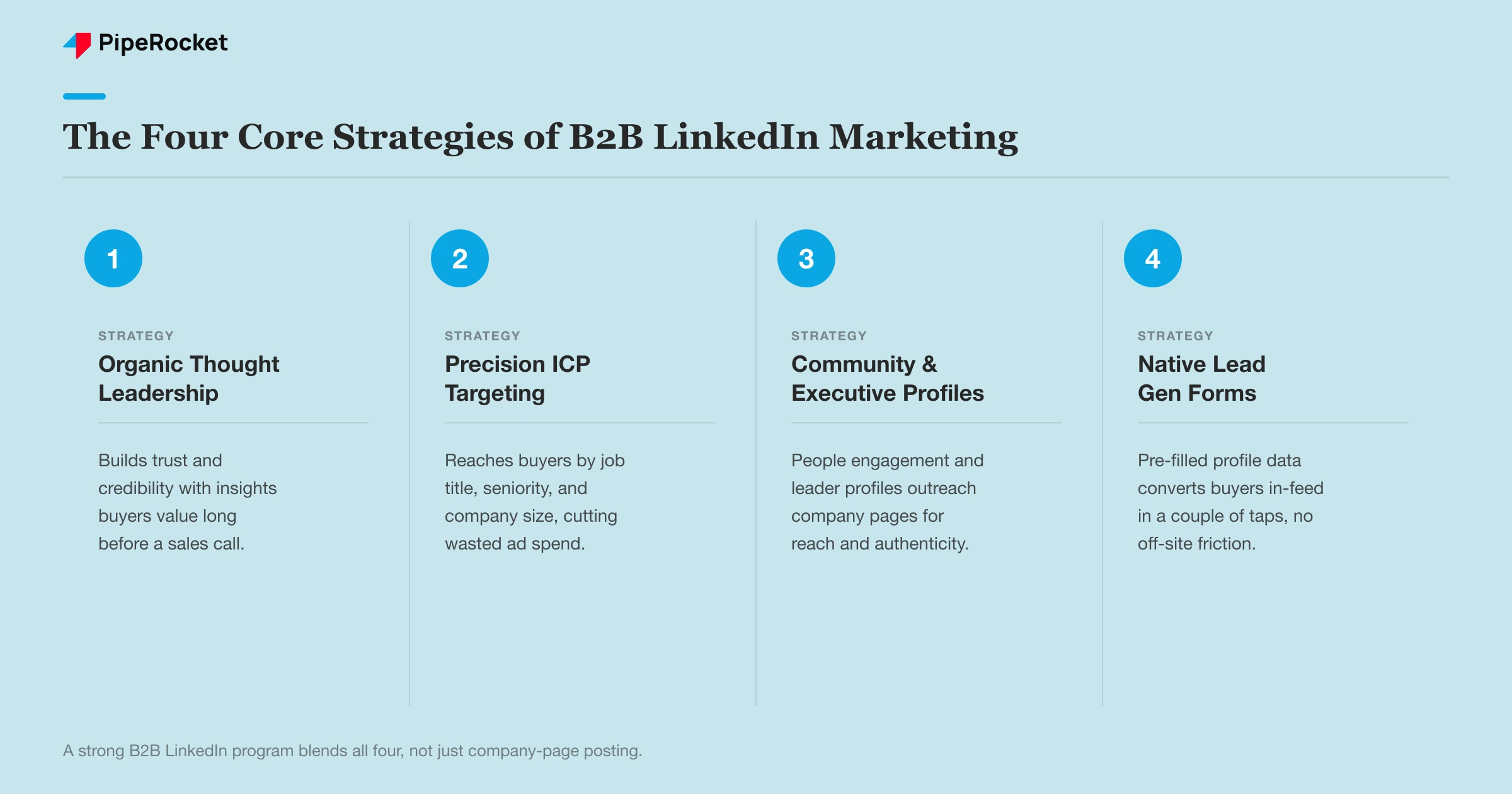
1. Decision-Maker Audience & Professional Context
LinkedIn is where professionals show up to learn, solve business problems, and explore new solutions. The audience includes founders, executives, managers, and specialists who influence or approve purchases.
This professional mindset creates a higher level of attention and intent compared to entertainment-based platforms. When people engage with content on LinkedIn, they are actively thinking about business outcomes, making it easier to start meaningful conversations that lead to pipeline.
2. Sophisticated Targeting & Ad Tools for B2B
LinkedIn offers advanced targeting options built specifically for B2B. You can reach audiences based on job title, seniority, company size, industry, skills, and even exact target accounts.
With LinkedIn B2B ads, you deliver messages to buyers who actually matter rather than a broad social audience. This precision improves conversion quality and reduces wasted spend. It also supports a more predictable LinkedIn B2B strategy that aligns directly with revenue goals.
3. Thought Leadership & Credibility Building
LinkedIn is the best platform for thought leadership because buyers value expertise before they engage in sales conversations. Sharing insights, case learnings, or helpful perspectives positions your brand as trustworthy.
In B2B, trust influences shortlisting and vendor decisions. When your voice appears consistently with useful content, you stay top-of-mind and build credibility long before buyers are ready to talk to sales.
4. Lead Generation, Pipeline & Measurable Outcomes
LinkedIn connects brand visibility with real business results. Lead-gen forms, retargeting, and personalised outreach let you move prospects from awareness to meetings and opportunities.
Our paid media team has been increasing LinkedIn spend for over 80% of clients in 2026, and the revenue data is why: one SaaS client scaled LinkedIn-influenced spend from $2,000 a month in 2024 to $60,000 a month in 2025, and LinkedIn-influenced revenue went 3x by January at $40K spend, climbing to 5.7x by April and holding around 4x consistently even as spend kept rising. The split that made it work was thought-leadership ads for awareness alongside cheaper image and video formats as CPMs on thought-leadership rose, roughly 70% of budget on prospecting (including accounts outside the original target list, since some of the best customers weren’t on it) and 30% on remarketing high-intent visitors from pricing, demo, and G2 pages. Creative did most of the work in that result, different content for each stage of the buyer journey, with every thought-leadership post linking to a landing page so the spend stayed attributable.
Because the audience has stronger intent, leads are typically more qualified and closer to decision stages. That makes LinkedIn business to business marketing a reliable channel for lead generation , creating measurable pipeline and revenue impact.
Building Your B2B LinkedIn Marketing Strategy
Build a B2B LinkedIn Marketing strategy in five steps: define goals and ICP, optimize company and executive profiles, set content pillars, blend organic and paid, then integrate with sales and ABM. The companies winning on LinkedIn treat it as a revenue channel, not a place to post occasionally and hope for results.
1. Define Business Goals, KPIs & Audience
Start by deciding what success looks like for your LinkedIn marketing. Your goals might include pipeline growth, demo requests, meetings booked, or targeted reach inside key accounts. Set KPIs like:
- Engagement rate and comment quality
- Lead-gen form submissions
- Connection requests from ICP roles
- Opportunities created
Define your audience by job titles, industries, company size and pain points. For example, PipeRocket helped Storylane refine targeting to mid-market enterprise buyers, improving lead quality because LinkedIn B2B ads reached real decision-makers instead of a broad audience.
2. Develop Your LinkedIn Company Page & Profile Strategy
Your LinkedIn presence should instantly communicate value. Optimise:
- Clear positioning statement
- Proof of outcomes
- Relevant CTAs and featured links
- Updated executive profiles
People trust people more than logos, so balance company page updates with leadership content.
3. Choose Content Themes & Formats for B2B Engagement
Use content pillars that align with buyer needs and reinforce expertise. Example themes:
- Industry insights
- Case studies and lessons learned
- Product explanations or demos
- Customer success stories and behind-the-scenes processes
Mix formats like short posts, carousels, long-form articles, and video. Real stories outperform generic tips. When PipeRocket shared Spendflo’s success results publicly, engagement improved because buyers value practical examples over theory.
A simple way to balance the mix is the 3/2/1 rule on LinkedIn: for every batch of posts, publish three value or thought-leadership pieces, two engagement or conversation posts, and one promotional post. This keeps the feed useful and stops it from reading like an ad channel.
Set a content calendar so the rhythm stays predictable. A workable weekly cadence: two thought-leadership posts, one case study or customer story, one carousel or document post, and one poll or question post to spark comments. Plan themes a month ahead so posting never stalls.
Posting is only half the work. Engagement, meaning commenting on prospects’ and peers’ posts, matters as much as publishing. Spend time each day leaving thoughtful comments on ICP decision-makers’ content. This puts your name in front of buyers before they ever visit your page and often earns more reach than a new post.
4. Organic vs Paid: How to Blend Them
Use organic posting to strengthen trust and build audience relationships. Use Linkedin b2b ads to scale reach and target specific accounts with offers, gated assets, or demo campaigns. A blended approach increases visibility while keeping authenticity.
5. Integration with Sales, ABM & Pipeline Activities
Align marketing and sales so insights from LinkedIn fuel pipeline. Share engagement data with SDRs and retarget warm account visitors. Consistent messaging helps shorten deal cycles.
PipeRocket applies this with a structured Initiate → Accelerate → Optimize workflow that supports ABM and improves conversion rates.
LinkedIn Content & Campaign Tactics for B2B
Six tactics carry a B2B LinkedIn marketing program: thought-leadership posts, case studies, targeted ads, employee advocacy, community and Groups, and retargeting with Lead Gen Forms. Together they educate buyers, build authority, and move accounts toward a conversation.
1. Thought-Leadership Articles & Posts
Thought leadership content positions your brand and subject experts as trusted voices that prospects turn to for clarity and direction. Share valuable insights, explain industry trends, break down processes, and talk about real learnings. Use:
- Short text posts
- Long-form articles
- Framework breakdowns
- Opinion pieces and lessons learned
In LinkedIn B2B marketing, strong thought leadership attracts conversation and connections from decision-makers.
2. Case Studies & Customer Success Stories
B2B buyers want proof, not promises. Share stories that explain the problem, process and results. Use:
- Carousel breakdowns
- Short testimonial posts
- Before-and-after problem framing
- Video snippets
Real outcomes build instant trust. For example, discussing Spendflo’s growth journey helped prospects visualise impact, which increased engagement and inbound interest because customers relate better to real experiences.
3. Targeted LinkedIn Ads: Sponsored Content, InMail, Dynamic Ads
Use linkedin b2b ads to reach specific accounts and buying-committee roles with precision. Match the ad format to the campaign goal:
| Campaign goal | Best ad format | Why |
|---|---|---|
| Awareness and reach | Sponsored Content | Native feed placement puts your message in front of a broad ICP audience |
| Event or offer promotion | Message Ads (InMail) | Direct-to-inbox delivery drives registrations and time-sensitive offers |
| Retargeting and personalization | Dynamic Ads | Auto-personalized creative pulls the viewer’s profile data to lift relevance |
| Lead capture | Lead Gen Forms | Pre-filled forms convert in-platform without sending users off-site |
This makes your LinkedIn B2B strategy measurable and scalable, especially when targeting high-value ABM accounts. For a channel-specific deep dive on campaign structure, bidding, and creative, our dedicated linkedin ads for saas guide covers the paid side end to end.
4. Employee Advocacy & Networking
People engage more with people than brands. Encourage employees to post learnings, achievements, insights and project updates. Benefits include:
- Increased reach inside ICP accounts
- More trust and authenticity
- Stronger internal culture visibility
Pipeline influence improves when real humans represent your story.
5. Community, Events & Groups
Use LinkedIn Events and Groups to create deeper engagement. Host:
- Webinars
- AMAs
- Roundtables
- Mini training sessions
Community interaction helps prospects feel part of your ecosystem before booking a meeting.
Treat LinkedIn Groups as their own lead surface, separate from Events. Join or create niche Groups where your ICP already gathers, answer real questions, and share resources without pitching. Active, helpful participation surfaces buyers with intent and warms them before any outreach, which makes Groups a low-cost complement to paid campaigns.
6. Retargeting, Nurturing & Lead Gen Forms
Use retargeting to re-engage visitors who interacted with your content or website. Pair this with native Lead Gen Forms for conversion. The reason they convert well: the form pre-populates the member’s LinkedIn profile data (name, company, job title, email) at submission, so buyers convert in a couple of taps without leaving the feed or typing anything. Nurture using:
- Case studies
- Value emails
- Problem-solution videos
This turns awareness into qualified pipeline without aggressive selling and strengthens LinkedIn business to business marketing performance.
Measuring Your B2B LinkedIn Marketing Program
Track four layers: visibility metrics (impressions, follower growth), content-level metrics (engagement rate, CTR, watch time), lead metrics (form fills, demo requests, meetings), and account engagement from target buyers. Together they show what content works across your B2B LinkedIn marketing and which actions move prospects toward pipeline.
Strong measurement also helps prove ROI and justify ongoing investment in your Linkedin B2B strategy.
1. Track Core Brand & Visibility Metrics
Start by tracking top-of-funnel visibility to understand brand awareness and reach inside your ICP. Key metrics include:
- Impressions and post reach
- Follower growth inside target industries
- Profile visits and page views
- Engagement rate (reactions, comments, shares)
These metrics show whether your brand is consistently getting in front of the right audience. According to Social Insider’s LinkedIn benchmarks , pages with 100,000 to 1 million followers now average about 1,380 video views per post, down from 2,430 a year earlier. Video reach is tightening across every page size, so audience growth and format choice matter more than ever.
2. Measure Content-Level Performance for Quality & Relevance
Evaluate individual content pieces to see what formats and topics resonate most. Track:
- Average watch time for video
- Carousel completion rate
- Click-through rate (CTR)
- Saves, shares, and comment themes
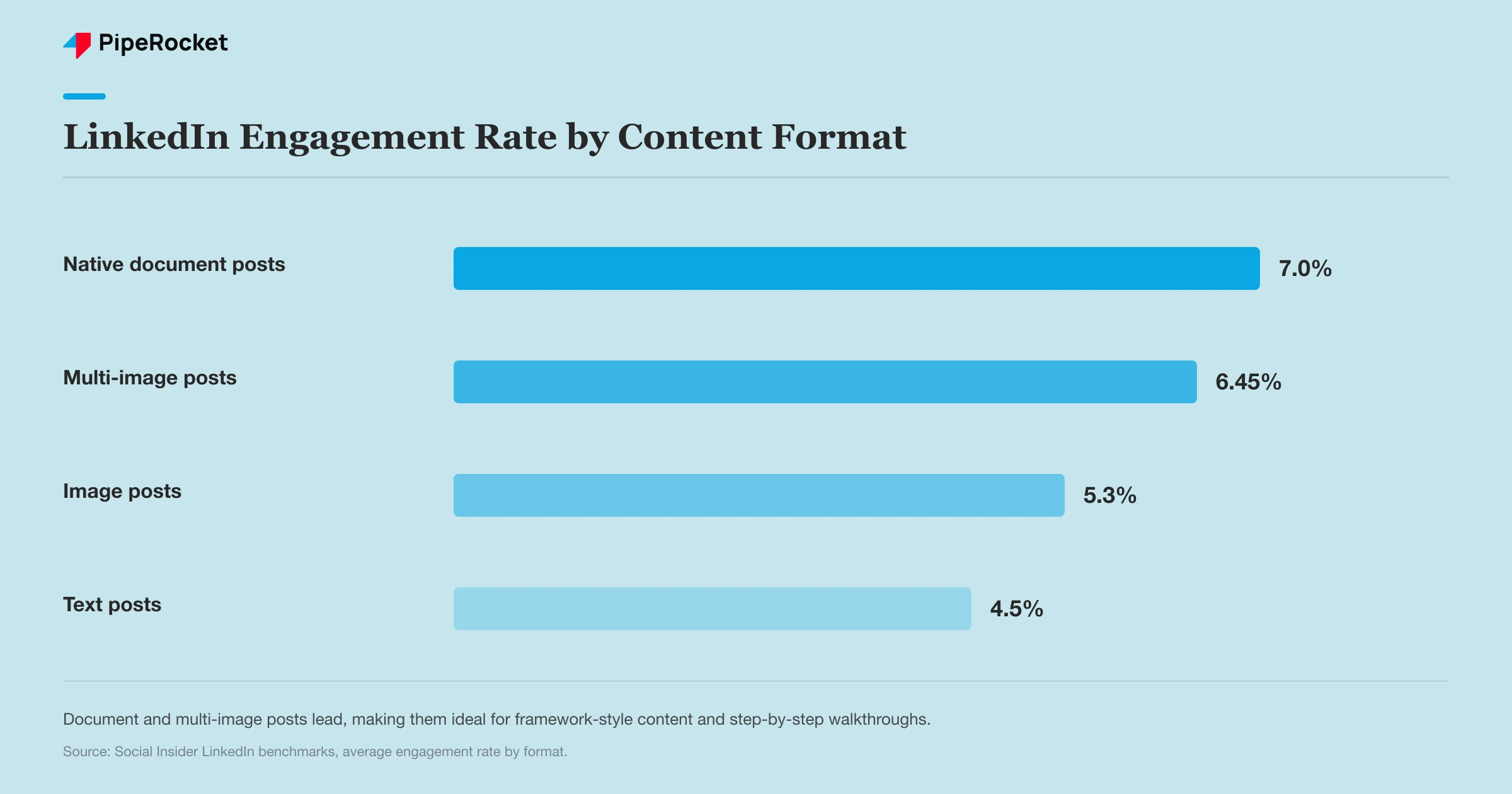
Look for patterns, not random spikes. Social Insider’s LinkedIn benchmarks rank content formats by average engagement rate:
| Content format | Average engagement rate |
|---|---|
| Native document posts | 7.0% |
| Multi-image posts | 6.45% |
| Image posts | 5.3% |
| Text posts | 4.5% |
Document and multi-image posts lead, which makes them ideal for framework-style content and step-by-step walkthroughs.
3. Evaluate Lead Generation & Demand Metrics
Measure actions tied directly to buying intent:
- Lead-gen form submissions
- Demo requests and event registrations
- Trials and gated content downloads
- Meeting conversions from campaigns
These metrics validate whether LinkedIn business to business marketing is filling pipeline with real opportunities.
4. Assess Account Engagement & Buyer Committee Activity
In B2B buying, multiple people influence the decision. Track:
- Interactions from target accounts
- Engagement from specific job roles
- Returning visitor behavior
- Warm-audience retargeting performance
This helps identify which accounts are ready for outreach and which need more nurturing.
5. Benchmark Against Competitors
Compare your metrics to direct competitors to judge whether your numbers are strong in context, not just in isolation. Track:
- Competitor follower growth and posting cadence
- Their top-performing formats and topics
- Engagement rate versus yours on similar content
- Share of voice inside your category conversations
Benchmarking shows where you lead, where you lag, and which content bets are worth copying or avoiding.
Common Pitfalls & How to Avoid Them
The four pitfalls that sink most B2B LinkedIn marketing programs: posting irregularly without a strategy, targeting too broadly, chasing brand vanity metrics over pipeline, and ignoring analytics or sales alignment. Fixing these lifts engagement, lead quality, and pipeline results.
1. Posting Irregularly or Without Strategy
A random posting pattern weakens visibility and slows audience growth. LinkedIn rewards consistency and relevance. To avoid this:
- Set a weekly posting schedule
- Use 3 core content themes aligned to buyer needs
- Track audience response and optimise formats
A predictable rhythm builds trust and keeps your brand top-of-mind.
2. Targeting Too Broadly or Missing Decision-Makers
Broad outreach attracts the wrong audience and increases wasted spend. Instead:
- Define your ICP clearly (industry, role, company size, region)
- Use retargeting and look-alike audiences
- Prioritise decision-makers and influencers
Precision improves conversion quality for LinkedIn b2b ads and strengthens your LinkedIn b2b strategy.
3. Focusing Only on Brand, Not Pipeline or Lead Quality
Brand visibility alone does not create revenue. Make sure brand activity supports pipeline goals:
- Track intent signals (profile visits, comments, DMs, clicks)
- Include clear CTAs like resources, webinars or demos
- Mix educational posts with conversion-focused offers
This ensures visibility turns into real business conversations.
4. Neglecting Analytics or Sales Alignment
When using LinkedIn for B2B marketing without data and collaboration, opportunities slip through the cracks. Improve alignment by:
- Reviewing performance weekly
- Sharing warm-engagement signals with sales teams
- Retargeting active accounts with tailored campaigns
Sales alignment increases conversion speed and ROI for LinkedIn business to business marketing.
Conclusion
B2B LinkedIn Marketing is one of the most powerful channels for building trust, engaging decision-makers, and generating high-quality pipeline. When you combine the right strategy, consistent content, targeted reach, and clear measurement, LinkedIn becomes a predictable engine for opportunities, not a guessing game. The companies winning today are the ones who show up consistently, speak to real problems, and create value long before asking for a meeting.
If you want to scale demand, improve lead quality, and build a LinkedIn program that actually drives revenue, now is the time to get intentional. PipeRocket Digital helps B2B brands build high-performing LinkedIn strategies that turn attention into results.
Want to grow faster on LinkedIn? Reach out to us and let’s build it together.
FAQ
1. What is B2B LinkedIn marketing?
B2B LinkedIn marketing is the process of using LinkedIn to reach business decision-makers, build authority through valuable content, and generate qualified leads through organic posts and paid campaigns. It focuses on strengthening relationships, increasing trust, and converting professional engagement into real pipeline and revenue opportunities.
2. How do I measure the ROI of LinkedIn marketing for a B2B business?
Track metrics tied to intent and pipeline, not just impressions. Measure demo requests, lead-gen form submissions, event signups, meetings booked, and opportunities created. Compare campaign cost to pipeline value and closed revenue to calculate ROI. Strong ROI shows LinkedIn is generating real business impact.
3. How often should a B2B company post on LinkedIn and what content formats work best?
Post 3 to 5 times per week for consistent visibility and engagement. Use a mix of short posts, carousels, videos, thought-leadership articles, and customer stories. Focus on educational content that solves problems and sparks conversation rather than announcements or promotional messaging.
4. Should my B2B LinkedIn strategy focus more on organic posts or paid advertising?
Use both. Organic content builds trust and community. LinkedIn B2B ads scale reach, target decision-makers, and accelerate lead generation . With LinkedIn advertising, B2B teams can also filter by job title, seniority, and company size. The best results come from blending the two: organic for authority, paid for predictable pipeline growth.
5. How can I integrate LinkedIn marketing with my sales and account-based marketing (ABM) efforts?
Share engagement data with sales teams, retarget active accounts, and align messaging across outreach and campaigns. Track interactions from ICP roles and share warm leads quickly. Use LinkedIn content to support ABM touchpoints and move deals faster.
6. What is the difference between B2B LinkedIn marketing vs B2B PPC?
LinkedIn marketing builds awareness and trust by targeting professionals through organic content, thought leadership, and community engagement. It’s stronger for nurturing long sales cycles and reaching specific roles or industries. B2B PPC focuses on capturing demand through paid search and display ads, driving immediate traffic and leads from users with active intent. LinkedIn is better for shaping perception and influencing early-stage buyers, while PPC excels at converting high-intent audiences already looking for solutions.
7. Is LinkedIn good for B2B marketing?
Yes. LinkedIn drives roughly 80% of B2B social media leads because it puts decision-makers in a professional, high-intent context that organic content and ads can reach directly.
8. What is the rule of 7 in B2B?
The rule of 7 says a buyer needs about seven touches with your brand before they act. It is why consistent LinkedIn posting and repeated exposure matter more than one-off campaigns.
9. What is the 3/2/1 rule on LinkedIn?
The 3/2/1 rule balances your content mix: for every batch of posts, publish three value or thought-leadership pieces, two engagement posts, and one promotional post. It keeps the feed useful, not salesy.