Paid Search vs Paid Social for B2B SaaS: How to Split the Budget
 Praveen Ravi
Last updated on
Praveen Ravi
Last updated on
Most of the “paid search vs paid social” debates I read treat it as a fight one channel wins. It isn’t. The two do completely different jobs, and picking the wrong one first is how B2B SaaS teams burn a quarter of budget with nothing in the pipeline to show for it.
Here’s the frame I use with every client: Google is for capture, and social is for influence. Search catches the person already looking for what you sell. Social plants the idea in someone who isn’t looking yet. Once you see the two that way, the budget question mostly answers itself.
TL;DR
- They do different jobs: Paid search captures demand that already exists in the market; paid social creates demand in buyers who aren’t searching yet. Neither replaces the other.
- Start with paid search: If people are already searching for your category, fund search first. It’s the highest-intent, fastest-payback money in B2B SaaS.
- Add paid social when capture is maxed: Once you can’t spend more on high-intent search profitably, social becomes the growth lever, but only for high-ACV products.
- Measure them differently: Judge search on last-click cost per lead; judge social on lift, brand-search rise, and total pipeline rather than the platform’s own attribution.
- The split follows the deal: Low ACV and mature demand lean search-heavy; high ACV and a new category lean social-heavy. A fixed template won’t fit.
- They differ in format and reach too: Search runs as text links on Google and Microsoft; social runs as visual and video ads across LinkedIn, Meta, and TikTok.
What’s the Real Difference Between Paid Search and Paid Social?
The real difference is intent, and it decides everything downstream. On Google, someone types “best contract management software” because they have a problem right now and want a solution. On LinkedIn, nobody is in buying mode. They’re scrolling between meetings, and your ad is an interruption they didn’t ask for.
That single fact changes how each channel behaves, what it costs, and how you’re supposed to measure it.
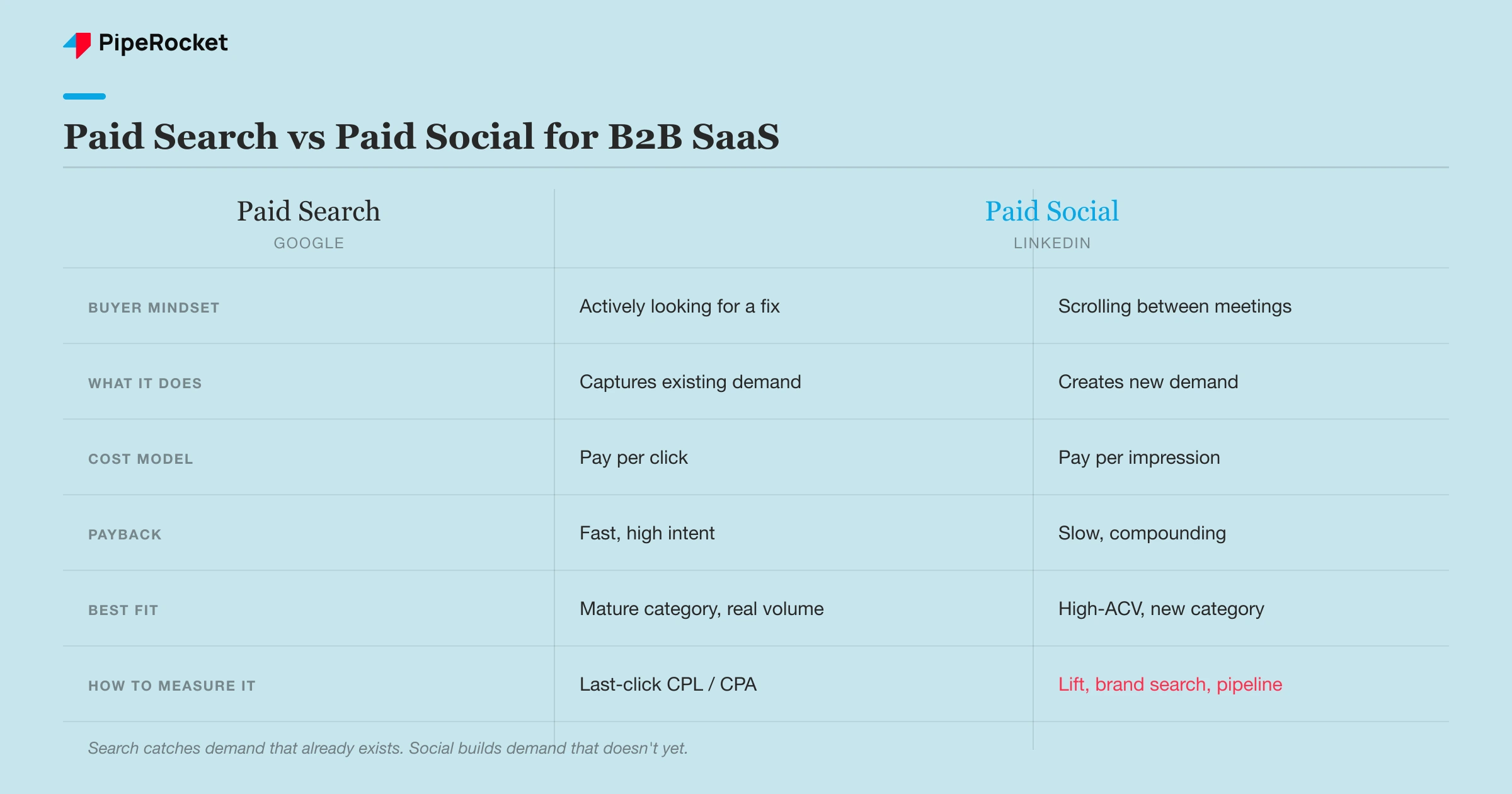
Search meets demand that already exists. Social builds demand that doesn’t. If you treat them as interchangeable line items, you’ll judge social by search’s rules and kill campaigns that were quietly working.
| Paid Search (Google) | Paid Social (LinkedIn) | |
|---|---|---|
| Buyer mindset | Actively looking for a fix | Scrolling between meetings |
| What it does | Captures existing demand | Creates new demand |
| Cost model | Pay per click | Pay per impression |
| Platforms | Google Ads, Microsoft/Bing Ads | LinkedIn, Meta (Facebook, Instagram), TikTok |
| Ad formats | Mostly text-based links | Images, video, carousels |
| Payback | Fast, high intent | Slow, compounding |
| Best fit | Mature category, real search volume | High-ACV, new or undefined category |
| How to judge it | Last-click CPL / CPA | Lift, brand search, total pipeline |
The teams that get this wrong usually run both, then look at a last-click report, see LinkedIn “converting” almost nobody, and pause it. They just switched off the channel that was warming up the pipeline search later closed.
Which Should a B2B SaaS Company Fund First?
Fund paid search first, in almost every case. If real people are already typing your category into Google, that’s the cheapest, fastest-closing money you can spend, and there’s no reason to go create demand before you’ve captured the demand that already exists.
I’m ruthless about this order because I’ve watched the alternative fail too many times. A team gets excited about LinkedIn’s targeting, pours budget into awareness, and six weeks later the pipeline hasn’t moved because they skipped the people who were ready to buy today.
Start Where the Money Is Already Moving
The first dollars go to the highest-intent search terms you have, the bottom-of-funnel queries where someone is comparing tools or looking for an alternative to what they use now. Terms like “what is X” pull in students, researchers, and people months away from a decision, so they wait.
Only when you’ve genuinely saturated high-intent search, meaning you can’t spend more there without your cost per lead climbing past what a customer is worth, do you open up the awareness plays. That’s the point where paid social stops being premature and starts being the obvious next lever.
The One Case Where You Flip the Order
Lead with paid social when almost nobody is searching for your category yet. If you’ve built something genuinely new, the search volume for it doesn’t exist, so there’s nothing for Google to capture. You have to go create the demand on social first, then watch search volume for your brand and category appear as a downstream effect.
The catch is deal size. Paid social on LinkedIn runs on high CPCs and CPMs, so if you’re selling a $20-a-month tool, the math never closes. Social-first only works when the contract value is high enough to absorb the cost of manufacturing demand.
How Do You Actually Split the Budget?
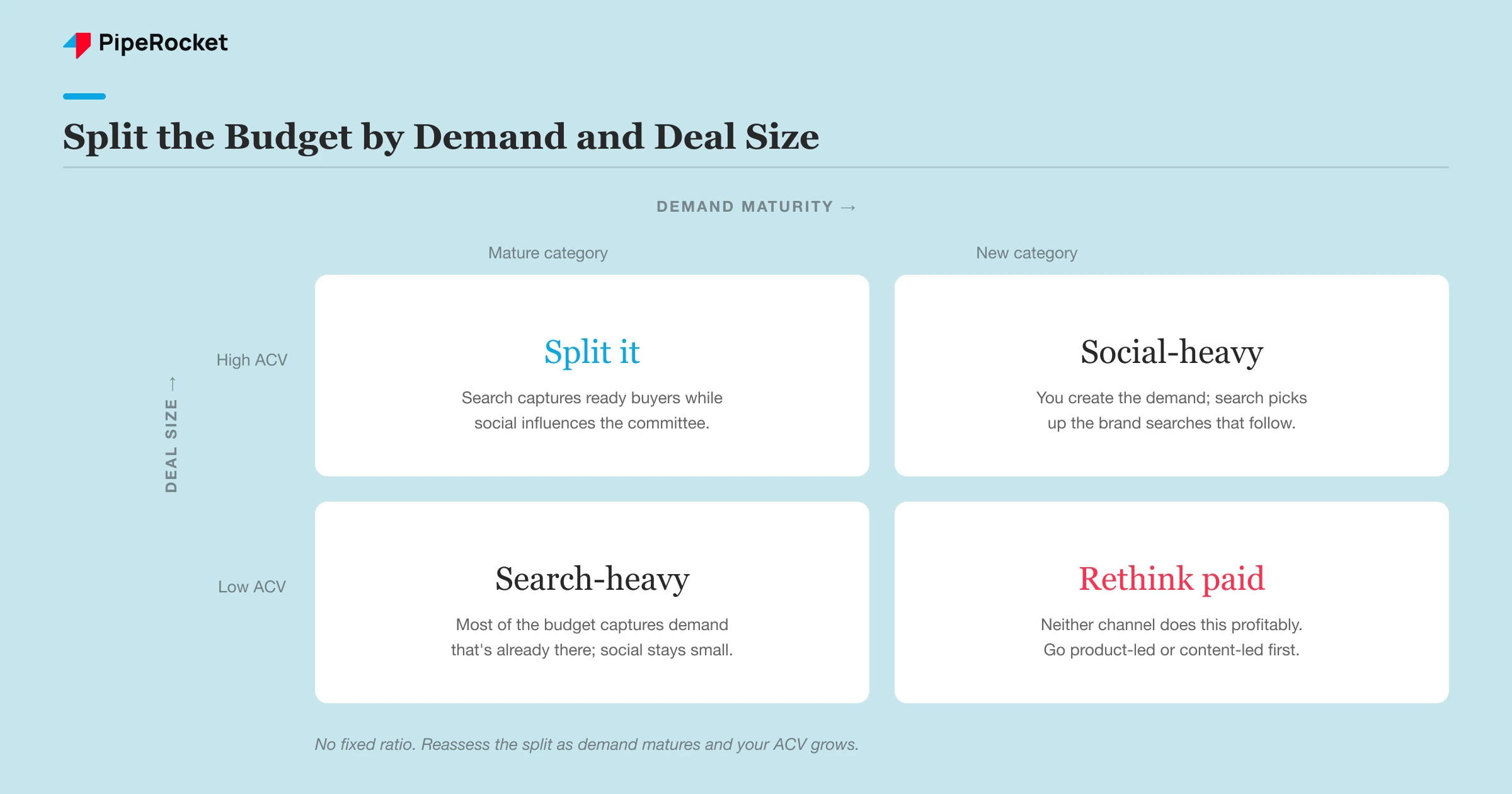
There’s no fixed ratio. The split follows two variables: how mature the demand for your category is, and how large your average deal is. Everything else is noise.
I start every budget conversation with the “Eagle’s View,” where I look at spend by channel against cost per lead and cost per SQL before touching a single campaign. That view exposes the bleeders fast. If one channel is eating half the budget for a tenth of the qualified pipeline, the split is already telling you what to fix.
Our Google Ads benchmarks put the average B2B SaaS search lead at $84 blended, so a channel costing multiples of that with no pipeline to show for it is the one to cut first.
Here’s the rough shape I work from, then adjust with real data:
- Mature category, lower ACV: Search-heavy. Most of the budget captures demand that’s already there; social stays small or off.
- Mature category, high ACV: Split it. Search captures the ready buyers while social influences the committee members who aren’t searching yet.
- New category, high ACV: Social-heavy. You’re creating the demand, and search picks up the brand and category searches that follow.
- New category, low ACV: Rethink paid entirely. Neither channel does this profitably; you likely need product-led or content-led growth first.
The mistake is treating the split as a set-and-forget decision. Demand maturity changes as you grow, and the ratio that’s right at $2M ARR is wrong at $10M.
Why You Can’t Measure Both Channels the Same Way
Judge paid social by last-click attribution and you will pause campaigns that are working. This is the single most expensive measurement mistake in B2B SaaS paid media, and it comes straight from treating an influence channel like a capture channel.
Search is honest on last-click, because the click and the intent happen together. Someone searched, clicked, and converted, so the cost per lead is a fair read. Social doesn’t work that way. The ad plants a seed, and weeks later that VP Googles your brand and converts as “organic” or “direct,” and your attribution tool hands the credit to search.
We took over a SaaS account that was running what I call spray-and-pray on paid social: a modest budget aimed at hundreds of thousands of people on the broadest targeting the platform offers. It was hitting an audience penetration of around 1.7%, which means it was influencing almost nobody, and most of the impressions were landing on junior, irrelevant profiles.
We restructured it by region and product, applied strict ICP filters on seniority, industry, and company size to right-size the audience to the budget, and switched from automated to manual bidding.
Audience penetration went from about 1.7% to 19.2%. Same budget, but now it was actually saturating the accounts that could buy, instead of scattering impressions across people who never would.
So how do you know social is working if the attribution report won’t tell you? You measure the lift. After launching a real social campaign, watch whether direct traffic rises, whether branded searches for you on Google climb, and whether total lead count goes up even when social isn’t claiming the credit.
The concrete read is simple: if you were getting around 10 leads a month from Google alone, and adding social pushes you to a steady 13 to 15, it’s working, no matter what the last-click dashboard says.
The Trade-Offs Nobody Puts in the Comparison Post
Paid search breaks the moment nobody is searching for your category yet; paid social breaks on low-ticket products and loose targeting. Every channel has a condition where it fails, and the honest version of this comparison names them:
- Paid search breaks when: you’re in a category people don’t search for yet, because you can’t capture demand that isn’t there. It also has a ceiling: there are only so many high-intent searches per month, and once you own them, more budget just buys worse traffic.
- Paid social breaks when: your ACV is low or your targeting is loose. A compliance SaaS selling six-figure contracts to security teams can afford to influence a slow-moving buying committee ; a $15-a-month project tool selling to freelancers cannot.
Platform choice softens the second failure, but only a little. LinkedIn carries the highest CPMs in B2B; Meta ads and Reddit ads can reach the same buyers for less, yet they still lose money on a low-ticket product. Deal size is what decides whether creating demand pays off, and the platform only moves the cost of getting there.
The other quiet trap is measurement patience. Search shows results in days, social shows them over weeks, and if your leadership expects both to prove out on the same timeline, social loses every internal budget review despite doing its job.
How PipeRocket Digital Runs Paid Search and Paid Social for SaaS
We build the two channels around the jobs they actually do. Our SaaS PPC service starts by capturing existing demand on search, fund the highest-intent terms first, prove the payback, then layer paid social only once search is maxed and the deal size justifies creating demand. Our paid social agency page covers that second layer in more depth. We measure each channel on its own terms so no one pauses the campaign that’s quietly filling the pipeline. If you want a second set of eyes on how your budget is split, get in touch .
Frequently Asked Questions
Is paid search or paid social better for B2B SaaS?
Neither is universally better, because they do different jobs. Paid search captures buyers who are already looking for your category, which makes it the faster, higher-intent channel and usually the one to fund first. Paid social creates demand in buyers who aren’t searching yet, which matters most for high-value deals and newer categories. The right answer depends on how mature demand is for your category and how large your average contract is.
How should I split my budget between paid search and paid social?
Let two variables decide it: demand maturity and deal size. If people are already searching for your category and your deals are smaller, go search-heavy. If your contracts are large and much of the buying committee isn’t searching yet, split the budget so search captures ready buyers while social influences the rest. For a brand-new category with high ACV, weight it toward social because you’re creating the demand search will later capture. Reassess the split as you grow, since the ratio that fits early rarely fits at scale.
Why does paid social look like it isn’t converting?
Because you’re probably judging it by last-click attribution, which is the wrong lens for an influence channel. Social plants the idea, then weeks later the buyer searches your brand and converts as “direct” or “organic,” so your attribution tool credits search instead of social. To see whether social is really working, track lift: rising direct traffic, more branded searches on Google, and higher total lead volume after you launch. If total pipeline grows even when social isn’t claiming credit, it’s doing its job.
What are the disadvantages of paid search?
Paid search breaks once you’re in a category people don’t search for yet, and it has a ceiling: once you own the high-intent searches, more budget just buys worse, lower-intent traffic.
What does “paid search” mean?
Paid search means buying placement on a search engine like Google or Microsoft Ads , so your ad appears when someone searches a relevant term. You pay per click, and the intent is already there.
What is considered paid social?
Paid social is any ad you pay to run on a social platform, including LinkedIn, Meta (Facebook and Instagram), and TikTok, targeted by demographics and interests rather than by a search query.