Creative Testing for B2B SaaS Paid Ads: A Practical System
 Immanual D M
Last updated on
Immanual D M
Last updated on
Most creative testing advice was written for e-commerce, where you get thousands of conversions a week and a clean read in days. B2B SaaS is the opposite: a tiny audience, a long sales cycle, and a “conversion” that might land three months after the click. Run standard A/B testing on that and you’ll call winners off noise every single time.
TL;DR
- Why B2B SaaS breaks standard testing: Small audiences and slow, multi-touch sales cycles mean conversion data comes too late and too thin to judge creative on, so you test differently.
- Test one thing at a time: Change only the hook or only the visual in a given test, so you know which one moved the number. The most common cause of dead tests is changing everything at once.
- Pick a metric your data can actually support: Early-stage creative gets judged on the signal you have volume for (click-through, thumb-stop, cost per lead), while closed-won stays too far off to read.
- Give the test room, then call it: Run enough variants, let each get enough impressions, and don’t let the platform pick a winner off ten random clicks.
- Keep a testing cadence: Prune the weakest creative, feed the winner, keep a queue of new angles. Creative fatigue is real and a static ad set decays.
Why B2B SaaS Breaks Standard Creative Testing
Standard A/B testing assumes you have volume, and in B2B SaaS you usually don’t. Your LinkedIn ABM list might be 2,000 companies. Your Google search terms might pull a few hundred qualified clicks a month. You can’t split that into ten creative variants and expect a statistically clean read on conversions. There isn’t enough data to go around.
The second problem is time. A SaaS deal can take weeks or months to close, so the “did this creative drive revenue” question can’t be answered inside a test window. If you wait for closed deals, the test runs for a quarter and the creative is stale before you learn anything.
So we don’t judge early creative on revenue. We judge it on the signal we actually have volume for at that stage of the funnel:
- Top of funnel: thumb-stop rate, CTR, cost per click
- Mid funnel: cost per lead, landing-page engagement
- Bottom of funnel: cost per qualified lead, demo-request rate
Here’s the trade-off. Judging creative on CTR is fast but shallow. A hooky ad can win on clicks and still send junk that never converts. So CTR gets you a fast read, but you always sanity-check the winner against lead quality before you scale it.
One more thing that’s specific to B2B. The ad often has a different job than getting a click: it plants a seed so the buyer remembers you when they’re ready.
Our team has seen creative do most of the work on a LinkedIn program by warming named accounts, with brand searches and direct traffic climbing weeks later. Judge that creative on last-click attribution and you’ll kill the ad that was actually working. Measure it on the downstream lift in brand search and direct instead.
Step 1: Isolate One Variable Per Test
Change one element per test, or the result tells you nothing. This is the single most common reason SaaS creative tests come back inconclusive: the team swaps the headline, the image, and the CTA all at once, the number moves, and now nobody knows which change did it.
We’ve watched this wreck accounts in the audit chair. A client changing creatives, landing pages , and bids in the same week had destroyed their own data clarity, so when performance dropped there was no clean signal left to isolate the cause. You can’t debug an account where three things changed at once.
Pick the one lever most likely to move the result and hold everything else steady:
- The hook (first line / headline) usually moves the most, so test it first
- The visual (static vs video, product screenshot vs concept)
- The offer / CTA (book a demo vs free trial vs a resource)
- The angle (speed vs security vs cost vs a specific job title)
Test in that rough order of impact. The hook and the angle move numbers hard; the button color barely registers in B2B. Don’t waste a small audience proving something that was never going to matter.
Step 2: Match the Metric to the Funnel Stage
Judge each creative on the metric its stage can actually produce data for. Chasing the metric you wish you had is where most testing frameworks fall apart in SaaS: they tell you to optimize for conversions when you don’t have enough conversions to be significant.
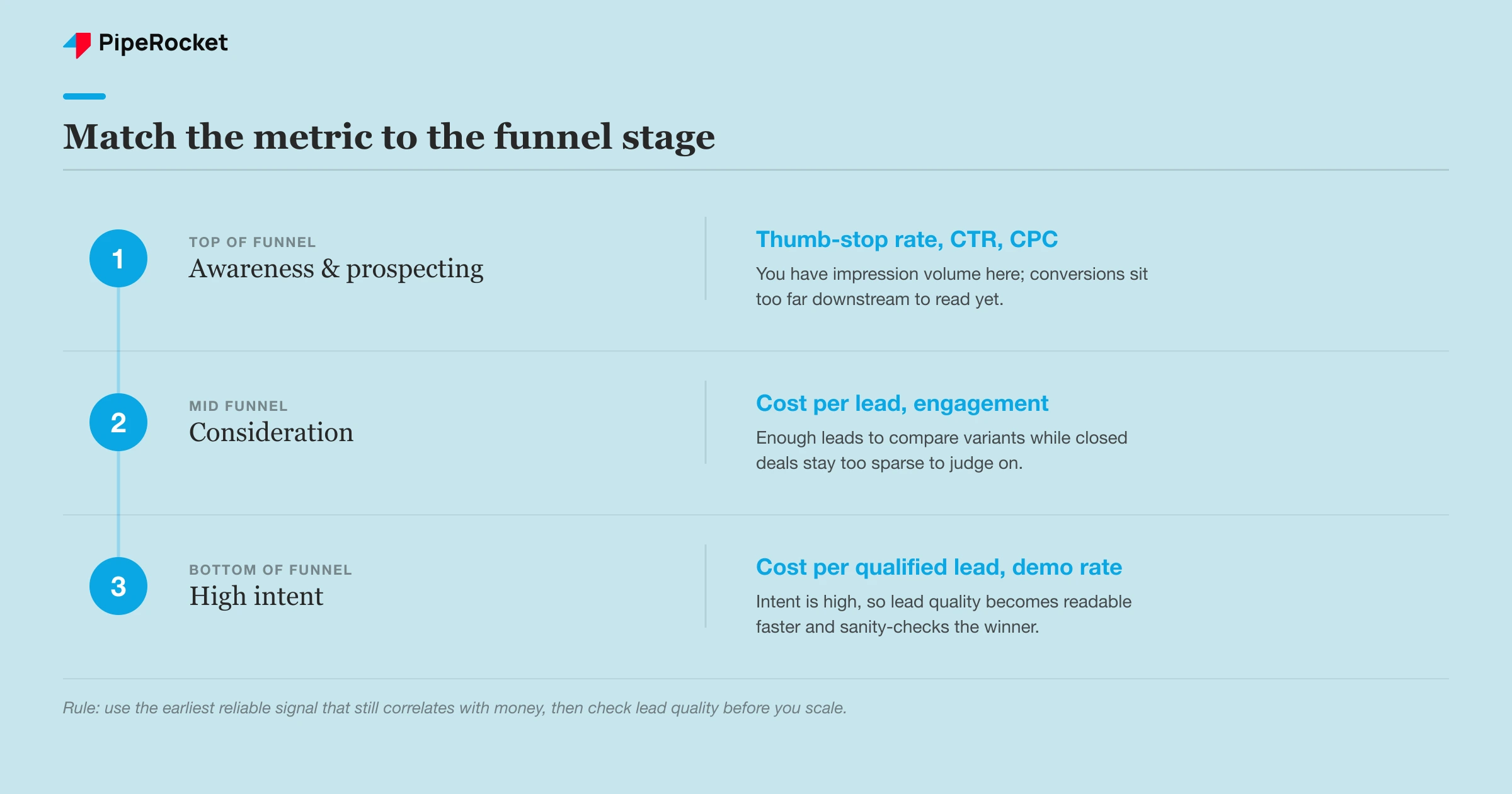
Here’s how we map it:
| Funnel stage | Judge creative on | Why |
|---|---|---|
| Top (awareness/prospecting) | Thumb-stop rate, CTR, CPC | You have impression volume; conversions are too far off |
| Mid (consideration) | Cost per lead, engagement | Enough leads to compare while deals stay too sparse |
| Bottom (high-intent) | Cost per qualified lead, demo rate | Intent is high, so lead quality is readable faster |
The rule is simple: use the earliest reliable signal that still correlates with money. CTR alone is a vanity trap because a clickbait hook wins on clicks and loses on pipeline. So we let CTR pick the shortlist, then we look one layer deeper at whether those clicks turned into leads before we crown anything.
A one-line creative beat the explainer by 3% CTR
On one B2B SaaS account we ran two creatives that differed in exactly one thing: how much they explained the product. One version spelled out what the product did in detail. The other said it in a single line. We judged them the way this stage allows, on click-through and engagement, and the simple one-line creative won with about 3% higher CTR than the detailed one.
The lesson we keep relearning is that on a crowded feed, less explanation earns the click. The detailed ad tried to close the sale inside the ad itself, while the one-liner earned attention and left the explaining for the landing page. CTR gave us a fast read on which message resonated, and from there we watch whether those clicks turn into real leads before we pour budget into the winner.
That layered read matters most on channels where you can’t even see placement. On some platforms you get impressions, clicks, and CTR but no view of where the ad ran, so the on-platform number is all you’ve got and lead quality downstream becomes your only honest check.
Step 3: Give the Test Enough Room, Then Call It
Launch enough variants, let each accumulate real impressions, and don’t let the algorithm crown a winner off a handful of clicks. On a small B2B audience the temptation is to run two ads and pick one after a day. With that little data you’re just guessing.
Our rough operating rules:
- Launch three to five variants per ad set, each on a genuinely different angle rather than a near-identical headline tweak
- Rotate them evenly for one to two weeks so the platform doesn’t declare an early winner off random early clicks
- Wait for a floor of impressions per variant before comparing anything (a few thousand at the top of funnel; you’ll never get millions in B2B)
- Then cut to the best by your stage metric and pause the clear losers
On LinkedIn specifically, the platform only shows the same ad to the same person a couple of times before it suppresses it, so shipping a single creative kills your own reach. You need multiple variants live just to keep serving, which conveniently is also what testing requires. Shipping one creative caps your own reach.
Warning: don’t kill a variant the moment it dips. On a small audience, day-to-day numbers swing hard on tiny sample sizes. Give it the full window before you make the call, or you’ll prune the eventual winner during a bad Tuesday.
Step 4: Run Creative Testing as an Ongoing Cadence
Treat creative testing as a loop that never stops, because a winning ad decays. Even a great creative fatigues once your audience has seen it enough times, and in B2B that happens fast because the audience is small and you’re hitting the same people repeatedly.
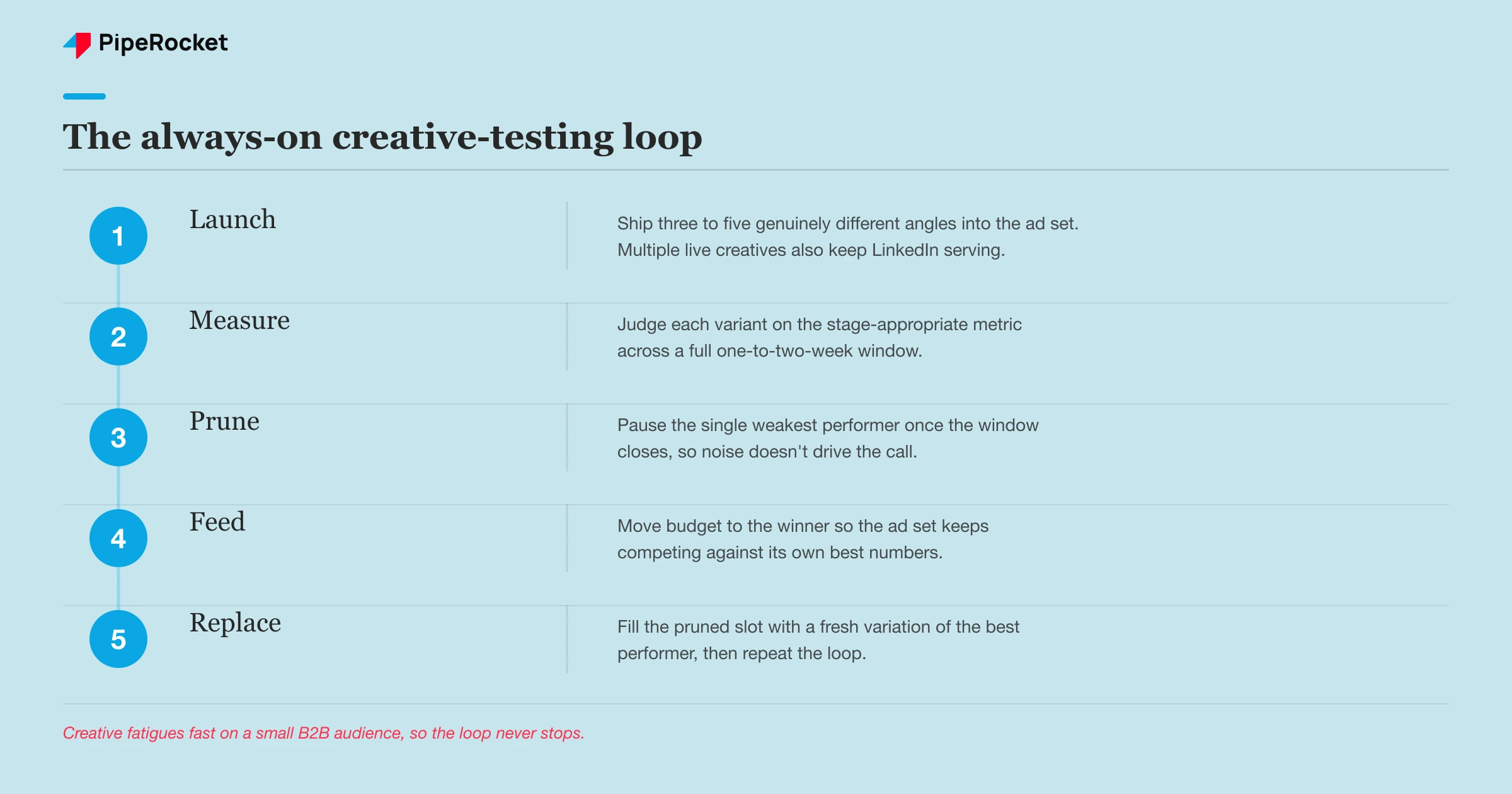
The loop we run:
- Launch three to five angles
- Measure on the stage-appropriate metric over the window
- Prune the single weakest performer
- Feed budget to the winner
- Replace the pruned slot with a fresh variation of your best performer
Then repeat. You’re always testing your best creative against a new challenger, so the ad set keeps competing against its own best numbers instead of coasting.
Test audience and funnel stage alongside the creative
Different funnel stages want different creative, too. The ad that warms a cold named account shouldn’t be the same ad that closes someone who already visited your pricing page. Showing a testimonial-heavy ad to someone who’s never heard of you is like proposing on the first date. Match the creative to how warm the audience is, and keep separate tests running per stage.
For lookalike and prospecting audiences, the source matters more than the creative sometimes. Our team’s best-performing Meta campaign for a fintech SaaS client was built on a tight one-percent lookalike of their actual active users. A sharp audience off real customers can out-earn a cleverer creative aimed at a broad one, so test your audience source as deliberately as you test your hooks.
How PipeRocket Runs Creative Testing for B2B SaaS
We treat creative testing as an always-on system that keeps running long after the first experiment. We isolate one variable per test, judge each creative on the metric its funnel stage can actually support, hold tests open long enough to beat the noise, and keep pruning and refreshing so nothing goes stale. Most of that work happens inside our paid social programs, where small B2B audiences punish sloppy testing hardest. If your creative tests keep coming back inconclusive, talk to us and we’ll rebuild the testing loop around your funnel.
Frequently Asked Questions
How many ad creatives should I test at once for B2B SaaS?
Three to five per ad set is the practical range for most B2B SaaS accounts. Fewer than three and you’re not really testing, more than five and a small audience can’t give each variant enough impressions to read cleanly. The variants should be genuinely different angles rather than minor headline tweaks, so you learn which message resonates rather than which synonym won. On LinkedIn you also need multiple live creatives to avoid the platform suppressing a single ad after limited exposure.
How long should a creative test run before I pick a winner?
Usually one to two weeks, but the real gate is impressions and stage-appropriate signal rather than the calendar. Let each variant accumulate enough impressions that the difference between them isn’t just day-to-day noise, which on a small B2B audience takes longer than it would in e-commerce. Rotate creatives evenly during that window so the platform doesn’t crown an early winner off a few random clicks. Then cut to the best performer on the metric your funnel stage can actually support.
Should I test creative on clicks or on conversions in B2B SaaS?
Use clicks and thumb-stop rate to shortlist fast, then check lead quality before you scale, because CTR alone is a vanity trap. A clickbait hook can win on clicks and still send traffic that never converts, so a high click-through rate is one input to weigh, and lead quality is what settles the verdict. Conversions and closed deals are the truth, but they arrive too slowly and too thinly in B2B to judge creative on directly. The workable answer is to use the earliest reliable signal you have volume for, then sanity-check the winner one layer deeper before committing budget.