What Is LSI Keywords? (And Why the Old Advice Is Outdated)
 Omar Sheriff
Last updated on
Omar Sheriff
Last updated on
LSI keywords are words and phrases conceptually related to a target keyword, drawn from a 1988 math technique called Latent Semantic Indexing. Google doesn’t run that formula, and it isn’t a ranking factor. What actually moves rankings is broader semantic and entity coverage of a topic.
TL;DR
- LSI keywords are terms conceptually tied to a page’s main keyword, based on an old indexing method from Bellcore, not a Google algorithm.
- Google’s own Search Advocate John Mueller said flatly that “there’s no such thing as LSI keywords,” in 2019 and again in 2023, so treating them as a ranking lever is built on a technique Google has never confirmed using.
- What actually works is covering a topic’s full set of related entities and subtopics, which modern NLP models like BERT and passage ranking pick up without any keyword list.
- Skip the LSI keyword generator tools and instead pull related terms straight from the SERP itself, from People Also Ask, from “searches related to,” and from what top-ranking pages already cover.
- Write for topic completeness first. The related terms show up naturally once the page actually answers the question in full.
What Is LSI Keywords, Really?
LSI keywords refer to words or phrases that share conceptual ground with a page’s main target term, a label borrowed from Latent Semantic Indexing rather than anything Google has ever named as a ranking system. The idea got attached to SEO in the mid-2000s and never let go.
Here’s the actual timeline behind the term.
- 1988: Bellcore (Bell Communications Research) researchers Deerwester, Dumais, Furnas, Harshman, Landauer, Lochbaum, and Streeter file the Latent Semantic Indexing patent, a method for mapping documents and terms into a mathematical space so a search system can group text by shared meaning instead of exact word matches.
- Mid-2000s: SEO blogs adopt “LSI keywords” as shorthand for “words related to your main keyword that you should sprinkle into your content,” years after the original patent and with no connection to how Google’s search systems actually work.
- Since then: Keyword-generator tools built entire products around producing “LSI” term lists, and plenty of writers still treat that list as homework to complete before publishing.
Nothing in that chain proves Google’s ranking systems run LSI math on a page. The term stuck in SEO culture because it sounded technical and gave writers a checklist, not because Google ever confirmed the mechanism.
LSI Keywords Work as Context Providers
The genuinely useful part of the LSI idea is disambiguation, not density. A word like “apple” means nothing on its own, but pair it with “orchard” and “pie” and a reader (and a search system) instantly knows you mean the fruit, not the company.
That’s the real job related terms do: they narrow down which meaning of an ambiguous word or topic a page is actually about. It has nothing to do with hitting a keyword count.
LSI Keywords Aren’t Strict Synonyms
LSI keywords are related concepts and co-occurring words, not synonyms for the main term. A common mix-up treats them as a thesaurus exercise, swapping in word-for-word replacements, and that’s not what the concept describes.
Related terms are connected ideas that travel with a topic, not restatements of it. “Annual fee” isn’t a synonym for “credit card,” but it’s a concept that naturally shows up alongside it because the two ideas travel together in how people actually discuss the topic.
LSI Keyword Examples: Main Keyword to Related Terms
The clearest way to see “related terms” is to pair a main keyword with the words that naturally travel alongside it. For “coffee,” related terms are caffeine, espresso, beans, roast, and brew. None of them is a synonym, and together they signal a page genuinely covers the topic.
| Main keyword | Related / semantic terms |
|---|---|
| Coffee | caffeine, espresso, beans, roast, brew |
| Roof repair | shingles, contractor, leak, flashing, slate tile |
| CRM software | pipeline, contact record, deal stage, automation, integrations |
| Credit card rewards | cashback rate, annual fee, sign-up bonus, redemption rules |
Read across any row and the pattern holds: the related terms are the subtopics a reader researching that main keyword would expect a thorough page to explain. You find them by studying the SERP and the top pages, not by running a generator, and you use them by actually covering each subtopic in the body of the page.
Why the LSI Keyword Ranking Factor Advice Is a Myth
Google has never confirmed using Latent Semantic Indexing as a ranking signal, and its own engineers have said as much directly. That makes the “LSI keywords help you rank” claim closer to SEO folklore than fact.
Two of Google’s own people have said this directly.
- John Mueller, Google’s Search Advocate, has stated flatly that Google doesn’t use anything called “LSI keywords,” posting in 2019 that “there’s no such thing as LSI keywords, anyone who’s telling you otherwise is mistaken,” and repeating the same point again in 2023.
- Danny Sullivan, Google’s Search Liaison, has made similar comments dismissing the term when it comes up on social media, generally framing Google’s language understanding as unrelated to the specific technique the SEO industry keeps citing.
These aren’t ambiguous statements open to interpretation.
The confusion partly comes from a real fact getting stretched. Google’s systems do use natural language processing to understand context and meaning, technology that shares a lineage with older semantic-analysis research. That’s genuinely true and worth understanding.
The leap SEO blogs made was assuming “Google understands context” must mean “Google runs the specific 1988 LSI algorithm on my page.” Those are two different claims, and only the first one holds up.
Modern ranking depends on transformer models like BERT and MUM instead, which represent meaning through neural embeddings, a completely different mechanism than the matrix math LSI relies on.
There’s also a more precise, patent-backed name for why related terms matter. Bill Slawski of SEO by the Sea pointed to Google’s phrase-based indexing and domain-term (context vector) patents, which describe how Google notes words that predictably co-occur with a phrase. That co-occurrence mechanism, not the 1988 LSI formula, is the technically accurate reason semantically related terms help a page read as topically complete.
What Google Engineers Have Actually Said
Mueller has said versions of this publicly since at least 2019, most directly on X (formerly Twitter), and the question still comes up regularly enough that he’s had to repeat it.
Sullivan’s position tracks the same direction, though his public comments read more as informal pushback on social media than a single citable statement. Between the two, the “LSI keywords are a ranking factor” claim has no real backing left to stand on.
That consistency matters. When a claim about a ranking factor survives repeated, direct denial from the people who’d know, and the SEO industry keeps repeating it anyway, that’s the definition of a myth that outlived the evidence against it.
What Modern Semantic SEO Actually Rewards
Modern ranking systems reward pages that cover a topic’s full set of related concepts and entities in depth. Language models trained to understand meaning detect that coverage directly, with no checklist of synonym keywords involved. Three mechanisms do the work:
- Neural embeddings. Google’s BERT and MUM models convert words and phrases into vectors that capture meaning and relationship, then compare those vectors across a page and a query. A page can rank well for “credit card rewards” without ever using that exact phrase, as long as it thoroughly covers cashback rates, annual fees, sign-up bonuses, and redemption rules.
- Passage ranking. Google can rank a specific section of a long page for a narrow query, which means depth on subtopics matters even inside one article. A page that only name-drops five related terms without explaining any of them loses to one that actually answers the follow-up questions a reader would ask next.
- Knowledge Graph entities. Google connects named things (people, products, places, concepts) and how they relate. Content that demonstrates it understands those relationships reads as more authoritative to both readers and ranking systems than content that just repeats a term list.
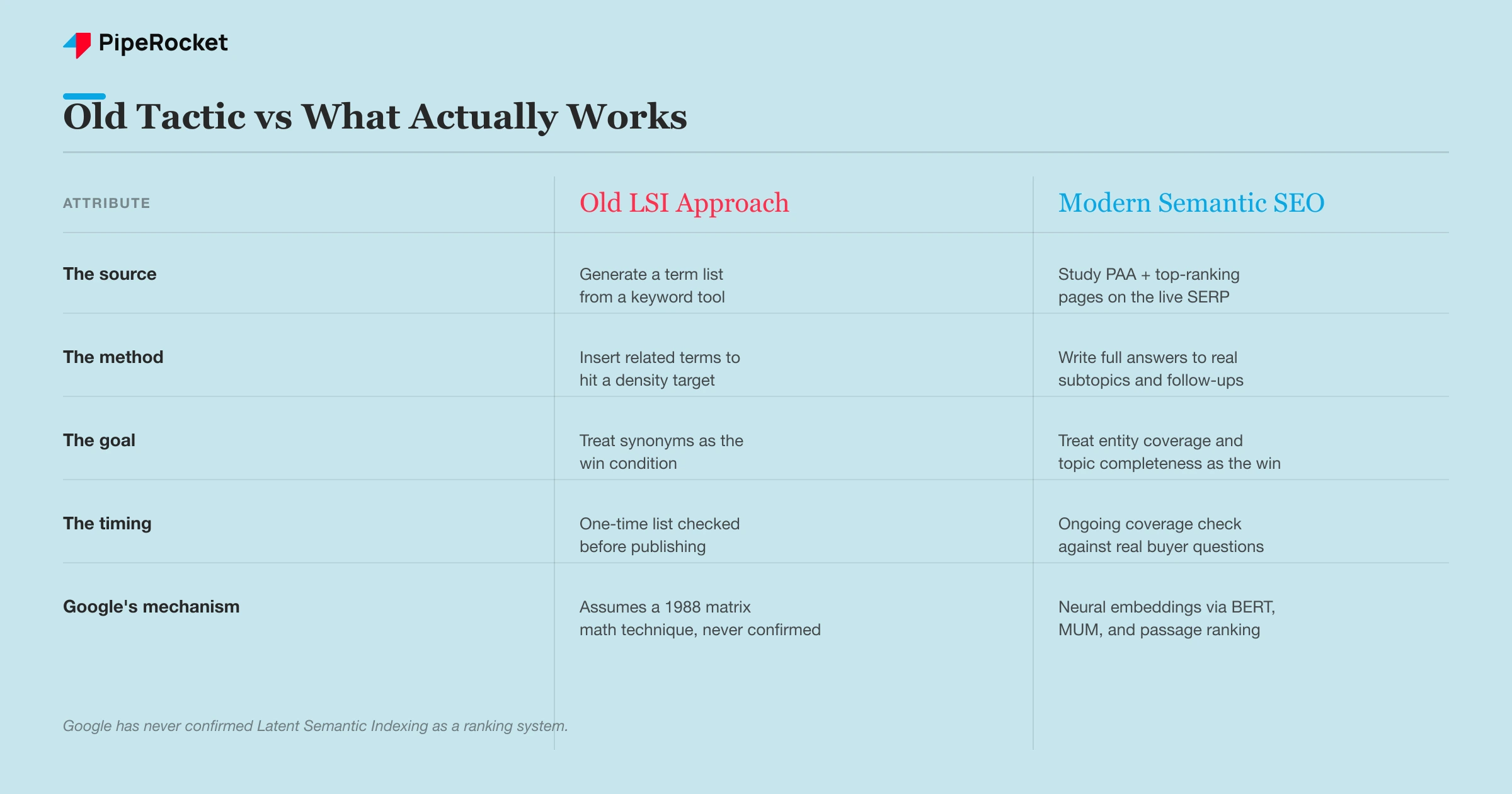
| Old LSI approach | Modern semantic approach |
|---|---|
| Generate a list of “related keywords” from a tool | Study what top-ranking pages and PAA questions actually cover |
| Insert terms to hit a density target | Write full, direct answers to real subtopics and follow-up questions |
| Treat synonyms as the goal | Treat entity relationships and topic completeness as the goal |
| One-time keyword list before writing | Ongoing coverage check against what buyers actually ask |
This is also why keyword stuffing with “related terms” backfires. If the underlying topic isn’t covered with real substance, no amount of inserted vocabulary fixes that. Google’s language models can tell the difference between a page that discusses a concept and one that just mentions its name.
Where the Real Benefit of Related Terms Actually Comes From
Covering genuinely related concepts still pays off, just not as a ranking trick. The payoff shows up in three places, and all three are side effects of real coverage rather than reasons to insert terms on purpose.
- Clarity for the reader and the algorithm. Explaining “annual fee” and “redemption rules” on a rewards-card page tells both a human and a language model exactly what the page is about, without repeating “credit card rewards” a dozen times.
- Writing that doesn’t sound repetitive. A page forced to reuse one exact phrase over and over reads worse than one that naturally varies its language while explaining related ideas.
- A wider net of queries answered by one page. A page that thoroughly explains a topic’s related concepts tends to satisfy several nearby searches at once beyond the exact phrase in the title.
None of that requires a term list drawn up before writing. It’s what happens automatically when a page actually teaches the full topic.
How to Find the Terms That Actually Matter
Skip the dedicated LSI keyword tools and pull related terms directly from the SERP for your target query, since that’s where Google is already showing you what it considers relevant to the topic. The signal is sitting in the results page itself.
Five places to check, in the order that tends to surface the most useful terms first.
- People Also Ask . These are the exact follow-up questions real searchers ask after your target query, and each one is a subtopic your page should probably answer.
- “Searches related to” at the bottom of the results page. This list shows adjacent queries Google groups with yours, which usually points at subtopics or a different angle on the same intent.
- The top 5-10 ranking pages themselves. Read them to see which subtopics Google is already rewarding for this query, without copying their wording.
- Bolded terms in Google’s own snippet descriptions. Scan the meta descriptions on the results page for words Google bolds beyond your exact query; those bolded terms are ones Google treats as relevant to the search.
- Autocomplete and “People also search for.” Type the seed query into the search box and note what Google suggests finishing it with; those suggestions reflect real query volume.
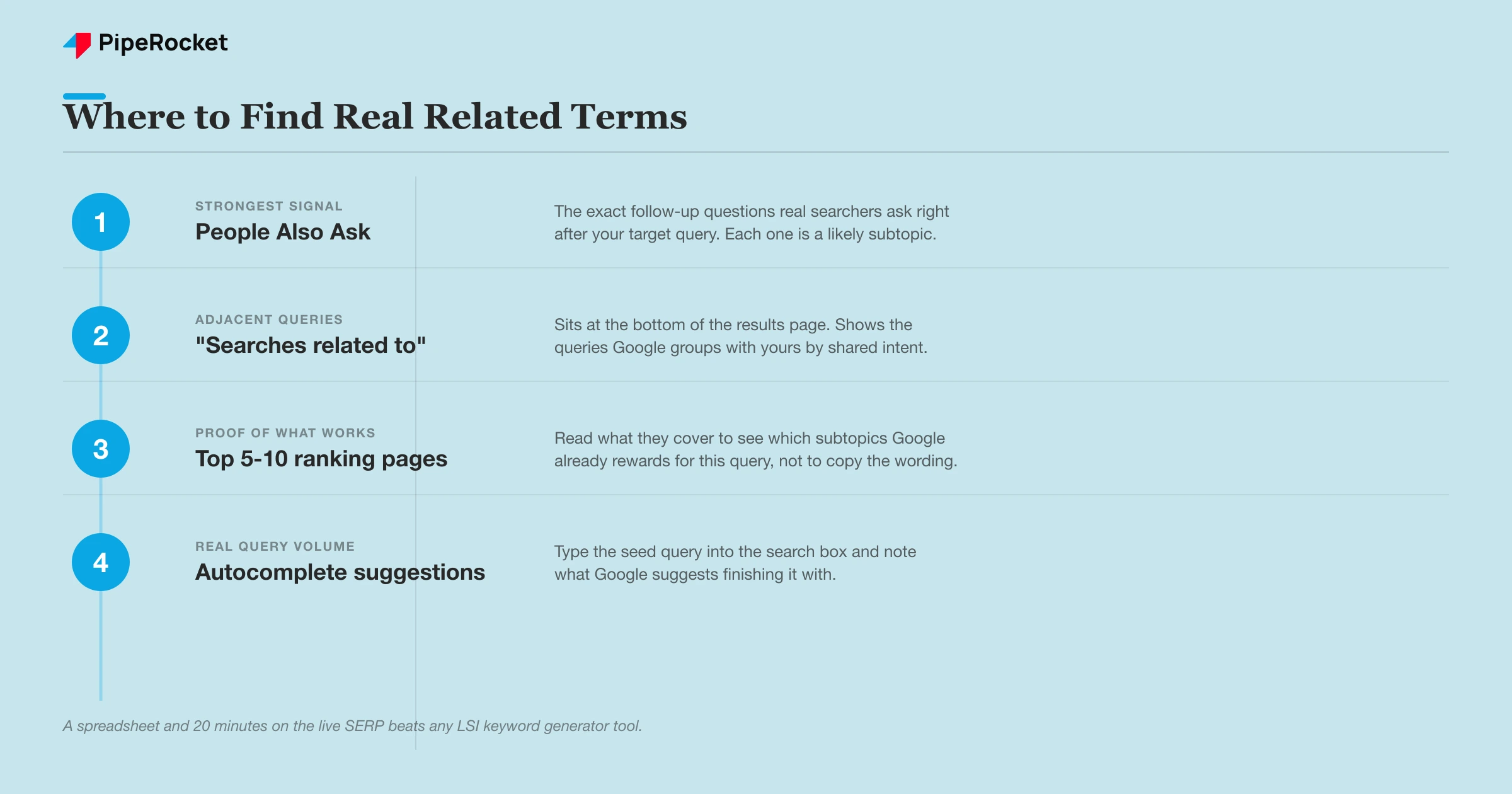
None of this requires a paid tool built around the word “LSI.” A spreadsheet and 20 minutes on the actual SERP gets you a more accurate list than any generator. You’re reading Google’s own signals instead of a third-party approximation of them.
Once collected, group the terms by the question they answer rather than by how closely they resemble your main keyword, the same grouping step that belongs in an SEO content brief before a draft ever gets written. A term like “annual fee” and a term like “foreign transaction fee” both belong under “credit card rewards,” but they answer different reader questions and probably deserve their own sentence or subsection each.
Keep in mind that grouping related terms is a different job from sorting the many types of keywords by intent, length, or funnel stage. LSI/related-term thinking is about topical coverage of one query, while intent and funnel-stage typing is about which query to target in the first place.
Common Mistakes to Avoid
Treating the term list as a checklist to complete before publishing
Writers who generate an LSI keyword list and then edit a finished draft to squeeze the terms in are optimizing for the wrong output. The related terms should shape what the article covers from the outline stage, not get retrofitted into sentences after the real writing is done.
Assuming more related terms automatically means better rankings
Piling in dozens of tangentially related words without explaining any of them in depth reads as thin coverage to both readers and language models. Three subtopics explained well beats fifteen mentioned in passing.
Ignoring the difference between a synonym and a related concept
“LSI keyword” tools often return straight synonyms alongside genuinely related concepts without distinguishing them:
- Synonym swap (“rewards” → “perks”): adds no new information to the page.
- Related concept (“redemption rules” on a rewards-card page): actually extends what the page teaches.
Skipping People Also Ask because it feels too basic
PAA questions look simple, but they’re real search behavior pulled straight from Google’s own query logs, the same signal that should shape your keyword research before it shapes the outline. Treating them as beneath a “real” content strategy means missing the most direct signal available for what a topic needs to cover.
How PipeRocket Digital Builds Topic Coverage That Actually Ranks
We build content around the entities and subtopics a query needs, not around a generated keyword list. A page built that way captures an entire topic’s search demand instead of ranking for one phrase.
If your content team is still running LSI keyword tools before every brief, our SaaS SEO agency team can rebuild that process around real SERP and entity research instead. Reach out through our contact page to see how we approach it for SaaS content teams.
Frequently Asked Questions
What is LSI keywords?
LSI keywords are terms considered conceptually related to a page’s main target keyword, a label taken from Latent Semantic Indexing, a 1988 mathematical technique for grouping text by shared meaning. The term is widely used in SEO advice, but Google has never confirmed running that specific technique, so it isn’t an actual ranking factor the way older blog posts describe it.
What are LSI keywords examples?
For “coffee,” related terms include caffeine, espresso, beans, roast, and brew. For “credit cards,” they include interest rate, annual fee, rewards program, and credit score, terms a reader on that topic would also want to understand. These are useful because they cover real subtopics a buyer cares about, not because inserting them trips any algorithmic switch.
What is the difference between LSI and SEO?
LSI is a decades-old indexing technique for grouping documents by conceptual similarity, while SEO is the broader practice of getting content found and ranked in search engines. LSI keywords became one small, largely outdated tactic discussed within SEO, but modern SEO for topic and language understanding runs on newer systems like BERT and entity-based Knowledge Graph connections, not on the LSI method itself.
Where can I find LSI keywords?
The most reliable places to find genuinely related terms are the live SERP itself: the People Also Ask box, the “searches related to” section, the terms Google bolds in snippet descriptions, and the subtopics covered by pages already ranking on page one. Dedicated “LSI keyword generator” tools exist too, but checking the SERP directly gives a more current and accurate picture of what a topic needs to cover.
What does LSI keyword stand for?
LSI stands for Latent Semantic Indexing, the 1988 mathematical technique the term originally comes from. “LSI keywords” is the label SEO writers attached to that name in the mid-2000s to mean “terms conceptually related to your main keyword,” even though Google has never confirmed running that specific technique on search results.