Content Marketing for Tech Companies: The No-Fluff Playbook
 Ranjeeth Kumar
Last updated on
Ranjeeth Kumar
Last updated on

Content marketing for tech companies means creating docs, comparisons, and technical explainers that answer the exact question a developer, IT buyer, or technical evaluator typed into Google, rather than generic “thought leadership” posts written for a general business audience.
TL;DR
- Write for the actual reader, an engineer or technical evaluator who skims for proof, not the marketing-style persona most tech content is aimed at.
- Docs, comparison pages, and proof-driven writing convert technical buyers better than blog posts built around outcomes and customer logos.
- A content program for a technical audience has to map formats to where the reader already is, not to a generic SaaS content calendar.
- Distribution runs through Hacker News, dev subreddits, and community threads, and it only works when someone technical shares it with real context.
- The same handful of mistakes, writing for a persona instead of a real reader, ignoring docs, and tracking traffic instead of pipeline, show up across almost every technical content program.
- Measuring success means tracking doc engagement, comparison-to-demo conversion, and sales mentions, not raw pageviews.
Why Most Tech Company Content Reads Like It Was Written for the Wrong Person
Most tech company content fails because it gets built off a SaaS marketing template aimed at a persona, when the real reader is a skeptical engineer who wants proof. Fix it by writing for that engineer’s evaluation instincts instead.
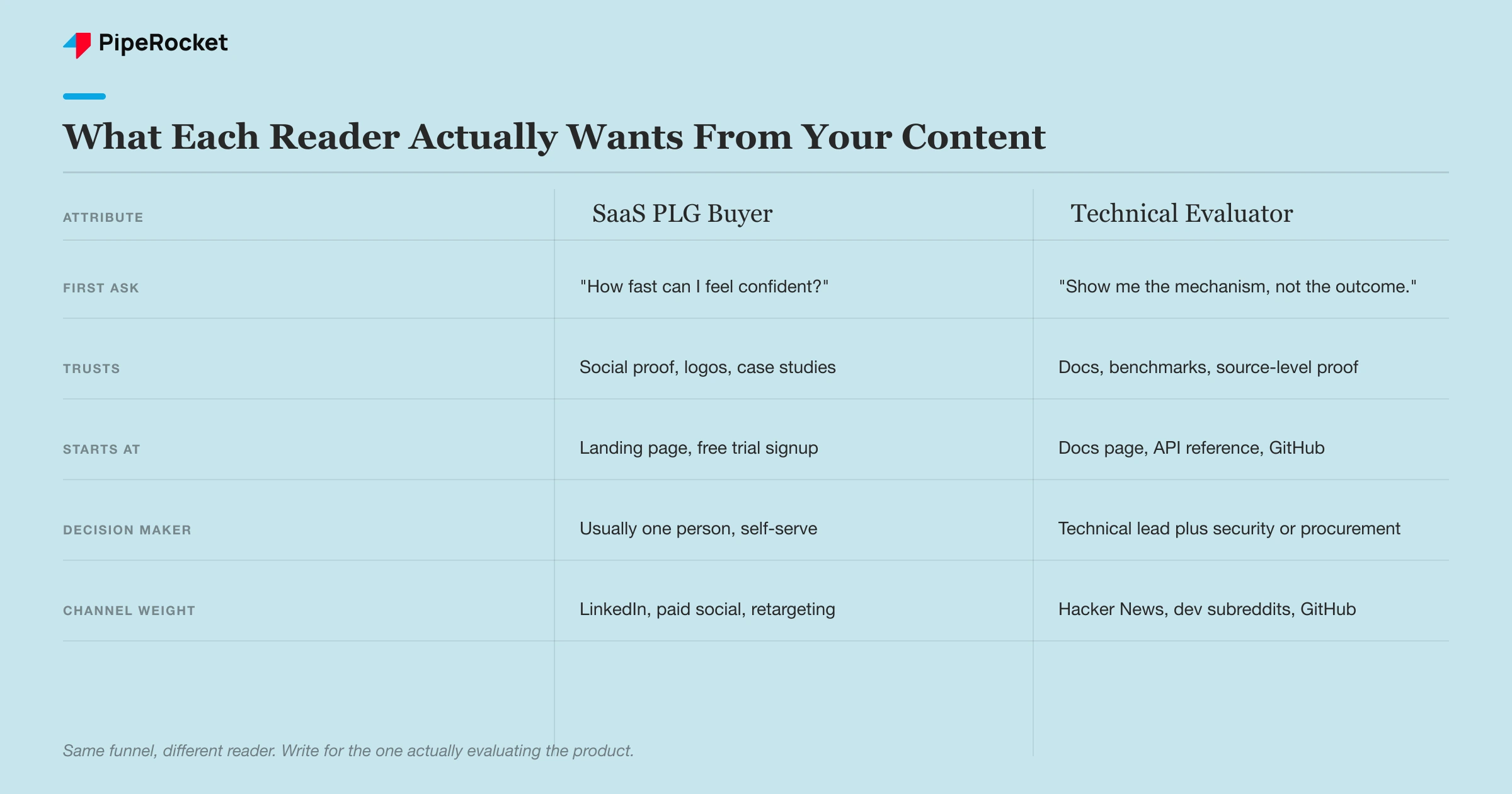
A SaaS PLG buyer signing up for a project management tool and a platform engineer evaluating a new observability stack are not reading with the same instincts.
The two readers want different proof:
- The PLG buyer wants to feel confident fast, and a logo carousel or a clean outcome story does that job.
- The engineer wants to be shown, not told, and will bounce off that same carousel before it shows a single technical detail.
We’ve worked with SaaS and devtools clients long enough to see the pattern repeat. A team writes a blog post that reads well to a marketer reviewing it internally, then the actual audience, engineers doing due diligence, closes the tab in ten seconds because it’s all outcomes and no mechanism.
Technical readers are trained by years of documentation and Stack Overflow to distrust anything that sounds like a pitch. If your “content marketing” reads like your sales deck with paragraph breaks, you’ve already lost the reader you were trying to earn.
Hardware, Infra, and AI Companies Aren’t SaaS With Extra Steps
Hardware, infra, and AI companies need content built for a longer, multi-person evaluation, not a single PLG signup. The buyer is a technical lead justifying the choice to procurement or security, so content must satisfy two readers at once.
A hardware company selling into manufacturing, an infra company selling to platform teams, and an AI company selling model access all have longer, more technical evaluation cycles than a typical SaaS PLG product. The buyer isn’t one person clicking “start free trial.” Content has to speak to two readers:
- The person who understands the architecture, who wants to see the mechanism, benchmarks, and trade-offs before trusting the tool.
- The person who signs the check, who needs the choice justified against procurement, security, and budget requirements.
That’s a different writing job than most SaaS content programs are built for.
If your company is specifically a SaaS product with a self-serve or PLG motion, our SaaS content marketing guide covers that narrower path in more depth. This piece is for the broader case: any tech company whose buyer reads more like an engineer evaluating a spec sheet than a marketer scanning a landing page .
5 Content Formats That Actually Work for Technical Buyers
The five formats that convert technical buyers are docs, comparison pages, technical proof, changelogs, and community-distributed technical posts. Each one runs through how an engineer actually evaluates a tool, before any sales call. Publishing these five well beats publishing more content that nobody technical reads.
1. Docs Are a Growth Channel, Not Just Support
Documentation is a growth channel: it ranks, earns links from Stack Overflow and GitHub, and often pulls more qualified traffic than your blog. Give it a content owner instead of treating it as something engineering writes once and marketing never touches.
Put an SEO and content owner on your docs the same way you would on your blog. Every “how to configure X with Y” doc page is a landing page for someone who already has intent. Treat docs as three things at once:
- A ranking surface that earns organic traffic and inbound links.
- A landing page for readers who are mid-implementation and searching for the exact fix.
- A bottom-of-funnel asset that most tech companies leave completely unowned.
2. Comparison Content Has to Survive a Technical Reader’s Skepticism
Comparison pages convert technical buyers only when they name the real trade-off. Say where the competitor genuinely wins, then explain why your product wins for the reader’s specific situation anyway. A page that quietly stacks the deck gets caught by a reader who reads benchmarks and pricing tables critically.
Technical buyers have usually already read three other comparison pages before landing on yours, and they know what a fair one looks like.
Name where the competitor genuinely wins, whether that’s price, a specific integration, or a use case you don’t serve well. This works when the situation you’re targeting is real. It breaks when you invent a scenario that flatters you and no actual buyer matches it.
3. Technical Proof Beats Customer Logos
Technical proof is what moves a skeptical reader: an architecture diagram, a benchmark against a known alternative, or a written explanation of how the product behaves under a specific condition. A logo wall tells that reader nothing about whether your product survives their load, compliance requirements, or existing stack.
We’ve seen devtools clients get more qualified inbound from one detailed “how we handle X at scale” post than from a dozen generic feature announcements, because it answers the question the reader actually came with instead of the question marketing assumed they had.
4. Changelogs That Explain the Why
A changelog is one of the highest-trust content formats a tech company has, and almost nobody invests in it. Explain the reasoning behind a change, not just the “what,” and it becomes proof that real engineers are thinking hard about the product.
Technical buyers read changelogs, API references, and even error messages constantly. A changelog entry that shows the trade-off behind a decision reads as candor to an engineer, which is the exact signal a persona-driven blog post can never fake.
5. Community-Distributed Technical Posts
A technical post shared into the right community by an actual engineer earns trust no ad or LinkedIn push can buy. The format is a genuine “we hit this exact problem and here’s how we solved it” write-up, posted with real context by someone technical, not dropped as a link by a marketing account.
This is the one format where distribution and content are inseparable: the write-up only works if the person sharing it can answer follow-up questions in the thread. The mechanics of doing this well are covered in the distribution section below.
How to Structure a Content Program for a Technical Audience
Structure the program by mapping content to where technical buyers actually search and what they read at each stage, then staffing it against real reader modes. Skip the generic funnel diagram borrowed from a SaaS playbook, it maps to a buyer this audience doesn’t contain.
Start From the Support Tickets and Sales Call Transcripts, Not a Keyword Tool
Source your content ideas from support tickets, sales call transcripts, and community threads where real users describe their problem in their own words. That’s where the highest-signal ideas live for a technical audience.
A keyword tool will tell you volume. It won’t tell you that engineers keep asking the same specific integration question in every discovery call, which is exactly the content gap worth filling first.
Match Format to Where the Reader Already Is
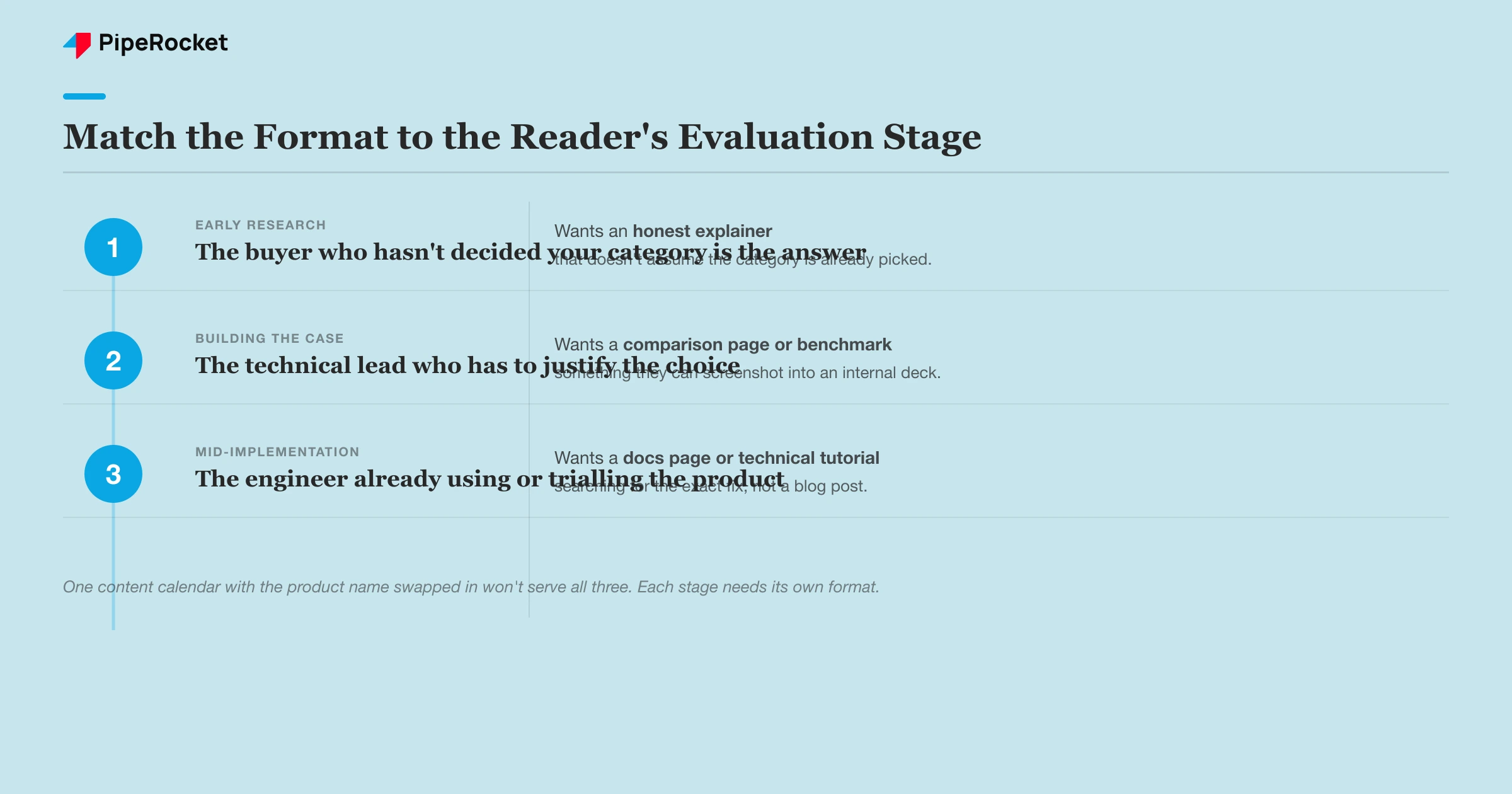
Match each format to the reader mode it serves, because a single template with the product name swapped in fails all three. The three modes and the format each one wants:
- Engineers evaluating a tool mid-implementation want a docs page or a technical tutorial, not a blog post.
- A technical lead building a business case wants a comparison page or a benchmark, something they can screenshot into an internal deck.
- A buyer doing early research wants an honest explainer that doesn’t assume they’ve already decided your category is the answer.
Building all three formats against the same generic “SaaS content calendar ” template is why so much tech company content underperforms. Each reader mode needs its own structure, not a shared template with the product name swapped in.
Distribution Runs Through Communities, Not Just LinkedIn
Distribute technical content through the developer communities your buyers actually trust, then layer mainstream social on top rather than relying on it. LinkedIn and general social still have a place for reach, but for a technical audience the trust is earned in Hacker News, subreddits, and dev Slack or Discord.
Technical buyers spend real time on Hacker News, relevant subreddits, and developer Slack or Discord communities that most B2B marketing teams never touch. A strong technical blog post that never gets shared into the right subreddit or dev community with genuine context, not a drive-by link drop, will quietly underperform its actual quality.
The tactic that works is having someone technical, not a marketer, post the content into the community with real context about why they wrote it. A founder or engineer sharing “we hit this exact problem and wrote up how we solved it” reads as a contribution.
The same link posted by a marketing account reads as spam. Communities like Hacker News and Reddit are unforgiving about that distinction.
Where Video, Podcasts, Repurposing, and AI Fit for a Technical Audience
Video, podcasts, repurposing, and AI-assisted writing work for tech companies only when they carry real technical substance. Used as generic reach plays they get ignored by engineers; used to show mechanism they extend the same proof-first content you already built.
Video and Podcasts
Video and audio earn a technical audience when they show the product working or explain a real engineering decision, not when they package a marketing message. A recorded architecture walkthrough, a screen-share of a hard configuration, or a founder explaining a genuine trade-off does the same job a written proof post does, in a format some buyers prefer.
A podcast where an engineer walks through how they solved a specific problem reads as a contribution to a technical audience. A polished brand video with no mechanism reads as an ad, and gets skipped.
Repurposing Technical Content
Repurpose by pulling the reusable mechanism out of one deep piece, then reshaping it for each reader mode. A single “how we handle X at scale” post can become a docs page, a comparison data point, a conference talk, and a community thread, because the underlying proof stays true across all of them.
The mistake is repurposing the packaging instead of the substance: chopping one blog post into ten shallow social snippets adds volume a technical reader will never reward.
AI-Assisted Content Creation
Use AI to accelerate drafting and structure, but keep a technical human supplying the mechanism and checking every claim. A technical reader spots generic AI-generated content instantly, and distrusts the whole page once they do.
The workable pattern is the same hybrid this piece argues for throughout: a subject-matter expert provides the real detail, AI and a content person speed up the shaping, and nothing ships without someone who understands the product verifying it is true.
Common Mistakes Tech Companies Make With Content Marketing
The same handful of mistakes show up across SaaS, devtools, and infra clients, and most of them come from applying a general B2B content template to a technical audience that reads differently.
Writing for the Persona Instead of the Actual Reader
Fix persona-driven content by putting a real technical reader on every draft before it publishes, ideally someone in support or sales engineering. The common failure is writing for a buyer persona deck instead of the actual engineer who reads it at 11pm while debugging something unrelated.
The fix is simple and unpopular: get a real technical reader to catch the sentences that sound fine to marketing and hollow to an engineer.
Treating the Blog as the Only Content Surface
Staff and optimize your docs, changelogs, and API references, not just the blog, because technical buyers read all of them constantly. Most companies invest in the blog alone and leave the surfaces engineers actually trust unowned.
Docs, changelogs, API references, and even error messages are content that a technical buyer reads while evaluating you. A changelog that explains the “why” behind a change is quietly one of the highest-trust formats a tech company has, and almost nobody invests in it.
Measuring Success by Traffic Instead of Qualified Signal
Rank, thousands of visits, zero pipeline: that’s what happens when a blog post attracts the wrong reader. For a technical audience, the better signal is whether traffic correlates with product signups from the right account type, doc engagement from logged-in users, or direct mentions in sales calls, not raw session count.
Outsourcing Technical Content to Writers Who’ve Never Touched the Product
Pair a subject-matter expert with a content person instead of outsourcing to a writer who has never touched the product. The expert supplies the real mechanism, the content person shapes it for readability, and neither one tries to fake the other’s job.
A generalist content writer can produce something that reads fine and says nothing an engineer would trust. The hybrid process is what produces content a developer audience actually believes.
How to Know Your Technical Content Program Is Actually Working
The right way to measure this is to look past pageviews and ask whether the content is influencing accounts that actually convert, not just accounts that click.
| Signal | What it tells you | Where to find it |
|---|---|---|
| Doc page traffic from logged-in users | Existing customers are self-serving instead of filing tickets | Product analytics, not just GA |
| Comparison page traffic paired with demo requests | Buyers are using your content to shortlist, not just browse | CRM source attribution |
| Community mentions and inbound from Hacker News/Reddit threads | Your content earned trust in a channel your competitors probably ignore | Referral traffic + manual monitoring |
| Sales team citing a specific post on calls | The content is doing actual sales enablement work | Sales call notes or transcripts |
If none of these signals move while your traffic climbs, the content is optimized for search engines, not for the technical buyer it’s supposed to be persuading.
How PipeRocket Digital Helps Tech Companies Build Content That Converts
We build content programs for B2B SaaS and devtools companies that treat docs, comparisons, and technical explainers as growth surfaces, not afterthoughts, and we write for the engineer actually reading, not the persona deck. If your team needs a partner who understands technical buyers, our SaaS SEO agency service builds that content engine from research through distribution.
You can also see how we rank against other options on our list of the best SaaS marketing agencies , or just reach out directly and we’ll tell you honestly whether we’re the right fit.
Frequently Asked Questions
What is content marketing for tech companies?
Content marketing for tech companies is the practice of creating documentation, comparisons, technical explainers, and proof-driven content aimed at engineers, IT buyers, and technical evaluators rather than a general business audience. It treats docs and technical proof as core growth content, not just support material, because that’s where most technical buyers actually form their opinion of a product.
How is content marketing different for B2B tech companies versus regular B2B companies?
The core difference is the reader’s skepticism level and evaluation process. A technical buyer at a tech company, whether SaaS, devtools, hardware, or infra, is used to reading documentation and source code, so they distrust content that sounds like a pitch and reward content that shows real mechanism, benchmarks, or trade-offs.
Regular B2B content can lean more on outcomes and case studies because the reader is often evaluating business impact rather than technical fit. A tech buyer wants proof the product will actually work under their specific conditions.
Does content marketing work for developer tools and infrastructure companies?
Yes, and it often works better than paid channels because developers actively research before buying and trust organic content, especially docs and technical write-ups, over ads. The catch is that it has to be written by or with someone technical.
A generic marketing writer producing surface-level content will get ignored or actively distrusted by a developer audience that can tell the difference immediately.
Is content marketing for tech businesses different from content marketing for tech companies?
No, the two phrases describe the same practice: writing docs, comparisons, and technical explainers for a technical buyer rather than a general business reader. The label matters less than whether the content answers the exact question an engineer or technical evaluator actually typed into search.