Startup SEO: When to Start, How Much to Spend, and What Actually Works Pre-PMF
 Ranjeeth Kumar
Last updated on
Ranjeeth Kumar
Last updated on
Startup SEO means running search strategy under founder-level constraints: no dedicated team, a tight or nonexistent budget, and a product that might still change shape next quarter. The real work is deciding how much of your limited time SEO deserves right now, and how that answer should change once you have product-market fit.
What This Guide Covers
- Whether to do SEO at all comes down to one question: do you have product-market fit yet? Pre-PMF, it’s a background task; post-PMF, it’s a real channel.
- Budget and time should scale as a percentage of marketing spend tied to your stage, roughly 10-15% generally, closer to 20% early, up toward 30% once SEO is proven.
- Pre-PMF, the goal is a short defensive checklist done once and revisited quarterly, not an ongoing content operation.
- Founder-led content works pre-PMF because it’s built from your own sales calls, not a keyword tool, and needs no team to produce.
- Most founders either skip SEO too long or throw a full content plan at a product that’s still changing shape, and both cost time they can’t get back.
Should Your Startup Even Be Doing SEO Right Now?
The honest answer depends on one thing: do you have product-market fit yet? Not whether SEO “works” in general. Pre-PMF, SEO is a background task you protect. Post-PMF, it becomes one of the highest-impact channels you have, because you finally know which pages actually convert.
There’s a real debate happening among founders right now about this, and it’s a healthy one. Plenty of early-stage teams argue for skipping SEO in favor of paid ads, since ads give a faster feedback loop and don’t force a months-long wait to see if a page ranks. That’s a reasonable sequencing call, but it’s an incomplete one on its own.
Choosing ads first is fine. Treating that choice as permanent is the actual mistake, since SEO compounds slowly and pays for years while paid traffic stops the moment you stop paying for it.
A startup running ads to validate messaging while doing the bare minimum on SEO is making a smart sequencing call. A startup that never revisits SEO once it has traction is leaving pipeline on the table it already earned the right to.
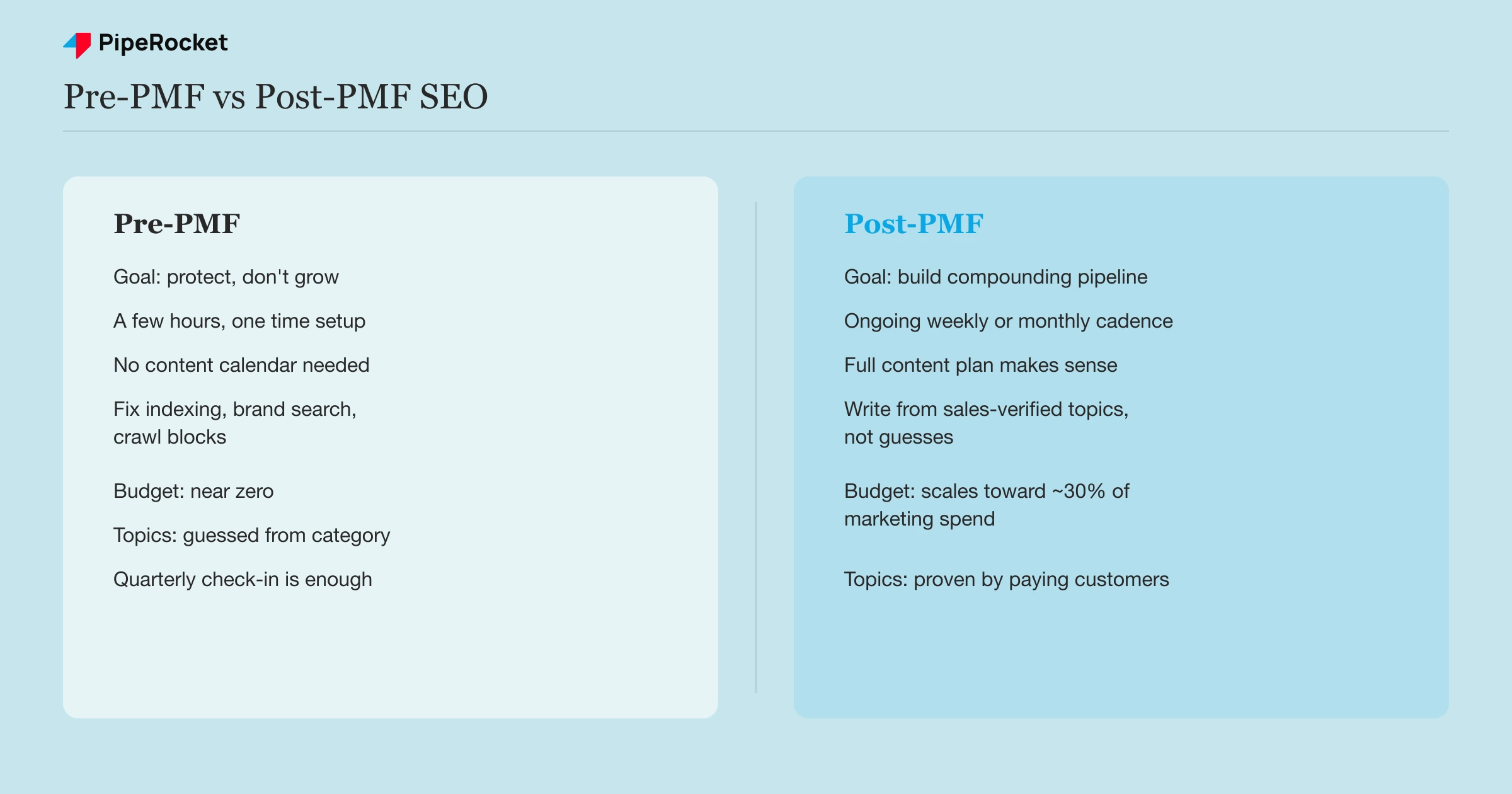
Pre-PMF Is About Protecting the Product, Not Growing Traffic
Pre-PMF, your job is defensive SEO, three maintenance tasks rather than a growth motion:
- Claim your brand name in search
- Make sure your own site outranks review sites and directories for your product name
- Confirm you’re not accidentally blocking Google from indexing your app
You don’t need a content calendar at this stage. You need your homepage indexed, your title tags not defaulting to “Home,” and Google Search Console connected so you’d notice if something broke. That’s maybe two hours of work, done once, checked quarterly.
Post-PMF Is Where SEO Starts Earning a Real Budget
Once you have paying customers and know which use case actually sells, SEO changes completely. Now you know what to write about, because your best customers already told you in sales calls and support tickets what they searched for before they found you.
This is the point where a content plan makes sense, because you’re not guessing at topics anymore. You’re writing about the exact problem your paying customers described, which is a very different exercise than blogging speculatively about your category.
How Much Time and Budget Should a Startup Actually Give SEO?
The honest number depends on your stage, not on a fixed percentage. A useful working range puts general B2B marketing spend on SEO around 10 to 15% of the marketing budget, weighted by stage:
- Early and startup-stage teams often lean closer to 20% just to establish a baseline presence.
- Companies that have scaled and proven SEO as a pipeline channel push it toward 30%.
That’s not a rule to copy exactly. It’s a signal that your SEO investment should grow as your evidence grows, not stay flat because “that’s what the article said.”
| Stage | What SEO looks like | Rough time/budget signal |
|---|---|---|
| Pre-seed / pre-PMF | Defensive only: indexing, brand terms, no broken pages | A few hours, one-time setup + quarterly check |
| Seed / early traction | One narrow topic cluster tied to your actual ICP | A few hours a week, or one freelance writer |
| Post-PMF / scaling | Full content plan tied to sales-verified topics | Dedicated hire or agency, budget scales with pipeline proof |
Most startups get this backwards. They either spend nothing until a board member asks about organic traffic, or they hire a full-time SEO person in month two before they know what their own buyers search for. Neither uses the money well.
What “No Budget” Actually Means in Practice
Zero marketing budget doesn’t mean zero SEO. It means using free tools instead of paid ones and writing the content yourself instead of hiring it out. Google Search Console and Google Analytics cover almost everything you need to see what’s happening. A keyword tool matters less than actually reading the questions your first ten customers asked you before they bought.
When Hiring an Agency or a Writer Finally Makes Sense
Bringing in outside help makes sense once you have more validated topics than time to write them, not before. Handing an agency a product with no proven use case just means you’re paying someone to guess at your positioning instead of guessing yourself for free.
What Defensive SEO Looks Like With No Team
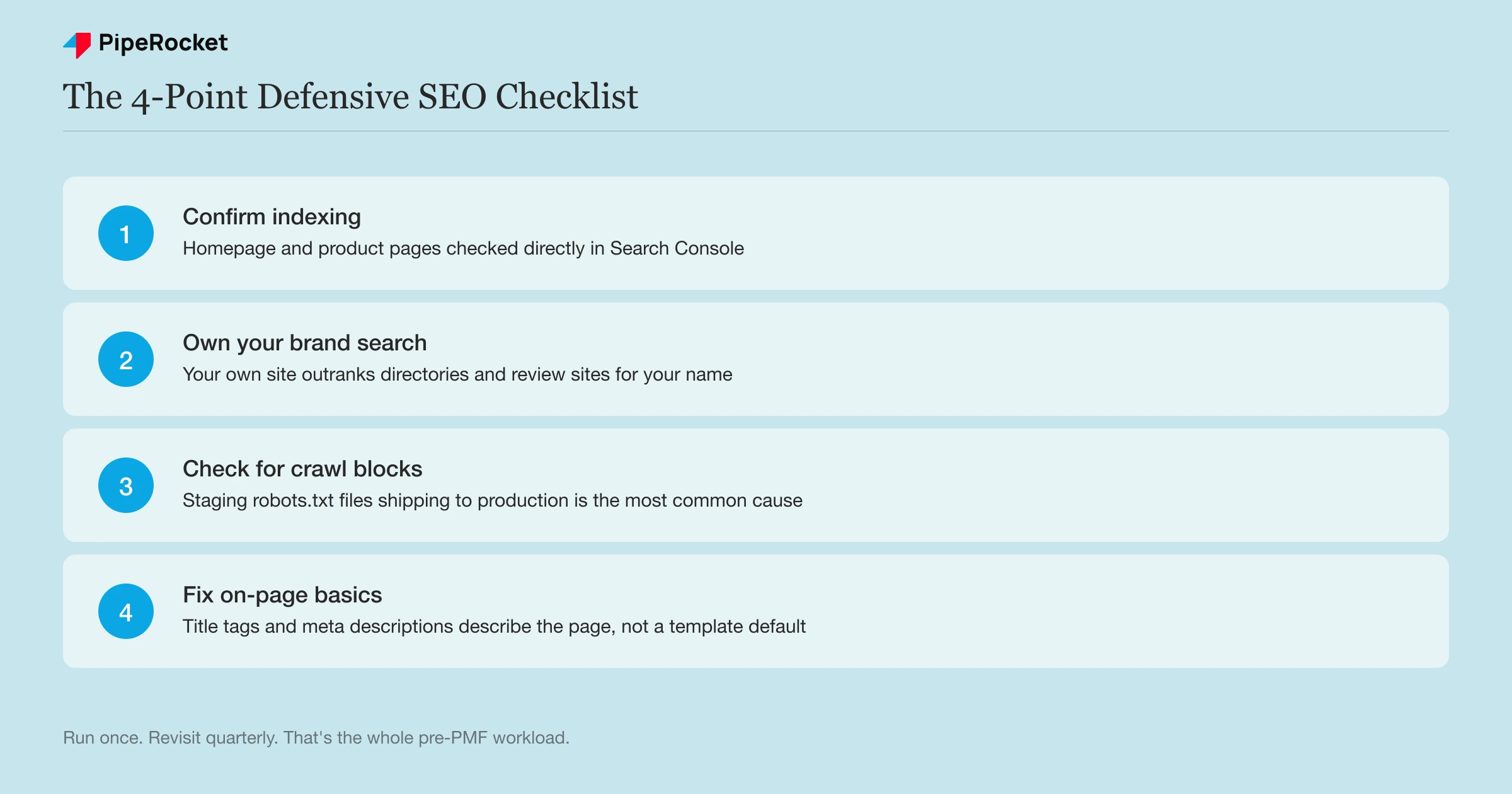
Defensive SEO pre-PMF is a short, fixed checklist you run once and revisit quarterly, not an ongoing content operation. The goal is making sure nothing is actively working against you while you focus on the product.
That checklist covers four things:
- Your homepage and product pages are indexed in Google, checked directly in Search Console.
- Your company name search results show your own site first, ahead of directory listings or old landing pages .
- Nothing on the site is accidentally blocked from crawling , which happens more often than founders think when a staging robots.txt file ships to production.
- Basic on-page details (title tags, meta descriptions) describe what the page actually does instead of defaulting to a template placeholder.
If you want the deeper technical version of this, including how to sequence keyword targeting once you’re ready to publish, how to rank a new SaaS site with low domain authority covers that ground in detail. This section is deliberately the short version, because pre-PMF, that’s all the time SEO deserves.
The Founder-Led Content That Actually Works Pre-PMF
Founder-led content works before you have a team because it’s the one form of SEO output that doesn’t require hiring anyone. You already know the problem better than any writer you could afford right now.
Write From Sales Calls, Not Keyword Tools
The fastest way to find your first ten topics is to reread your last ten sales or discovery calls and note the exact phrases prospects used to describe their problem. Those phrases are what they’d type into Google. A keyword tool tells you volume. Your own calls tell you intent, and pre-PMF, intent matters more than volume every time.
One Narrow Topic Beats Five Broad Ones
Pick one specific problem your product solves and write everything you can about that single angle before touching a second topic. A founder covering five broad categories thinly will lose to a founder who’s genuinely useful on one narrow one, because Google rewards depth on a topic more than breadth across many.
Publish Consistently Over Publishing Often
Two well-researched posts a month for six months beats eight rushed posts in one month followed by silence. Search visibility for a new site builds slowly regardless of how fast you publish, so a founder writing solo should optimize for a pace they can actually sustain past month three.
Common Mistakes Startups Make With SEO
Targeting Keywords a DA-60 Competitor Already Owns
A pre-seed startup writing “best CRM software” is competing against sites with a decade of backlinks and a content team ten times their size. That fight isn’t winnable yet, and every hour spent on it is an hour not spent on a keyword you could actually rank for this year.
- Fix: check who’s already on page one before you write a word, and skip the topic entirely if it’s all established players.
Hiring an SEO Agency Before Product-Market Fit
Paying someone to build a content strategy around a product that might pivot in three months means paying twice: once now, and again when the positioning changes and the content no longer matches what you sell.
Treating SEO Like a Switch You Can Flip Later
Some founders decide to focus on paid first and never come back to SEO once traction arrives. They treat a sequencing decision as a permanent one. This is the mistake that actually costs pipeline, because competitors’ content keeps compounding while you wait, and catching up two years later costs far more than starting on time would have.
Publishing Content With No One Checking If It Ranks
Writing without ever opening Search Console means you can’t tell if a topic is working or if it’s invisible. Even a founder with zero budget should spend fifteen minutes a month checking which pages are getting impressions, because that’s the only feedback loop that tells you whether to keep going on a topic or drop it.
How PipeRocket Helps Startups Get SEO Sequencing Right
We work with SaaS founders at every stage, from pre-PMF teams that need the defensive basics done right to post-PMF teams ready to build a real content engine.
If you’re past the “should we even do this” question and want a plan built around your actual ICP instead of a generic checklist, our SaaS SEO agency team can build that with you. You can compare the field on our ranked list of the best SaaS SEO agencies , or just reach out when you’re ready to move past the defensive checklist.
Frequently Asked Questions
What is startup SEO?
Startup SEO is search engine optimization scoped to the resource and stage constraints a young company actually has: little to no dedicated team, a limited budget, and a product that may still change based on customer feedback. It’s less about advanced tactics and more about deciding how much SEO effort your current stage can justify, then executing that specific amount well.
Is SEO still worth it in 2026?
Yes. For a resource-constrained startup, the real debate is about timing and sequencing, not whether SEO works at all. SEO still drives compounding organic pipeline that doesn’t disappear the moment you stop spending, which paid channels can’t match. The question worth asking is whether to invest heavily now or run the defensive minimum until product-market fit gives you something worth writing about.
Is it true that 90% of startups fail?
Startup failure rates vary a lot depending on the source and how “failure” gets defined. It’s widely cited that a large majority of startups don’t reach long-term success, and running out of cash or never finding product-market fit are consistently the top reasons named.
That’s directly relevant to SEO sequencing. Pre-PMF, the bigger risk is burning limited runway on a channel that takes months to pay off instead of on validating the product itself. Keep SEO spend minimal and defensive until you have traction.
How do I start SEO as a beginner?
Start by connecting Google Search Console to your site so you can see what’s already happening, then fix anything that’s blocking indexing before writing a single word of new content.
After that, list the exact phrases your first customers used to describe their problem in sales calls, and write your first few pieces around those instead of guessing at keywords from a tool. Depth on one narrow topic beats a scattered start across many.