150+ SEO Statistics (Updated October 2026)
 Kamaraj Mathiarasan (Kim)
Last updated on
Kamaraj Mathiarasan (Kim)
Last updated on
96.55% of all pages get zero organic search traffic from Google, and the #1-ranking result has 3.8x more backlinks than everything ranking below it. Those two numbers alone say most of what you need to know about SEO in 2026: the gap between winning and losing pages is enormous, and it’s driven by a small number of factors that actually move rankings, not the dozens that content mills claim matter.
We pulled the most recent, named SEO research available, from Ahrefs, Backlinko, Semrush, and industry survey data, and checked every stat against a live source before including it. Where a widely repeated number turned out to have no traceable source, we say so instead of repeating it.
Key Takeaways
- Google searches ended without a click 68.01% of the time in the US in early 2026, up from 60.45% in 2024.
- 96.55% of all pages get zero organic traffic from Google, and 95% of pages have zero backlinks at all.
- The #1-ranking result has 3.8x more backlinks than pages ranking #2 through #10, based on an 11.8-million-result study.
- Word count shows almost zero correlation with ranking position (a Spearman correlation of just 0.04), despite “ideal word count” advice still dominating SEO content.
- Only 33% of websites pass Core Web Vitals thresholds overall, though mobile “Good” status has climbed from 44% to 48% year over year.
- 72.9% of pages currently ranking in the top 10 are more than 3 years old.
- Featured snippet visibility on Google’s SERPs reportedly fell from 15.41% to 5.53% in just six months in 2025 as AI Overviews expanded, though tracker methodologies vary.
- 92% of marketers plan on or already use SEO for both traditional and AI-powered search.
- Across 53 B2B SaaS brands we analyzed, organic search drove 91.3% of all traffic and 37x more leads than every AI engine combined.
Search Behavior and Zero-Click Statistics
- Google searches ended without a click 68.01% of the time in the US during the first four months of 2026, up from 60.45% in 2024, a 7.56 percentage point rise in two years. (SparkToro via Search Engine Land, February 2026 )
- For every 1,000 US Google searches, only about 276 clicks now reach the open web, down from 374 in 2024. (SparkToro via Search Engine Land, February 2026 )
- 96.55% of all pages get zero organic search traffic from Google, and 94.74% of keywords get 10 or fewer monthly searches. (Ahrefs )
- 96.6% of all Google search clicks go to first-page results. (Ahrefs )
- Google holds 90.39% of global search engine market share, and over 93.9% of global mobile search market share specifically. (StatCounter via Ahrefs )
- Organic CTR on queries carrying an AI Overview fell to 0.61% by September 2025, down 61% from 1.76% in June 2024. (Seer Interactive via Ahrefs )
- CTR for Google’s #1 position fell 32%, from 28% to 19%, in a 2025 study of 200,000 keywords, and #2 CTR fell 39%, from 20.83% to 12.60%. (GrowthSRC, 2025 )
Our take: the zero-click and CTR-decline stats above sound like a blanket “organic search is dying” story until you separate them by query type. Queries carrying an AI Overview are absorbing almost all of the CTR loss, and most B2B SaaS commercial and comparison queries don’t trigger one yet. Don’t let a headline stat about informational search convince you to abandon commercial-intent SEO .
Ranking Factors: What Actually Correlates With Rankings
Backlinko’s analysis of 11.8 million Google search results, run with Ahrefs data and last updated April 2025, remains the deepest available study on ranking correlation. (Backlinko, April 2025 )
- The #1-ranking page has 3.8x more backlinks and roughly 3x more referring domains than pages ranking #2 through #10.
- Domain-wide authority correlates strongly with rankings; page-level authority is a far weaker signal (a median URL Rating of just 12 for positions #1 to #6).
- Word count shows essentially zero correlation with ranking position, at a Spearman correlation of just 0.04, despite an average first-page word count of 1,447 words.
- Page load speed and page size showed zero correlation with rankings, and the average load time of first-page results was 1.65 seconds.
- Titles and H1s containing the exact keyword showed no meaningful ranking correlation, despite appearing on 60% to 85% of first-page pages.
- 72.6% of first-page pages implement schema markup, though schema use itself showed no correlation with ranking.
Separately, Semrush’s own ranking factors research names text relevance as the most influential Google ranking signal, with referring domain diversity ranking 12th among tested factors. (Semrush, 2024 edition )
- 72.9% of pages currently ranking in the top 10 are more than 3 years old, and only 1.74% to 5.7% of newly published pages reach the top 10 within a year. (Ahrefs )
- A top-ranking page typically also ranks for roughly 1,000 other relevant keywords. (Ahrefs )
Our take: the word-count correlation being effectively zero is the single most useful finding here, and the industry hasn’t caught up to it. Backlinko’s own report still lists “1,447 words” as the average, which gets repeated everywhere as a target instead of what it actually is: a symptom of comprehensiveness, not a cause of it. Chase thoroughness. Length is just the shadow that casts.
Backlink and Link Building Statistics
- Roughly 95% of all pages have zero backlinks whatsoever, while the #1 result averages 3.8x more backlinks than everything below it, which means links matter enormously at the margin and not at all for most of the web. (Backlinko/Ahrefs, April 2025 )
- 66.5% of links pointed at sites over the last 9 years are now dead. (Ahrefs )
- Only 10.6% of backlinks to the top 110,000 sites are marked
nofollow, and just 0.44% of referring domains userel="ugc". (Ahrefs ) - Top-ranking pages gain new followed backlinks at a pace of roughly 5% to 14.5% per month. (Ahrefs )
- Pages using exact-match anchor text get 5x or more traffic than pages without it. (Zyppy via Ahrefs )
- SEOs typically spend 1 to 2 hours building a single link. (Aira via Ahrefs )
Our take: the 95%-of-pages-have-zero-backlinks stat is the real story hiding behind every “backlinks are a top ranking factor” headline. Backlinks aren’t a top-of-funnel SEO tactic. They’re an elite-tier one that decides who wins position 1 versus position 5, and most pages never get close enough to that fight for a single link to matter yet.
Technical SEO Statistics
- Only 33% of websites pass Core Web Vitals thresholds overall, though Google’s own CrUX data shows 48% of mobile pages and 56% of desktop pages hit “Good” status as of mid-2025, up from 44% and 55% a year earlier. (HTTP Archive Web Almanac 2025 )
- Mobile loading speed (LCP) is the weakest Core Web Vitals metric: only 62% of mobile pages pass it, versus 81% passing layout stability and 77% passing interactivity. (HTTP Archive Web Almanac 2025 )
- Pages ranking at position 1 were 10% more likely to pass Core Web Vitals than pages at position 9. (Search Engine Journal, 2025 Core Web Vitals CMS analysis )
- 95.2% of sites have 3XX redirect issues, and 88% have HTTP-to-HTTPS redirect issues flagged in a crawl. (Ahrefs )
- 59.5% of sites are missing H1 tags altogether, and 51.3% have multiple H1 tags on a single page. (Ahrefs )
- 80.4% of websites are missing alt attributes on their images. (Ahrefs )
- 7.4% of top-ranking pages lack a title tag entirely, and 25.02% lack a meta description . Google rewrites title tags 33.4% of the time and meta descriptions 62.78% of the time regardless. (Ahrefs )
Our take: the gap between “48% of mobile pages pass Core Web Vitals” and “95.2% of sites have redirect issues” tells you where most technical SEO effort should actually go. Teams chase Core Web Vitals scores because they’re visible in a dashboard, while basic hygiene issues like broken redirects and missing H1s sit unfixed on nearly every site measured.
Content Length, Format, and SERP Feature Statistics
- The average length of Google’s current top-10 organic results is 1,188 words, compared to 1,282 words for content specifically cited inside AI Overviews. (Ahrefs, December 2025, 174,048-page study )
- Word count and ranking position showed a Spearman correlation of just 0.04 in that same study, essentially no relationship once other factors are accounted for. (Ahrefs, December 2025 )
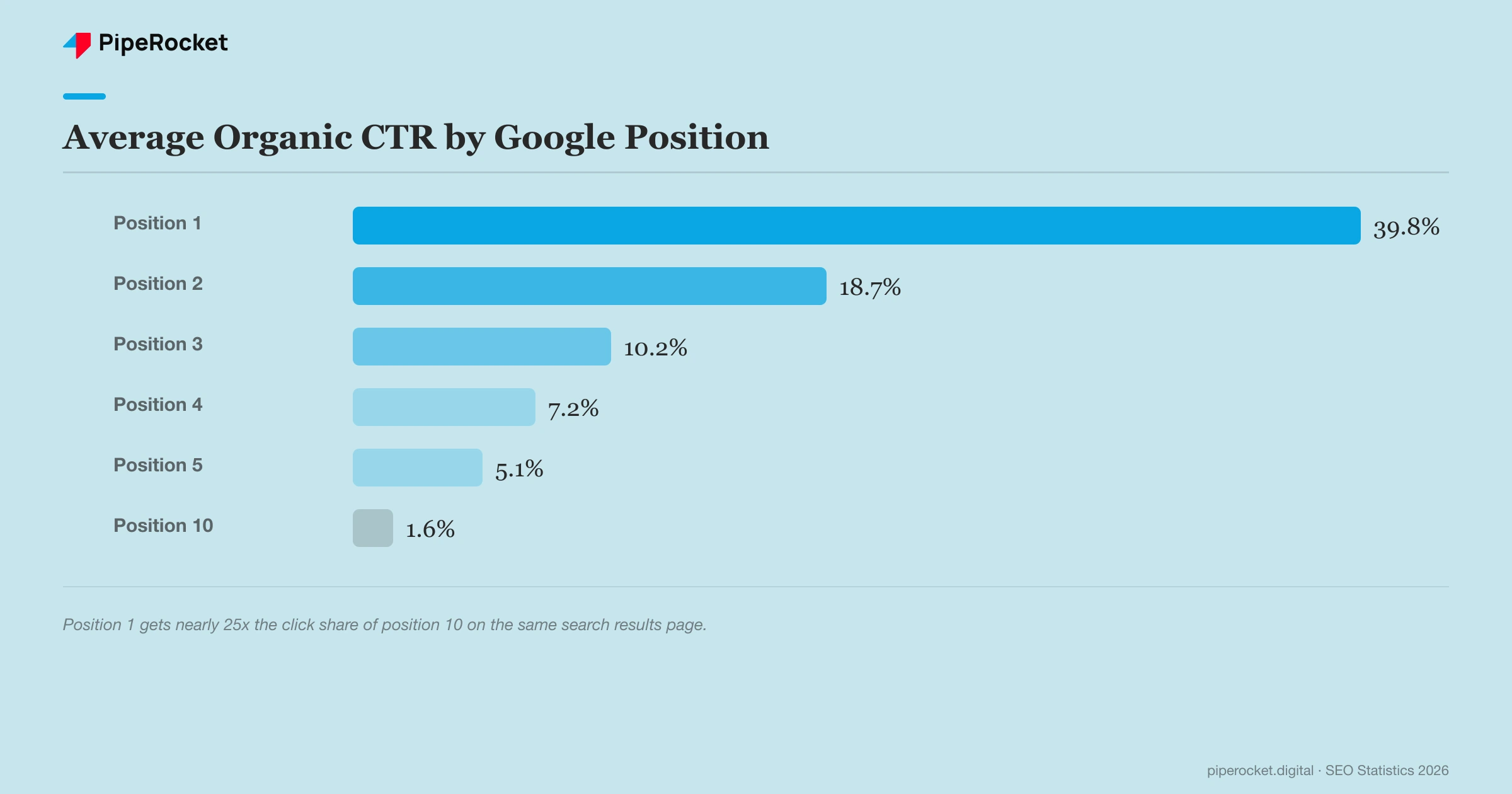
- Average organic CTR by position (First Page Sage, last updated May 2025): position 1 gets 39.8%, position 2 gets 18.7%, position 3 gets 10.2%, and position 10 gets just 1.6%. (First Page Sage, May 2025 )
- When a featured snippet appears, it captures roughly 42.9% of total SERP clicks, the single highest-CTR element on the page. (First Page Sage, 2025 )
- Featured-snippet SERP presence reportedly fell from 15.41% in January 2025 to 5.53% by June 2025 as AI Overviews expanded, per one tracker’s data. (Keywords Everywhere, cited across 2025 trade coverage )
- 30.9% of featured snippets display content that is also ranking in position one organically. (Ahrefs )
Our take: any “featured snippet appears on X% of SERPs” number you read should come with a specific month attached. That percentage reportedly dropped by two-thirds in six months during 2025 as AI Overviews rolled out, so a figure quoted without a date is likely already stale by the time you read it.
Local SEO Statistics
- Businesses appearing in Google’s Map Pack get 126% more traffic and 93% more calls, clicks, and direction requests than businesses ranked 4th through 10th locally. (Industry local-SEO compilation, 2026 )
- 76% of “near me” mobile searches result in an in-store visit within a day, and 28% of “nearby” searches result in a purchase. (Google, via Ahrefs )
- A complete Google Business Profile makes consumers 2.7x more likely to consider a business reputable and 50% more likely to purchase from it. (Google, via Ahrefs )
- Google Business Profile signals account for roughly 32% of local pack ranking influence. (Whitespark via Ahrefs )
- 58% of companies don’t optimize for local search at all. (ReviewTrackers via Ahrefs )
- Reviews have grown from 16% to 20% weight in local-pack ranking importance since 2023, while on-page and link signals have declined in relative weight over the same period. (Whitespark, November 2025 Local Search Ranking Factors survey )
SEO Statistics for SaaS Companies
The stats above are cross-industry. Here’s what organic search actually delivers for B2B SaaS specifically, drawn from our own 8-month analysis of 53 B2B SaaS brands. (PipeRocket Digital, AI SEO Statistics, October 2026 )
- Organic search drove 91.3% of all traffic across the SaaS brands studied, versus 8.7% from every AI engine combined.
- Organic search visitors convert to leads at 0.92%, and organic generated 37x more leads in absolute terms than every AI referral source combined.
- Organic search drove 11x more traffic than all AI engines combined across the brands studied, and not a single vertical showed AI traffic surpassing organic in absolute volume.
- In cybersecurity SaaS specifically, organic leads closed at 81% Lead-to-SQL, versus just 20% for AI-referred leads in the same vertical.
- In Customer Support SaaS, organic accounted for 87% of all traffic, the highest organic dominance of any vertical in the dataset.
Our take: the cross-industry stats earlier in this report show zero-click search climbing and organic CTR eroding on AI-Overview-triggering queries. Our own SaaS data shows organic still carrying the overwhelming majority of traffic and lead volume in that same window. The two aren’t in conflict. The CTR erosion concentrates in informational queries, and most of what a SaaS buyer searches on the way to a purchase still isn’t one of them yet.
SEO ROI, Budget, and Industry Adoption Statistics
- Over 92% of marketers plan on or are already using SEO optimization for both traditional and AI-powered search engines. (HubSpot State of Marketing 2026 )
- 41% of marketers name updating SEO strategy for search changes as the top trend they’re exploring for 2026, while nearly 30% report decreased search traffic as consumers shift to AI tools. (HubSpot State of Marketing 2026 )
- 70% of B2C marketers, versus 62% of B2B marketers, say they understand the current challenges in organic search and what to do about them. (HubSpot State of Marketing 2026 )
- 78.2% of SEOs charge monthly retainers, with $501 to $1,000 per month the most common tier, and $75 to $100 per hour the most common hourly rate. Average retainers run $1,557 for local-market work versus $3,474 for worldwide-market work. (Ahrefs State of SEO industry survey )
- Median annual salary for in-house SEOs is $56,789, versus $44,169 for agency SEOs and $60,232 for self-employed SEOs. (Ahrefs )
Our take: the B2B-versus-B2C understanding gap (62% versus 70%) is worth sitting with. B2B SEO deals with longer sales cycles and less query volume per keyword, which makes ranking-factor cause and effect genuinely harder to observe. If your team feels behind on understanding what’s changed in search, that gap shows up in the data industry-wide, not just for you.
What This Means for Your SEO Strategy in 2026
- Stop optimizing for a word count. The correlation between length and rankings is close to zero. Optimize for comprehensiveness instead, and let length follow from that.
- Fix hygiene issues before chasing Core Web Vitals scores. Broken redirects, missing H1s, and missing alt text sit unfixed on the majority of sites measured, and they’re cheaper to fix than a full performance overhaul.
- Date every SERP -feature statistic you use. Featured snippet visibility moved dramatically in a matter of months during 2025. A number without a date attached is a guess.
- Don’t treat backlinks as a starting-point tactic. With 95% of pages holding zero backlinks, most sites should fix on-page fundamentals and content depth before link building becomes the lever that matters.
- Track your own AI Overview exposure by query type, rather than assuming it’s blanket across your site. The CTR damage concentrates in AI-Overview-triggering queries, which skew informational over commercial.
If you want SEO benchmarks built from real B2B SaaS accounts instead of blended averages across every industry, our SaaS SEO agency team can show you where your own numbers stand against the data above. Talk to us .