AI citation tracking is the practice of monitoring when and how generative search engines and chat platforms, ChatGPT, Perplexity, Google AI Overviews, and Claude, reference your brand, URLs, or content as source material in their generated answers.
TL;DR
- AI citation tracking diverges from traditional SEO rank tracking, since only a small fraction of AI-cited sources overlap with the standard top-10 organic results.
- Traffic referred from an AI citation tends to convert at a meaningfully higher rate than typical organic traffic, which is why the tracking gap matters.
- Cited sources shift quickly from month to month, so a one-time check misses more than it catches. Continuous observation beats a static audit.
- Perplexity is the easiest platform to track directly, since it shows citations inline with every answer by default.
- The right core metrics are citation frequency, share of voice against named competitors, and referral traffic, tracked together rather than any single number alone.
- A mention names your brand with no link, while a citation includes a clickable source back to your URL. Track both, since mentions still signal visibility even without a click-through.
- Named tools for AI citation tracking include Similarweb, the Semrush AI Visibility Toolkit, Profound, and Otterly.ai, though a manual query pass still confirms what any automated tool reports.
Why AI Citation Tracking Diverges From SEO Tracking
AI citation tracking has to work differently from rank tracking because generative engines don’t return a stable, ranked list the way a traditional SERP does. The same query can produce a different set of cited sources between one run and the next.
- Traditional rank tracking captures a fixed position. Your keyword either ranks #3 or it doesn’t, and that position is checkable on demand with high consistency between checks.
- AI citation behavior is comparatively unstable. The same prompt run twice in Perplexity or ChatGPT can surface a different mix of sources, since generative outputs aren’t fully deterministic the way a cached SERP is.
- Overlap with traditional rankings is limited. A brand ranking #1 organically for a query isn’t guaranteed a citation in that same query’s AI answer, since AI engines weigh extraction clarity and source structure differently than classic ranking factors.
Referral traffic from an AI citation also tends to convert at meaningfully higher rates than typical organic search traffic, since a user who reached your site through an AI answer has already had part of their research done for them by the time they click through.
Mentions vs Citations: What’s the Difference?
A mention names your brand in an AI answer without a link, while a citation includes a clickable source badge or footnote pointing back to your specific URL. Both matter, and a full tracking setup counts each separately.
- Mention: the model names your brand, product, or claim in its answer text, but attributes nothing and links nowhere. It still signals that the engine associates you with the topic.
- Citation: the model attaches a visible source, a footnote, badge, or inline link, back to a specific page on your domain. This is the version that can drive a click.
Treating the two as one number hides useful signal. A brand can rack up mentions while earning few citations, which points to a structure or attribution problem rather than a visibility problem.
How AI Citation Tracking Differs From AI Visibility Tracking
AI citation tracking is the narrow discipline of monitoring which specific URLs get attributed as sources, while broader AI visibility tracking measures overall topical presence, share of voice , and sentiment across conversational answers. Citation tracking is a subset of visibility tracking.
The distinction matters when you pick tools and set goals. General AI visibility work asks whether the model talks about you at all. Citation tracking asks the tighter question of whether it links to your pages and which ones, which is what actually feeds referral traffic and attribution.
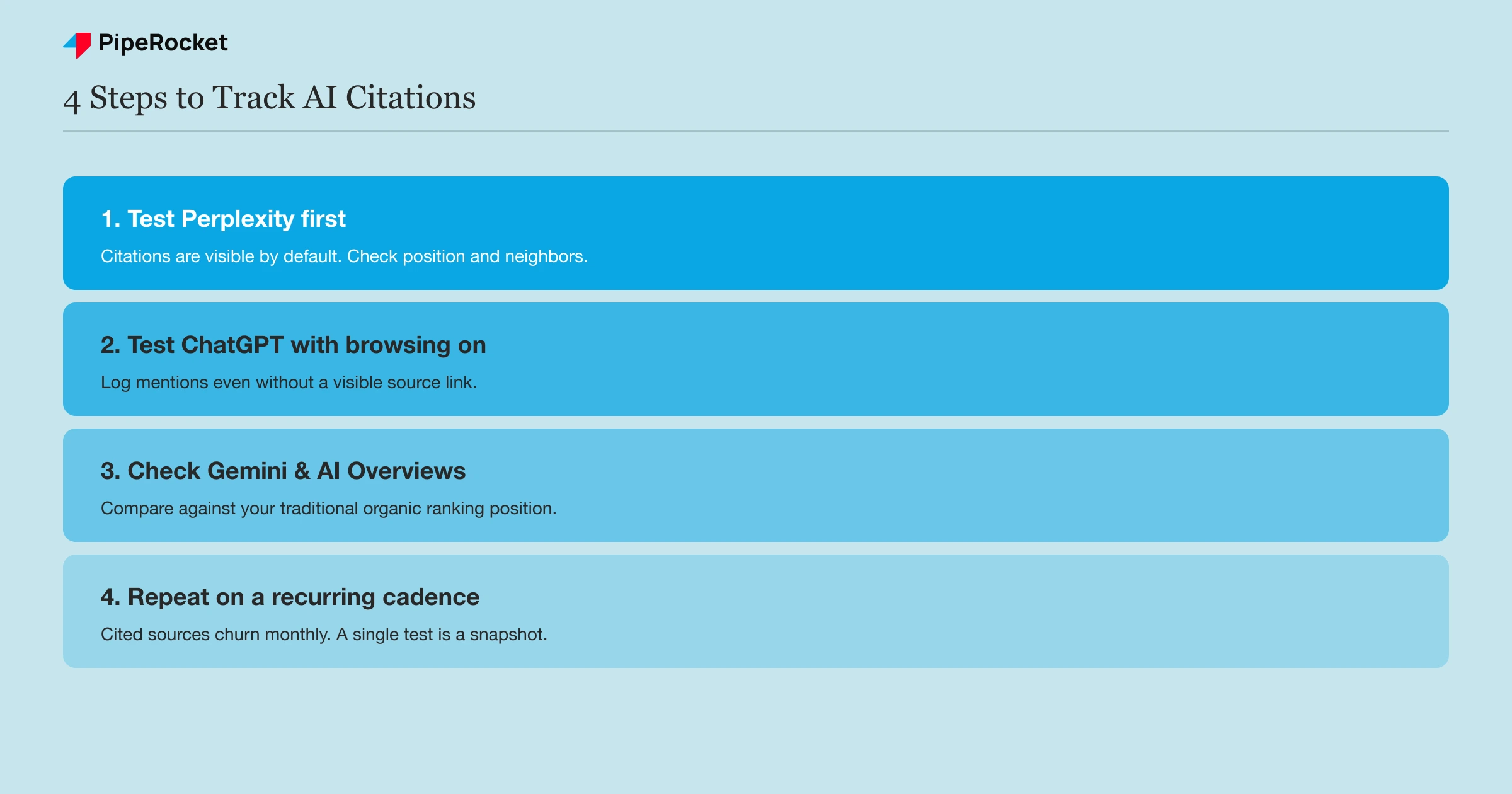
How to Track AI Citations Step by Step
Test Perplexity First, Since Citations Are Visible
Test Perplexity first because it is the only major AI engine that shows source citations inline by default, giving immediate, auditable feedback the other platforms don’t offer as directly. Search your priority queries directly and record:
- Whether your domain appears in the visible source list
- At what position it sits among the cited sources
- Which competitors are cited alongside or ahead of you
Test the Same Queries in ChatGPT With Browsing Enabled
ChatGPT citation behavior is less consistent, since it blends trained knowledge with live browsing depending on the query, so log both linked citations and unlinked brand mentions. A mention without a citation link still counts as a real visibility signal worth tracking. For each query, record:
- Whether your brand is named at all
- Whether the mention includes a linked source back to your domain
- Which competitors are named in the same answer
Check Gemini and Google’s AI Overviews for the Same Query Set
Check Gemini and AI Overviews against your traditional ranking position for the same queries, since Gemini draws heavily on Google’s existing index, so this comparison shows whether your organic strength is actually translating into AI visibility. For each query, record:
- Whether your domain is cited in the AI Overview or Gemini answer
- Your traditional organic position for the same query
- Any gap between strong rankings and missing citations
Run the Full Query Set on a Recurring Cadence
A single test is a snapshot. Given how quickly cited sources churn from month to month, a monthly or quarterly repeat of the same query set is what actually shows whether your visibility is improving or declining over time.
The DIY Method: Track AI Referral Traffic in Analytics
You can track AI citations without a paid tool by isolating AI-platform referrers in your analytics, since traffic from a citation click carries a recognizable source. This is the no-tool baseline that pairs with the manual query testing above.
- Filter by referrer domain. Build a segment or custom dashboard in your analytics that isolates visits from
chatgpt.com,perplexity.ai,gemini.google.com, and similar AI-platform domains. - Watch for URL parameters. Some AI platforms append tracking parameters (for example
utm_sourcevalues or platform-specific tags) to outbound links, which makes the referral easy to attribute in a landing-page report. - Match spikes to queries. When a landing page shows AI referral traffic, cross-check it against your manual query tests to confirm which prompt produced the citation.
This method only captures clicks, so it undercounts citations that answered the user without a visit. Pair it with manual testing to see the mentions and citations that never produced a trackable click.
How much that undercount matters varies by vertical. Across the 53 B2B SaaS brands in our AI SEO statistics , Fintech buyers appeared to use AI to shortlist vendors, then switched to organic search for compliance and security verification before converting — both channels underperformed on raw Lead-to-SQL (organic 25%, AI 20%) because of the high-scrutiny due-diligence process. In a category like that, an AI citation is doing real shortlisting work even when the referral-traffic numbers alone make it look negligible.
Core Metrics for AI Citation Tracking
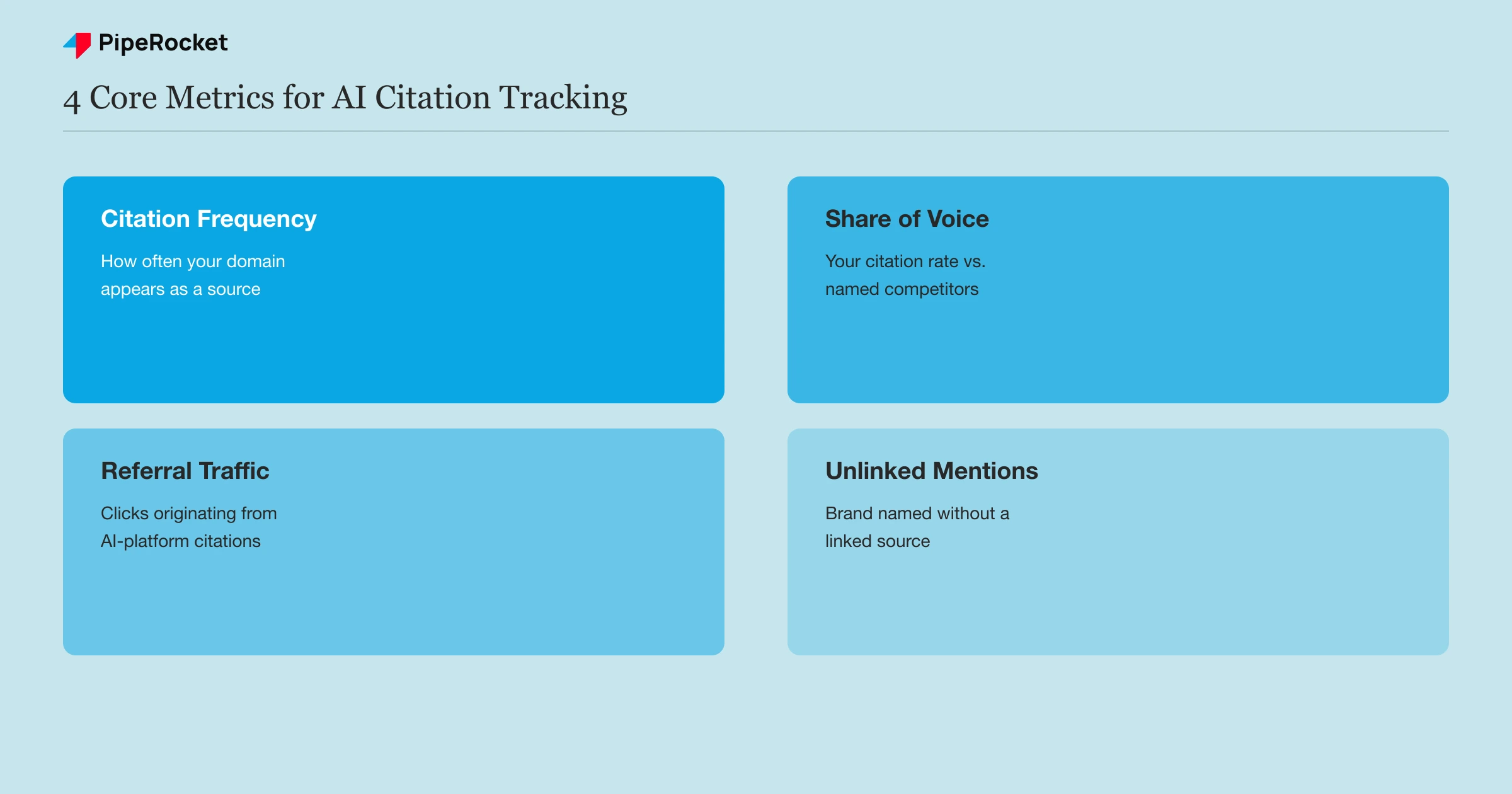
The four core metrics are citation frequency, share of voice against competitors, referral traffic, and unlinked brand mentions, tracked together rather than in isolation. Citation frequency alone doesn’t tell the full story, so a useful setup combines all four into one picture.
| Metric | What it measures | Where to find it |
|---|---|---|
| Citation frequency | How often your domain appears as a source across a query set | Manual or tool-based query testing |
| Share of voice | Your citation rate relative to named competitors on the same queries | Manual comparison or dedicated AEO tracking tools |
| Referral traffic | Actual clicks originating from AI-platform citations | Analytics, filtered by AI-platform referrer sources |
| Brand mentions without citation | Instances your brand is named without a linked source | Brand-mention monitoring tools, cross-checked against manual AI query tests |
Referral traffic understates the real picture, since a meaningful share of AI citations never produce a click at all. The user got their answer directly and never needed to visit your site, which is still a valuable outcome even though it doesn’t show up in a traffic report.
Tools for AI Citation Tracking
A growing category of dedicated tools samples queries across multiple AI engines at scale and reports citation frequency automatically. The named options below each approach the problem differently, so match the tool to whether you need URL-level citations, competitive share of voice, or enterprise-wide monitoring.
| Tool | What it broadly does | Best suited for |
|---|---|---|
| Similarweb (AI citation analysis) | Tracks specific URL citations across ChatGPT, Gemini, and Perplexity and maps domain influence | Teams wanting URL-level citation data tied to a domain-influence view |
| Semrush AI Visibility Toolkit | Measures AI share of voice and runs competitor gap analyses | Teams already in the Semrush ecosystem doing competitive tracking |
| Profound | Enterprise-grade conversation intelligence across AI engines | Larger organizations needing broad, ongoing monitoring |
| Otterly.ai | Self-serve monitoring across multiple AI engines | Smaller teams wanting a lighter, do-it-yourself setup |
The category is still maturing, so run a manual query pass alongside any tool to confirm what it reports. No automated sampler catches every prompt variant, and a spot-check keeps the tool honest.
Common Mistakes to Avoid
Testing a Query Only Once and Treating It as Definitive
A single test result can be misleading, since AI outputs vary between runs. Testing each priority query multiple times, or on a recurring schedule, gives a far more reliable picture than a single snapshot.
Tracking Only Perplexity Because It’s the Easiest
Perplexity’s visible citations make it the most convenient starting point, but stopping there misses how your visibility looks on ChatGPT and Gemini, both of which reach different audiences with different sourcing behavior.
Measuring Only Referral Traffic
Referral traffic captures only the clicks that happened. It misses the mentions and citations that influenced a user’s decision without ever producing a trackable visit, which undercounts your actual AI visibility.
Ignoring Competitor Citation Patterns
Tracking your own citations in isolation misses the more useful comparison: which specific competitor pages are winning citations on the same queries, and what’s different about their content structure.
Citation tracking is only useful if someone acts on it weekly, and the SaaS SEO agency comparison marks which firms build that loop.
How PipeRocket Digital Tracks AI Citations
We test a structured query set across ChatGPT, Perplexity, and Gemini on a recurring cadence, tracking citation frequency and share of voice against named competitors rather than relying on a single check. This feeds directly into our AI search visibility audits and broader AI search optimization work.
Get in touch if you don’t currently have visibility into how often your brand gets cited.
Frequently Asked Questions
What is AI citation tracking?
AI citation tracking is the practice of monitoring when and how generative search engines and chat platforms, including ChatGPT, Perplexity, Google’s AI Overviews, and Claude, reference a brand, URL, or piece of content as source material in their generated answers.
It’s a newer discipline distinct from traditional rank tracking , since generative outputs don’t return a fixed, checkable position the way a SERP does.
Which AI platform should I track first?
Perplexity is the easiest starting point, since it shows source citations directly and consistently with nearly every answer, giving immediate feedback without guesswork. From there, expanding to ChatGPT and Gemini fills out the picture, since each platform sources answers differently .
Are there dedicated tools for AI citation tracking?
Yes. Named options include Similarweb’s AI citation analysis, the Semrush AI Visibility Toolkit, Profound, and Otterly.ai, each sampling queries across multiple engines and reporting citation frequency automatically.
The category is still maturing, so pair a tool with manual query testing to confirm what it reports.
How accurate are AI citations?
AI citations vary run to run, since generative answers aren’t fully deterministic. The same query can return different sources each time, so judge accuracy over repeated tests rather than a single check.
How to check AI citations?
Search your priority queries in Perplexity first, since it shows sources inline, then repeat in ChatGPT and Gemini. Record whether your domain is cited, at what position, and alongside which competitors.