SaaS Lead Generation Strategies That Actually Fill Pipeline
 Sabari Rohith
Last updated on
Sabari Rohith
Last updated on
SaaS lead generation is the process of turning product usage, content, and paid channels into qualified pipeline, using signals like trial activity and feature adoption that most B2B lead gen playbooks don’t account for.
TL;DR
- Generic B2B lead gen advice misses the two things that make SaaS different: self-serve product usage and compounding trial data.
- Pick a lead gen motion first, PLG, sales-led, or a hybrid, because it changes which channels and lead definitions actually matter.
- Trial and signup activity is a lead source in its own right, and scoring product usage catches buying intent your forms never will.
- The channel mix for SaaS ICPs needs a different ratio of content, PPC, and ABM than a generic B2B stack.
- SQL and pipeline attribution in SaaS has to account for sales cycles that stretch across a free trial, not just a form fill.
Most SaaS teams read a B2B lead generation guide, swap “leads” for “signups,” and call it a strategy. That’s the mistake. If you want the fundamentals of ICP definition, multi-channel outreach, and nurture sequencing, our B2B lead generation guide covers that ground well and it applies to any company selling to businesses.
This piece stays narrow to what’s actually different when the product itself is part of the funnel. We’re covering PLG versus sales-led motions, trial-to-lead scoring, and attribution across a sales cycle that includes a free trial nobody in the B2B guide accounted for.
Why Generic B2B Playbooks Undercount SaaS Signals
The core gap is simple: B2B lead gen assumes every prospect enters through a form. SaaS prospects often enter through a product signup, and that changes what counts as a lead in the first place.
A prospect who signs up for a 14-day trial and invites three teammates has shown more buying intent than someone who downloaded a whitepaper. Most lead scoring models still weight the whitepaper download higher.
- Whitepaper download: shows curiosity about the topic
- Trial signup + teammate invite: shows the prospect is already testing the product with the people who’d have to adopt it
This matters because SaaS companies increasingly run two motions at once. Product-led growth (PLG) puts the product in front of the buyer before a sales rep ever gets involved. Sales-led motions still gate access behind a demo request. Scoring a demo request and a trial signup on identical criteria misses what each signal actually means.
The teams getting this right build lead scoring around product behavior first, form behavior second. A prospect who activates a core feature within 48 hours of signup is a stronger SQL candidate than one who fills out five form fields and never logs in again.
Pick Your Motion Before You Pick Your Tactics
The motion you run, not the tactics you borrow from a generic playbook, is what should decide your channel mix and lead definitions. Skipping this step is why so many SaaS teams end up running sales-led outbound against a product built for self-serve adoption.
Product-Led Growth Puts the Trial in Front of the Funnel
In a PLG motion, the free trial or freemium tier is the primary conversion point, not a form. Marketing’s job shifts from generating form-fill leads to driving qualified signups and then getting the right prospects to activate inside the product.
This works well when the product delivers value in minutes rather than weeks. A project management tool a user can set up and see value from in one sitting is a strong PLG candidate.
A platform that needs a data migration and an implementation call before anyone sees value isn’t a good PLG fit, no matter how much the team wants a self-serve motion.
Sales-Led Motions Still Need a Human in the Loop Early
Sales-led SaaS, usually higher ACV, longer implementation, multiple stakeholders, keeps the demo or discovery call as the primary conversion point. The lead gen job here looks closer to the traditional B2B playbook: content and ads drive demo requests, SDRs qualify, AEs run the sales process.
The trap is running this motion with PLG-style top-of-funnel tactics. Flooding the top of funnel with low-friction content downloads produces leads that were never going to sit through a 45-minute demo, and SDR time gets burned qualifying people who wanted a PDF, not a platform.
Most SaaS Companies Actually Run a Hybrid
A hybrid motion offers a free trial for smaller accounts while running a sales-led process for enterprise deals, and it’s more common than either pure model. The trial acts as a qualification filter: engaged trial users who show enterprise-scale usage patterns get routed to sales, while smaller accounts self-serve to a paid plan.
| Motion | Primary conversion point | Best lead signal | Where it breaks |
|---|---|---|---|
| PLG | Trial or freemium signup | Feature activation, seat invites | Complex products that need onboarding before value shows |
| Sales-led | Demo request | Firmographic fit, stated intent | Slow-moving buyers who’d convert self-serve if given the option |
| Hybrid | Trial signup, routed by usage | Usage thresholds that trigger a sales handoff | Poorly defined routing rules that send every trial to an overloaded SDR queue |
Decide which column describes your product before you build a single campaign. A hybrid motion without clear usage-based routing rules just means every trial signup lands in an SDR’s queue regardless of fit, which burns sales capacity on accounts that were never going to need a rep.
Turn Trial Activity Into a Real Lead Source
The most under-used SaaS lead gen source is the trial data your product is already generating. A product qualified lead (PQL) is a signup who has hit a usage threshold that historically correlates with becoming a paying customer. Building that threshold is a data project before it’s a marketing one.
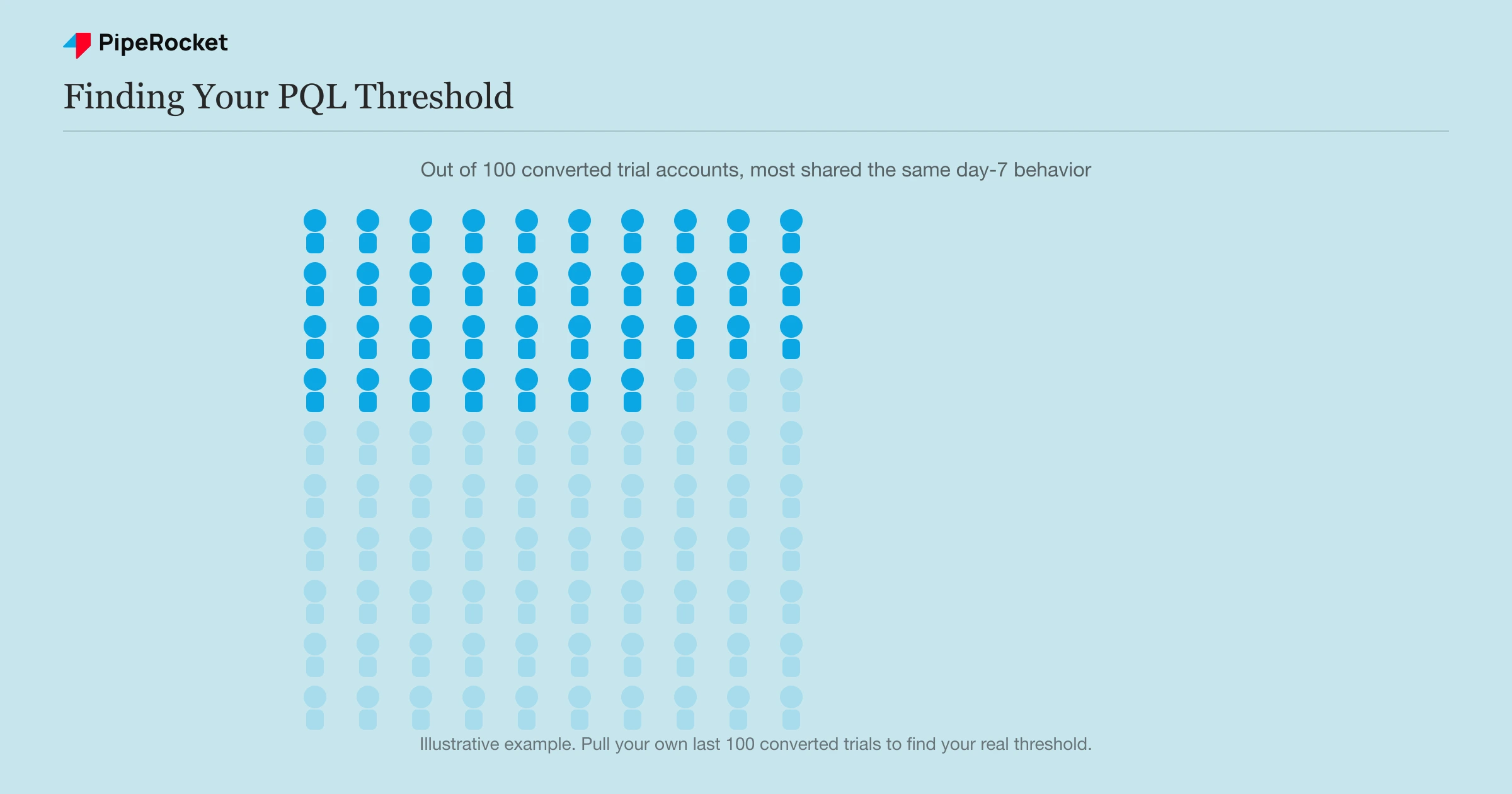
Start by pulling your last 100 converted trial accounts and looking for what they did in the first seven days that non-converters didn’t. Common patterns worth checking:
- Did they invite a teammate, and how fast?
- Did they connect an integration, versus just poking around the UI?
- Did they hit a specific feature more than once, versus trying it and abandoning it?
- Did they return on day 2 or 3, versus only logging in once?
Once you have two or three signals that reliably separate converters from churned trials, build a PQL score. Route anyone crossing the threshold to sales, or trigger an automated nudge sequence for accounts approaching it but not quite there.
This is where SaaS lead gen genuinely diverges from generic B2B. The qualification signal lives in your product analytics, not your marketing automation platform’s lead score field.
Don’t over-engineer this before you have volume. A team with 40 trial signups a month doesn’t need a machine learning model, they need someone reviewing usage data weekly and manually flagging the accounts that look like the last cohort of closed-won deals.
Build a Channel Mix Suited to SaaS Buying Cycles
B2B SaaS lead generation strategies work best when the channel mix reflects how SaaS buyers actually research and trial software, not a generic B2B ratio borrowed from a services company selling six-figure contracts.
Each channel plays a different role depending on how close it sits to the trial:
| Channel | Role in the SaaS mix | Where it goes wrong |
|---|---|---|
| Content | Comparison pages , integration-specific landing pages , and use-case pages that match a searcher already evaluating tools. Closer to the trial than a top-of-funnel guide. | Publishing definitional content instead of “[competitor] alternative” or “[integration] plus [category]” pages that sit right next to the signup decision |
| PPC | Segmented by use case and funnel stage, not run as one broad account. Bottom-of-funnel terms like “[category] software” and competitor comparisons get budget priority. | Spending on top-of-funnel awareness terms before bottom-of-funnel terms are saturated |
| ABM | Reserved for the enterprise tier of a hybrid motion, where deal sizes justify one-to-one personalization | Running ABM against the entire self-serve funnel, where a $20/month checkout page would have converted the account anyway |
| Paid social | Mostly retargeting trial abandoners | Used for cold prospecting instead of re-engaging people who already signed up |
Heavy content and PPC investment belongs at the trial-adjacent stage. ABM stays reserved for a defined enterprise list, and paid social does its best work on retargeting.
Teams that flip this ratio, heavy ABM spend against a self-serve product, or broad TOFU content for an enterprise-only sales motion, end up funding a channel mix that doesn’t match how their own buyers behave.
Measure SQLs the Way SaaS Sales Cycles Actually Work
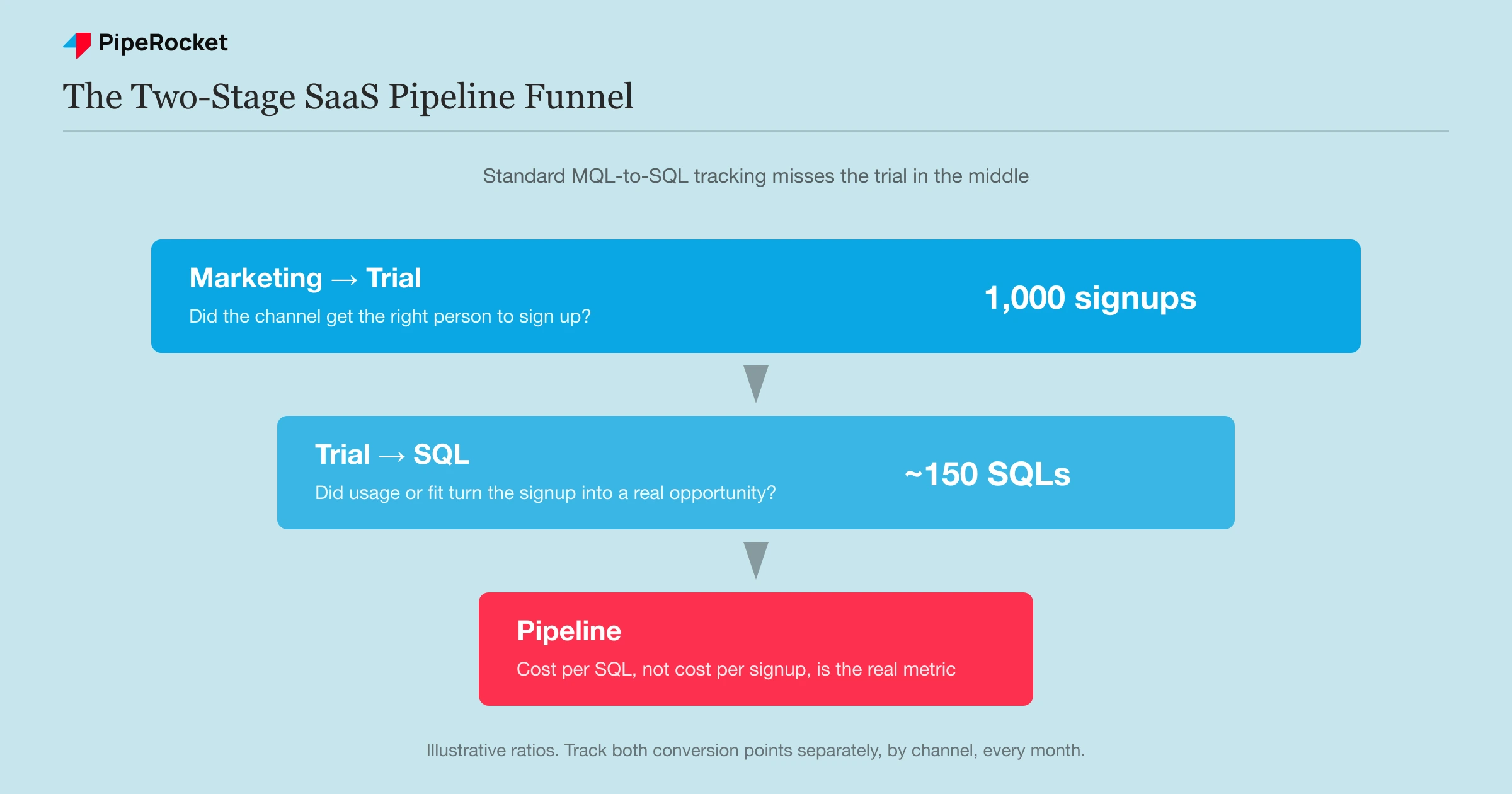
Standard MQL-to-SQL attribution assumes a linear path: content, then a form fill, then a sales call. SaaS sales cycles route through a trial in the middle, and pipeline attribution has to account for that stretch or it misreads what’s actually working.
The fix is tracking two separate conversion points instead of one: marketing-to-trial (did the channel get the right person to sign up) and trial-to-SQL (did that signup show enough usage or fit to become a real opportunity). A channel that drives cheap trial signups but a low trial-to-SQL rate only looks cheap. It’s really moving the cost downstream where it’s harder to see.
Pull this monthly, split by channel:
- Trial signups by source
- Trial-to-SQL conversion rate by source
- Average days from signup to SQL by source
- Cost per SQL (not cost per signup) by source
A channel with a high signup volume and a poor trial-to-SQL rate usually means the targeting is off rather than the channel being broken. We’ve seen SaaS teams cut a paid channel entirely based on a high cost-per-lead number. The real issue was often that the channel brought in individual contributors instead of the budget-holders who actually convert to paid.
Common Mistakes to Avoid in SaaS Lead Generation
Scoring Every Signup the Same Way
Treating a solo developer testing your API the same as a VP evaluating for a 200-seat rollout produces a lead list that looks busy and converts terribly. Score by usage pattern and account size signals, not just activity volume.
Running PLG Tactics Against a Sales-Led Product
Cheap top-of-funnel content and low-friction lead magnets generate volume, but if your product needs a 30-minute onboarding call before anyone sees value, that volume just becomes unqualified pipeline your sales team has to sort through manually.
Ignoring Trial Abandoners
Most teams nurture converted trials and ignore everyone else. The trial abandoner list is usually the single richest retargeting audience a SaaS company has.
- They’ve already shown intent
- They already know your product name
- A well-timed offer or feature update email converts far better than cold outbound ever will
Attributing Pipeline to Last Touch Only
Last-touch attribution credits whatever channel happened to be present the day someone converted to SQL, usually a branded search or a sales outreach email, and starves the earlier channels that actually built the awareness making that last touch effective.
How PipeRocket Digital Builds SaaS Lead Gen Systems
We build SaaS lead generation programs around the motion a product actually runs, not a generic template. That means PQL scoring tied to real usage data, a channel mix weighted toward trial-adjacent content and PPC, and attribution that tracks the full trial-to-SQL stretch instead of stopping at the form fill. If you’re on our SaaS PPC service or working with a SaaS SEO agency , this is the framework we bring to the account. Talk to us about auditing your current lead gen setup.
Frequently Asked Questions
What is SaaS lead generation?
SaaS lead generation means turning product usage signals, content, and paid channels into pipeline for a software company, using data like trial activity and feature adoption that a services business selling a one-time contract doesn’t have available. It differs from general B2B lead gen mainly in the signals available: a self-serve trial or freemium tier gives SaaS teams product-usage data most B2B categories never see before a sale closes.
What are the best B2B SaaS lead generation strategies?
The strongest b2b saas lead generation strategies start with matching tactics to motion: PLG companies should prioritize PQL scoring off trial usage and trial-adjacent content like comparison and integration pages, while sales-led SaaS should keep demo requests as the primary conversion point and reserve ABM for enterprise accounts. Hybrid companies need clear usage thresholds that route the right trial signups to sales without flooding SDRs with every signup regardless of fit.
How is SaaS lead generation different from regular B2B lead generation?
The biggest difference is the trial or freemium signup as a lead source in its own right, something a services company or a SaaS company without self-serve access doesn’t have. General B2B lead gen tactics like content, outbound, and paid search still apply, but SaaS adds a layer where product usage data becomes a qualification signal alongside or instead of a form fill.