SaaS Inbound Marketing: The Channel Mix and Framework That Actually Works
 Vignesh Sampath
Last updated on
Vignesh Sampath
Last updated on
SaaS inbound marketing means running content, SEO, and product signals such as trial activity as one connected system that pulls in self-serve signups and expansion revenue, instead of buying every lead through ads or outbound.
TL;DR
- SaaS inbound treats the trial or free signup as a real channel, not just content and SEO working alone.
- Outbound and ABM push a message at an account list. SaaS inbound earns attention from people already searching, testing, or using the product.
- The channel mix that works is content and SEO tied to bottom-of-funnel and product intent, product-led signals from self-serve usage, and peer distribution in communities.
- A working framework picks the motion first, then builds content, product signals, and distribution around that motion, not the other way around.
- The right SaaS inbound metrics are CAC, trial-to-paid conversion, and expansion revenue, not raw traffic or blog volume.
- The most common failure is building an inbound program that stops at “get more visitors” and never wires product usage back into marketing at all.
What Is SaaS Inbound Marketing, Really?
SaaS inbound marketing is the version of inbound built around a product people can try before they buy it. Instead of only earning attention through content and search, a SaaS company also earns it through what happens inside a free trial or freemium account.
That distinction matters more than it sounds. A generic inbound playbook treats every visitor the same, while a SaaS company has a better signal sitting right there in the product:
| Generic inbound playbook | SaaS inbound marketing | |
|---|---|---|
| How it treats a visitor | Attract with content, capture the email, nurture until sales can call | Attract with content, but also watch what they do inside a trial or freemium account |
| Strongest buying signal | Downloaded a checklist or gated whitepaper | Activated a feature and invited a teammate |
| What “SaaS” usually means in this content | The word bolted onto a generic strategy list, then blogged, SEO’d, and posted on LinkedIn | Product usage treated as real intent data, not just a demo request queue |
None of the generic playbook is wrong. It’s just incomplete for a company whose product is sitting right there generating its own intent data.
We’re not re-explaining what inbound marketing is from scratch here. If you want the general playbook (buying committees, gated content, the awareness-to-decision stages that apply to any B2B company), that lives in our separate piece on B2B inbound marketing fundamentals. This page stays narrow to what changes when the product itself becomes part of the acquisition funnel for a self-serve or PLG SaaS company.
How Is SaaS Inbound Different From Outbound and ABM?
The short answer: outbound and ABM push a message at a target list before anyone asked for it. SaaS inbound earns attention from people already searching for a solution, comparing tools, or actively testing your product.
That difference plays out differently for self-serve SaaS than for enterprise SaaS sold through a sales team, and that’s the split most B2B inbound advice skips entirely.
A self-serve product wants inbound to fill the top of a trial funnel. A sales-assisted or enterprise product wants inbound to warm an account before an SDR ever emails them, which is where ABM and outbound usually still carry weight.
| SaaS inbound | Outbound / ABM | |
|---|---|---|
| Who starts the conversation | The buyer, by searching, comparing, or signing up | Your team, through cold email, ads, or SDR sequences |
| What triggers it | Content ranking, a trial signup, a community mention | A target account list and a sequence |
| Cost pattern over time | Compounds down as content ranks and product usage grows | Stays flat or climbs as lists get worked and channels saturate |
| Best fit | Self-serve or PLG motions with a real free trial or freemium tier | Enterprise deals, long sales cycles, high ACV accounts |
| What it needs to work | Content mapped to intent, plus product signals wired into marketing | A tight ICP list and a rep with context on the account |
Most SaaS companies need both, and the mistake isn’t picking the wrong one. It’s running outbound and ABM with zero connection to what inbound is already telling you. If someone from a target account is already active in a trial, that account doesn’t need a cold SDR sequence. It needs a warm, specific follow-up based on what they’ve actually done in the product.
The question worth asking is whether your product is self-serve, sales-assisted, or a hybrid, because that decides how much weight inbound should carry:
- Self-serve: a card-optional trial or freemium tier can run on inbound alone for a long stretch, with product signals doing the qualifying work a rep would otherwise do.
- Sales-assisted or enterprise: a six-figure ACV deal almost never closes on inbound content by itself, even when inbound is what got the account into the room, so inbound warms the account and outbound closes it.
What Does the Inbound Channel Mix Actually Look Like for a SaaS Company?
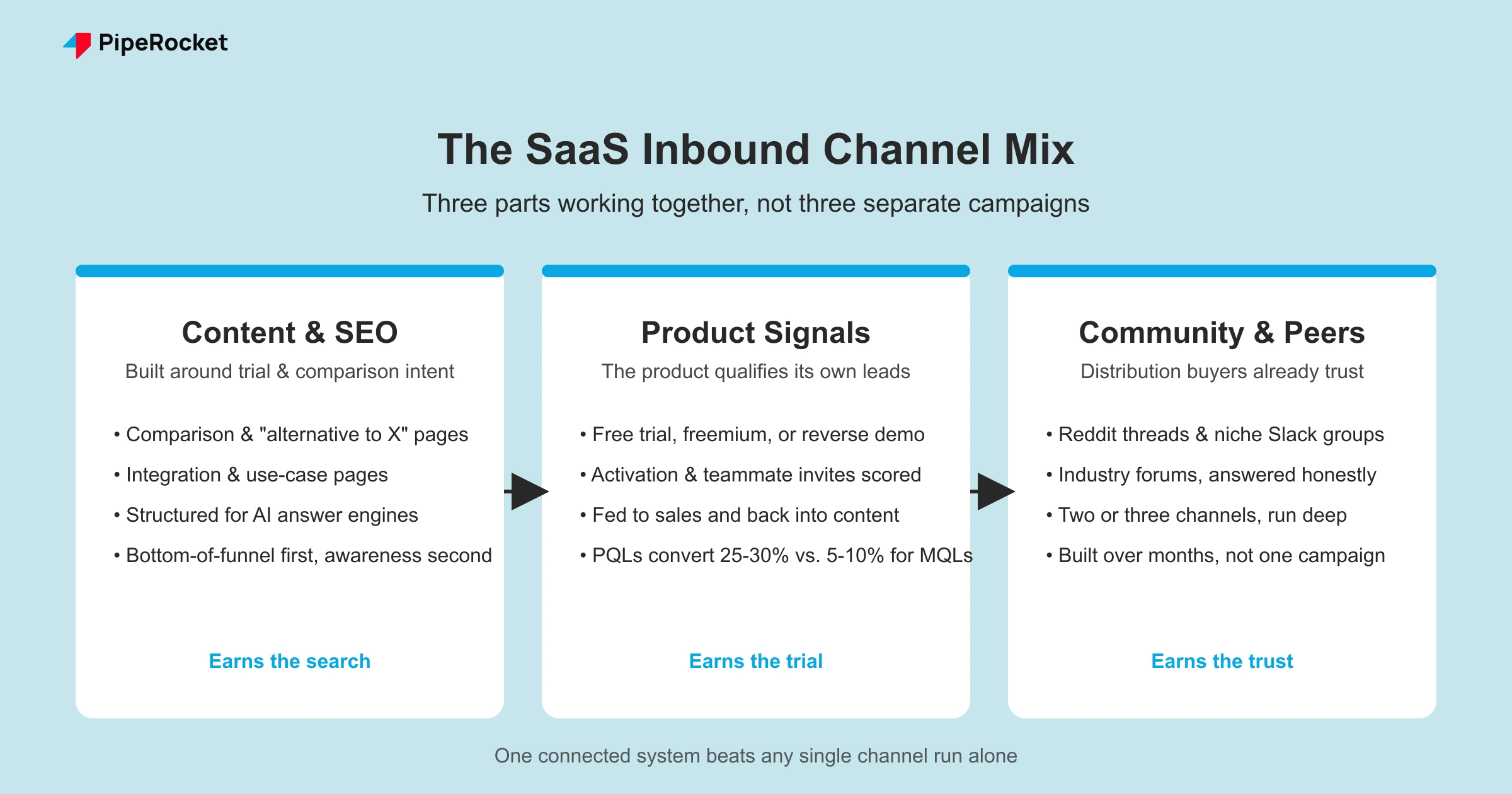
The channel mix for SaaS inbound has three parts working together: content and SEO built around real buying and product intent, the product itself generating signals, and peer distribution that gets your content in front of people who’ll actually act on it.
Content and SEO Built Around Trial and Comparison Intent
Awareness content earns traffic. It rarely earns a trial signup on its own. The content that actually moves a SaaS inbound program is built around bottom-of-funnel and product-adjacent intent: comparison pages , “alternative to X” pages, integration pages, and use-case pages that map directly to what someone searches right before they try a product.
Someone searching “best project management tool for agencies” or “Asana alternative for small teams” is closer to signing up than someone searching “what is project management.” Both queries are technically inbound. Only one of them should get most of your content budget.
SEO here also has to cover more than the traditional search results page. Buyers increasingly research tools inside AI answer engines before they ever hit a search results page, which means the same comparison and use-case content needs to be structured clearly enough to get cited there too, not written only for a human skimming ten blue links.
Let the Product Generate Its Own Inbound Signals
This is the part most generic inbound advice skips entirely. For a PLG or freemium SaaS company, the product itself is an inbound channel. A free tier, an interactive demo, or a reverse trial lets a buyer self-qualify before marketing or sales ever talks to them.
Industry benchmarks from product-led growth research bear this out. ProductLed and Prospeo’s PLG data puts product-qualified leads converting in the 25 to 30% range, against 5 to 10% for a traditional marketing-qualified lead built on form fills alone. That gap exists because a PQL has already used the thing you sell.
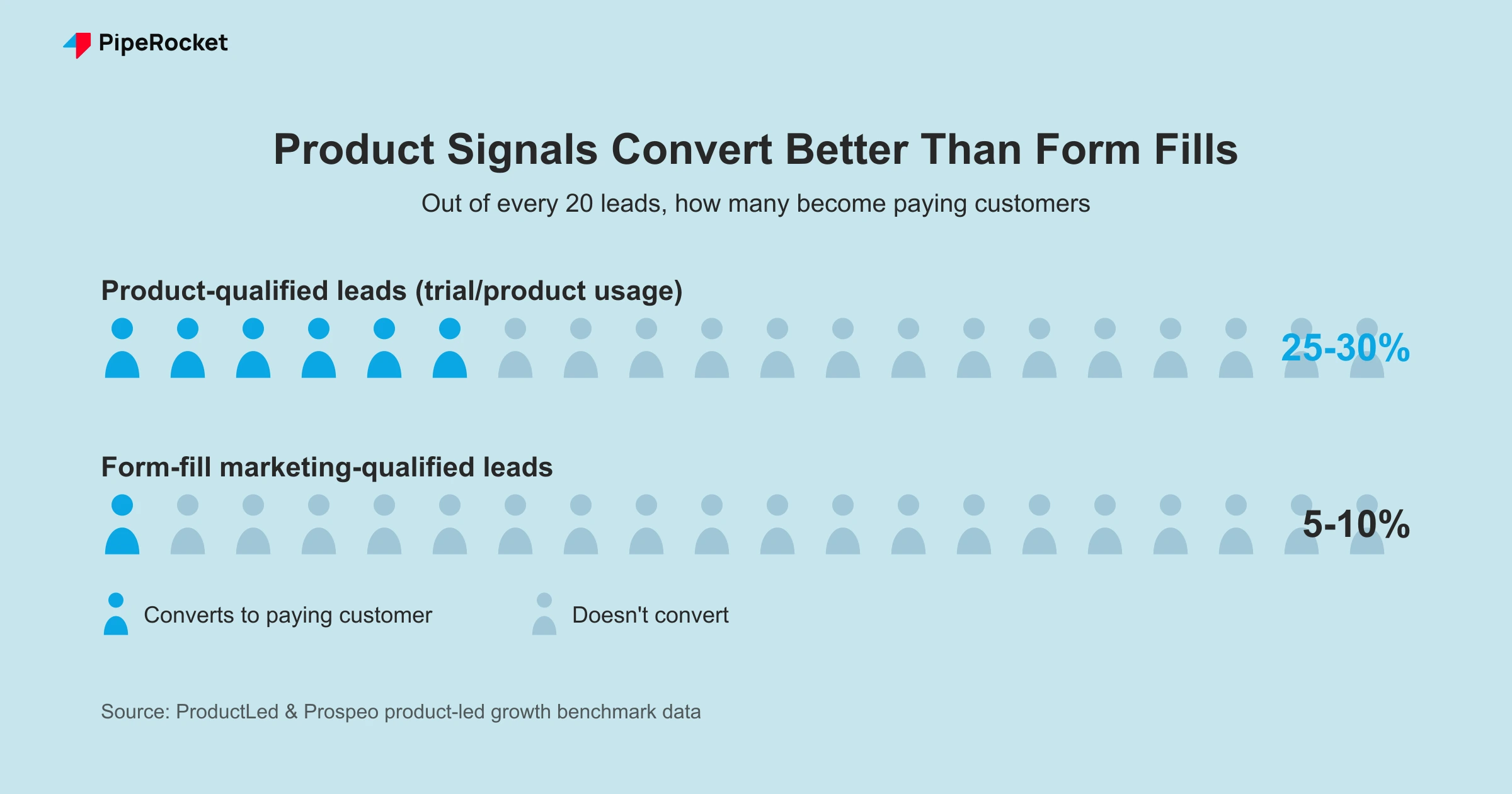
The practical version of this: score trial activity the same way you’d score a form fill, if not higher.
A signup who activates a core feature and invites a teammate in the first 48 hours is a stronger signal than someone who filled out five fields on a contact form and never logged back in. Feed that signal to sales, and feed it back into which content you invest in next.
Community and Peer Distribution
Distribution still matters even when the content and the product signals are both solid. SaaS buyers increasingly trust recommendations from peers in communities over anything a vendor publishes directly, which is why Reddit threads, niche Slack communities, and industry forums have become a real distribution layer, not just a nice-to-have.
The version of this that works isn’t dropping a link and leaving. It’s answering the actual question someone asked, with your product mentioned only where it genuinely fits the answer. Community trust is slow to build and fast to lose, so treat it as a long-term presence, not a campaign you run for a quarter.
Which Content Maps to Each Funnel Stage (TOFU, MOFU, BOFU)?
SaaS inbound content maps to three funnel stages: top of funnel (TOFU) for awareness, middle of funnel (MOFU) for consideration, and bottom of funnel (BOFU) for decision. For a PLG SaaS company, the free trial itself sits at BOFU as a decision asset, not a post-marketing handoff.
| Funnel stage | Buyer intent | SaaS content and assets that fit |
|---|---|---|
| TOFU (awareness) | Learning the problem exists | Blog posts, SEO guides, organic social, category explainers |
| MOFU (consideration) | Comparing approaches and tools | Comparison pages, “alternative to X” pages, webinars, how-to videos, integration and use-case content |
| BOFU (decision) | Ready to try or buy | Free trial or freemium signup, interactive product demo, case studies, ROI calculators |
Most SaaS teams over-invest at TOFU and under-invest at BOFU, which is exactly backward. The BOFU assets, especially the trial itself, carry the most weight because a buyer testing the product is closer to paying than one reading a definition. Weight your content budget toward MOFU and BOFU first, then backfill awareness content.
A Framework for Running SaaS Inbound This Quarter
The framework has six steps, and it starts by naming your motion (self-serve, sales-assisted, or hybrid), because that one decision shapes how much work inbound does versus outbound, which content you build first, and where product signals get routed. Here’s the sequence we’d actually run, not a wish list.
- Name your motion. Self-serve, sales-assisted, or hybrid. This single decision determines whether inbound should be doing most of the work or just warming accounts for a rep.
- Map content to the two or three moments that matter. Bottom-of-funnel comparison and use-case content first, informational awareness content second. Most teams get this backward and wonder why traffic grows while signups don’t.
- Wire product signals into marketing, not just sales. Trial activation, feature adoption, and teammate invites should inform what content you build next and who marketing follows up with, not just who gets an SDR call.
- Pick two or three distribution channels and go deep, not wide. One or two communities where your actual buyers hang out will outperform a scattered presence across ten.
- Set a realistic timeline before you start measuring. Content compounds over months, and product signals need enough signup volume to mean anything statistically. Killing the program at 60 days because pipeline hasn’t moved yet is the single fastest way to waste the investment already made.
- Review the motion every quarter, not the tactics every week. Channel mix should shift when the motion shifts (say, moving from pure self-serve into enterprise), not every time a new tactic trends on LinkedIn.
Here’s how that looks in practice, using a simplified example. Say a self-serve project-management tool names its motion (step 1), then ships three comparison and “alternative to X” pages instead of ten awareness posts (step 2). It scores trial signups that activate a core feature and invite a teammate, and routes those to marketing follow-up rather than a cold SDR queue (step 3). It goes deep in two communities where agency owners actually hang out (step 4). It holds the line for two full quarters before judging pipeline (step 5). The point isn’t the exact numbers, it’s the order: motion first, BOFU content next, product signals wired in, then distribution, then patience.
How Do You Know If SaaS Inbound Is Working?
The right SaaS inbound metrics track cost efficiency and revenue durability, not just how much traffic showed up. Three numbers matter more than the rest.
-
Customer acquisition cost (CAC): track whether inbound is actually lowering your blended cost to acquire a paying account instead of simply piling traffic on top of what paid channels already bring in.
-
Trial or signup-to-paid conversion rate : this is the number that tells you whether inbound is bringing in people who fit, or just people who are curious. Public benchmark data from OpenView and similar PLG research gives a useful gut check if your own numbers are wildly off either direction:
Trial type Typical signup-to-paid conversion Card-required trial ~17% Open freemium (no card) ~5% -
Expansion revenue from inbound-acquired accounts: in a subscription business, the first sale is rarely the whole story. Net revenue retention above 100% on accounts that came in through inbound is a stronger long-term signal than any single month’s signup count.
Traffic and blog publishing cadence are useful diagnostics, but they aren’t the goal. If trial-to-paid conversion and expansion revenue haven’t moved, the program is generating pageviews, not pipeline.
Where Does AI Fit in SaaS Inbound?
AI shows up in SaaS inbound in two places: how buyers research and how teams produce content. Buyers increasingly ask AI answer engines for tool recommendations before they ever open a search results page, and teams use AI to draft and scale content faster. Neither replaces intent-mapped content, they change how it needs to be structured.
On the buyer side, comparison and use-case pages now have to be structured cleanly enough to get cited inside AI answers, not just ranked on ten blue links. Clear claims, tables, and direct answers make a page quotable by an answer engine. On the production side, AI can speed up drafting and research, but the intent match and the product-specific detail still have to come from people who know the product. AI that pumps out generic awareness posts just makes the “content volume over intent match” mistake faster.
Does Marketing Automation Still Matter for SaaS Inbound?
Yes. Even for a PLG motion built on product signals, marketing automation still runs the top-of-funnel email and nurture side: capturing a signup, scoring behavior, and sending the right follow-up at the right moment. Product-usage scoring and traditional lead scoring work together, they don’t cancel each other out.
The practical split: automation handles the mechanics of capture, scoring, and nurture sequences, while product signals like trial activation and teammate invites feed that scoring model better data than a form fill ever could. A signup who activates a core feature should get a different automated sequence than one who never logged back in. The tooling is the same HubSpot-style stack most B2B teams already run, the inputs are what change for SaaS.
Common Mistakes to Avoid
Treating the Trial as a Sales Handoff Instead of a Marketing Signal
Most teams pass a trial signup straight to sales and stop paying attention. That throws away the richest intent data a SaaS company has. Marketing should be watching activation and feature adoption just as closely as sales is watching demo requests.
Gating Everything Behind a Form, Including the Product Itself
Google and AI answer engines can’t index what’s sitting behind a login, and neither can a buyer who wants to try before they commit. Gating a whitepaper is normal. Gating the actual product experience behind a demo request when your buyers expect self-serve access is how competitors with an open trial win the comparison.
Chasing Content Volume Instead of Intent Match
Publishing more posts doesn’t create more qualified signups if none of them map to a real buying moment. A dozen awareness posts and zero comparison or use-case pages is a common pattern, and it’s exactly backward from where SaaS buyers actually convert.
Measuring Community Presence Like a Paid Campaign
Community distribution judged on a 30-day ROI will always look like it’s failing, because trust in a forum builds over months, not a sprint. Teams that pull out early lose the exact credibility they’d need to make it work later.
How PipeRocket Digital Approaches SaaS Inbound
We build SaaS inbound around the motion first: content mapped to comparison and use-case intent, product signals wired back into marketing, and distribution focused on two or three channels instead of ten.
If you’re weighing whether your program needs a rebuild or just a tighter framework, get in touch with our team or see how our SaaS SEO service approaches the content and search side of this from the ground up. If your model isn’t PLG or self-serve, the general B2B inbound marketing fundamentals for committee-based buying are the better starting point.
Frequently Asked Questions
What is SaaS inbound marketing?
SaaS inbound marketing is the practice of attracting and converting software buyers using content, search visibility, and product usage signals such as trial activity, rather than paying for every lead through ads or outbound outreach. It treats the free trial or freemium tier as part of the acquisition funnel, not just a step that happens after marketing’s job is done.
Does inbound marketing work for early-stage SaaS startups?
Yes, but with a caveat on timing. Early-stage SaaS companies often have the most to gain from inbound because they can’t yet afford sustained outbound or paid spend, and a lean team can still build comparison and use-case content that ranks. The trade-off is patience: inbound compounds over months, so an early-stage team that needs pipeline in the next 30 days should lean on a mix of inbound and a lighter outbound motion rather than betting everything on content that hasn’t ranked yet.
What are examples of SaaS inbound marketing?
Examples include comparison and “alternative to X” pages, integration and use-case content, SEO guides mapped to buying intent, product-led signals like a free trial or freemium activation, and peer distribution in communities such as Reddit threads and niche Slack groups. The common thread is earning attention from people already searching, testing, or using the product.
How is SaaS inbound marketing different from general B2B inbound marketing?
The core difference is the product itself. General B2B inbound marketing is built around forms, content, and a buying committee working through a long consideration cycle. SaaS inbound adds a layer that most B2B playbooks don’t account for: a trial or freemium signup that generates real usage data before anyone has a sales conversation, which changes what counts as a qualified lead and how quickly a buyer can self-select in or out.