Edtech SEO: The Complete Guide for 2026
 Ranjeeth Kumar
Published on · Last updated on
Ranjeeth Kumar
Published on · Last updated on
Edtech SEO means ranking content for education software across four different searchers at once: administrators vetting procurement, teachers checking classroom fit, parents researching for their kids, and students hunting quick answers, each with a different intent on the same keyword.
TL;DR
- Edtech SEO grows organic visibility across a buying group where the searcher, the buyer, and the daily user are often three different people.
- Administrators, teachers, parents, and students search the same category in completely different query shapes, and most edtech sites only cover one.
- Publishing has to track the academic calendar, because budget approvals, RFPs, and back-to-school searches all cluster in fixed windows.
- FERPA and COPPA compliance content works as a visible trust signal for both cautious buyers and search engines, not just a legal box to tick.
- Institutional edtech runs a long committee-based B2B2C sales cycle, while consumer ed products close in a single B2C session, and content has to match which one you’re selling.
- Informational content wins the parent and student research phase while commercial content wins the procurement evaluation phase.
- Most edtech SEO programs stall from writing to a single persona, ignoring the buying calendar, or burying compliance proof in a footer link.
- Measuring edtech SEO means checking whether the right persona is arriving at the right point in the buying calendar, not just tracking total traffic.
What Is Edtech SEO?
Edtech SEO refers to growing organic visibility for education software and platforms in a market where the person who searches, the person who buys, and the person who uses the product are frequently three different humans.
It borrows every technical and content fundamental from SaaS SEO , but layers a persona and compliance problem on top that generic B2B SEO advice doesn’t touch.
What makes it a distinct discipline is the split between user and buyer. The same page can get found by:
- A district CTO researching procurement compliance
- A curriculum director benchmarking pedagogy
- A teacher reading practitioner reviews
- A parent checking if a tool is worth requesting at the school board meeting
Write it for only one of them and you lose the other three.
It also runs on a calendar you don’t control. Budget cycles and the school year itself decide when your buyers are even looking. An edtech content plan that ignores the academic calendar is publishing into silence for half the year.
Why Edtech SEO Needs Its Own Playbook
Standard SaaS SEO advice assumes a single buyer persona reading a coherent research journey. Edtech breaks that assumption at the root, because the searcher standing in front of any given keyword changes depending on who’s looking. Three forces make this its own discipline.
Your Buyers Aren’t Your Users
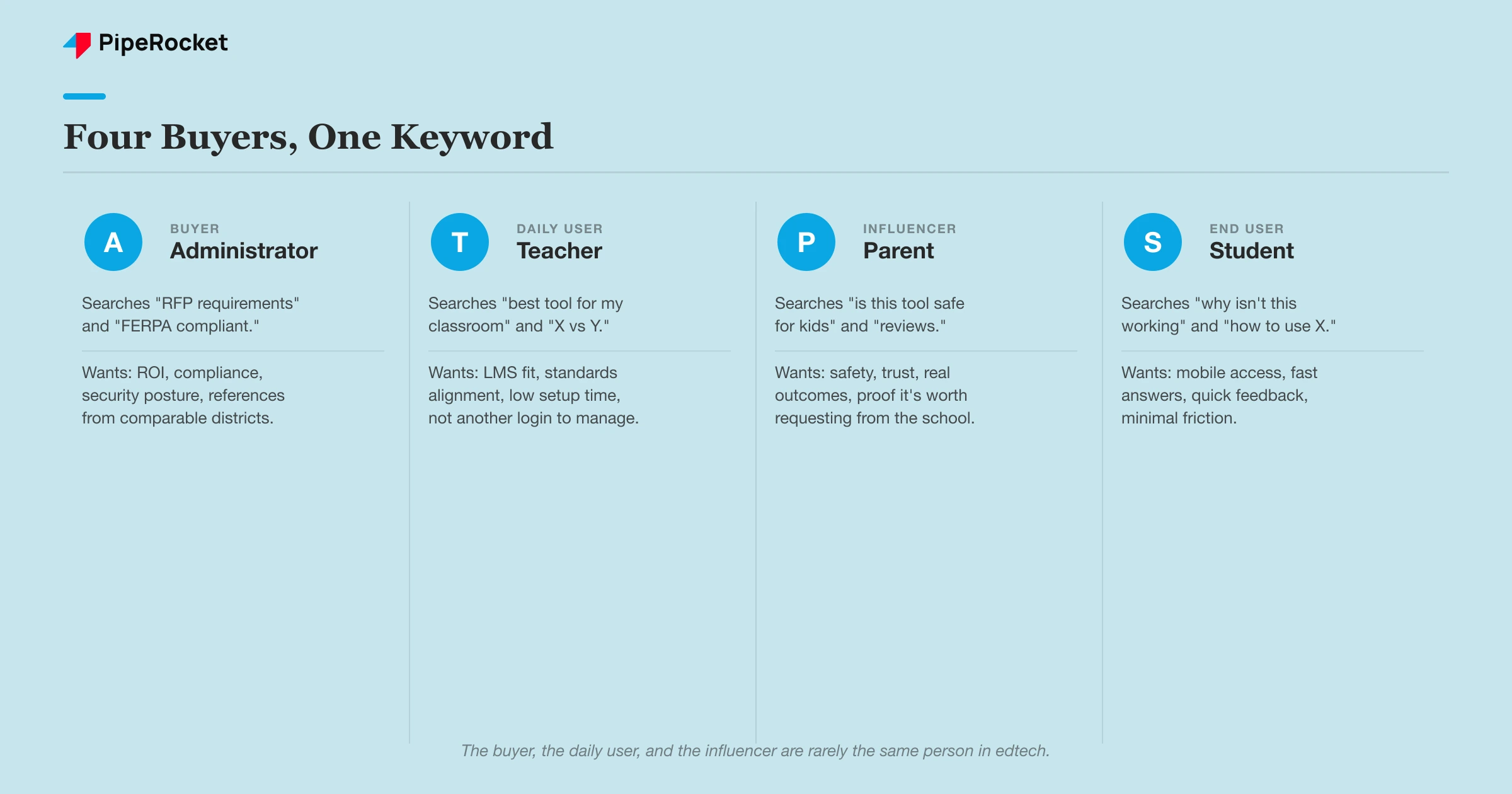
The person who signs the contract in edtech is almost never the person who opens the app every day. Administrators sign off on ROI and compliance, teachers need something that fits state standards and doesn’t add setup time, and students and parents care about whether the thing actually works on a phone at 9pm during homework.
That split means one landing page can’t carry the whole sales motion. A district superintendent needs procurement-grade proof: security posture, pricing tiers, implementation support, and references from comparable districts. A classroom teacher searching the same category wants to know if the tool integrates with their LMS and whether it eats prep time or saves it.
We map content to each of these roles separately instead of writing one “features and benefits” page and hoping it lands for everyone. A procurement page and a teacher-facing “how it works in the classroom” page can sit on the same site, target overlapping keywords, and serve completely different intents without competing with each other.
Teachers, Admins, Parents, and Students All Search Differently
The same product category produces wildly different query shapes depending on who’s typing:
- An administrator searches “[category] RFP requirements” or “[category] FERPA compliant.”
- A teacher searches “best [category] for my classroom” or “[tool] vs [tool] for grading.”
- A parent searches “is [tool] safe for kids” or “[tool] reviews for parents.”
- A student searches “[tool] not working” or “how to use [tool].”
Most edtech marketing sites answer exactly one of these shapes well, usually whichever matches the founder’s own mental model of the buyer. That leaves three entire query clusters uncovered, which is real search volume left on the table every single month.
Map keyword research to persona before a single title gets picked, instead of writing more content into the shape you already cover. Tag every target keyword with the persona it actually serves, then check you have coverage across all four before you greenlight a content calendar .
The Enrollment Calendar Runs Your Content Calendar
Edtech content has to publish ahead of fixed institutional windows, not on a generic weekly cadence, because the buying calendar itself is seasonal in a way most SaaS verticals aren’t. Miss the window and the content sits idle until next year’s cycle opens.
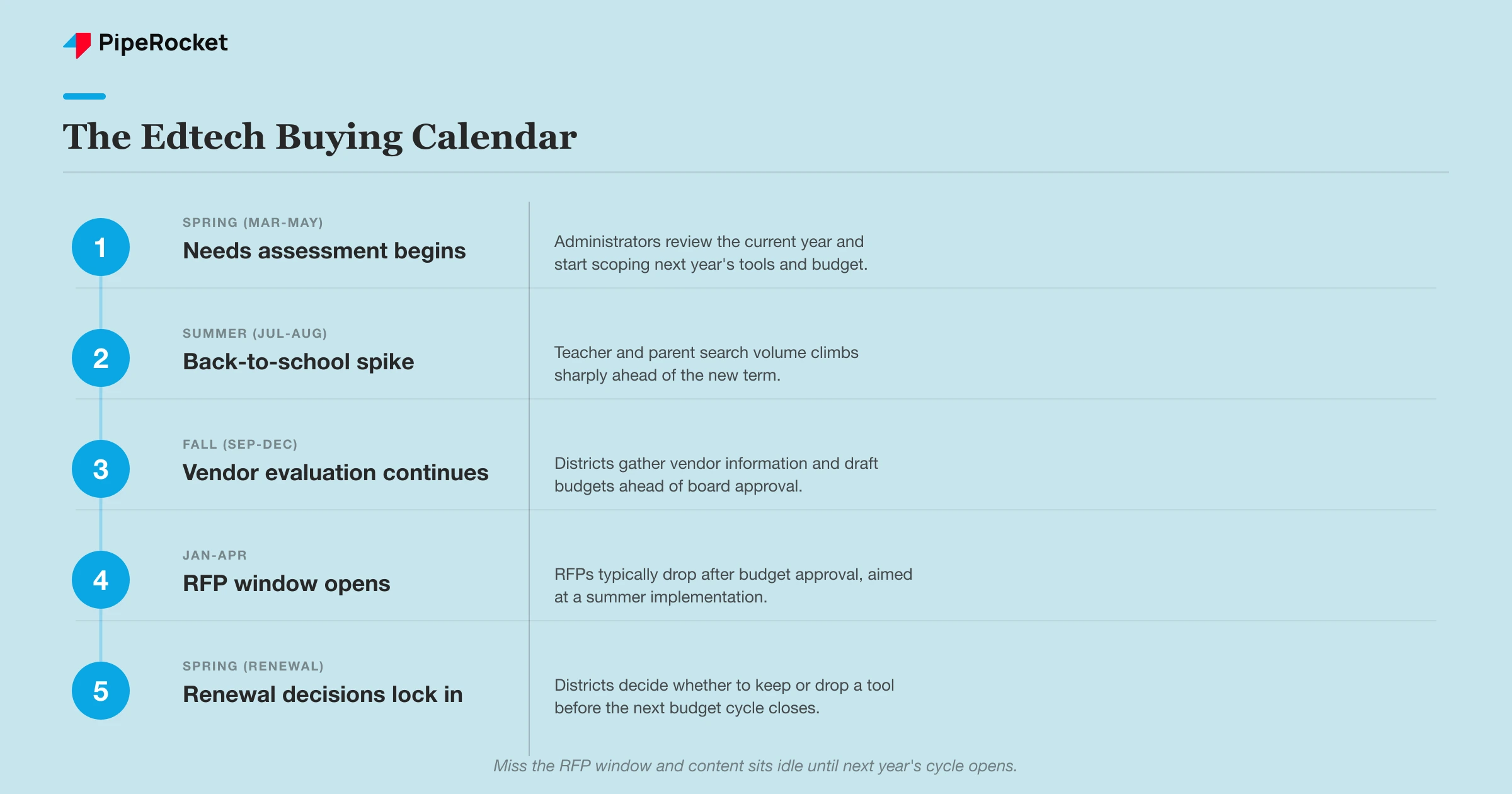
District buying typically starts each spring, when administrators assess the current year and start scoping next year’s needs. That needs-assessment phase runs through the fall.
RFPs tend to drop between January and April for a summer implementation, and budget approvals happen before the RFP is even issued. Content meant to influence a purchase has to be live well before that RFP window opens.
Layer three more spikes on top of the institutional cycle:
- Back-to-school search volume climbs sharply in July and August as teachers and parents research tools for the new term.
- Renewal-season content matters most in spring, when districts are deciding whether to keep or drop a tool before the next budget cycle locks in.
- Accreditation and compliance review cycles create recurring bursts of interest in trust-signal content (security, data privacy, accessibility) tied to institutional review dates rather than the calendar month.
This is the biggest scheduling mistake we see edtech teams make: treating content publishing like a standard SaaS blog cadence and being surprised when a great piece on RFP requirements gets zero traffic in November, six weeks after that year’s window already closed.
Trust Signals That Actually Move Edtech Rankings
FERPA and COPPA compliance content works as both a legal necessity and a ranking signal in edtech, because a cautious administrator is scanning for exactly the same proof a search engine rewards: a named, specific, verifiable compliance posture. Vague reassurance fails both audiences at once.
FERPA Governs Any Product Touching Student Records
FERPA is the federal law protecting the privacy of student education records, and it applies to any school receiving U.S. Department of Education funding, which in practice means nearly every public K-12 and higher-ed institution your product touches. A vendor typically qualifies for the “school official exception” by meeting three conditions:
- Performing a function the school would otherwise handle in-house
- Staying under the school’s direct control over how the data gets used
- Signing a Data Processing Agreement that restricts use strictly to educational purposes
The content implication is direct: a compliance or trust page that names the DPA, states plainly what data is collected and why, and doesn’t dodge the third-party sharing question reads as credible to both a procurement officer and Google. A page that just says “FERPA compliant” with no supporting detail reads as marketing copy, not proof.
COPPA Applies When Your Users Are Under 13
COPPA governs any product collecting data from children under 13, which makes it central for K-12 tools and irrelevant for most higher-ed or corporate L&D platforms. New COPPA rules took effect in 2025, with full compliance required by April 22, 2026, and they raise the bar meaningfully:
- Explicit opt-in consent for third-party data sharing, kept separate from consent for the core educational service
- Extended protections covering biometric data such as voiceprints and facial recognition
If your product serves under-13 students, this belongs on a dedicated trust page in plain language, not buried in a privacy policy PDF. If it doesn’t apply, say so directly rather than leaving the question unanswered, because a K-12 buyer will ask it either way.
State Laws Stack on Top of Federal Ones
More than 130 state-level student data privacy laws now exist in the U.S., and several go further than FERPA and COPPA. California’s SOPIPA, Illinois’s SOPPA, and New York’s Ed Law 2-d all impose their own contractual, deletion, and breach-notification requirements that bind a vendor regardless of where the company is based.
Warning: don’t publish a single generic “we’re compliant” claim and call the trust section done. A buyer in a state with stricter rules than the federal floor is checking for the specific law that applies to them, and a page that only mentions FERPA reads as incomplete to anyone in California, Illinois, or New York.
B2B2C Institutional Sales vs. B2C Consumer Ed Products
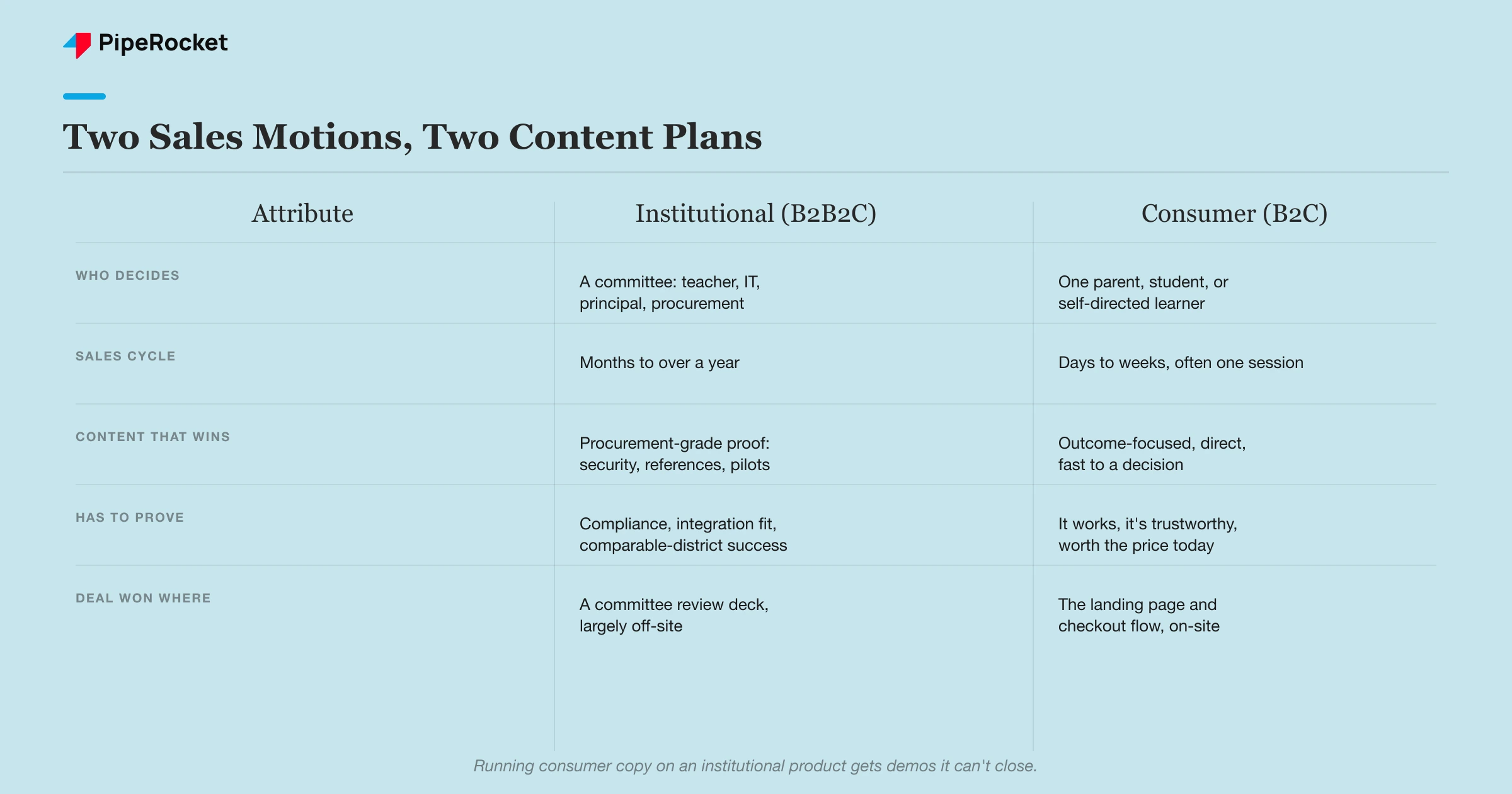
Edtech content strategy has to match which sales motion the product actually runs, because institutional and consumer edtech close in fundamentally different ways and content built for one will underperform badly on the other.
| B2B2C institutional (districts, higher ed) | B2C consumer ed products | |
|---|---|---|
| Who decides | A committee: teacher, IT director, principal, procurement, sometimes the school board | An individual parent, student, or self-directed learner |
| Sales cycle length | Months to over a year, tied to budget and RFP cycles | Days to weeks, often a single session |
| Content that wins | Procurement-grade proof: security, references, pilot results, RFP-ready documentation | Outcome-focused, emotionally direct, fast to a decision |
| What content has to prove | Compliance, integration fit, comparable-district success | It works, it’s trustworthy, and it’s worth the price today |
| Where the deal is won | A committee review deck and reference calls, largely off-site | The landing page and checkout flow, on-site |
Selling into a district means content has to survive being forwarded to stakeholders who never talk to your sales team directly. That’s why RFP-ready documentation and named references do more work than a punchy homepage.
Selling a consumer learning app means the entire decision happens in one browsing session, so outcome proof and pricing clarity carry the page instead.
The mistake we see most often is a product with a genuinely B2B2C institutional buyer running C2C-style consumer marketing copy, all outcomes and urgency with no procurement depth, and wondering why it can get demos but can’t close a district.
Build Content for Both the Parent and the Procurement Officer
Edtech content has to serve informational research and commercial evaluation on the same site, because parents and students are usually still learning what’s possible while administrators and teachers are actively comparing named vendors. Collapsing both into one funnel loses whichever intent gets the smaller word count.
Informational Content Wins the Research Phase
A parent typing “how to help my kid with reading” or a student typing “why is algebra so hard” isn’t ready to compare vendors yet, they’re trying to understand the problem first. This is where a broad, genuinely useful “what is X” and “how to help with X” content layer earns trust before a brand ever gets mentioned.
This content also does double duty for AI search, since these are exactly the query shapes that show up in AI Overviews and chat answers looking for a clear, well-structured explanation rather than a sales pitch. Answer the question directly, then let the product enter the page naturally once the concept is established.
Commercial Content Wins the Evaluation Phase
An administrator typing “[category] vendors for K-12” or a teacher typing “[tool A] vs [tool B]” already knows the category and is actively narrowing a shortlist. This is comparison pages , category pages, and named-vendor content, the pages that carry pricing, integrations, security posture, and named district references.
Here’s a small compliance SaaS example that generalizes well to edtech: a fictional K-12 assessment platform built two separate content tracks, one explaining test anxiety and study habits for parents, one comparing itself against named LMS-integrated competitors for district IT directors.
Neither page tried to do the other’s job, and each converted its own persona instead of diluting both.
Warning: don’t let the commercial pages read like the informational ones or vice versa. A comparison page padded with generic “here’s what test anxiety is” filler buries the procurement proof a decision-maker actually needs, and an informational page that pivots into a hard sell three paragraphs in loses the parent who just wanted an answer.
Common Mistakes to Avoid
Most edtech SEO programs stall for the same handful of reasons, and each one traces back to treating edtech like generic B2B SaaS instead of the four-persona, calendar-bound, compliance-heavy discipline it actually is.
Writing for Only One Persona
A site built entirely around the administrator’s procurement questions, or entirely around the teacher’s classroom questions, is only ever going to rank and convert for that one slice of the buying committee . The other personas search in real volume too, and leaving their queries uncovered hands that traffic straight to a competitor who did map all four.
Publishing on a Generic Blog Cadence
Treating edtech content like a standard weekly SaaS blog ignores the fact that RFPs, budget approvals, and back-to-school research all cluster into fixed windows. A strong piece on procurement requirements published after that year’s RFP season has already closed just sits idle for eleven months.
Treating Compliance as a Footer Link
Burying FERPA and COPPA detail in a privacy policy PDF instead of a dedicated, specific trust page means neither the cautious buyer nor the search engine gets the proof they’re looking for. Compliance content works exactly like a fintech trust page: specific and visible beats vague and buried every time.
Running Consumer Copy on an Institutional Product
A product that actually sells through a district committee but markets itself with consumer urgency and emotional outcome copy will generate demos it can’t convert.
The content never builds the procurement-grade proof the real buying committee needs to move a deal through five stakeholders.
Ignoring the User-Buyer Split
Optimizing only for the administrator who signs the check while ignoring the teacher who has to adopt the tool daily produces a page that closes the sale and loses the renewal.
The buyer’s fear that end users won’t actually use the product is one of the most common reasons edtech deals stall or churn.
How to Know Edtech SEO Is Working
Measuring edtech SEO means checking whether traffic is arriving as the right persona at the right point in the buying calendar, not just tracking a total organic number. Traffic that spikes in November, after the RFP window closed, didn’t move a single deal forward, no matter how big it looks in a dashboard.
Track these instead of a single blended traffic metric:
- Organic sessions segmented by persona-tagged content (administrator, teacher, parent, student), not lumped together
- Demo requests or contact-form fills coming from procurement and comparison pages specifically
- Ranking position for RFP-season keywords checked against the actual RFP window, not just a monthly average
- Time-on-page and scroll depth on trust and compliance pages, since a buyer skimming past your FERPA section fast usually means it didn’t answer their question
If procurement-page traffic is flat right before your buyers’ typical RFP window opens, that’s a signal to fix now, not a metric to note and move past. That window doesn’t repeat until next year.
Why PipeRocket Digital Runs Edtech SEO This Way
We build edtech content around the persona a keyword actually serves, time publishing to the academic and procurement calendar, and make FERPA and COPPA proof visible on the page instead of buried in a footer link.
See how other shops approach this category in our best edtech marketing agencies roundup, or start with our SaaS SEO guide for the fundamentals this playbook builds on. If you’d rather have us run it, see our edtech marketing agency page or talk to us .
Frequently Asked Questions
What is edtech SEO?
Edtech SEO is the discipline of growing organic search visibility for education software and platforms across a buying group that includes administrators, teachers, parents, and students, each searching with a different intent on the same keyword. It uses the same technical and content foundations as SaaS SEO, but layers persona mapping, academic-calendar timing, and FERPA/COPPA trust signals on top. The goal is to rank in front of the right person at the right moment in an institutional buying cycle, not just to rank.
How is edtech SEO different from regular SaaS SEO?
Edtech SEO has to serve four distinct searcher intents on overlapping keywords instead of one buyer persona , and it runs on a fixed academic calendar of budget approvals, RFP windows, and back-to-school spikes rather than a steady publishing cadence. It also carries a compliance layer, FERPA for student records and COPPA for under-13 users, that functions as a visible trust signal, not just a legal requirement. The mechanics are the same as SaaS SEO, but the persona split, seasonality, and compliance bar are all higher.
Do I need FERPA and COPPA content if I sell to higher ed or corporate L&D?
FERPA still applies broadly, since it covers any institution receiving U.S. Department of Education funding, which includes most higher-ed institutions your product might touch. COPPA specifically covers users under 13, so it’s central for K-12 products and typically irrelevant for higher-ed or corporate learning platforms serving adult learners. Either way, state it plainly on a trust page rather than leaving the question unanswered, because a buyer evaluating your product will look for that answer regardless of which law actually applies to your product.