
Enterprise Content Marketing: How to Scale Without Losing Control
 Sabari Rohith
Last updated on
Sabari Rohith
Last updated on
Enterprise content marketing means running a content function built to survive multiple business units, legal review, and global teams, not just producing more blog posts. At this scale the governance, workflows, and distribution matter far more than the writing itself, because they’re what keep dozens of teams from working against each other.
TL;DR
- Enterprise content marketing refers to the governance, workflows, and distribution systems large organizations need to publish consistently across regions, brands, and business units without losing quality or stalling on legal sign-off.
- Four pillars hold the program together: centralized governance, connected ContentOps, omnichannel distribution, and data-driven personalization.
- Every asset still needs a funnel-stage owner, or ContentOps becomes a publishing machine with no strategy behind it.
- Enterprise SEO and AI search visibility only work when they’re built into the ContentOps workflow from day one, not bolted on after launch.
- Legal and brand review is usually the real bottleneck, and the fix is a governance model, not faster writers.
- Business units competing for the same keywords quietly cancels out the SEO gains the whole program is supposed to produce.
The Four Pillars That Actually Make Enterprise Content Marketing Work
Four pillars separate a working enterprise content program from a content team that happens to work at a big company: centralized governance, connected ContentOps, omnichannel distribution, and data-driven personalization. Treat them as sequential build steps, not four independent buckets you can staff in any order.
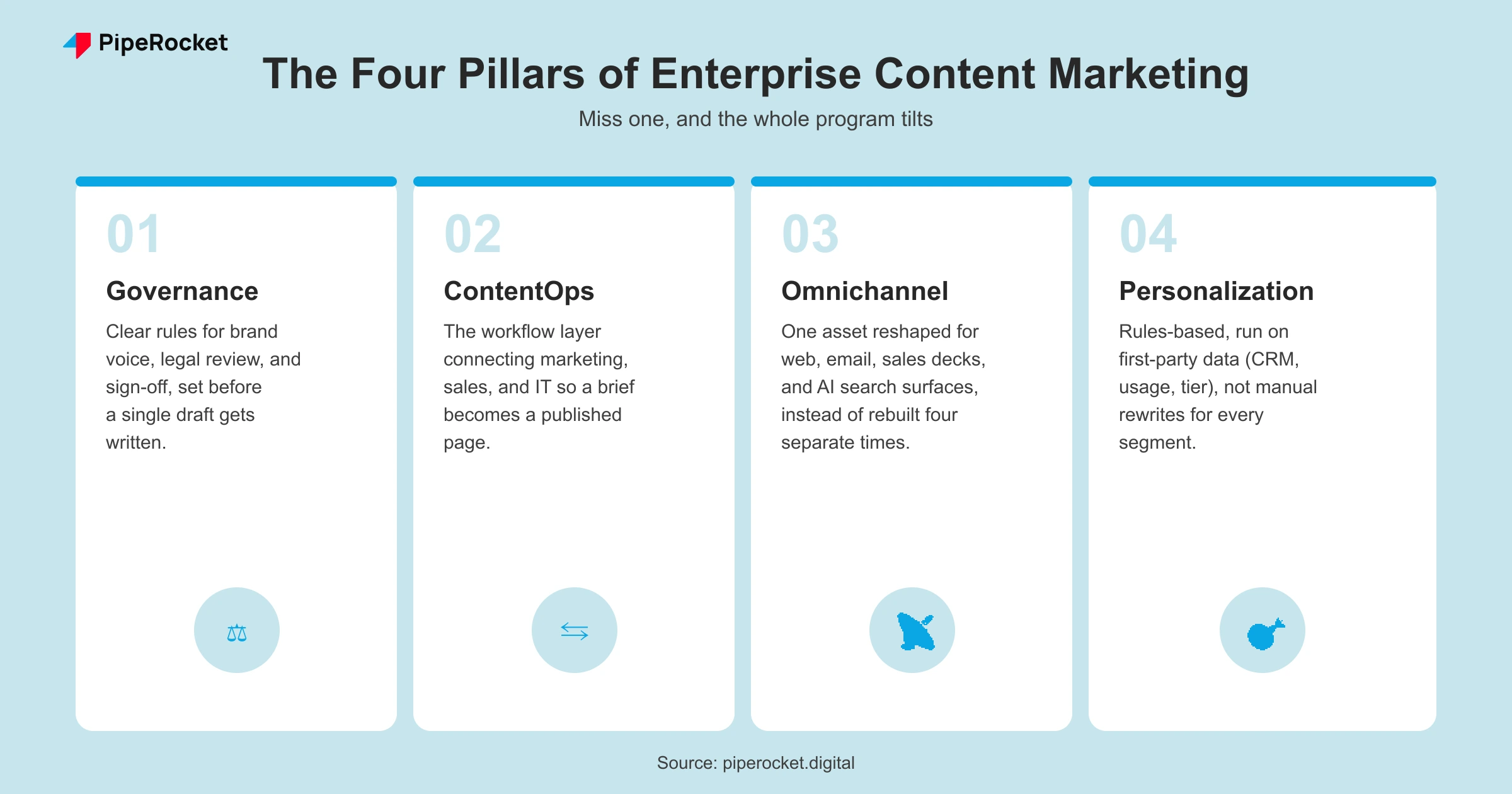
Most enterprise content problems trace back to one of these four being missing or half-built. A team with strong writers but no governance model ships inconsistent messaging. A team with governance but no ContentOps drowns in approval queues. Fix the structure and the content quality problem usually fixes itself.
Centralize Governance Before You Scale Anything Else
Governance means setting clear rules for brand voice, legal compliance, and approval steps before content gets written, not after a draft gets rejected for the third time. Without it, every business unit invents its own review process, and none of them agree on what “done” looks like.
The fix isn’t a 40-page brand bible nobody reads. It’s a short, enforceable set of rules: who owns final sign-off, what needs legal review versus a quick brand check, and what templates are pre-approved so most content skips the queue entirely.
Build Content Operations That Actually Connect Marketing, Sales, and IT
ContentOps is the workflow layer that gets an asset from brief to published without six people forwarding the same document over email. At enterprise scale, that workflow has to connect marketing, sales, and IT, because sales needs the asset in their enablement tool and IT owns the CMS permissions that decide who can publish where.
Most enterprise teams build ContentOps around a tool (a new CMS, a new project tracker) instead of a workflow. A tool can’t repair a broken handoff between departments; it only moves the bottleneck somewhere new.
Adapt the Same Asset for Every Channel, Don’t Rebuild It
Omnichannel distribution means one well-built asset gets reshaped for a website, an email, a sales deck, and increasingly, an AI search surface, instead of a separate team rebuilding it four times for four channels. A single research report can become a pillar page, a three-part email series, a sales one-pager, and a set of extractable stats for AI Overviews , without anyone starting from a blank page twice.
The teams that do this well treat every asset as a source of parts, not a finished product. The teams that don’t end up paying four content budgets for one idea.
Use First-Party Data to Personalize at Scale
Personalization at enterprise scale runs on first-party data (CRM fields, product usage, account tier), not guesswork about what a “persona” wants. A healthcare-vertical account and a retail-vertical account reading the same product page should see different proof points, different case studies, and sometimes a different headline, pulled from data you already own.
This works when it’s rules-based (if account industry equals X, show case study Y) rather than a manual rewrite for every segment. Manual personalization doesn’t survive contact with more than a handful of segments.
Pick the Tech Stack Infrastructure That Lets Every Team Reuse Content
Enterprise content infrastructure means a headless CMS plus a digital asset management (DAM) platform, so one asset can be stored once and reused across every business unit, channel, and region instead of copied into a dozen local folders. This is an infrastructure decision, separate from the ContentOps workflow that runs on top of it.
A headless CMS separates content from where it’s displayed, so the same product explainer can render on a website, a partner portal, and a mobile app without three rebuilds. A DAM platform keeps images, video, and approved brand assets in one governed library, so a regional team can’t quietly ship an outdated logo or an unlicensed stock photo.
The trap is buying an enterprise content marketing platform before the workflow exists. Infrastructure supports a ContentOps model that already works; it can’t invent one. Pick the stack after you know who owns publishing and how assets move from brief to live, not before.
Map Every Asset to a Funnel Stage Before You Scale Content Ops
Every piece of enterprise content needs a funnel-stage owner before it enters production, or ContentOps turns into a publishing machine with nothing steering it. This isn’t a lesson in what TOFU, MOFU, and BOFU mean; if you’re running enterprise content marketing , you already know that part. It’s a reminder that scale magnifies the cost of skipping it.
| Funnel stage | What it does at enterprise scale | Common formats |
|---|---|---|
| Top-of-funnel | Builds category awareness across business units without duplicating the same topic five times | Trend reports, educational blogs, original research |
| Middle-of-funnel | Helps a buying committee compare options and build internal consensus | Whitepapers, webinars, use-case guides |
| Bottom-of-funnel | Gives a buyer or their legal/procurement team the specifics to justify a decision | Case studies, product comparisons, ROI calculators |
A 30,000-person org running content across five product lines without this mapping ends up with a dozen near-identical TOFU pieces and almost nothing built for the procurement team stuck at the finish line. Map the gap before you approve the next content calendar, not after.
Decide Who Owns What: Centralized, Embedded, or Hybrid
In enterprise content marketing, the team can sit centrally, embed inside each business unit, or run as a hybrid of both, and the right pick depends on how many product lines you run and how different their buyers are. There’s no universally correct answer, so match the model to the org, not the other way around.
The quick take on the three trade-offs:
- Centralized gives you consistent voice and one governance queue, but turns into a bottleneck once more than a handful of business units all request content at once.
- Embedded moves faster inside each unit, but voice and quality drift apart, and nobody catches keyword overlap between two units until both pages are already live.
- Hybrid keeps the speed of embedded teams while a small center guards voice and catches overlap early.
| Model | Best fit | Main risk |
|---|---|---|
| Centralized | Two to three business units, similar buyers | Becomes a bottleneck as request volume grows |
| Embedded | Very different products or buyer types per unit | Voice drift and duplicate keyword targeting |
| Hybrid | Most enterprises past a certain size | Requires a clear split of what’s shared versus owned |
The hybrid model is what most enterprises land on eventually, with a clear split of what’s shared versus owned:
- The center owns governance, the shared keyword registry, brand voice standards, and SEO strategy, so it sets the rules and catches overlap early.
- Writers or content leads embedded in each business unit produce the actual assets against that shared framework, keeping the speed and subject-matter depth a central team usually can’t match.
Whichever model you pick, name an actual owner for the shared keyword registry and the governance rulebook. A shared resource with no named owner quietly turns into nobody’s job within two quarters, and that’s usually when the cannibalization problem creeps back in.
Where Enterprise SEO and AI Search Visibility Fit Into the Program
Enterprise SEO has to be designed into the ContentOps workflow from the brief stage, not audited in afterward, because that’s the only point where keyword ownership and content architecture decisions actually stick. Most of the enterprise content marketing advice ranking for this topic stops at governance and workflow and never gets to what happens once that content needs to be found.
That gap matters more now than it did two years ago. Search behavior has split across traditional results, AI Overviews, and AI assistants like ChatGPT and Perplexity, and enterprise brands with dozens of business units are the ones most likely to get this wrong, because nobody owns the full keyword map across the organization.
Making a program SEO- and AI-visibility-ready doesn’t require a separate workstream. It comes down to three things built into the existing ContentOps flow:
- A shared keyword and topic registry that every business unit checks before greenlighting a brief, not a rule enforced by memo, but a spreadsheet or tool that makes duplicate targeting visible before the writer starts.
- Clear, well-structured, extractable answers in every asset, since AI search visibility runs on the same content quality that gets a page ranked on page one.
- A funnel-stage tag on every asset, so BOFU comparison pages (the kind that earns AI Overview citations for decision-stage queries) get built with that goal in mind instead of by accident.
A program that’s already publishing clean, well-governed content is most of the way to being AI-search ready without extra work. TOFU content built for broad awareness rarely earns that same citation, and enterprise teams that measure AI visibility only at the awareness layer usually end up disappointed with the results.
The Real Bottleneck Is Legal and Brand Review, Not Content Quality
The most common failure point in enterprise content marketing isn’t writing quality. It’s the review pipeline sitting between a finished draft and a published page. We’ve seen this play out on an enterprise SEO engagement where a set of competitor-comparison landing pages got flagged for legal review before publish.
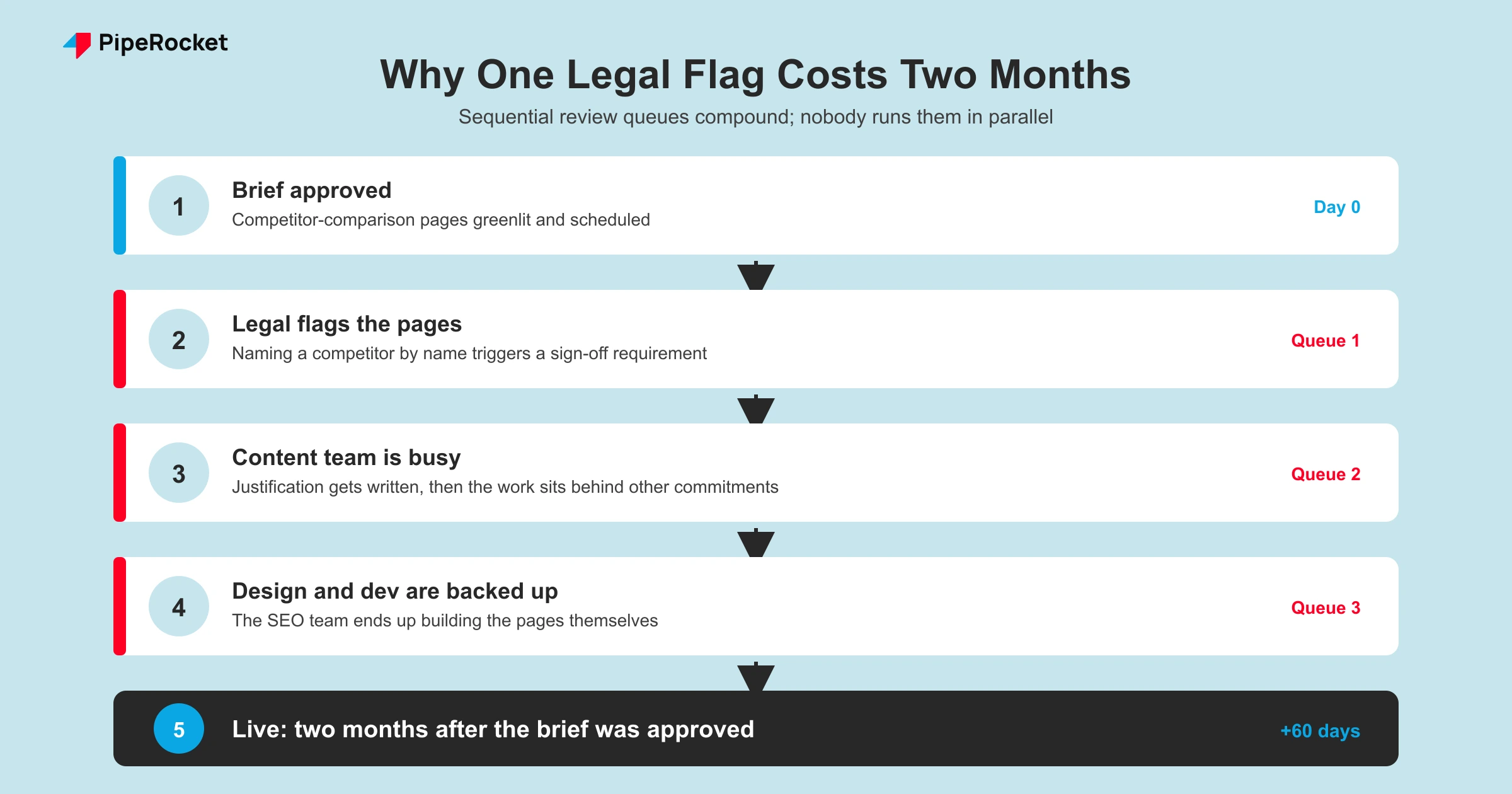
The pages weren’t the problem. The naming of a competitor by name was flagged as needing sign-off, so the team had to justify the pages as business-critical before legal would clear them. Then the content team had other commitments, so the work sat. Then design and dev were backed up too, so the SEO team ended up building the pages themselves.
The first set went live two months after the brief was approved, and almost none of that time was spent on the actual content. It was governance, one department at a time, each with its own queue. That’s the pattern to plan for: legal review, brand review, and resourcing conflicts compound sequentially unless a program manager is actively running them in parallel.
The fix isn’t rushing legal or skipping brand review. It’s building a pre-cleared fast track so most content never touches the slow queue at all:
- Reserve full legal sign-off for content that names competitors, makes compliance claims, or covers a regulated topic.
- Everything else moves on a lighter, faster track with a brand check instead of a full legal review.
Stop Multiple Business Units From Competing for the Same Keywords
When two business units at the same company both publish enterprise content marketing assets aimed at the same keyword, the SEO program doesn’t get two chances to rank. It gets one weakened chance, split across two competing URLs, and Google has no reason to prefer either one.
This shows up constantly in enterprise portfolios, especially after an acquisition or a reorg that leaves two teams unaware they’re building the same content. A fintech holding company with a payments division and a lending division might both publish a guide to “compliance automation,” each unaware the other exists, and neither ranking as well as one consolidated page would.
The fix runs through the same shared keyword registry mentioned above, checked before a brief gets approved, not after two pages are already live and competing.
When overlap is found after the fact, the answer is almost always consolidation: pick the stronger page, redirect or merge the weaker one, and let the combined authority work for one URL instead of splitting across two.
Audit and Update Existing Content Before Publishing More
Auditing and refreshing existing content is a standing step in any enterprise content marketing program, not a one-off cleanup, because a 30,000-person org publishing across five product lines accumulates stale, overlapping, and orphaned pages faster than any new-content calendar can outrun. Fix what you already own before you commission more.
Run a content audit on a set cadence (quarterly for large portfolios) and sort every page into one of three actions:
- Keep and refresh: the page ranks or earns pipeline but has aging stats, dead links, or a stale example. Update it in place and reset the published date.
- Consolidate: two or more pages target the same intent. Merge them into the stronger URL and redirect the rest, so combined authority works for one page instead of splitting.
- Retire: the page no longer serves a buyer or a business unit. Redirect it to the closest live equivalent instead of leaving a thin orphan.
At enterprise scale the audit is also where cannibalization gets caught before it compounds, since overlap between business units shows up as two pages chasing one keyword. Tie the audit to the shared keyword registry so the same review resolves both problems at once.
Manage Content Vendors, Agencies, and Contractors Deliberately
Most enterprise content marketing programs run partly on outside agencies and contractors, so treat vendor management as part of ContentOps, with the same briefs, brand rules, and keyword registry your internal writers work from. External help scales output; it also multiplies the ways voice and quality can drift if the governance model doesn’t reach them.
Use outside vendors when demand is spiky, a business unit needs subject-matter depth the internal team lacks, or a new product line has to ramp faster than hiring allows. Keep the work coordinated with a few rules:
- Give agencies the same brief template, brand voice standards, and pre-approved formats internal writers use, so their output clears the same review track.
- Route every external brief through the shared keyword registry, so a contractor doesn’t build a page that competes with a live internal one.
- Name one internal owner per vendor relationship, so quality feedback and revisions don’t scatter across five stakeholders.
On tooling, most enterprises do eventually invest in dedicated content marketing platforms, and that step is worth taking once the workflow is settled. Buy the tools to support a ContentOps model that already works, so the software reinforces the process instead of standing in for one you never built.
Common Mistakes to Avoid
These mistakes show up across most enterprise content marketing programs we’ve reviewed, and every one of them is a structural problem, not a talent problem.
Building ContentOps Around Tools Instead of Workflows
A new CMS or project management tool can’t repair a broken handoff between marketing, sales, and IT; it only relocates the bottleneck. Map the actual workflow first, then pick tools that support it.
Treating Governance as a Blocker Instead of a Design Constraint
Teams that see legal and brand review as an obstacle to route around end up rebuilding the same approval fights on every launch. Teams that design a pre-cleared fast track around governance from the start spend far less time waiting.
Measuring Volume Instead of Pipeline Contribution
Publishing more content is not the same as producing more pipeline. Content Marketing Institute’s January 2026 enterprise research found the top challenges cluster around output outrunning insight:
- 42% of enterprise marketers cite resource constraints
- 38% cite measuring content effectiveness
- 33% cite cross-departmental collaboration
All three point to the same root issue: teams keep producing without a clear read on what’s actually working, or on whether other departments are pulling in the same direction.
Letting Every Business Unit Run Its Own SEO Program
Decentralized SEO without a shared keyword registry guarantees overlap. One business unit’s win becomes another’s cannibalization loss, and the aggregate program looks weaker than any single team’s output would suggest.
Skipping the Operating Model Decision Entirely
Plenty of enterprise programs never formally decide whether they’re centralized, embedded, or hybrid. They just grow that way by accident, one hire and one reorg at a time. By the time anyone notices the voice has drifted and two business units are chasing the same keyword, untangling it costs far more than picking a model upfront would have.
How to Tell If Enterprise Content Marketing Is Actually Working
The enterprise content marketing metrics that matter most are cross-departmental collaboration friction, content effectiveness measurement, and governance speed, not raw publishing volume. Those map straight onto the top challenges enterprise marketers report, so measuring them tells you where the program actually leaks.
Track how long it takes a piece of content to move from brief to published, broken down by how much of that time was writing versus review. If review consistently eats more time than production, that’s the lever to pull, not headcount. Track keyword-level overlap across business units on a quarterly cadence, since new overlap creeps in every time a team launches a new product line or campaign without checking the registry first.
Tie content to pipeline the same way any other SEO or demand-gen channel gets measured: organic-attributed opportunities, not just sessions or downloads. A whitepaper that generates 500 downloads and zero sales conversations isn’t a win just because the number looks good in a report. Enterprise leadership generally cares about the second number, not the first.
A quarterly scorecard works better than a monthly one for most enterprise programs, since governance and cross-departmental fixes take longer than a month to show up in the numbers. Report on a small set of things every business unit stakeholder can actually act on:
- Time from brief to published, split into writing time versus review time
- Keyword overlap flagged and resolved across business units
- Organic-attributed pipeline by business unit, not just total sessions
- Which pieces of content sales teams are actually pulling into deals, not just what’s published
If a business unit can’t answer where its content sits on those four points, that’s usually the sign the operating model needs a revisit before the next planning cycle, not more content.
How PipeRocket Digital Helps With Enterprise Content Marketing
We build the SEO layer that enterprise content programs usually bolt on too late: shared keyword registries that stop business units from cannibalizing each other, content briefs built around real search intent, and measurement tied to pipeline instead of publishing volume. If your content team already has the governance and ContentOps sorted but SEO keeps getting treated as an afterthought, that’s exactly where we plug in. Teams comparing options can start with our list of the best enterprise SEO agencies or the best B2B marketing agencies , or just get in touch directly.
Frequently Asked Questions
What is enterprise content marketing?
Enterprise content marketing is the discipline of publishing content at the scale of a large organization, across multiple business units, regions, or brands, without losing consistency or slowing down under legal and compliance review. It leans on governance, connected workflows (ContentOps), omnichannel distribution, and first-party data personalization instead of just producing more content. The goal is coordinated output across departments, not a bigger blog calendar for one team.
What is an enterprise content strategy?
An enterprise content strategy is the plan that decides which business units own which topics, how content gets reviewed and approved, and how assets get reused across channels instead of rebuilt from scratch for each one. It sits above individual campaigns and exists specifically to stop different parts of a large organization from working against each other. A strong one includes a shared keyword registry so business units don’t quietly compete for the same search terms.
How is enterprise content marketing different from regular content marketing?
Regular content marketing usually involves one team, one brand voice, and a fairly short approval chain. The enterprise version adds multiple business units, formal legal and brand review, cross-departmental workflows, and the real risk of different teams publishing overlapping or even competing content. The tactics (blogs, case studies, whitepapers) look similar. The operational layer around them, governance, ContentOps, and shared measurement, is what actually changes.
What are examples of ECM software?
Enterprise content software falls into two categories: headless CMS platforms that separate content from where it’s displayed, and digital asset management (DAM) platforms that keep images, video, and approved brand assets in one governed library. Most enterprise programs run both, plus a workflow or project tool on top.

