Why Your SEO Isn't Driving Pipeline: A B2B SaaS Diagnostic
 Ranjeeth Kumar
Last updated on
Ranjeeth Kumar
Last updated on
Your organic traffic chart goes up and to the right, and your pipeline report doesn’t move. If you’re staring at those two graphs wondering what broke, you’re in the exact spot most B2B SaaS marketing teams hit around month six of an SEO program. The trap is treating “traffic up, pipeline flat” like one problem with one fix. It’s usually one of five, and you can’t fix it until you know which one is yours.
TL;DR
- It’s a diagnosis, not a fix: “Traffic up, pipeline flat” has five distinct causes, so run the symptom table and name the right one before you touch the content calendar.
- Wrong intent: You ranked for keywords people read, not keywords people buy after, so the traffic was never going to convert.
- Wrong audience: Growing traffic from people who’ll never buy is the failure mode that fools the most teams, because the number still goes up.
- No BOFU page: The right people land, but there’s no comparison, alternatives, or pricing page for them to convert on, so they leave.
- Broken attribution: The pipeline is real and the tracking is hiding it, so a conversion problem and an attribution gap look the same in a dashboard.
- The funnel doesn’t connect: Each stage works alone, but a buyer on a TOFU page has no route to the BOFU page, so the path never closes.
Traffic Up and Pipeline Flat Is Almost Never One Problem
The reason most teams stay stuck is they treat this as a single fault with a single switch. It isn’t. We’ve audited enough SaaS SEO programs to see the same five failure modes again and again, and they need completely different fixes. Throw “publish more” at an attribution gap and you’ve spent another quarter producing content that the CRM was never going to credit.
So before you do anything, name the failure mode. Here’s the diagnostic table I run first. Find the row that matches what your own data is showing, then read the section for that cause.
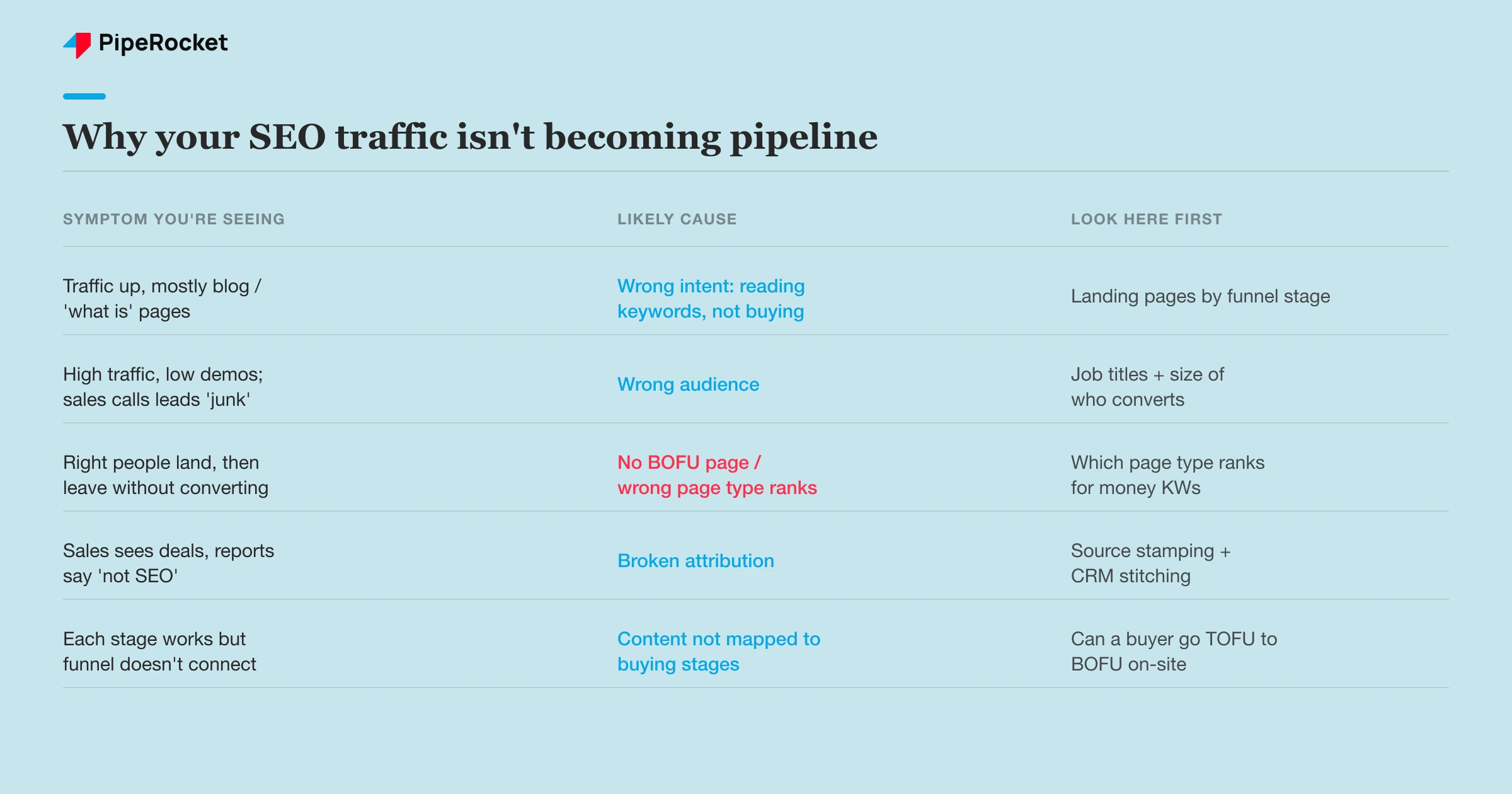
| Symptom you’re seeing | Likely cause | Where to look first |
|---|---|---|
| Traffic is up, but it’s mostly on blog and “what is” pages | Wrong intent: you ranked for reading keywords, not buying keywords | Your top landing pages by funnel stage |
| Lots of traffic, low demo requests, leads sales calls “junk” | Wrong audience: real traffic, wrong people | Job titles and company size of who converts |
| High-intent visitors land, then leave without converting | No BOFU pages, or the wrong page type ranks | Which page type ranks for your money keywords |
| Sales says “deals came from somewhere,” reports say “not SEO” | Broken attribution hiding the pipeline | Source stamping and CRM-to-session stitching |
| Each stage works alone but the funnel doesn’t connect | Content not mapped to buying stages | Whether a buyer can move TOFU to BOFU on your site |
One important note before you read on. These causes stack. A program can have a real intent problem and a broken attribution setup at the same time, which is exactly why the dashboard stays confusing. Work the list top to bottom, fix the most likely cause, and re-check before assuming you have a second one.
You Ranked for Keywords People Read, Not Keywords People Buy After
The most common reason SEO traffic doesn’t convert is that you targeted keywords with no buying intent behind them. A buyer searching “what is lead scoring” is learning. A buyer searching “best lead scoring software for HubSpot” is shopping. Both are “keywords.” Only one is attached to a credit card, and most content programs spend their whole budget on the first kind because the volume looks better.
The math is what gives it away. A keyword with 1,000 monthly searches, even ranking top three, brings maybe 100 clicks. At a normal SaaS conversion rate of 2 to 4%, that’s four or five conversions, and that’s before you ask whether those searchers were buyers at all. High volume with the wrong intent loses to low volume with buying intent every time.
How to tell if this is you: open your top 20 organic landing pages and tag each one by funnel stage. If 80% of your traffic lands on TOFU “what is” and “how to” pages and almost none lands on comparison, alternatives, or pricing-style pages, intent is your problem. The traffic was never going to convert because you optimized for the wrong moment in the buying conversation. Fixing this means shifting your keyword strategy toward bottom-of-funnel terms, scoring keywords by pipeline value before you write a word, and being deliberate about how you tie content to MQLs so each new page has a clear path to a qualified lead rather than just a pageview.
Your Traffic Is Real, But It’s the Wrong People
This is the failure mode that fools the most teams, because the traffic is genuine and growing, so it looks exactly like a win. The catch is that growing traffic from people who’ll never buy is worse than flat traffic, because it hides the problem behind a number going up.
We once repositioned a client around a tighter ICP and watched the same traffic start converting. At first we did what most SEO teams do: target high-volume BOFU keywords and publish traffic-focused content. Traffic grew. Pipeline didn’t, and the leads weren’t qualified.
So we changed the question. Instead of “what keywords get the most searches,” we asked “what does someone search when they already have this problem and need a solution now?”
- Implementation problems
- Scaling bottlenecks
- Operational headaches specific to their category
Most of those terms had near-zero search volume.
But the searchers were decision-makers. A single page might pull only five to ten visitors a week, almost all of them highly qualified. In enterprise SaaS, one high-intent visitor is worth more than thousands of random clicks, which is exactly why it pays to calculate the revenue impact of each blog post instead of ranking your content by traffic. If your traffic is climbing but pipeline isn’t, you may not have a traffic problem at all. You have an audience problem.
There’s a sneakier version of this. If your company repositioned in the last year, moved upmarket, or changed your ICP, your SEO is probably still ranking the old version of the company. The pages, the keywords, the backlinks all still reflect who you used to sell to, so traffic looks healthy while the wrong people land. That isn’t a metadata refresh; it’s a rebuild around the new ICP’s language.
How to tell if this is you: pull the job titles and company sizes of everyone who converted from organic in the last quarter. If they don’t match your ICP, or sales keeps calling the leads “junk,” the audience is wrong even though the traffic is real.
High-Intent Visitors Land, Then Leave Without Converting
If the right people are landing and still not converting, the problem is usually the page they land on, not the traffic to it. Most SEO audits stop at rankings and traffic and never check the conversion layer, which is exactly where this failure mode hides.
We had a client ranking top three for high-intent keywords while conversions sat flat. The cause: they were ranking with blog posts for queries where searchers now wanted a product or comparison page . The intent had shifted from “explain this to me” to “let me choose,” and the content no longer matched. Ranking with the wrong content type is about as useful as not ranking at all.
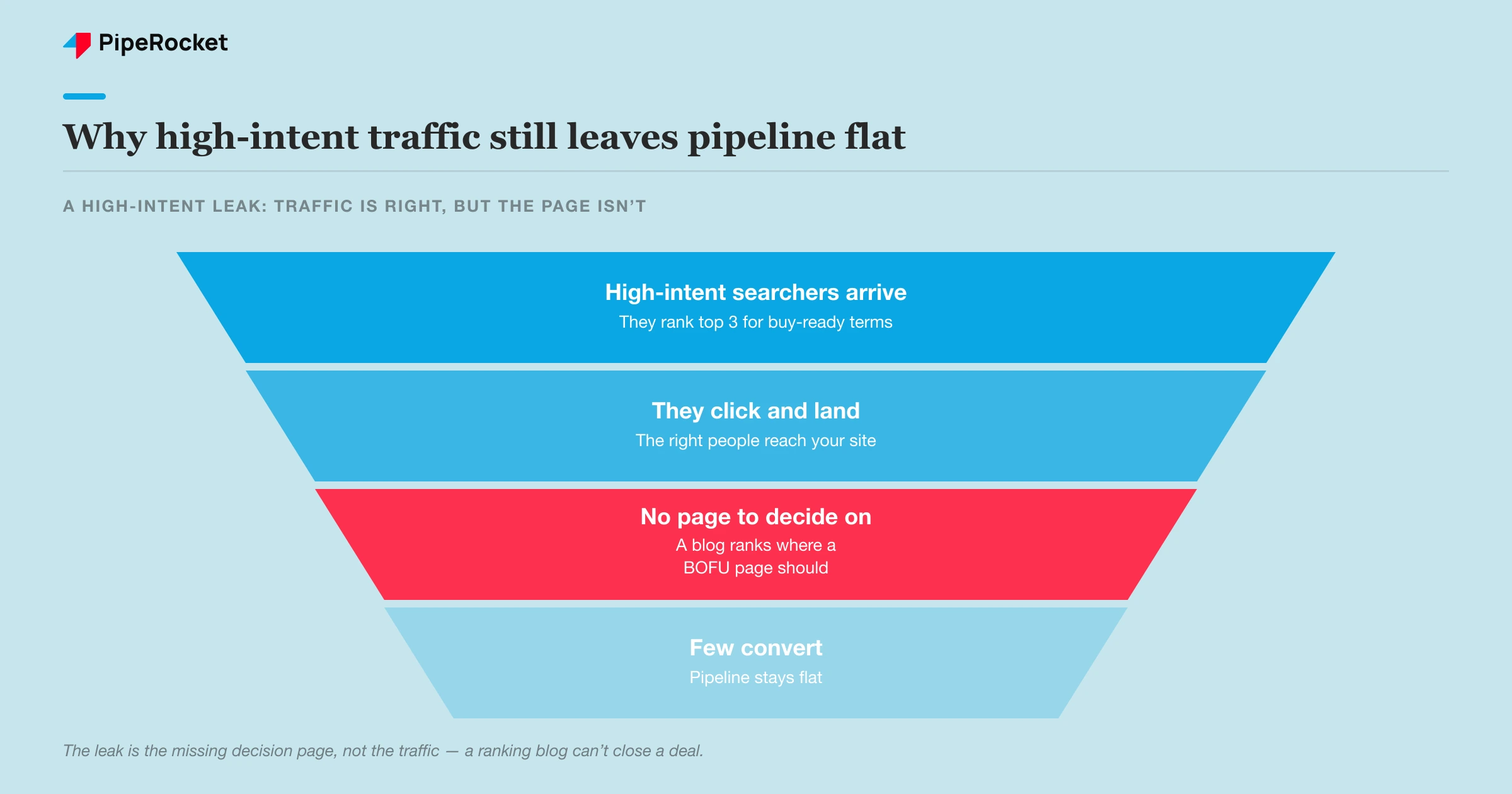
The other common version is missing pages entirely. You rank for “[your category] software” with a glossary article, but you have no comparison page, no alternatives page , and no pricing page for the buyer to convert on. The intent arrives and finds nowhere to land. These decision-stage pages are where the credit card actually comes out.
When conversions don’t move on high-intent traffic, check three things in order:
- Which page type ranks for your money keywords (blog vs product vs comparison)
- Whether the CTAs on those pages clearly point to the next step
- Whether a BOFU page even exists for the keyword, or whether a TOFU page is filling the slot by accident
This is a genuine trade-off worth naming. A TOFU blog ranking for a high-intent term gives you traffic and topical authority , but it costs you the conversion if you never build the BOFU page underneath it. It works while you’re building authority. It breaks the moment the buyer is ready and there’s nothing to buy.
Sales Knows the Deals Are There, Your Reports Don’t
Sometimes the pipeline is there and your tracking is hiding it. This is the failure mode where everything is actually working and the dashboard is lying to you, which is why it’s the trickiest of the five to diagnose.
Telling a tracking problem apart from a real conversion problem is the whole game here. They look identical in a report: “SEO isn’t driving pipeline.” The difference is whether the pipeline exists and isn’t being credited, or doesn’t exist at all.
Here’s the test we use. Don’t start in the analytics tool. Go ask sales, which is far easier when you already align SEO with sales so both teams share a definition of a real opportunity: are deals closing where the buyer first found you through search, a comparison page, or a “best tools” list? The answer splits two ways:
- If sales can point to those deals and your SEO report can’t, you have an attribution problem, not a conversion problem.
- If sales also can’t find them, the pipeline genuinely isn’t there and you’re back to one of the first three causes.
Attribution breaks for honest reasons in 2026. AI engines answer buyers without a click. Cookie tracking has been gutted. People discover you on channels nothing can track, then come back later through a branded search that gets credited to “direct.”
Industry observers suggest a meaningful and growing share of traffic now comes from LLM tools where the visit never registers at all. The result is a real pipeline that standard last-click reporting simply never assigns to organic.
How to tell if this is you: if your homepage and branded-search conversions are quietly climbing month over month while your “organic” attribution stays flat, that’s the signature of discovery happening upstream and getting miscredited downstream. The fix is wiring, not more content, and it usually means you need to set up multi-touch attribution so the early organic touches get credited instead of collapsing into “direct.” Get the attribution plumbing right before you conclude SEO isn’t working.
Each Stage Works, But the Funnel Doesn’t Connect
The last failure mode is structural: every piece works in isolation and nothing connects into a path. You have TOFU content, you have a BOFU page somewhere, but a buyer who lands on the awareness blog has no clear route to the decision-stage page, so they read, leave, and never enter pipeline.
This is what content-mapped-to-buying-stages actually means in practice. It’s not a tidy diagram on a slide. It’s whether a real person who arrives on “what is SOC 2 compliance” can find their way to your comparison page and then your pricing page without leaving the site to do it. If the only thing connecting your TOFU and BOFU content is hope, the funnel has a gap the buyer falls through.
Picture a compliance SaaS for fintech teams. They rank well for “SOC 2 audit checklist” and they have a strong “SOC 2 software vs spreadsheets” comparison page. But the checklist article links to three more checklist articles and never points down to the comparison page. The reader gets educated and bounces, and the comparison page only ever sees traffic that already knew to search for it.
Tip: To tell if this is you, pick your best-trafficked TOFU page and try to get from it to a demo request using only the links on the page. If you can’t get there in two clicks, your buyers can’t either. The goal is to feed buying signals from one stage into the next, which is the difference between SEO that brings traffic and SEO that builds pipeline.
How PipeRocket Digital Fixes This
When pipeline is flat, we diagnose before we publish. We tag your traffic by intent and ICP fit, check which page type ranks for your money keywords, and test whether the gap is real conversion or broken attribution before recommending a single new page.
Most teams want more content; we usually find the fix is fewer, better-mapped pages and tighter tracking. If your organic traffic is climbing while pipeline sits still, our SaaS SEO team will tell you which of the five causes is actually yours. You can reach out to us here .
Frequently Asked Questions
Why is my organic traffic going up but my leads aren’t?
Rising traffic with flat leads almost always means you’re ranking for the wrong intent or attracting the wrong audience. You optimized for high-volume informational keywords that people read but don’t buy after, or you’re pulling visitors who don’t match your ICP. Pull your top landing pages and tag them by funnel stage and visitor job title. If the traffic is TOFU-heavy or off-ICP, the leads were never coming, no matter how high the traffic climbs.
How do I know if it’s a tracking problem or a real conversion problem?
Ask sales before you open the analytics tool. If sales can point to closed deals where the buyer first found you through search or a comparison page, but your SEO report shows none of it, you have an attribution problem. If sales also can’t find those deals, the pipeline genuinely isn’t there and the cause is intent, audience, or missing BOFU pages. The two look identical in a dashboard, so the sales conversation is what separates them.
How long should SEO take before it drives pipeline?
For a B2B SaaS program built around buying intent, qualified pipeline usually starts showing in the four-to-six month range, with compounding picking up after that. But “it’s too early” is also the excuse that hides every failure mode on this list. If you’re past six months with traffic climbing and pipeline flat, time isn’t your problem. Run the diagnostic table instead of waiting another quarter.