Most SaaS marketing teams don’t have a paid media strategy. They have a list of channels someone turned on at some point, and a budget split that hasn’t changed since the last planning meeting. Google gets the biggest number because it always has. LinkedIn gets whatever’s left because a competitor is running ads there. Nobody can tell you why the mix looks the way it does, only that it does.
TL;DR
- Channel mix is a portfolio decision: the right paid mix depends on your company’s stage and how many people sit in the buying decision.
- Sequence channels in order: fund the channels that capture existing demand first, then layer in channels that create demand once capture is maxed out.
- Budget follows funnel data: allocate based on where pipeline is actually stalling this quarter, and rebalance every quarter as that changes.
- Every channel gets the same measurement bar: judge it on lift and pipeline influence, so an influence channel isn’t held to a capture-channel’s last-click standard.
- Add or cut channels on evidence: a new channel earns budget once the current mix is maxed and proven; a channel gets cut when it can’t show influence after a fair test window.
- Default split for most teams: roughly 50-60% to demand capture (Google Search), 20-30% to precision targeting (LinkedIn/Meta), 15-20% to brand and education, then adjust by company stage per the allocation table.
Why Your Paid Channel Mix Needs Its Own Strategy
Adding a channel is an action, not a strategy, and it’s usually the wrong action when the real problem is that your first channel was never fully funded. I’ve watched SaaS teams launch LinkedIn ads to “diversify” while their Google Search campaigns were still leaving high-intent keywords unfunded because the daily budget capped out by 11 a.m.
That’s backward. If your best capture channel is starved, the fix is more budget on that channel, not a new line item on a channel you haven’t tested yet. Diversification only makes sense once the channel doing the most obvious job, catching people who are already looking for a solution like yours, is running at full capacity.
The deeper problem is that most teams think about channels one at a time. They ask “should we run Meta ads?” as an isolated question instead of asking where Meta fits inside a portfolio that already includes Search, LinkedIn, and maybe Microsoft Ads. A channel decision made in isolation almost always overweights whichever platform the most recent conference talk was about.
The higher your deal size, the more the channel mix matters. A low-ACV, self-serve product can win on a single channel because one person makes the buying call. A high-ACV SaaS deal is a committee decision, and no single channel reaches an entire buying committee .
Think about who actually touches a $40,000-a-year contract:
- A champion finds you through search.
- A VP sees your name on LinkedIn a month later and stops treating it as an unknown vendor.
- Finance asks procurement to check your security page.
None of those three people had the same journey, and no single channel was built to reach all of them at once. The real argument for running more than one channel is reach, not raw spend.
This is also why a channel mix built for a five-person sales-assisted deal doesn’t transfer to a self-serve product priced at $30 a month. The self-serve buyer doesn’t need influence spend warming them up over six weeks. They need a fast, cheap capture channel and a frictionless signup flow. Copying a committee-sized channel mix onto a single-buyer product just adds cost without adding conversions.
How to Sequence Paid Channels by Company Stage
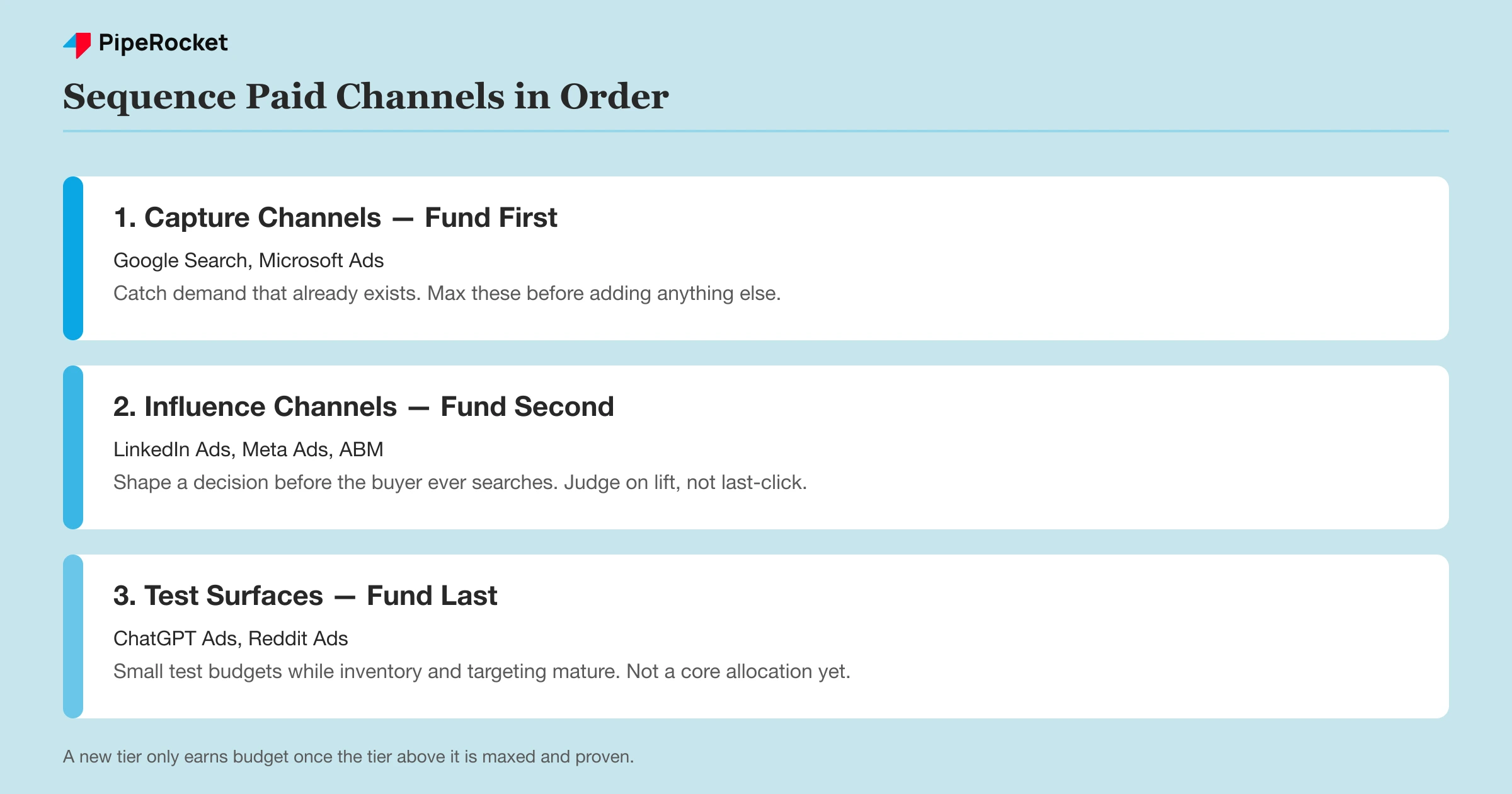
Fund capture channels first (Google and Microsoft Search), add influence channels (LinkedIn, Meta, ABM) once capture is maxed with diminishing returns, and treat AI and other test surfaces as the budget-last layer until you have your own data on them.
Sequencing means deciding which channel earns budget first, which earns it second, and what has to be true before you add a third. Most teams get this backward by adding channels in order of hype instead of order of funnel logic.
Fund the Capture Channels First
Capture channels catch demand that already exists. Someone typed a search query, someone clicked a comparison link, someone is already in market. Google Ads for SaaS and, in categories where the CPC gap is real, Microsoft Ads are the clearest examples.
On one SaaS account we manage, the same category keyword cost about $18 on Bing versus roughly $61 on Google for the same intent, and Bing still pulled more raw volume on that term. That doesn’t mean abandon Google. It means fund the cheaper capture channel alongside it before spending a single dollar on a channel that has to create the demand from scratch.
The rule here is simple: don’t fund an influence channel until your capture channels are maxed. Maxed means you’ve raised bids or budgets on high-intent terms and started seeing diminishing returns, not that you’ve hit an arbitrary monthly number. If your Search campaigns still have headroom on branded and high-intent non-branded terms, that’s where the next dollar goes.
Add Influence Channels Once Capture Is Proven
Influence channels don’t close deals on the spot. They shape a buyer’s decision weeks before that buyer ever searches your brand name. LinkedIn Ads and Meta Ads for B2B SaaS both sit here. Google is for capture, LinkedIn is for influence. Nobody scrolling LinkedIn is in buying mode. The ad plants a seed, and weeks later, when that VP actually needs the solution, they Google your brand and convert somewhere else entirely.
That’s exactly why influence channels get funded second, not first. You need a capture layer already running so the demand these channels create somewhere lands and converts. Turn on LinkedIn before Search is working and you’ll spend real money warming up buyers who then convert on a Google campaign you haven’t properly funded, or worse, on a competitor’s.
For accounts selling into named accounts or a small number of high-value targets, ABM-style paid belongs in this layer too, funded once you know which accounts are worth the spend, not before. For the specific search-versus-social tradeoff, see our paid search vs paid social breakdown.
When AI Ad Surfaces Earn a Budget Line
AI-native ad surfaces, ChatGPT Ads among them, are the newest layer, and they earn budget last for a specific reason: inventory and targeting maturity are still catching up to what marketers expect from an established platform. That doesn’t mean skip it. It means treat it as a test budget, not a core allocation, until you have a quarter or two of your own data on how it performs for your category. That’s how our ChatGPT ads agency runs it: a test budget with kill criteria set up front. If you’re comparing partners for that test, our review of the best ChatGPT ads agencies covers who is already running campaigns in the Ads Manager.
The same logic applies to smaller channels like Reddit Ads , which behave like an awareness channel rather than a closing one, and it’s how our Reddit advertising agency scopes the first test. Judge these newer or thinner surfaces on reach and assisted signals, the same way you’d judge LinkedIn, not on whether they can match Search’s last-click conversion rate . They can’t, and that’s not the job you funded them for.
How to Allocate Budget Across the Paid Mix
The common industry default puts roughly 50-60% of paid budget into demand capture (Google Search), 20-30% into precision targeting (LinkedIn/Meta prospecting), and 15-20% into brand and education. That’s a starting point, not a rule, and the right split depends on company stage.
| Budget layer | Default share | What it funds |
|---|---|---|
| Demand capture | 50-60% | High-intent Google Search, Microsoft Ads |
| Precision targeting | 20-30% | Account-based LinkedIn and social prospecting |
| Brand and education | 15-20% | Ungated awareness, thought leadership , top-of-funnel reach |
Treat that split as the common default, then refine it by stage. Allocation is a working split you revisit every quarter based on where the funnel is actually stalling, not a fixed percentage you set once, and the honest starting point depends on company stage more than anything else.
| Stage | Capture (Search) | Influence (LinkedIn/Meta) | ABM / Named Accounts | Test Budget (AI surfaces, Reddit) |
|---|---|---|---|---|
| Early-stage, still proving product-market fit | 60-70% | 15-25% | 0-10% | 0-5% |
| Growth-stage, repeatable sales motion | 45-55% | 25-35% | 10-20% | 5-10% |
| Scale-stage, multiple segments and ACV tiers | 35-45% | 25-30% | 20-30% | 5-10% |
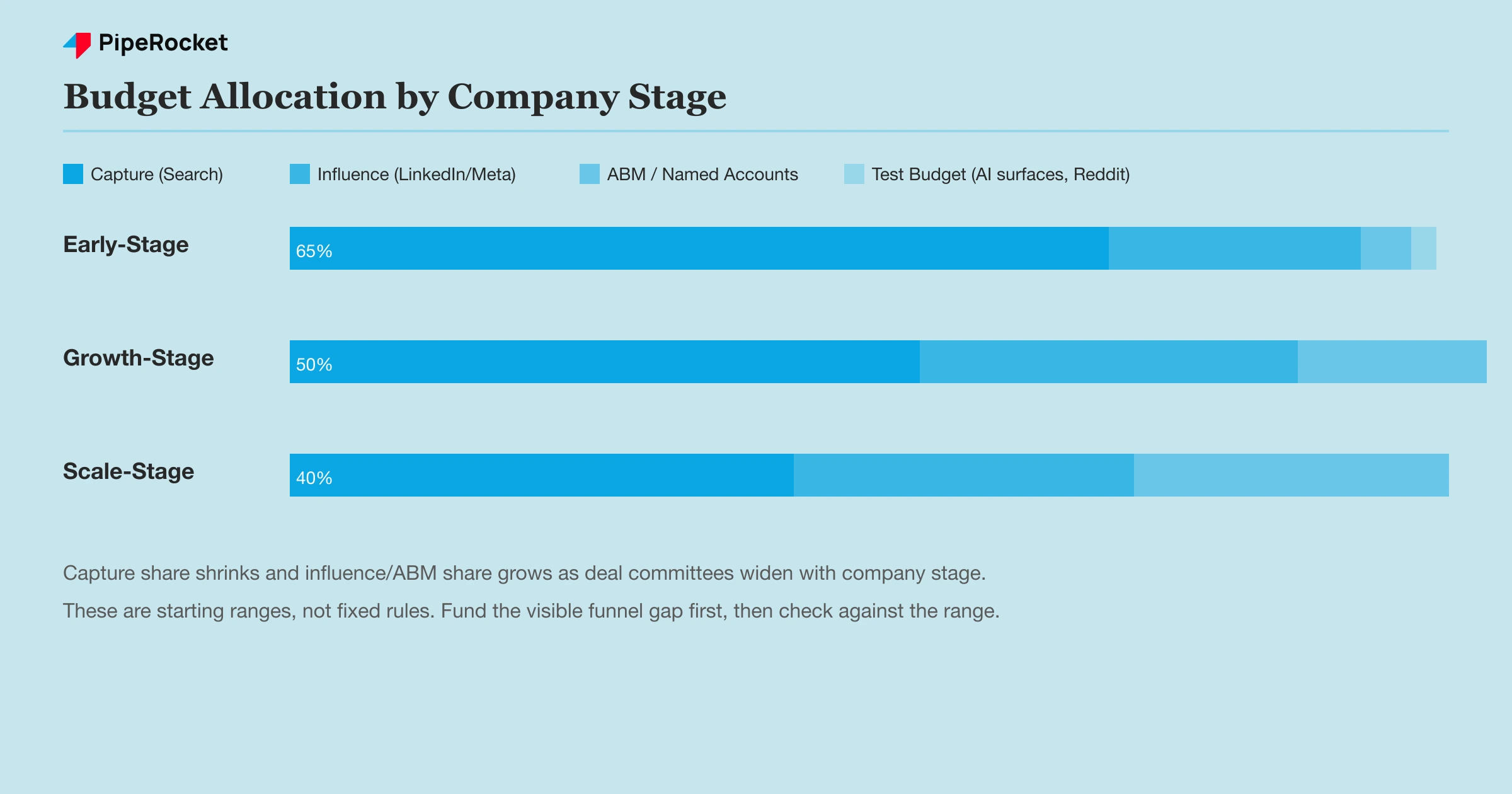
Early-stage SaaS should put most of the budget into capture, because you’re still learning which keywords and messages convert, and influence spend on an unproven message just burns money faster. As the sales motion becomes repeatable and deal sizes climb, influence and ABM earn a bigger share because more people are now involved in every deal, and a single capture channel physically cannot reach all of them. For what capture spend actually costs at each stage, our Google Ads benchmarks break down CPC and cost per lead by campaign type and region across 65+ B2B SaaS accounts.
None of these ranges are a rule to follow blindly. If your Search campaigns are still leaving qualified keywords unfunded, don’t shift budget to LinkedIn because a table said 25%. Fund the gap you can see first, then use the table as a sanity check.
Rebalance Quarterly, Not Annually
A lot of SaaS marketing teams set a channel split once a year during planning season and never touch it again until the next budget cycle. That’s too slow. Funnel conditions change faster than that. A competitor drops brand-search CPCs, a category gets crowded on LinkedIn, or a new sales hire suddenly needs more BOFU retargeting to close a backlog of stalled deals.
Reviewing the split quarterly means asking the same three questions every time: which channel is closest to being maxed, which channel is showing lift that justifies more budget, and which channel hasn’t moved a number in two consecutive reviews. That last one is your first cut candidate, not automatically, but it’s where the conversation should start.
Treat ABM as a Budget Layer, Not a Separate Program
Account-based paid spend often gets planned in a silo, with its own budget owner and its own reporting, disconnected from the rest of the paid mix. That’s a mistake once ABM crosses more than a small test allocation. The accounts you’re targeting with ABM are usually also seeing your Search and LinkedIn ads. Treating those as unrelated programs means you can’t tell whether an account converted because of the ABM push, or because it had already seen three other touches first.
Common Mistakes in Cross-Channel Paid Strategy
Copying a Competitor’s Channel Mix
Seeing a competitor run LinkedIn, Meta, and Reddit ads at once tells you almost nothing about whether that mix fits your deal size or your funnel gaps. Their channel mix reflects their stage and sales motion, plus a budget you don’t have visibility into. Copying the mix without copying the reasons behind it just means paying to run someone else’s experiment.
Judging Every Channel by Last-Click
Last-click attribution kills influence channels for a reason that has nothing to do with whether they’re working. LinkedIn and Meta rarely get last-click credit because the buyer converts somewhere else, usually a branded search, weeks later. Cutting a channel because a dashboard shows zero direct conversions is one of the fastest ways to pause something that was quietly doing its job.
Adding a Channel Before the Last One Is Maxed
This is the sequencing mistake in a different outfit. Teams add a third or fourth channel because the second one hasn’t “worked yet” after three weeks, when the real issue is the first channel was never given enough budget to prove itself. Spreading a fixed budget across more channels usually just means every channel gets too little to generate a real signal.
Letting Budget Follow Last Quarter’s Plan
Budgets that don’t move quarter to quarter are budgets that stopped listening to the funnel. If your top-of-funnel is overflowing but demos aren’t closing, the fix might be less influence spend and more budget on retargeting or sales enablement content instead of the same split you used six months ago.
Running Every Channel on the Same Message
A capture-channel ad and an influence-channel ad are answering two different questions. Using the same creative for both flattens that distinction.
- Search ad copy should speak to someone who already knows what they’re looking for and needs proof you’re the right pick.
- LinkedIn and Meta creative needs to earn attention from someone who wasn’t thinking about the problem thirty seconds ago.
Running identical messaging across both usually means the capture channel’s copy feels too educational and the influence channel’s copy feels too transactional for a cold scroll.
Sending High-Intent Traffic to a Generic Landing Page
A perfectly sequenced channel mix still leaks money if a high-intent Search click lands on a generic homepage. Someone who searched a specific category term or comparison query wants a page that matches that exact intent, with the proof and the demo CTA already in view.
Match the landing page to the intent of the click. A branded or category search should land on a page built for that query, not a catch-all homepage that makes a ready buyer hunt for the next step. The channel gets blamed for a weak conversion rate when the landing page was the actual gap.
Chasing Cheap Leads Instead of Pipeline Value
Optimizing for the lowest cost per lead often buys the wrong leads. A channel that produces cheap sign-ups can look like the winner on a CPL dashboard while producing almost nothing that turns into pipeline, because low-intent traffic converts on a form and then never buys.
Optimize for buyer fit over volume. Judge each channel on cost per qualified opportunity and pipeline influence, not raw lead count, so a channel filling the top of the funnel with poor-fit leads doesn’t outrank one bringing fewer but better-fit accounts.
How to Measure Paid Performance Across the Whole Mix
Judge capture channels on cost per qualified opportunity and payback period, and judge influence channels on lift (did branded search, direct traffic, or total qualified leads rise), never holding both to the same last-click bar. Test surfaces get judged on reach and assisted touches only.
The right measurement question is “which channels influenced this pipeline, and would it have happened without them,” not “which channel gets credit for this conversion.” No company has attribution fully figured out, and if a dashboard tells you it does, that dashboard is fooling you.
Track influence and lift instead of forcing every channel into a last-click model:
- For capture channels: track cost per qualified opportunity and payback period, since these channels are closest to the transaction.
- For influence channels: track directional lift, did direct traffic rise, did branded search volume rise, did total qualified leads increase even where the influence channel claims zero direct credit.
- For test-budget surfaces: track reach and assisted touches only, and don’t expect them to clear the same bar as a channel you’ve run for two years.
One practical read: if you were getting roughly ten leads a month from Search alone, and adding LinkedIn pushes that to a consistent thirteen to fifteen without LinkedIn claiming direct credit for any of them, that’s the influence layer working exactly as designed. Cutting it because its own reporting shows zero conversions would be the wrong call, made off the wrong metric.
Attribution breaks down across a paid mix for structural reasons, not because of a tooling gap you can buy your way out of. Industry estimates suggest roughly 8% of website traffic now comes from LLM -driven surfaces, where users get answered without ever visiting the site. On top of that:
- Tracking prevention has removed a meaningful share of cross-device signal.
- Buyers increasingly share links through channels no pixel can see.
Building a model that assumes clean, complete tracking is building on a foundation that’s gotten weaker every year this decade. Judging channel influence on a trailing window of pipeline data, rather than a single month’s last-click report, is the more honest read.
Use a spend-by-channel view every month as your first pass, an eagle’s-eye read on where money is going relative to where pipeline is actually coming from, before you dig into channel-level attribution debates. If a paid budget is quietly bleeding into a channel with no lift signal at all, that view catches it faster than any multi-touch model will.
When to Add a Channel and When to Consolidate
Add a channel when three things are true at once:
- Your current capture channels are maxed on budget with diminishing returns.
- You’ve identified a specific funnel gap the new channel is built to close.
- You have enough runway to give it a genuine three-month test before judging it.
Consolidate when either of these shows up instead:
- A channel has run its fair test window and still can’t show lift on any metric, direct or assisted.
- Two channels are targeting the same audience with the same message, splitting your signal instead of adding to it.
The instinct to keep every channel “just in case” usually means every channel gets a thinner budget and a weaker result. The mix as a whole ends up telling you less than a smaller, better-funded one would.
The test that matters most: could you explain, in one sentence, what job each channel in your current mix is doing that no other channel does? If two channels answer the same job description, one of them is probably a consolidation candidate rather than a permanent fixture.
Run this test on a fixed cadence, not just when a budget review forces it. A quarterly channel audit, going line by line and naming the job each channel does, catches drift early. Channels rarely fail loudly. They fade, keep spending, and quietly stop earning their slot while nobody flags it because the total budget number still looks the same.
How Company Size Changes the Decision
A 20-person SaaS company and a 200-person SaaS company are answering the “add or consolidate” question with completely different constraints. The smaller team usually can’t run more than two or three channels well at once, since running a channel properly means someone is watching creative fatigue, bid strategy, and audience overlap on it every week. Adding a fourth channel at that size often means all four get worse, not that reach expands.
A larger team with a dedicated paid media function can run more channels in parallel, since there’s enough headcount to actually manage each one instead of letting it run on autopilot. Even then, more channels only help if each one is still answering a distinct job.
Headcount solves the operational capacity problem. It doesn’t solve the “do we actually need a fifth channel” question, and that question still comes back to the funnel gap, not the team size.
Build in a Kill Date Before You Launch
The cleanest way to avoid the “we’ll give it a bit more time” trap is to set the test window and the kill criteria before a new channel launches, not after three disappointing weeks make the conversation emotional.
Decide upfront what a pass looks like on lift, reach, or assisted pipeline, and decide what a fail looks like too. When the review date arrives, the decision is already made. You’re just checking the numbers against a bar you set with a clear head.
How PipeRocket Digital Builds SaaS Paid Media Strategy
We don’t start a paid engagement by picking channels. We start by mapping your funnel stage and deal size, fund the capture channels properly, then sequence influence and ABM spend behind evidence, not guesswork. If your budget is scattered across channels that were never sequenced or measured the same way, that’s usually the first fix we make. You can see how we approach SaaS PPC as a full-funnel program, or reach out if you want a second opinion on your current mix.
Frequently Asked Questions
What is paid media strategy?
Paid media strategy is the plan for how you sequence, allocate, and measure budget across paid channels. It decides which channel earns budget first, how the split shifts by company stage, and how each channel is judged on pipeline rather than clicks.
How much should a SaaS company spend on paid media?
There’s no universal percentage, but most SaaS teams treat paid as roughly 10-15% of the broader marketing budget, adjusted up in growth stages when a repeatable sales motion needs more capture volume and adjusted down early on when the product message is still being validated. The bigger question isn’t the total number, it’s whether that budget is sequenced correctly across capture and influence channels, since a well-sequenced smaller budget usually outperforms a scattered larger one.
Should SaaS companies run Google Ads and LinkedIn Ads at the same time?
Yes, but not from day one and not in equal amounts. Google Search captures people already looking for a solution, so it should be funded and maxed first. LinkedIn plants awareness with buyers who aren’t searching yet and pays off later when they do search, usually for your brand by name. Running both together works once the capture layer is solid enough that the demand LinkedIn creates has somewhere reliable to land and convert.
How do you measure paid media ROI across multiple channels?
Judge capture channels like Search on cost per qualified opportunity, since they sit closest to the transaction and last-click data is mostly trustworthy there. Judge influence channels like LinkedIn and Meta on lift instead, tracking whether direct traffic, branded search volume, or total qualified leads rose after launch, since last-click will almost always under-credit them. Mixing these two measurement standards, holding an influence channel to a capture-channel bar, is the single most common reason teams cut a channel that was actually working.